Unauthorized Access to Offline Publication Cover Pages via SOURCE_DOCUMENT_ID
An endpoint that returns a cover-page URL for a publication accepted a source document identifier and returned a link to an offline publication the requester did not own. An attacker could use it to view cover pages of unpublished publications that should only be visible to their owners.

- Triaged in 11 hours
- Fixed in 34 days
- Disclosed after 35 days
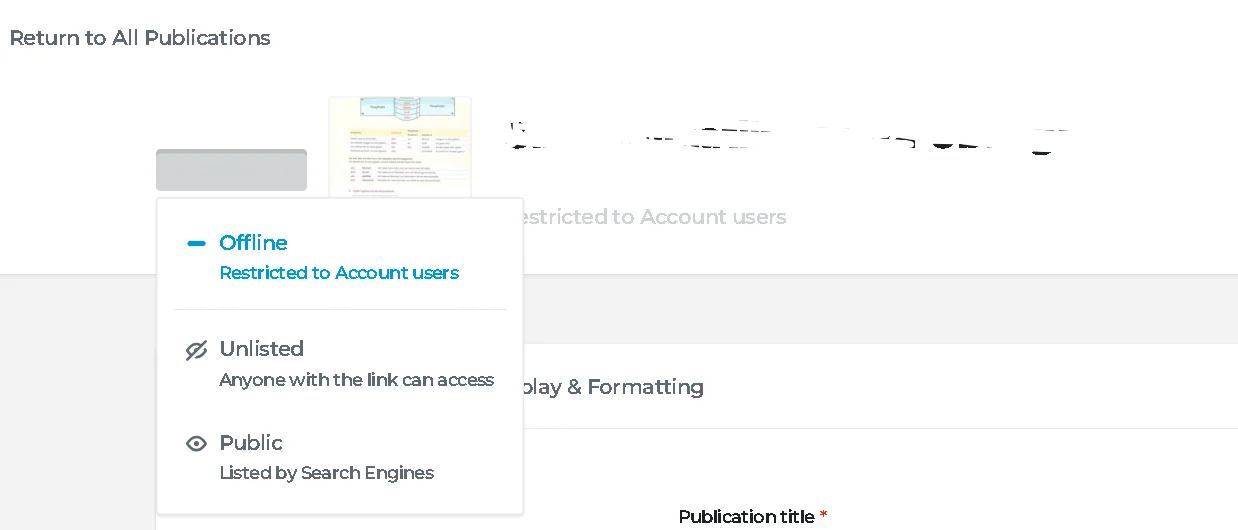
I discovered a vulnerability that is related to accessing publication cover pages via a specific request using sourceDocumentId. When sending a request with the source ID, the system responds with a URL to the cover page of that publication. However, the cover page is intended to be offline and not publicly accessible and the offline publication are only accessible by the account users. Beside that in the URL there is also the user id and the main id corresponding to that publication. So, due to a vulnerable endpoint we are able to disclose the cover page of an offline publication that we don't own.
Vulnerable endpoint: ██████████
- Steps to Reproduce:
- Create account on ██████.
- Create a new offline publication and take the sourceDocumentId of it.
- Send a request to the program's endpoint with a valid SOURCE_ID corresponding to a specific publication.
- Analyze the response to retrieve the URL of the publication's cover page.
- Access the URL provided in the response, which contains both the user ID and the main ID of the publication.
Impact
This vulnerability allows unauthorized access to offline publication cover pages, which may contain sensitive information not intended for public viewing. An attacker could potentially view confidential content from the cover pages of unpublished publications.
Context
Publitas runs a publication platform where accounts create publications, including offline publications that are meant to stay private to the account that owns them. Each publication has a cover page, and the platform exposes a request that resolves a publication's sourceDocumentId into a URL for that cover page. The report describes an Insecure Direct Object Reference in that resolution step: the endpoint returns a cover page URL for any publication whose source ID you supply, without checking that the caller owns it.
Setup
The researcher needed only an account on the platform. The steps to reproduce begin with creating an account, then creating a new offline publication so that a valid sourceDocumentId is available for testing. No special role, tooling or version is mentioned in the report.
Finding it
The researcher noticed that sending a request with a sourceDocumentId makes the system respond with a URL to the cover page of the corresponding publication. That behaviour is wrong for offline publications: a cover page is intended to be offline and not publicly accessible, and offline publications are only accessible by the account users. The returned URL also carries the user ID and the main ID of the publication, so the response leaks more than a bare path. Because the endpoint accepts a source ID that the caller does not own, it discloses the cover page of an offline publication belonging to someone else.
Exploitation
Step 1: Create an account
Create an account on the platform. This gives the attacker a normal authenticated session with no privileged role.
Step 2: Create an offline publication and take its sourceDocumentId
Create a new offline publication and record its sourceDocumentId.
Step 3: Send a request with a valid SOURCE_ID for a specific publication
Send a request to the program's endpoint with a valid SOURCE_ID corresponding to a specific publication. The vulnerable endpoint is redacted in the report:
The important part is the source ID: the server resolves it to a cover page URL without checking ownership.
Step 4: Read the cover page URL from the response
Analyse the response to retrieve the URL of the publication's cover page. The response contains a URL that includes both the user ID and the main ID of the publication, so the attacker learns the identifiers of a publication they do not own.
Step 5: Access the URL
Access the URL provided in the response. It contains both the user ID and the main ID of the publication, and it serves the cover page of the offline publication that the attacker does not own.
Root cause
The endpoint resolves a sourceDocumentId to a cover page URL without verifying that the requesting account owns the publication behind that identifier. A valid source ID for a publication the caller does not own returns a usable URL. The URL itself then embeds the user ID and main ID, which means the disclosure also hands over the identifiers needed to reach the cover page directly. The report does not describe any authorisation check that was present and bypassed.
Impact
An attacker with an account can obtain cover page URLs for offline publications they do not own, and can then view those cover pages. The report rates this as medium severity (CVSS 5.3) and classifies it as an Insecure Direct Object Reference. The exposure is limited to cover pages of offline publications, which may contain sensitive information not intended for public viewing, including confidential content from the cover pages of unpublished publications. The report does not describe access to the full publication content, only the cover page.
Fix
The fix should be to authorise the request: resolve the sourceDocumentId only when the authenticated account owns the publication, and reject requests for publications belonging to other accounts. The cover page URL should not be returned for offline publications to callers outside the owning account.
Variants to test
- Swap the source ID for one belonging to another account and check whether the response still returns a cover page URL. A positive result is a URL containing another user's ID and publication ID.
- Try the same request without authentication, or with a second account, to see whether ownership is checked at all. A positive result is a cover page URL returned to a caller who does not own the publication.
- Take the returned URL and request it directly, stripping any session, to see whether the cover page itself is protected. A positive result is the cover page being served to an unauthenticated client.
- Enumerate or guess source IDs around your own to see whether the lookup is sequential and returns other publications. A positive result is a stream of cover page URLs for publications you do not own.
Hunting notes
This kind of bug tends to hide in endpoints that translate one identifier into another, such as resolving a document ID into a URL, a thumbnail or a download link. During recon, look for parameters named after internal identifiers (sourceDocumentId, documentId, mainId) and for responses that echo user IDs and object IDs back to the client. The signal is a lookup that returns a resource URL rather than the resource itself, because the authorisation check is easy to forget at that indirection layer. The researcher showed impact by starting from a normal account, creating an offline publication, and then retrieving a cover page URL for an offline publication they did not own.
What happened, in plain words
Publitas is a platform where accounts create publications. Some of those publications are set to offline, which means they are meant to stay private to the account that owns them and should not be visible to the public.
Every publication has a cover page. The platform has a request that takes an internal identifier for a publication (its sourceDocumentId) and answers with a web address (a URL) where that cover page can be found.
The researcher found that this request does not check who is asking. If you send it the identifier of an offline publication that belongs to someone else, it still hands back a working address for that cover page. In security terms this is an Insecure Direct Object Reference (IDOR): the server lets you reach an object (here, a publication's cover page) just by naming its identifier, without checking that the object is yours.
The report rates this as medium severity, with a CVSS score of 5.3. CVSS is a standard way of scoring how serious a security flaw is; 5.3 sits in the middle of the scale.
Background ideas you need first
Before walking through the steps, here are the few ideas the report relies on.
- Account and session. When you log in to a website, the site gives your browser a small piece of proof that you are logged in, so you do not have to type your password on every page. That proof is often stored in a cookie or a token. The report calls this being an authenticated user: the server knows which account is making the request.
- API and endpoint. Many websites are built from two parts: the pages you see, and a behind-the-scenes service that the pages talk to. That service is often called an API (Application Programming Interface). Each specific address on that service that you can send a request to is called an endpoint. Think of an endpoint as a service counter: you hand over a request, and it hands back an answer.
- Request and response. A request is what your browser (or a tool) sends to the server: an address, sometimes some data, and often your session proof. A response is what the server sends back: a status, some data, sometimes a web address.
- Identifier (ID). A unique label for a thing in a database, usually a number or a short string. Your account has a user ID; each publication has its own ID. If you know someone's ID, you can often refer to their object directly, which is exactly what makes IDOR bugs possible.
- URL. The web address of a page or file, the thing you type in the address bar.
sourceDocumentId. In this report, the internal identifier the platform uses to look up a publication when resolving its cover page. The report also calls it the source ID or SOURCE_ID.
Setup
The researcher needed only an ordinary account on the platform. The steps begin with creating an account, then creating a new offline publication so that there is a valid sourceDocumentId to experiment with. The report does not mention any special role, tool or software version.
Finding it
The researcher noticed that sending a request with a sourceDocumentId makes the system respond with a URL to the cover page of the matching publication. That is wrong for offline publications: a cover page is meant to be offline and not publicly accessible, and offline publications are only accessible by the account users. The returned URL also carries the user ID and the main ID of the publication, so the response leaks more than a bare path. Because the endpoint accepts a source ID that the caller does not own, it discloses the cover page of an offline publication belonging to someone else.
Exploitation
Step 1: Create an account
Create an account on the platform. This gives the attacker a normal logged-in session with no privileged role. The point of this step is to have a legitimate account, because the bug is not about breaking in; it is about what a normal account is allowed to ask for.
Step 2: Create an offline publication and take its sourceDocumentId
Create a new offline publication and record its sourceDocumentId.
Step 3: Send a request with a valid SOURCE_ID for a specific publication
Send a request to the program's endpoint with a valid SOURCE_ID corresponding to a specific publication. The vulnerable endpoint is redacted in the report:
This block is the address of the vulnerable endpoint, hidden in the report. The important part is the source ID: the server resolves it to a cover page URL without checking ownership.
Step 4: Read the cover page URL from the response
Analyse the response to retrieve the URL of the publication's cover page. The response contains a URL that includes both the user ID and the main ID of the publication, so the attacker learns the identifiers of a publication they do not own.
Step 5: Access the URL
Access the URL provided in the response. It contains both the user ID and the main ID of the publication, and it serves the cover page of the offline publication that the attacker does not own. This last step matters because it turns a leaked address into access to the cover page.
Why it works
The endpoint resolves a sourceDocumentId to a cover page URL without verifying that the requesting account owns the publication behind that identifier. A valid source ID for a publication the caller does not own returns a usable URL. The URL itself then embeds the user ID and main ID, which means the disclosure also hands over the identifiers needed to reach the cover page directly. The report does not describe any authorisation check that was present and bypassed.
A useful comparison: imagine a hotel reception that gives out room keys to anyone who knows the room number, without checking that the person is the guest. The room number is not a secret, but it should not be enough on its own.
Impact
An attacker with an account can obtain cover page URLs for offline publications they do not own, and can then view those cover pages. The report rates this as medium severity (CVSS 5.3) and classifies it as an Insecure Direct Object Reference. The exposure is limited to cover pages of offline publications, which may contain sensitive information not intended for public viewing, including confidential content from the cover pages of unpublished publications.
Fix
The fix should be to authorise the request: resolve the sourceDocumentId only when the logged-in account owns the publication, and reject requests for publications belonging to other accounts. The cover page URL should not be returned for offline publications to callers outside the owning account.
Variants to test
These are follow-up checks a tester could run to see how far the flaw goes. Each one changes a single thing and looks at the answer.
- Swap the source ID for one belonging to another account and check whether the response still returns a cover page URL. A positive result is a URL containing another user's ID and publication ID.
- Try the same request without logging in, or with a second account, to see whether ownership is checked at all. A positive result is a cover page URL returned to a caller who does not own the publication.
- Take the returned URL and request it directly, stripping any session, to see whether the cover page itself is protected. A positive result is the cover page being served to a client that is not logged in.
- Enumerate or guess source IDs around your own to see whether the lookup is sequential and returns other publications. A positive result is a stream of cover page URLs for publications you do not own. "Sequential" means the identifiers follow a predictable order, such as 1001, 1002, 1003, which makes guessing easy.
Where to look for this kind of bug
This kind of bug tends to hide in endpoints that translate one identifier into another, such as resolving a document ID into a URL, a thumbnail or a download link. During recon (the early stage of exploring a target to see what it exposes), look for parameters named after internal identifiers (sourceDocumentId, documentId, mainId) and for responses that echo user IDs and object IDs back to the client. The signal is a lookup that returns a resource URL rather than the resource itself, because the authorisation check is easy to forget at that indirection layer. The researcher showed impact by starting from a normal account, creating an offline publication, and then retrieving a cover page URL for an offline publication they did not own.
Glossary
- API: the behind-the-scenes service a website uses to fetch and send data, separate from the pages you see.
- Endpoint: one specific address on an API that accepts a particular kind of request.
- Request: the message your browser or tool sends to a server, containing an address, sometimes data, and often proof of who you are.
- Response: the message the server sends back, containing a status and data such as a web address.
- URL: a web address, the thing you type in the address bar.
- Parameter: a named value attached to a request, like a form field.
- Identifier (ID): a unique label for a record in a database, such as a user ID or a publication ID.
sourceDocumentId: the internal identifier the platform uses to look up a publication when resolving its cover page; also called source ID or SOURCE_ID.- User ID: the identifier of the account that owns a publication.
- Main ID: the identifier of the publication itself, as used in the returned cover page URL.
- Cover page: the first page of a publication, the front of the brochure or catalogue.
- Offline publication: a publication set to stay private to the account that owns it, not publicly accessible.
- Session: the state of being logged in, usually kept alive by a cookie or token.
- Cookie: a small piece of data a site stores in your browser, often used to remember that you are logged in.
- Token: a piece of text that proves your identity or permission to a server.
- Authenticated: the server knows which account is making the request.
- Authorisation: the check that a logged-in account is allowed to do or see a particular thing.
- IDOR (Insecure Direct Object Reference): a flaw where a server lets you reach an object just by naming its identifier, without checking that the object is yours.
- CVSS: a standard scoring system for the severity of a security flaw; 5.3 is medium.
- Severity: how serious a flaw is judged to be.
- Recon: the early stage of exploring a target to see what it exposes.
- Enumerate: to try identifiers in order or by guessing, to discover objects you were not given.
- Sequential: following a predictable order, such as consecutive numbers.