Username Validation Bypass
The username validation patch in Revive Adserver only blocks control characters and whitespace, so invisible or look-alike Unicode characters still pass. An attacker could register usernames that appear identical to existing ones, enabling impersonation and phishing.
 Originally disclosed on HackerOne
- Triaged in 11 hours
- Fixed in 26 hours
- Disclosed after 7 days
Cricetinae
Executive Summary
The security patch in commit d239a0845e4f64fbacd25fff2854426734d43aa2 is INSUFFICIENT.
Testing confirms that 3 out of 4 exploit vectors still bypass validation.
Vulnerability Details
Affected Component: Username validation in user registration/creation
File: lib/OA/Admin/UI/UserAccess.php
Line: 116
Current Pattern: #[\x00-\x1F\x7F\s]#u
Severity: Medium-High (CVSS 6.5) Impact: Account impersonation, phishing, validation bypass
Proof of Concept - Working Exploits
Exploit 1: Zero-Width Space (U+200B) CRITICAL
Description: Invisible Unicode character that creates duplicate accounts
Payload (Hex): 61646d696ee2808b
Payload (Decoded): admin + 0xE2 0x80 0x8B (UTF-8 for U+200B)
Payload (Literal): The username "admin" followed by Unicode character U+200B
How to reproduce:
$malicious_username = "admin" . "\xE2\x80\x8B";  // Hex bytes
// OR
$malicious_username = "admin" . mb_chr(0x200B, 'UTF-8');  // Unicode codepoint
Test code:
<?php
$username = "admin" . "\xE2\x80\x8B";  // admin + Zero-Width Space

echo "Username: admin[U+200B]\n";
echo "Hex bytes: " . bin2hex($username) . "\n";
echo "Expected: 61646d696ee2808b\n\n";

// Test against patched pattern
if (preg_match('#[\x00-\x1F\x7F\s]#u', $username)) {
    echo "Result: BLOCKED ✓\n";
} else {
    echo "Result: PASSES - VULNERABLE! ✗\n";
}
?>
Expected output:
Username: admin[U+200B]
Hex bytes: 61646d696ee2808b
Expected: 61646d696ee2808b

Result: PASSES - VULNERABLE! ✗
Impact:
- Creates account that looks identical to "admin" visually
- Bypasses username uniqueness constraints
- Enables account enumeration attacks
- Perfect for impersonation attacks
Exploit 2: RTL Override (U+202E) HIGH
Description: Right-to-Left Override mark that reverses text display direction
Payload (Hex): 61646d696ee280ae74657374
Payload (Decoded): admin + 0xE2 0x80 0xAE + test
Payload (Literal): The text "admin" + U+202E + "test"
How to reproduce:
$malicious_username = "admin" . "\xE2\x80\xAE" . "test";  // Hex bytes
// OR
$malicious_username = "admin" . mb_chr(0x202E, 'UTF-8') . "test";  // Unicode
Test code:
<?php
$username = "admin" . "\xE2\x80\xAE" . "test";  // admin + RTL Override + test

echo "Username: admin[U+202E]test\n";
echo "Hex bytes: " . bin2hex($username) . "\n";
echo "Expected: 61646d696ee280ae74657374\n";
echo "Visual display: 'tset' + 'admin' (reversed!)\n\n";

// Test against patched pattern
if (preg_match('#[\x00-\x1F\x7F\s]#u', $username)) {
    echo "Result: BLOCKED ✓\n";
} else {
    echo "Result: PASSES - VULNERABLE! ✗\n";
}
?>
Expected output:
Username: admin[U+202E]test
Hex bytes: 61646d696ee280ae74657374
Expected: 61646d696ee280ae74657374
Visual display: 'tset' + 'admin' (reversed!)

Result: PASSES - VULNERABLE! ✗
Impact:
- Text appears reversed in UI ("testadmin" displays as different order)
- Confuses administrators reviewing user accounts
- Enables social engineering attacks
- Visual spoofing in logs and admin panels
Exploit 3: Cyrillic Homograph (U+0430) CRITICAL
Description: Cyrillic letter 'а' (U+0430) that looks identical to Latin 'a' (U+0061)
Payload (Hex): d0b0646d696e
Payload (Decoded): 0xD0 0xB0 + dmin
Payload (Literal): Cyrillic 'а' (U+0430) followed by Latin "dmin"
How to reproduce:
$malicious_username = "\xD0\xB0" . "dmin";  // Hex bytes
// OR
$malicious_username = mb_chr(0x0430, 'UTF-8') . "dmin";  // Unicode
Test code:
<?php
$username = "\xD0\xB0" . "dmin";  // Cyrillic а + Latin dmin

echo "Username: [U+0430]dmin (looks like 'admin')\n";
echo "Hex bytes: " . bin2hex($username) . "\n";
echo "Expected: d0b0646d696e\n";
echo "Visual: Appears identical to 'admin'\n\n";

// Compare with real admin
$real_admin = "admin";
echo "Real 'admin' hex: " . bin2hex($real_admin) . "\n";
echo "Looks same? YES | Hex same? NO\n\n";

// Test against patched pattern
if (preg_match('#[\x00-\x1F\x7F\s]#u', $username)) {
    echo "Result: BLOCKED ✓\n";
} else {
    echo "Result: PASSES - VULNERABLE! ✗\n";
}
?>
Expected output:
Username: [U+0430]dmin (looks like 'admin')
Hex bytes: d0b0646d696e
Expected: d0b0646d696e
Visual: Appears identical to 'admin'

Real 'admin' hex: 61646d696e
Looks same? YES | Hex same? NO

Result: PASSES - VULNERABLE! ✗
Complete Test Script
Save this as test_vulnerability.php and run with php test_vulnerability.php:
<?php
error_reporting(E_ALL);
ini_set('display_errors', 1);

echo "========================================\n";
echo "Revive Adserver - Vulnerability Test\n";
echo "========================================\n\n";

// Test 1: Zero-Width Space
echo "[TEST 1] Zero-Width Space (U+200B)\n";
echo "----------------------------------------\n";
$test1 = "admin" . "\xE2\x80\x8B";
echo "Payload hex: " . bin2hex($test1) . "\n";
echo "Expected:    61646d696ee2808b\n";
echo "Match: " . (bin2hex($test1) === "61646d696ee2808b" ? "YES ✓" : "NO ✗") . "\n";
$blocked1 = preg_match('#[\x00-\x1F\x7F\s]#u', $test1);
echo "Status: " . ($blocked1 ? "BLOCKED ✓" : "VULNERABLE ✗") . "\n\n";

// Test 2: RTL Override
echo "[TEST 2] RTL Override (U+202E)\n";
echo "----------------------------------------\n";
$test2 = "admin" . "\xE2\x80\xAE" . "test";
echo "Payload hex: " . bin2hex($test2) . "\n";
echo "Expected:    61646d696ee280ae74657374\n";
echo "Match: " . (bin2hex($test2) === "61646d696ee280ae74657374" ? "YES ✓" : "NO ✗") . "\n";
$blocked2 = preg_match('#[\x00-\x1F\x7F\s]#u', $test2);
echo "Status: " . ($blocked2 ? "BLOCKED ✓" : "VULNERABLE ✗") . "\n\n";

// Test 3: Cyrillic Homograph
echo "[TEST 3] Cyrillic Homograph (U+0430)\n";
echo "----------------------------------------\n";
$test3 = "\xD0\xB0" . "dmin";
echo "Payload hex: " . bin2hex($test3) . "\n";
echo "Expected:    d0b0646d696e\n";
echo "Match: " . (bin2hex($test3) === "d0b0646d696e" ? "YES ✓" : "NO ✗") . "\n";
$blocked3 = preg_match('#[\x00-\x1F\x7F\s]#u', $test3);
echo "Status: " . ($blocked3 ? "BLOCKED ✓" : "VULNERABLE ✗") . "\n\n";

// Test 4: Ideographic Space (should be blocked)
echo "[TEST 4] Ideographic Space (U+3000) - Control\n";
echo "----------------------------------------\n";
$test4 = "admin" . "\xE3\x80\x80" . "test";
echo "Payload hex: " . bin2hex($test4) . "\n";
echo "Expected:    61646d696ee3808074657374\n";
echo "Match: " . (bin2hex($test4) === "61646d696ee3808074657374" ? "YES ✓" : "NO ✗") . "\n";
$blocked4 = preg_match('#[\x00-\x1F\x7F\s]#u', $test4);
echo "Status: " . ($blocked4 ? "BLOCKED ✓" : "VULNERABLE ✗") . "\n\n";

// Summary
echo "========================================\n";
echo "SUMMARY\n";
echo "========================================\n";
$vuln_count = (!$blocked1 ? 1 : 0) + (!$blocked2 ? 1 : 0) + (!$blocked3 ? 1 : 0);
echo "Vulnerabilities found: $vuln_count/3\n";
echo "Patch effectiveness: " . ((3 - $vuln_count) / 3 * 100) . "%\n\n";

if ($vuln_count > 0) {
    echo "  CRITICAL: Patch is INSUFFICIENT!\n";
    echo "Working exploits:\n";
    if (!$blocked1) echo "  • Zero-Width Space\n";
    if (!$blocked2) echo "  • RTL Override\n";
    if (!$blocked3) echo "  • Cyrillic Homograph\n";
} else {
    echo "✓ All exploits blocked\n";
}
echo "\n========================================\n";
?>
Recommended Fix
Replace the current blacklist pattern with a whitelist approach:
// Current (VULNERABLE):
if (preg_match('#[\x00-\x1F\x7F\s]#u', $this->request['login'])) {
    $this->aErrors = [$GLOBALS['strInvalidUsername']];
}

// Recommended (SECURE):
if (empty($this->request['login']) ||
    strlen($this->request['login']) > 255 ||
    !preg_match('/^[a-zA-Z0-9._@-]+$/D', $this->request['login']) ||
    $this->request['login'] !== trim($this->request['login'])) {
    $this->aErrors = [$GLOBALS['strInvalidUsername']];
}
Additional recommendations:
- Unicode normalization (NFC) before validation
- Implement confusables detection
- Log suspicious username patterns
- Display hex representation in admin UI
Verification Steps for Developers
- Save the test script above as
test_vulnerability.php - Run:
php test_vulnerability.php - Observe output - you should see 3 VULNERABLE results
- Apply the recommended fix
- Run the test again - all should show BLOCKED
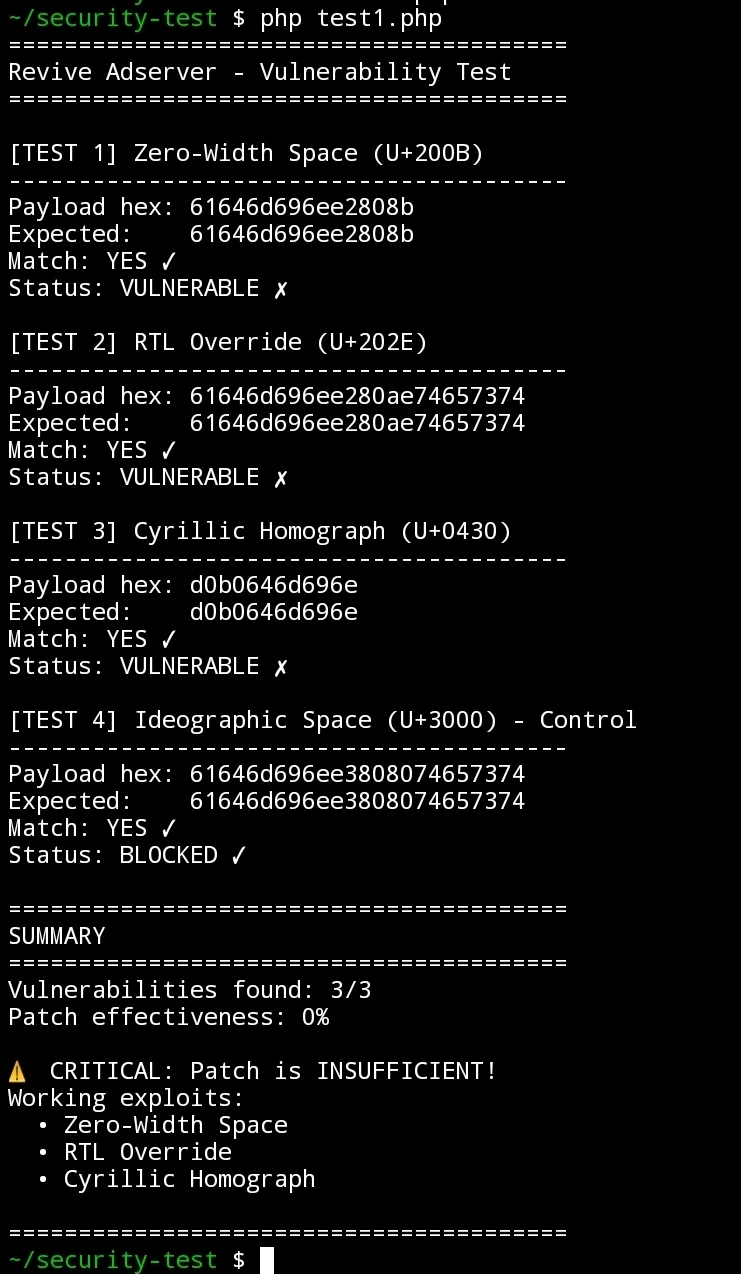
POC:
References
- Unicode Security: https://www.unicode.org/reports/tr36/
- CWE-20: https://cwe.mitre.org/data/definitions/20.html
- OWASP Input Validation: https://cheatsheetseries.owasp.org/
Contact
Please acknowledge receipt of this report and provide an estimated timeline for patch development and CVE Assignment [kassem_s94] https://x.com/kassem_s94 https://t.me/apesofficial https://hackerone.com/kassem_s94?type=user
Impact
- MOST DANGEROUS - Visually indistinguishable from "admin"
- Perfect phishing vector
- Users cannot detect the fake account
- Credential harvesting
- Admin impersonation attacks
Context
Revive Adserver is an open source ad server, and this report concerns the username validation applied when a user account is created or registered. The affected component is the username check in lib/OA/Admin/UI/UserAccess.php, at line 116. At the time of testing the check was a blacklist regular expression:
#[\x00-\x1F\x7F\s]#u
That pattern rejects ASCII control characters (\x00 to \x1F), DEL (\x7F) and anything matched by \s under the u modifier. The researcher's starting point is the security patch in commit [redacted], which introduced or relied on this pattern. The central claim of the report is that this patch is insufficient: testing showed that 3 out of 4 exploit vectors still bypass validation.
The researcher rates the issue Medium-High with a CVSS of 6.5, and describes the impact as account impersonation, phishing and validation bypass.
Setup
The report does not describe a deployed Revive Adserver instance, a specific version, accounts or roles. The work is done against the validation pattern itself, using PHP test scripts that call preg_match with the same expression used in UserAccess.php. The only tooling implied is a PHP interpreter: the complete test script is meant to be saved as test_vulnerability.php and run with php test_vulnerability.php. The report includes a screenshot of the proof of concept.
Finding it
The pattern is a blacklist. It enumerates the characters that must not appear, so any character outside that enumeration is accepted. Unicode contains a large number of characters that are invisible, that reorder the display of surrounding text, or that are visually identical to Latin letters, and none of them fall inside \x00-\x1F, \x7F or \s. The researcher therefore tested four candidate usernames against the patched pattern: a zero-width space, a right-to-left override, a Cyrillic homograph of the letter a, and an ideographic space as a control that should be blocked.
Exploitation
Step 1: Zero-width space (U+200B)
The first payload is the literal text admin followed by the Unicode character U+200B. Its hex encoding is 61646d696ee2808b, and the trailing bytes 0xE2 0x80 0x8B are the UTF-8 encoding of U+200B.
$malicious_username = "admin" . "\xE2\x80\x8B";  // Hex bytes
// OR
$malicious_username = "admin" . mb_chr(0x200B, 'UTF-8');  // Unicode codepoint
The test code builds the username and runs it through the patched pattern:
<?php
$username = "admin" . "\xE2\x80\x8B";  // admin + Zero-Width Space

echo "Username: admin[U+200B]\n";
echo "Hex bytes: " . bin2hex($username) . "\n";
echo "Expected: 61646d696ee2808b\n\n";

// Test against patched pattern
if (preg_match('#[\x00-\x1F\x7F\s]#u', $username)) {
    echo "Result: BLOCKED ✓\n";
} else {
    echo "Result: PASSES - VULNERABLE! ✗\n";
}
?>
The expected output confirms the bytes and the result:
Username: admin[U+200B]
Hex bytes: 61646d696ee2808b
Expected: 61646d696ee2808b

Result: PASSES - VULNERABLE! ✗
U+200B is not a control character in the \x00-\x1F range, is not \x7F, and is not matched by \s, so the pattern lets it through. The researcher's stated impact is that the account looks visually identical to admin, bypasses username uniqueness constraints, enables account enumeration attacks and is well suited to impersonation.
Step 2: Right-to-left override (U+202E)
The second payload is admin, then U+202E, then test. Its hex encoding is 61646d696ee280ae74657374, with 0xE2 0x80 0xAE being the UTF-8 encoding of U+202E.
$malicious_username = "admin" . "\xE2\x80\xAE" . "test";  // Hex bytes
// OR
$malicious_username = "admin" . mb_chr(0x202E, 'UTF-8') . "test";  // Unicode
The test code:
<?php
$username = "admin" . "\xE2\x80\xAE" . "test";  // admin + RTL Override + test

echo "Username: admin[U+202E]test\n";
echo "Hex bytes: " . bin2hex($username) . "\n";
echo "Expected: 61646d696ee280ae74657374\n";
echo "Visual display: 'tset' + 'admin' (reversed!)\n\n";

// Test against patched pattern
if (preg_match('#[\x00-\x1F\x7F\s]#u', $username)) {
    echo "Result: BLOCKED ✓\n";
} else {
    echo "Result: PASSES - VULNERABLE! ✗\n";
}
?>
Expected output:
Username: admin[U+202E]test
Hex bytes: 61646d696ee280ae74657374
Expected: 61646d696ee280ae74657374
Visual display: 'tset' + 'admin' (reversed!)

Result: PASSES - VULNERABLE! ✗
U+202E is a formatting character that changes the display direction of the text that follows it, so the rendered username does not read the way the stored string does. The researcher lists the impact as reversed text in the UI, confusion for administrators reviewing accounts, social engineering and visual spoofing in logs and admin panels.
Step 3: Cyrillic homograph (U+0430)
The third payload is the Cyrillic letter а (U+0430) followed by the Latin letters dmin. Its hex encoding is d0b0646d696e, where 0xD0 0xB0 is the UTF-8 encoding of U+0430.
$malicious_username = "\xD0\xB0" . "dmin";  // Hex bytes
// OR
$malicious_username = mb_chr(0x0430, 'UTF-8') . "dmin";  // Unicode
The test code also compares it with the real admin:
<?php
$username = "\xD0\xB0" . "dmin";  // Cyrillic а + Latin dmin

echo "Username: [U+0430]dmin (looks like 'admin')\n";
echo "Hex bytes: " . bin2hex($username) . "\n";
echo "Expected: d0b0646d696e\n";
echo "Visual: Appears identical to 'admin'\n\n";

// Compare with real admin
$real_admin = "admin";
echo "Real 'admin' hex: " . bin2hex($real_admin) . "\n";
echo "Looks same? YES | Hex same? NO\n\n";

// Test against patched pattern
if (preg_match('#[\x00-\x1F\x7F\s]#u', $username)) {
    echo "Result: BLOCKED ✓\n";
} else {
    echo "Result: PASSES - VULNERABLE! ✗\n";
}
?>
Expected output:
Username: [U+0430]dmin (looks like 'admin')
Hex bytes: d0b0646d696e
Expected: d0b0646d696e
Visual: Appears identical to 'admin'

Real 'admin' hex: 61646d696e
Looks same? YES | Hex same? NO

Result: PASSES - VULNERABLE! ✗
The two strings render the same but have different bytes, so the uniqueness check sees a different username while a human reader sees admin. The researcher calls this the most dangerous variant: visually indistinguishable from admin, a perfect phishing vector, undetectable by users, useful for credential harvesting and for admin impersonation.
Step 4: Ideographic space (U+3000) as a control
The fourth case is admin, then U+3000, then test, with hex 61646d696ee3808074657374. This one is labelled a control that should be blocked.
<?php
$test4 = "admin" . "\xE3\x80\x80" . "test";
In the complete script below, the fourth test prints the payload hex, compares it with the expected value and reports the status from preg_match.
Step 5: The complete test script
The researcher provides a single script that runs all four cases and summarises the result. Save it as test_vulnerability.php and run php test_vulnerability.php:
<?php
error_reporting(E_ALL);
ini_set('display_errors', 1);

echo "========================================\n";
echo "Revive Adserver - Vulnerability Test\n";
echo "========================================\n\n";

// Test 1: Zero-Width Space
echo "[TEST 1] Zero-Width Space (U+200B)\n";
echo "----------------------------------------\n";
$test1 = "admin" . "\xE2\x80\x8B";
echo "Payload hex: " . bin2hex($test1) . "\n";
echo "Expected:    61646d696ee2808b\n";
echo "Match: " . (bin2hex($test1) === "61646d696ee2808b" ? "YES ✓" : "NO ✗") . "\n";
$blocked1 = preg_match('#[\x00-\x1F\x7F\s]#u', $test1);
echo "Status: " . ($blocked1 ? "BLOCKED ✓" : "VULNERABLE ✗") . "\n\n";

// Test 2: RTL Override
echo "[TEST 2] RTL Override (U+202E)\n";
echo "----------------------------------------\n";
$test2 = "admin" . "\xE2\x80\xAE" . "test";
echo "Payload hex: " . bin2hex($test2) . "\n";
echo "Expected:    61646d696ee280ae74657374\n";
echo "Match: " . (bin2hex($test2) === "61646d696ee280ae74657374" ? "YES ✓" : "NO ✗") . "\n";
$blocked2 = preg_match('#[\x00-\x1F\x7F\s]#u', $test2);
echo "Status: " . ($blocked2 ? "BLOCKED ✓" : "VULNERABLE ✗") . "\n\n";

// Test 3: Cyrillic Homograph
echo "[TEST 3] Cyrillic Homograph (U+0430)\n";
echo "----------------------------------------\n";
$test3 = "\xD0\xB0" . "dmin";
echo "Payload hex: " . bin2hex($test3) . "\n";
echo "Expected:    d0b0646d696e\n";
echo "Match: " . (bin2hex($test3) === "d0b0646d696e" ? "YES ✓" : "NO ✗") . "\n";
$blocked3 = preg_match('#[\x00-\x1F\x7F\s]#u', $test3);
echo "Status: " . ($blocked3 ? "BLOCKED ✓" : "VULNERABLE ✗") . "\n\n";

// Test 4: Ideographic Space (should be blocked)
echo "[TEST 4] Ideographic Space (U+3000) - Control\n";
echo "----------------------------------------\n";
$test4 = "admin" . "\xE3\x80\x80" . "test";
echo "Payload hex: " . bin2hex($test4) . "\n";
echo "Expected:    61646d696ee3808074657374\n";
echo "Match: " . (bin2hex($test4) === "61646d696ee3808074657374" ? "YES ✓" : "NO ✗") . "\n";
$blocked4 = preg_match('#[\x00-\x1F\x7F\s]#u', $test4);
echo "Status: " . ($blocked4 ? "BLOCKED ✓" : "VULNERABLE ✗") . "\n\n";

// Summary
echo "========================================\n";
echo "SUMMARY\n";
echo "========================================\n";
$vuln_count = (!$blocked1 ? 1 : 0) + (!$blocked2 ? 1 : 0) + (!$blocked3 ? 1 : 0);
echo "Vulnerabilities found: $vuln_count/3\n";
echo "Patch effectiveness: " . ((3 - $vuln_count) / 3 * 100) . "%\n\n";

if ($vuln_count > 0) {
    echo "  CRITICAL: Patch is INSUFFICIENT!\n";
    echo "Working exploits:\n";
    if (!$blocked1) echo "  • Zero-Width Space\n";
    if (!$blocked2) echo "  • RTL Override\n";
    if (!$blocked3) echo "  • Cyrillic Homograph\n";
} else {
    echo "✓ All exploits blocked\n";
}
echo "\n========================================\n";
?>
The summary counts only the first three tests as vulnerabilities; the ideographic space is excluded from the count because it is expected to be blocked. The screenshot in the report shows the proof of concept as run on the device:
Root cause
The validation is a blacklist of ASCII control characters and whitespace. The character class only names ASCII code points. and the u modifier makes the pattern operate on UTF-8, but the character class itself still only names ASCII code points. Every Unicode character outside that class is accepted, including invisible formatting characters such as U+200B and U+202E and letters from other scripts that are visually confusable with Latin letters, such as U+0430. The researcher states that the lookalike bypasses username uniqueness constraints.
Impact
The researcher's impact statement focuses on the homograph case: an account that is visually indistinguishable from admin, usable as a phishing vector, undetectable by users, useful for credential harvesting and for admin impersonation. The zero-width space variant is described as creating an account that looks identical to admin, bypassing username uniqueness constraints and enabling account enumeration. The RTL override variant is described as confusing administrators reviewing user accounts, enabling social engineering and producing visual spoofing in logs and admin panels. All of these depend on a user or administrator seeing the crafted username in a UI, log or admin panel and interpreting it as the name it imitates.
Fix
The report recommends replacing the blacklist with a whitelist. The current check in the code is:
// Current (VULNERABLE):
if (preg_match('#[\x00-\x1F\x7F\s]#u', $this->request['login'])) {
    $this->aErrors = [$GLOBALS['strInvalidUsername']];
}
The proposed replacement:
// Recommended (SECURE):
if (empty($this->request['login']) ||
    strlen($this->request['login']) > 255 ||
    !preg_match('/^[a-zA-Z0-9._@-]+$/D', $this->request['login']) ||
    $this->request['login'] !== trim($this->request['login'])) {
    $this->aErrors = [$GLOBALS['strInvalidUsername']];
}
This rejects empty input, input longer than 255 bytes, anything outside a small set of ASCII letters, digits and the characters ., _, @ and -, and any value that differs from its trimmed form. The additional recommendations are Unicode normalisation (NFC) before validation, confusables detection, logging of suspicious username patterns, and displaying a hex representation of the username in the admin UI.
The report also gives verification steps for developers: save the test script as test_vulnerability.php, run php test_vulnerability.php, observe the three vulnerable results, apply the fix, and run the test again, at which point all cases should show as blocked.
Variants to test
The general technique is to try characters that a blacklist does not name but that a human reader will not distinguish from ordinary text. On another target, a positive result looks like the crafted value being accepted by the validator and stored, while rendering as the imitated name in the UI, logs or admin panels.
- Invisible characters inside a reserved name: insert U+200B, U+200C, U+200D or U+FEFF between letters of an existing username. Positive result: the account is created and the rendered name matches the existing one.
- Bidirectional control characters: insert U+202E, U+202D or U+2066 to U+2069 into a username. Positive result: the displayed order differs from the stored order in account lists or logs.
- Cross-script homographs: substitute Cyrillic or Greek letters that look like Latin ones (for example U+0430 for
a, U+0435 fore, U+03BF foro). Positive result: the stored bytes differ from the real account but the rendered name is indistinguishable. - Unicode whitespace outside
\sas interpreted by the engine: try U+3000, U+00A0 and similar. Positive result: the value is accepted where the developer expected whitespace to be rejected. - Normalisation collisions: submit a name in decomposed form (for example
aplus U+0301) and compare it with the precomposed form. Positive result: two accounts exist that normalise to the same string. - Length and trimming edge cases: leading or trailing whitespace, and values at the length boundary. Positive result: a value that differs from its trimmed form, or exceeds the intended limit, is accepted.
What happened, in plain words
Revive Adserver is a piece of open source software that websites use to show adverts. Like most such systems, it lets people create user accounts, and each account has a username. The software checks the username when the account is created, to stop people choosing names that are confusing or dangerous.
A security researcher looked at a recent fix to that username check, a fix shipped in a code change (a commit) identified as [redacted]. The fix was meant to block bad usernames. The researcher found it does not work well enough: of four test usernames, three still got through the check.
The trick is that computers store text as numbers, and the Unicode standard (the giant catalogue that assigns a number to every character in every writing system) contains characters that are invisible, that flip the direction text is displayed in, or that look exactly like ordinary Latin letters but are actually from another alphabet. The check only listed a few specific bad characters, so anything not on that list, including all of these lookalikes, was accepted.
Why does that matter? Because someone could create an account whose name looks exactly like admin on screen but is a different name to the computer. That is useful for tricking people: phishing, impersonation, and confusing administrators who review account lists.
The researcher rated the issue Medium-High with a CVSS score of 6.5. CVSS is a standard scoring system for how serious a security flaw is; 6.5 sits in the middle of the scale.
Background you need first
A few ideas come up repeatedly, so here they are before we start.
What a username check is. When you sign up somewhere, the site usually checks what you typed. It might reject spaces, or symbols, or names that are already taken. That check is a small piece of program code, and it runs on the server, the computer that hosts the website, before the name is saved.
What a regular expression is. A regular expression (often shortened to regex) is a pattern written in a special mini-language for matching text. Think of it like a search rule: "find any line that contains a digit followed by a letter". Programmers use them to say "this input must look like this" or "this input must not contain that". In PHP, the programming language Revive Adserver is written in, the function preg_match takes a pattern and a piece of text and answers yes or no: does the text match the pattern?
Blacklist versus whitelist. A blacklist says "these specific things are forbidden". A whitelist says "only these specific things are allowed". Blacklists are fragile because the person writing them has to think of every bad thing in advance. Whitelists are safer because anything the author did not think of is rejected by default. This whole report is essentially a story about a blacklist that missed things.
What Unicode is. Every character a computer can display has a number, called a code point, written like U+200B. Unicode is the master list of all of them, covering Latin letters, Cyrillic, Arabic, emoji, punctuation, invisible formatting marks and much more. When text is stored or sent over the network it is usually encoded as UTF-8, a scheme that turns each code point into one or more bytes (a byte is a number from 0 to 255). So the character a is code point U+0061 and is one byte, 0x61, while a Cyrillic а is code point U+0430 and is two bytes, 0xD0 0xB0. They look the same on screen but are completely different to the computer.
What hex is. Hex (hexadecimal) is just a way of writing bytes using the digits 0 to 9 and the letters a to f. It is handy because each byte is exactly two hex digits. So 61 is one byte, 61646d696e is the six bytes that spell admin in UTF-8. When this report shows a payload as hex, it is showing the exact bytes the computer will store.
What a payload is. A payload is the specific piece of input an attacker sends to try to trigger a flaw. Here, each payload is a crafted username.
What a proof of concept is. A proof of concept (PoC) is a small demonstration that shows a flaw is real, usually a script or a screenshot. It is not a full attack; it is evidence.
What PHP is. PHP is a programming language used heavily for websites. You can install it on your own computer and run a .php file from a terminal (the text window where you type commands). The researcher's tests are all PHP scripts that you can run yourself.
What CVSS is. The Common Vulnerability Scoring System gives a number from 0 to 10 for how severe a flaw is, based on things like how easy it is to exploit and what damage it can do. The researcher gave this one 6.5.
The affected code
The username check lives in a file called lib/OA/Admin/UI/UserAccess.php, at line 116. At the time of testing it looked like this pattern:
#[\x00-\x1F\x7F\s]#u
This is a regular expression. Reading it from left to right:
- The outer
#...#are just delimiters; they mark where the pattern starts and ends, like quotation marks. [\x00-\x1F]is a range of ASCII control characters. These are non-printing codes from the earliest days of computing, things like the code for "newline" or "bell". They are not letters and should never appear in a username.\x7Fis another control character, called DEL.\smeans "whitespace", which in most regex engines covers ordinary spaces, tabs and line breaks.- The trailing
uis a modifier that tells PHP to treat the text as UTF-8 rather than raw bytes.
So the pattern says: "match if the text contains any control character, DEL, or whitespace". If it matches, the username is rejected. If it does not match, the username is accepted.
That is a blacklist. It names a handful of bad characters and lets everything else through. The researcher's point is that Unicode contains many characters that are not in that list but are still dangerous in a username.
How the researcher tested it
The report does not describe a live Revive Adserver installation, a particular version, real accounts or user roles. Instead, the researcher tested the pattern itself, in isolation, using small PHP scripts that call preg_match with exactly the same expression used in UserAccess.php. That is a sensible approach: if the pattern is the thing that is broken, you can prove it without setting up the whole product.
The only tool needed is a PHP interpreter. The complete test script is meant to be saved as test_vulnerability.php and run with php test_vulnerability.php from a terminal. The report includes a screenshot of the proof of concept.
Finding the flaw
The reasoning is straightforward once you know about Unicode. The pattern only rejects a fixed list of characters. Any character outside that list is accepted. Unicode has thousands of characters that are invisible, that reorder the display of nearby text, or that look identical to Latin letters. None of them fall inside \x00-\x1F, \x7F or \s. So the researcher picked four candidate usernames and ran each through the pattern:
- A zero-width space, an invisible character.
- A right-to-left override, a character that flips the display direction of the text after it.
- A Cyrillic letter that looks like the Latin
a. - An ideographic space, a wide space used in East Asian writing, included as a control that should be blocked.
A control is a test case you expect to behave correctly; here it is expected to be blocked.
Step 1: the zero-width space (U+200B)
The first payload is the literal text admin followed by the Unicode character U+200B, the zero-width space. It is called zero-width because it takes up no visible space on screen; it is there in the bytes but you cannot see it. Its hex encoding is 61646d696ee2808b, and the last three bytes 0xE2 0x80 0x8B are the UTF-8 encoding of U+200B.
Here is how the researcher builds the payload in PHP:
$malicious_username = "admin" . "\xE2\x80\x8B";  // Hex bytes
// OR
$malicious_username = "admin" . mb_chr(0x200B, 'UTF-8');  // Unicode codepoint
Line by line:
- The first line builds the string by gluing
adminto three raw bytes written in hex. In PHP,\xE2means "the byte 0xE2", and so on. The dot.is the string concatenation operator, meaning "join these together". - The second line does the same thing a different way:
mb_chr(0x200B, 'UTF-8')asks PHP to produce the UTF-8 character for code point 0x200B. Themb_prefix stands for "multi-byte", meaning it understands characters that take more than one byte. - The
//starts a comment, which the computer ignores; it is there for the human reader.
Both lines produce the same string. The researcher offers both because some readers find bytes easier to follow and others find code points easier.
Next, the test code runs the payload through the patched pattern:
<?php
$username = "admin" . "\xE2\x80\x8B";  // admin + Zero-Width Space

echo "Username: admin[U+200B]\n";
echo "Hex bytes: " . bin2hex($username) . "\n";
echo "Expected: 61646d696ee2808b\n\n";

// Test against patched pattern
if (preg_match('#[\x00-\x1F\x7F\s]#u', $username)) {
    echo "Result: BLOCKED ✓\n";
} else {
    echo "Result: PASSES - VULNERABLE! ✗\n";
}
?>
Line by line:
<?phpopens a PHP block. Everything until?>is PHP code.$username = ...stores the crafted username in a variable called$username. In PHP, variable names start with a dollar sign.- The three
echolines print text to the terminal.\nmeans "new line".bin2hex($username)converts the string to its hex representation, so you can see the exact bytes. TheExpected:line prints the hex the researcher expects to see, so you can compare by eye. - The
if (preg_match(...))line is the actual test. It asks: does$usernamematch the pattern? If yes, the code inside the first block runs and printsBLOCKED. If no, theelseblock runs and printsPASSES - VULNERABLE!. - The check marks
✓and✗are just visual cues in the output. ?>closes the PHP block.
The expected output is:
Username: admin[U+200B]
Hex bytes: 61646d696ee2808b
Expected: 61646d696ee2808b

Result: PASSES - VULNERABLE! ✗
So the bytes are exactly as intended, and the pattern does not match. Why? Because U+200B is not a control character in the \x00-\x1F range, is not \x7F, and is not matched by \s. The pattern simply has no rule for it, so it lets it through.
What does that mean in practice? The researcher lists the impact: the account looks visually identical to admin, it bypasses the uniqueness check (because the stored bytes differ from the real admin), it enables account enumeration (an attacker can probe which names exist by trying lookalikes), and it is well suited to impersonation.
Step 2: the right-to-left override (U+202E)
The second payload is admin, then U+202E, then test. Its hex encoding is 61646d696ee280ae74657374, with 0xE2 0x80 0xAE being the UTF-8 encoding of U+202E.
U+202E is a formatting character. It tells whatever is displaying the text to switch to right-to-left mode for the characters that follow. Many scripts, such as Arabic and Hebrew, are written right to left, so this character exists to let those scripts be mixed with left-to-right text. But if you put it in a username, the display of the rest of the name flips.
Here is how the researcher builds it:
$malicious_username = "admin" . "\xE2\x80\xAE" . "test";  // Hex bytes
// OR
$malicious_username = "admin" . mb_chr(0x202E, 'UTF-8') . "test";  // Unicode
Line by line:
- The first line joins three pieces: the text
admin, the three raw bytes0xE2 0x80 0xAE(which encode U+202E), and the texttest. - The second line does the same using
mb_chr(0x202E, 'UTF-8')to produce the character from its code point. - Again, both produce the same string.
The test code:
<?php
$username = "admin" . "\xE2\x80\xAE" . "test";  // admin + RTL Override + test

echo "Username: admin[U+202E]test\n";
echo "Hex bytes: " . bin2hex($username) . "\n";
echo "Expected: 61646d696ee280ae74657374\n";
echo "Visual display: 'tset' + 'admin' (reversed!)\n\n";

// Test against patched pattern
if (preg_match('#[\x00-\x1F\x7F\s]#u', $username)) {
    echo "Result: BLOCKED ✓\n";
} else {
    echo "Result: PASSES - VULNERABLE! ✗\n";
}
?>
Line by line:
- The first line builds the payload exactly as before.
- The
echolines print the username, its hex bytes, the expected hex, and a note about how it will look on screen. The note says the display will showtsetfollowed byadmin, because the override flips the order of what comes after it. - The
preg_matchtest is identical to the previous step: it asks whether the pattern matches, and printsBLOCKEDorPASSES - VULNERABLE!accordingly.
Expected output:
Username: admin[U+202E]test
Hex bytes: 61646d696ee280ae74657374
Expected: 61646d696ee280ae74657374
Visual display: 'tset' + 'admin' (reversed!)

Result: PASSES - VULNERABLE! ✗
Again the pattern does not match, because U+202E is not a control character in the ASCII range and is not whitespace. The stored string reads admin then the override then test, but the rendered username does not read the way the stored string does. The researcher lists the impact as reversed text in the user interface, confusion for administrators reviewing accounts, social engineering (tricking a person into trusting the wrong thing), and visual spoofing in logs and admin panels.
Step 3: the Cyrillic homograph (U+0430)
The third payload is the Cyrillic letter а (U+0430) followed by the Latin letters dmin. Its hex encoding is d0b0646d696e, where 0xD0 0xB0 is the UTF-8 encoding of U+0430.
A homograph is a character that looks the same as another but is different. The Cyrillic small letter а and the Latin small letter a are visually almost identical in most fonts, but they are different code points and different bytes. This is the classic trick behind lookalike domain names: аpple.com with a Cyrillic а is not the same domain as apple.com with a Latin a.
Here is how the researcher builds it:
$malicious_username = "\xD0\xB0" . "dmin";  // Hex bytes
// OR
$malicious_username = mb_chr(0x0430, 'UTF-8') . "dmin";  // Unicode
Line by line:
- The first line joins the two raw bytes
0xD0 0xB0(which encode U+0430) to the textdmin. - The second line uses
mb_chr(0x0430, 'UTF-8')to produce the same character from its code point. - The result looks like
adminon screen but is not the same string.
The test code also compares it with the real admin:
<?php
$username = "\xD0\xB0" . "dmin";  // Cyrillic а + Latin dmin

echo "Username: [U+0430]dmin (looks like 'admin')\n";
echo "Hex bytes: " . bin2hex($username) . "\n";
echo "Expected: d0b0646d696e\n";
echo "Visual: Appears identical to 'admin'\n\n";

// Compare with real admin
$real_admin = "admin";
echo "Real 'admin' hex: " . bin2hex($real_admin) . "\n";
echo "Looks same? YES | Hex same? NO\n\n";

// Test against patched pattern
if (preg_match('#[\x00-\x1F\x7F\s]#u', $username)) {
    echo "Result: BLOCKED ✓\n";
} else {
    echo "Result: PASSES - VULNERABLE! ✗\n";
}
?>
Line by line:
- The first line builds the payload.
- The
echolines print the username, its hex, the expected hex, and a note that it looks identical toadmin. $real_admin = "admin";stores the genuine username in a second variable.- The next
echoprints the hex of the realadmin, which is61646d696e. - The line
Looks same? YES | Hex same? NOis a plain statement of the point: the two strings look the same to a human but have different bytes. - The
preg_matchtest is the same as before.
Expected output:
Username: [U+0430]dmin (looks like 'admin')
Hex bytes: d0b0646d696e
Expected: d0b0646d696e
Visual: Appears identical to 'admin'

Real 'admin' hex: 61646d696e
Looks same? YES | Hex same? NO

Result: PASSES - VULNERABLE! ✗
The two strings render the same but have different bytes. The uniqueness check sees a different username, so it allows the account to be created, while a human reader sees admin. The researcher calls this the most dangerous variant: visually indistinguishable from admin, a perfect phishing vector, undetectable by users, useful for credential harvesting (tricking people into typing their password into the wrong place) and for admin impersonation.
Step 4: the ideographic space (U+3000) as a control
The fourth case is admin, then U+3000, then test, with hex 61646d696ee3808074657374. U+3000 is the ideographic space, a wide space used in East Asian writing. This one is expected to be blocked, and it is the control that shows the pattern does catch some Unicode whitespace.
<?php
$test4 = "admin" . "\xE3\x80\x80" . "test";
Line by line:
$test4 = ...stores the fourth payload in a variable.- The string is
admin, then the three bytes0xE3 0x80 0x80(which encode U+3000), thentest.
In the complete script below, the fourth test prints the payload hex, compares it with the expected value and reports the status from preg_match. The report labels it a control that should be blocked, but does not show its result. That is useful: it shows the pattern is not simply broken for everything, and it makes the three failures stand out as specific gaps.
Step 5: the complete test script
The researcher provides a single script that runs all four cases and summarises the result. Save it as test_vulnerability.php and run php test_vulnerability.php:
<?php
error_reporting(E_ALL);
ini_set('display_errors', 1);

echo "========================================\n";
echo "Revive Adserver - Vulnerability Test\n";
echo "========================================\n\n";

// Test 1: Zero-Width Space
echo "[TEST 1] Zero-Width Space (U+200B)\n";
echo "----------------------------------------\n";
$test1 = "admin" . "\xE2\x80\x8B";
echo "Payload hex: " . bin2hex($test1) . "\n";
echo "Expected:    61646d696ee2808b\n";
echo "Match: " . (bin2hex($test1) === "61646d696ee2808b" ? "YES ✓" : "NO ✗") . "\n";
$blocked1 = preg_match('#[\x00-\x1F\x7F\s]#u', $test1);
echo "Status: " . ($blocked1 ? "BLOCKED ✓" : "VULNERABLE ✗") . "\n\n";

// Test 2: RTL Override
echo "[TEST 2] RTL Override (U+202E)\n";
echo "----------------------------------------\n";
$test2 = "admin" . "\xE2\x80\xAE" . "test";
echo "Payload hex: " . bin2hex($test2) . "\n";
echo "Expected:    61646d696ee280ae74657374\n";
echo "Match: " . (bin2hex($test2) === "61646d696ee280ae74657374" ? "YES ✓" : "NO ✗") . "\n";
$blocked2 = preg_match('#[\x00-\x1F\x7F\s]#u', $test2);
echo "Status: " . ($blocked2 ? "BLOCKED ✓" : "VULNERABLE ✗") . "\n\n";

// Test 3: Cyrillic Homograph
echo "[TEST 3] Cyrillic Homograph (U+0430)\n";
echo "----------------------------------------\n";
$test3 = "\xD0\xB0" . "dmin";
echo "Payload hex: " . bin2hex($test3) . "\n";
echo "Expected:    d0b0646d696e\n";
echo "Match: " . (bin2hex($test3) === "d0b0646d696e" ? "YES ✓" : "NO ✗") . "\n";
$blocked3 = preg_match('#[\x00-\x1F\x7F\s]#u', $test3);
echo "Status: " . ($blocked3 ? "BLOCKED ✓" : "VULNERABLE ✗") . "\n\n";

// Test 4: Ideographic Space (should be blocked)
echo "[TEST 4] Ideographic Space (U+3000) - Control\n";
echo "----------------------------------------\n";
$test4 = "admin" . "\xE3\x80\x80" . "test";
echo "Payload hex: " . bin2hex($test4) . "\n";
echo "Expected:    61646d696ee3808074657374\n";
echo "Match: " . (bin2hex($test4) === "61646d696ee3808074657374" ? "YES ✓" : "NO ✗") . "\n";
$blocked4 = preg_match('#[\x00-\x1F\x7F\s]#u', $test4);
echo "Status: " . ($blocked4 ? "BLOCKED ✓" : "VULNERABLE ✗") . "\n\n";

// Summary
echo "========================================\n";
echo "SUMMARY\n";
echo "========================================\n";
$vuln_count = (!$blocked1 ? 1 : 0) + (!$blocked2 ? 1 : 0) + (!$blocked3 ? 1 : 0);
echo "Vulnerabilities found: $vuln_count/3\n";
echo "Patch effectiveness: " . ((3 - $vuln_count) / 3 * 100) . "%\n\n";

if ($vuln_count > 0) {
    echo "  CRITICAL: Patch is INSUFFICIENT!\n";
    echo "Working exploits:\n";
    if (!$blocked1) echo "  • Zero-Width Space\n";
    if (!$blocked2) echo "  • RTL Override\n";
    if (!$blocked3) echo "  • Cyrillic Homograph\n";
} else {
    echo "✓ All exploits blocked\n";
}
echo "\n========================================\n";
?>
Line by line:
error_reporting(E_ALL);andini_set('display_errors', 1);tell PHP to show every warning and error. That is useful when you are testing, because you want to see if something goes wrong.- The first three
echolines print a banner so the output is easy to read. - Each test block follows the same shape. It prints a heading, builds the payload, prints the payload hex, prints the expected hex, compares the two with
===(strict equality, meaning "exactly the same bytes"), and printsYESorNO. - The line
$blocked1 = preg_match(...)runs the pattern and stores the answer in a variable.preg_matchreturns 1 if the pattern matches and 0 if it does not, so$blocked1is effectively a yes/no flag. - The next line prints
BLOCKEDif the flag is true andVULNERABLEif it is false. The? :syntax is a compact if/else:condition ? value_if_true : value_if_false. - The summary section counts how many of the first three tests were not blocked.
(!$blocked1 ? 1 : 0)means "add 1 if test 1 was not blocked, otherwise add 0". The three are added together. Patch effectivenessis calculated as(3 - $vuln_count) / 3 * 100, which gives a percentage of the three tests that were blocked.- The final
ifprints a warning and lists which exploits worked, or prints a success message if none did.
The summary counts only the first three tests as vulnerabilities. The ideographic space is excluded from the count because it is expected to be blocked; including it would distort the score.
The screenshot in the report shows the proof of concept as run on the device:
Why the fix failed
The validation is a blacklist of ASCII control characters and whitespace. The character class only names ASCII code points. The u modifier does make the pattern operate on UTF-8, but the character class itself still only names ASCII code points. Every Unicode character outside that class is accepted, including invisible formatting characters such as U+200B and U+202E, and letters from other scripts that look like Latin letters, such as U+0430.
The researcher states that the lookalike bypasses username uniqueness constraints. That is the heart of the problem: the check and the human eye are looking at two different things.
What an attacker could do with it
The researcher's impact statement focuses on the homograph case: an account that is visually indistinguishable from admin, usable as a phishing vector, undetectable by users, useful for credential harvesting and for admin impersonation. The zero-width space variant is described as creating an account that looks identical to admin, bypassing username uniqueness constraints and enabling account enumeration. The RTL override variant is described as confusing administrators reviewing user accounts, enabling social engineering and producing visual spoofing in logs and admin panels.
All of these depend on a person seeing the crafted username in a user interface, a log or an admin panel and interpreting it as the name it imitates. The flaw is not that the software crashes or leaks data directly; it is that the software lets someone create a name that lies to human eyes.
The recommended fix
The report recommends replacing the blacklist with a whitelist. The current check in the code is:
// Current (VULNERABLE):
if (preg_match('#[\x00-\x1F\x7F\s]#u', $this->request['login'])) {
    $this->aErrors = [$GLOBALS['strInvalidUsername']];
}
Line by line:
$this->request['login']is the username the user submitted.$thisrefers to the current object in PHP, andrequestis the collection of submitted form data.preg_match(...)runs the blacklist pattern against it.- If the pattern matches (meaning a bad character was found), the code sets
$this->aErrorsto an array containing an error message.$GLOBALS['strInvalidUsername']is a global variable holding the translated text for "invalid username".
The proposed replacement:
// Recommended (SECURE):
if (empty($this->request['login']) ||
    strlen($this->request['login']) > 255 ||
    !preg_match('/^[a-zA-Z0-9._@-]+$/D', $this->request['login']) ||
    $this->request['login'] !== trim($this->request['login'])) {
    $this->aErrors = [$GLOBALS['strInvalidUsername']];
}
Line by line:
empty($this->request['login'])is true if the username is missing or an empty string. Rejecting empty input is the first rule.strlen($this->request['login']) > 255rejects anything longer than 255 bytes. That is a length limit, to stop absurdly long names.!preg_match('/^[a-zA-Z0-9._@-]+$/D', ...)is the whitelist. The^and$anchor the pattern to the start and end of the string, so the whole string must match. The character class[a-zA-Z0-9._@-]allows only Latin letters, digits, and the four characters.,_,@and-. The+means "one or more of these". The!in front means "if it does not match, reject". TheDmodifier makes$match only at the very end of the string, so a trailing newline cannot sneak in.$this->request['login'] !== trim($this->request['login'])rejects any value that changes when you strip leading and trailing whitespace. That catches a name with a space at the start or end.- The
||between the conditions means "or": if any one of them is true, the whole condition is true and the error is set.
This rejects empty input, input longer than 255 bytes, anything outside a small set of ASCII letters, digits and the characters ., _, @ and -, and any value that differs from its trimmed form. Because it is a whitelist, anything the author did not think of is rejected by default.
The additional recommendations are:
- Unicode normalisation (NFC) before validation. Normalisation is the process of converting text to a standard form, so that two strings that look the same are also stored the same. NFC is one specific normal form.
- Confusables detection, meaning checking whether a name contains characters that look like other characters.
- Logging of suspicious username patterns, so administrators can see attempts.
- Displaying a hex representation of the username in the admin UI, so an administrator can see the real bytes rather than only the rendered text.
The report also gives verification steps for developers:
- Save the test script as
test_vulnerability.php. - Run
php test_vulnerability.php. - Observe the three vulnerable results.
- Apply the fix.
- Run the test again, at which point all cases should show as blocked.
How to try this kind of test on another site
The general technique is to try characters that a blacklist does not name but that a human reader will not distinguish from ordinary text. On another target, a positive result looks like the crafted value being accepted by the validator and stored, while rendering as the imitated name in the UI, logs or admin panels.
- Invisible characters inside a reserved name: insert U+200B, U+200C, U+200D or U+FEFF between letters of an existing username. Positive result: the account is created and the rendered name matches the existing one.
- Bidirectional control characters: insert U+202E, U+202D or U+2066 to U+2069 into a username. Positive result: the displayed order differs from the stored order in account lists or logs.
- Cross-script homographs: substitute Cyrillic or Greek letters that look like Latin ones (for example U+0430 for
a, U+0435 fore, U+03BF foro). Positive result: the stored bytes differ from the real account but the rendered name is indistinguishable. - Unicode whitespace outside
\sas interpreted by the engine: try U+3000, U+00A0 and similar. Positive result: the value is accepted where the developer expected whitespace to be rejected. - Normalisation collisions: submit a name in decomposed form (for example
aplus U+0301) and compare it with the precomposed form. Positive result: two accounts exist that normalise to the same string. - Length and trimming edge cases: leading or trailing whitespace, and values at the length boundary. Positive result: a value that differs from its trimmed form, or exceeds the intended limit, is accepted.
Glossary
- ASCII: the original character encoding for English text, covering letters, digits, punctuation and control codes, each stored as one byte.
- Blacklist: a rule that forbids a specific list of things, letting everything else through.
- Byte: a number from 0 to 255, the basic unit of computer storage.
- Code point: the number Unicode assigns to a character, written like
U+200B. - Commit: a saved change in a version control system such as Git, identified by a long hash.
- Control character: a non-printing code from the early days of computing, used for things like newlines and bells.
- Confusables: characters from different scripts that look the same or very similar.
- Control (test case): a test you expect to behave correctly, used to show that a failure is specific rather than total.
- Credential harvesting: tricking people into entering their username and password somewhere they should not.
- CVSS: the Common Vulnerability Scoring System, a 0 to 10 score for how severe a security flaw is.
- Cyrillic: the alphabet used for Russian, Bulgarian and several other languages; some of its letters look like Latin ones.
- DEL: the ASCII delete control character, code 0x7F.
- Homograph: a character that looks identical to another but is a different code point.
- Hex (hexadecimal): a way of writing bytes using the digits 0 to 9 and letters a to f, two digits per byte.
- Ideographic space: a wide space character used in East Asian writing, code point U+3000.
- Impersonation: pretending to be another user or administrator.
- NFC: one of the Unicode normal forms, which converts text to a standard representation.
- Normalisation: converting text to a standard form so that equivalent strings are stored identically.
- Payload: the specific input an attacker sends to try to trigger a flaw.
- PHP: a programming language widely used for websites.
- Phishing: tricking someone into trusting a fake account, site or message.
- Proof of concept (PoC): a small demonstration that a flaw is real.
- Regular expression (regex): a pattern language for matching text.
- Right-to-left override (U+202E): a formatting character that flips the display direction of the text after it.
- Social engineering: manipulating a person rather than a computer to get them to do something unsafe.
- Terminal: a text window where you type commands.
- Termux: an app that provides a Linux-style terminal on Android.
- Unicode: the standard catalogue that assigns a code point to every character in every writing system.
- UTF-8: an encoding that turns Unicode code points into bytes, using one or more bytes per character.
- Whitelist: a rule that allows only a specific list of things, rejecting everything else.
- Zero-width space (U+200B): an invisible character that takes up no space on screen but exists in the bytes.




