Ability to identify actual private from sandboxed programs using link hackerone.com/$handle/terms_acceptance_data.csv
A CSV download endpoint for terms acceptance data responded differently for sandboxed programs versus private programs, allowing an attacker to distinguish private programs from non-existent ones. This could reveal which companies have private bug bounty programs on HackerOne.

- Triaged in 22 days
- Fixed in 24 days
- Paid in 23 days
- Disclosed after 4 months
I was looking through the settings of one of my sandboxed programs I use for testing and I noticed some weird behavior, when we go to any program's advanced vetting page hackerone.com/$handle/advanced_vetting, it loads up regardless of permission, granted no other confidential info is displayed since the GraphQL request appropriately restricts unauthorized users so this is what is shown:
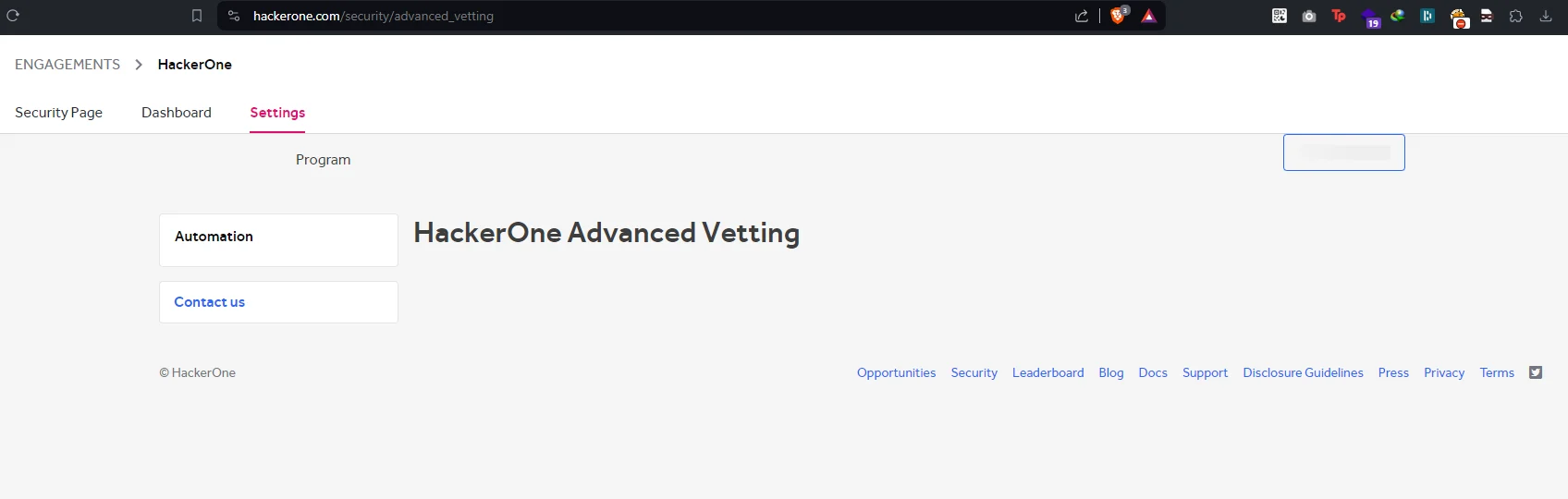
although this shouldn't happen, so far there wouldn't a significant risk from this behavior alone, but one thing I noticed from the Advanced vetting page (when it loads properly, of course) is that it has a link to download a .csv file:
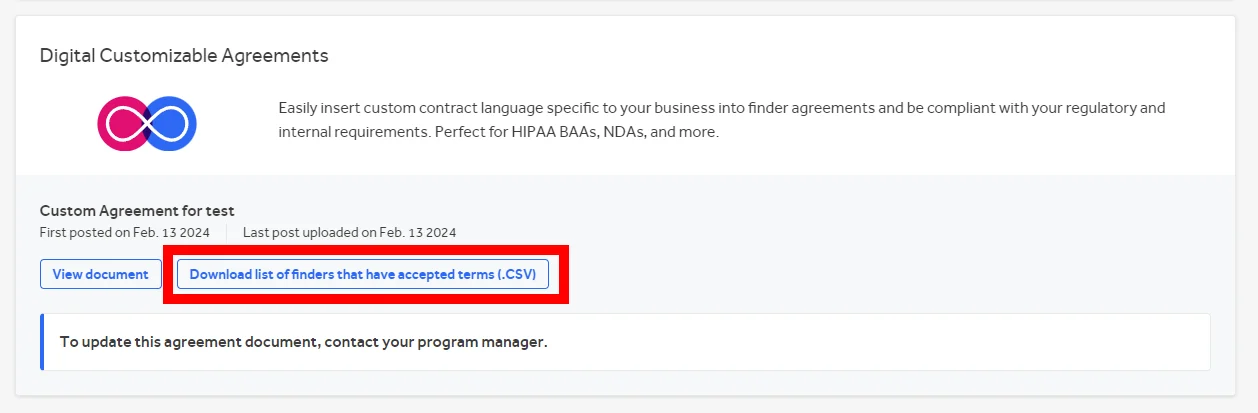
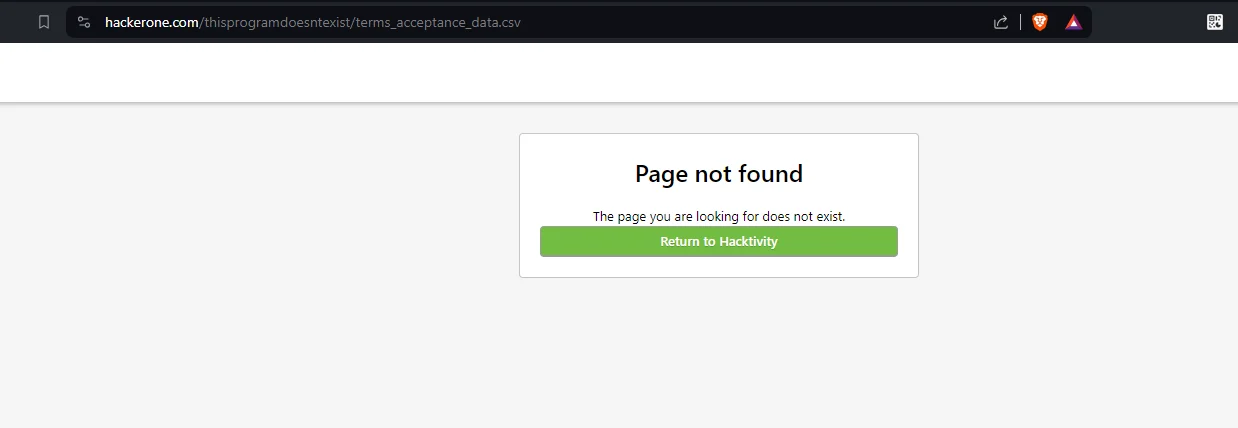
that leads to https://hackerone.com/$handle/terms_acceptance_data.csv I decided to experiment with this link and sure enough, I found some risky behavior, when any HackerOne user goes to https://hackerone.com/$SANDBOXED_PROGRAM/terms_acceptance_data.csv the request goes through and we download the csv file, although it doesn't have any relevant information, just default text, take for example my own sandboxed program https://hackerone.com/test_pie77/terms_acceptance_data.csv if you or any user in Hackerone go to that link the request will go through and download the csv file, now let's take for example, ██████, they have a totally private program although you can access the embedded report submission form from their own security page, so if we go to █████ we can see that the request doesn't go through, confirming that the program is, in fact, private and we know that it is private and exists because when we try with a handle that doesn't exist it shows the Hackerone default 404 page like this:
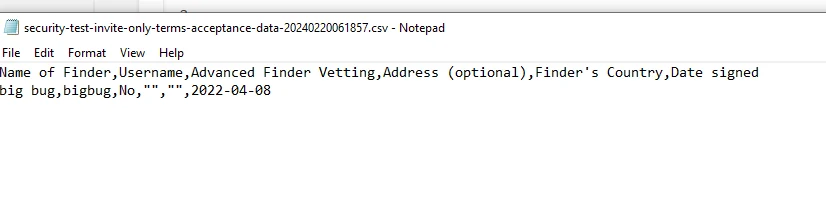
but when we go to ███ program: █████████ it shows a different response I tried this with other actual private programs and the behavior was the same, the request didn't go through, I tried with other sandboxed programs of mine using a second account and the behavior was the same, the request did go through, the only private program it did work was in HackerOne's own dummy invite-only program at https://hackerone.com/security-test-invite-only/terms_acceptance_data.csv this could be due to some misconfiguration on HackerOne's side as the request does goes through and we can see the csv file has been modified.
Steps To Reproduce
- Use my sandboxed program as an example: https://hackerone.com/test_pie77/terms_acceptance_data.csv or replace my program's handle with a sandboxed program of yours and use a second account and go to that link
- Check how you can download the Csv file confirming the program is sandboxed
- Now replace the sandboxed program's handle with a private program's handle and see how it doesn't work, confirming the program is private
Impact
Here we can clearly identify which programs are private, we can build a script or just try manually using company names that we might believe have a private program in Hackerone and check if they actually have one, leading to some loss of the confidentiality of all private programs in HackerOne. This is confirmed to be a valid vulnerability going by this text on HackerOne's policy page:

Context
HackerOne programs have an advanced vetting page at hackerone.com/$handle/advanced_vetting, and that page includes a link to download a CSV export of terms acceptance data at https://hackerone.com/$handle/terms_acceptance_data.csv. The CSV is a per-program export reached from the advanced vetting page, and its responses differ depending on the program's visibility.
The report is about that CSV endpoint and about what its responses reveal about a program's visibility. The researcher's own sandboxed program, test_pie77, is used throughout as the working example.
Setup
The researcher used a sandboxed program they own for testing, and later checked other sandboxed programs of theirs from a second account. No special tooling is described: the checks are made by visiting URLs in a browser and observing whether the CSV download goes through.
Finding it
While looking through the settings of a sandboxed program, the researcher noticed that the advanced vetting page loads for any program handle, regardless of permission. The page itself is not a data leak: the GraphQL request behind it restricts unauthorised users, so no confidential information is displayed. What is shown is the page shell without its data.
That behaviour alone is not a significant risk. The interesting part came from the same page when it loads properly: it contains a link to download a .csv file.
That link points to:
https://hackerone.com/$handle/terms_acceptance_data.csv
Exploitation
Step 1: fetch the CSV for a sandboxed program
The researcher replaced the handle with their own sandboxed program:
https://hackerone.com/test_pie77/terms_acceptance_data.csv
Any HackerOne user who visits that URL gets the request through and downloads the CSV file. The file contains no relevant information, just default text, but the download itself succeeds. The same held for other sandboxed programs of the researcher's when tested from a second account.
Step 2: fetch the CSV for a private program
The researcher then took a private program, one that exposes an embedded report submission form from its own security page, and requested the same path with that program's handle. This time the request did not go through. The failure is the signal: the endpoint answers differently for a private program than for a sandboxed one.
Step 3: distinguish private from non-existent
A handle that does not exist returns HackerOne's default 404 page:
A private program's handle returns a different response from that 404. So the three cases can be told apart: sandboxed program, private program, and handle that does not exist. The researcher repeated this against other actual private programs and saw the same behaviour each time.
Step 4: the exception
The only private program where the request did go through was HackerOne's own dummy invite-only program:
https://hackerone.com/security-test-invite-only/terms_acceptance_data.csv
The CSV there has been modified, which the researcher suggests could be due to a misconfiguration on HackerOne's side.
Steps to reproduce (as given in the report)
- Use the sandboxed program as an example:
https://hackerone.com/test_pie77/terms_acceptance_data.csv, or replace the handle with a sandboxed program of your own and use a second account to visit the link. - Check how you can download the CSV file, confirming the program is sandboxed.
- Replace the sandboxed program's handle with a private program's handle and see how it does not work, confirming the program is private.
Root cause
The CSV endpoint does not apply the same access control as the rest of the program's private data. For a sandboxed program it serves the file to any HackerOne user, and for a private program it refuses, but the refusal is distinguishable from the 404 returned for a handle that does not exist. The advanced vetting page loading without permission is a related symptom: the page shell is served regardless, while the GraphQL request behind it correctly restricts unauthorised users. The report does not describe the server-side check itself, so the exact mistake is not stated; the observable behaviour is that the endpoint's response varies with program visibility in a way an outsider can read.
Impact
An attacker can identify which programs are private. They can build a script, or work manually using company names they believe might run a private program on HackerOne, and check whether such a program actually exists. The researcher frames this as a loss of confidentiality covering all private programs on HackerOne. The information disclosed is the existence and private status of a program, not its reports or other confidential content; the CSV for a sandboxed program contains only default text.
The researcher cites HackerOne's policy page as confirming that this is a valid vulnerability.
Fix
The report does not say what was changed. The behaviour it describes implies the endpoint should answer identically for a private program the requester cannot access and for a handle that does not exist, so that the response cannot be used to tell the two apart.
Variants to test
- Other per-program export or download endpoints, such as CSV, JSON or PDF exports reached from program settings pages. A positive result is a response that differs between a private program and a non-existent handle.
- The same path with a handle you own versus a private program's handle, from a second account that is not a member of either. A positive result is a successful download for your own sandboxed program and a distinguishable failure for the private one.
- Pages that load without permission but fetch their data through a separate API call, as the advanced vetting page does here. A positive result is a page shell served to an unauthorised user whose backing request is properly restricted, which is a lead rather than a finding on its own.
- Invite-only or dummy programs on the platform. A positive result is a private program whose export endpoint behaves like a sandboxed one, as with
security-test-invite-onlyhere.
Hunting notes
This kind of bug tends to sit in secondary endpoints reached from a settings or admin page: exports, downloads and report generators that were added after the main access checks and do not reuse them. During recon, the signal is a page that loads for handles you should not be able to see, combined with links on that page to file downloads. Comparing the response for a handle you own, a private program's handle and a random non-existent handle is enough to confirm whether the endpoint leaks visibility. The researcher showed impact by demonstrating the three distinguishable outcomes and repeating the check across several private programs.
What happened, in plain words
HackerOne is a website where companies (called "programs") ask security researchers to look for bugs in their software and pay for the useful findings. Each program has a short name, called a handle, that appears in its web address. For example, a program with the handle test_pie77 lives at hackerone.com/test_pie77.
Some programs are public: anyone can see them and read about them. Others are private: only invited people know they exist. Keeping that difference secret matters, because the fact that a company runs a private program on HackerOne is itself information the company did not choose to publish.
This report is about a file download offered from a program's advanced vetting page. The file is a CSV, which is a plain text file where each line is a row of values separated by commas, the kind of thing a spreadsheet opens. The download link looks like this:
https://hackerone.com/$handle/terms_acceptance_data.csv
Here $handle is a placeholder for a program's short name. The researcher found that this download behaves differently depending on what kind of program the handle belongs to. For a program that is only a test sandbox, the file downloads for anyone. For a real private program, the download is refused. For a handle that does not exist at all, the site shows its standard "page not found" page. Those three outcomes are different from each other, and that difference is the bug: by trying a handle and watching what comes back, an outsider can work out whether a private program exists.
A sandbox is a practice program researchers use for testing, separate from a real company's data.
The page that started it
Every program has an "advanced vetting" page. Vetting is the process of checking whether a researcher is trustworthy enough to be let into a private program. The page's address is:
hackerone.com/$handle/advanced_vetting
Again, $handle stands for the program's short name.
While looking through the settings of one of their own sandboxed programs, the researcher noticed that this page loads for any program handle, even when the person viewing it has no permission for that program. That sounds alarming, but the page itself does not show secret data. Modern websites often work in two parts: the page you see (the shell) and a separate request the page makes behind the scenes to fetch the actual data. That behind-the-scenes request is called an API call, and an API is simply a way for one piece of software to ask another for data in a structured format. Here the API call was properly protected: it refused to hand over confidential information to users who were not allowed to see it. So the visitor got the empty shell of the page and nothing more.
The screenshot shows that page loading for a program the viewer has no permission for, with no confidential information in it.
On its own, that is not a serious problem. The interesting part came when the same page loaded properly, for a program the researcher did have access to. On that page there is a link to download a .csv file.
The screenshot shows the advanced vetting page with its download link for the CSV file.
That link is the address shown earlier:
https://hackerone.com/$handle/terms_acceptance_data.csv
In plain words: https:// means the connection is encrypted, hackerone.com is the website, $handle picks the program, and terms_acceptance_data.csv is the name of the file being requested. The .csv ending tells the browser the file is a comma-separated table.
Trying the download
Step 1: a sandboxed program
The researcher put their own sandbox's handle into the address:
https://hackerone.com/test_pie77/terms_acceptance_data.csv
Any HackerOne user who visits that address gets the request through and downloads the CSV file. The file holds nothing sensitive, just default placeholder text, but the download itself succeeds. The same thing happened with the researcher's other sandboxed programs when tested from a second account.
The researcher used a second account to check other sandboxed programs of theirs.
Step 2: a private program
Next the researcher took a private program, one that shows a report submission form on its own security page, and requested the same file path with that program's handle. This time the request did not go through.
The failure is the signal. The same address, with only the handle changed, produced a different result. That means the server is making a decision based on which program the handle points to, and the visitor can see the outcome of that decision.
Step 3: telling private apart from non-existent
There is a third case to check: a handle that does not exist at all. For that, HackerOne returns its standard 404 page. "404" is the status code a web server sends when the address you asked for has nothing behind it, and the browser then shows a "not found" page.
The screenshot shows HackerOne's default 404 page for a handle that does not exist.
A private program's handle returns something different from that 404 page. So the three cases can be told apart:
| What you request | What comes back |
|---|---|
| A sandboxed program's handle | The CSV file downloads |
| A private program's handle | The request does not go through, with a response different from the 404 |
| A handle that does not exist | HackerOne's default 404 page |
The researcher repeated this against other real private programs and saw the same behaviour each time.
Step 4: the exception
One private program did let the request through: HackerOne's own dummy invite-only program.
https://hackerone.com/security-test-invite-only/terms_acceptance_data.csv
"Invite-only" means the program is not open to the public and you need an invitation to take part. The CSV there has been modified, and the researcher suggests this could be due to a misconfiguration on HackerOne's side. A misconfiguration is a setting that was set up wrongly, the software equivalent of leaving a door unlocked because the lock was fitted the wrong way round.
The screenshot shows the CSV file from that invite-only program, which has been modified.
Steps to reproduce, as given in the report
- Use the sandboxed program as an example:
https://hackerone.com/test_pie77/terms_acceptance_data.csv, or replace the handle with a sandboxed program of your own and use a second account to visit the link. - Check how you can download the CSV file, confirming the program is sandboxed.
- Replace the sandboxed program's handle with a private program's handle and see how it does not work, confirming the program is private.
Each step exists to isolate one variable. Step 1 establishes the baseline: a handle you know is a sandbox, fetched by an account that is not its owner. Step 2 confirms the download works in that baseline. Step 3 changes only the handle, so any difference in the result must come from the program's visibility, not from the account or the address format.
Why it happens
Access control is the part of a website that decides who is allowed to see or do what. The CSV download does not apply the same access control as the rest of a program's private data. For a sandboxed program it serves the file to any HackerOne user. For a private program it refuses. But the refusal looks different from the 404 returned for a handle that does not exist, and that difference is readable from outside.
The advanced vetting page loading without permission is a related symptom: the page shell is served regardless, while the API call behind it correctly restricts unauthorised users. The report does not describe the server-side check itself, so the exact mistake in the code is not stated. What is observable is that the endpoint's response varies with program visibility in a way an outsider can read.
Impact
An attacker can identify which programs are private. They can build a script, or work manually using company names they believe might run a private program on HackerOne, and check whether such a program actually exists. The researcher frames this as a loss of confidentiality covering all private programs on HackerOne. Confidentiality here means keeping information away from people who are not supposed to have it.
What is disclosed is the existence and private status of a program, not its reports or other confidential content. The CSV for a sandboxed program contains only default text. The researcher cites HackerOne's policy page as confirming that this is a valid vulnerability.
The screenshot shows the text on HackerOne's policy page that the researcher cites.
The fix
The report does not say what was changed. The behaviour it describes implies the endpoint should answer identically for a private program the requester cannot access and for a handle that does not exist, so that the response cannot be used to tell the two apart. When two different situations produce the same answer, an outsider learns nothing from comparing them.
Other places to look
- Other per-program export or download endpoints, such as CSV, JSON or PDF exports reached from program settings pages. A positive result is a response that differs between a private program and a non-existent handle.
- The same path with a handle you own versus a private program's handle, from a second account that is not a member of either. A positive result is a successful download for your own sandboxed program and a distinguishable failure for the private one.
- Pages that load without permission but fetch their data through a separate API call, as the advanced vetting page does here. A positive result is a page shell served to an unauthorised user whose backing request is properly restricted, which is a lead rather than a finding on its own.
- Invite-only or dummy programs on the platform. A positive result is a private program whose export endpoint behaves like a sandboxed one, as with
security-test-invite-onlyhere.
Notes for hunting
This kind of bug tends to sit in secondary endpoints reached from a settings or admin page: exports, downloads and report generators that were added after the main access checks and do not reuse them. During recon, the signal is a page that loads for handles you should not be able to see, combined with links on that page to file downloads. Comparing the response for a handle you own, a private program's handle and a random non-existent handle is enough to confirm whether the endpoint leaks visibility. The researcher showed impact by demonstrating the three distinguishable outcomes and repeating the check across several private programs.
Glossary
- API: a way for one piece of software to ask another for data in a structured format, separate from the page you see.
- Access control: the part of a website that decides who is allowed to see or do what.
- Advanced vetting page: a per-program page on HackerOne used in the process of checking whether a researcher can be trusted with a private program.
- Confidentiality: keeping information away from people who are not supposed to have it.
- CSV: a plain text file where each line is a row of values separated by commas, openable in a spreadsheet.
- Endpoint: a specific address on a website that does one job, such as serving a particular file.
- GraphQL: a way for a web page to request exactly the data it needs from a server through a single API call.
- Handle: the short name that identifies a program in its web address.
- Invite-only: a program you cannot join unless you are invited.
- Misconfiguration: a setting that was set up wrongly, leaving something exposed that should not be.
- Private program: a program only invited people know about.
- Public program: a program anyone can see and read about.
- Sandbox: a practice program for testing, separate from a real company's data.
- Status code: a number a web server sends with its answer to say what happened, such as 404 for "not found".
- 404: the status code and page a web server returns when the address you asked for has nothing behind it.
- Vetting: the process of checking whether a researcher is trustworthy enough to be let into a private program.



