Account creation with invalid email addresses / email is accepting % and %0d%0a line termination chars
The sign-up form accepted email addresses containing percent signs and line-termination characters, so accounts could be created with addresses that could never be verified. An attacker could therefore create multiple accounts.

- Fixed in 3.5 years
- Paid in 3.5 years
- Disclosed after 3.9 years
Summary: Hackerone SignUp feature is misconfigured with email parameter. Email address parameter is accepting % and %0d%0a character along with genuine email address. Using this technique hackerone user account can be created but cannot be verified as there is not possible to verify those invalid email accounts. Basically random use of invalid email address, attacker can create multiple accounts.
Description: As email address field always being verified with any special character (except @ and .) but here email is accepting % and line termination char %0d%0a
Steps To Reproduce
- SignUp with new hacker account
- Use email address adding with character like % or %0d%0a, account will be created and you will get a account creation message
████ ███████
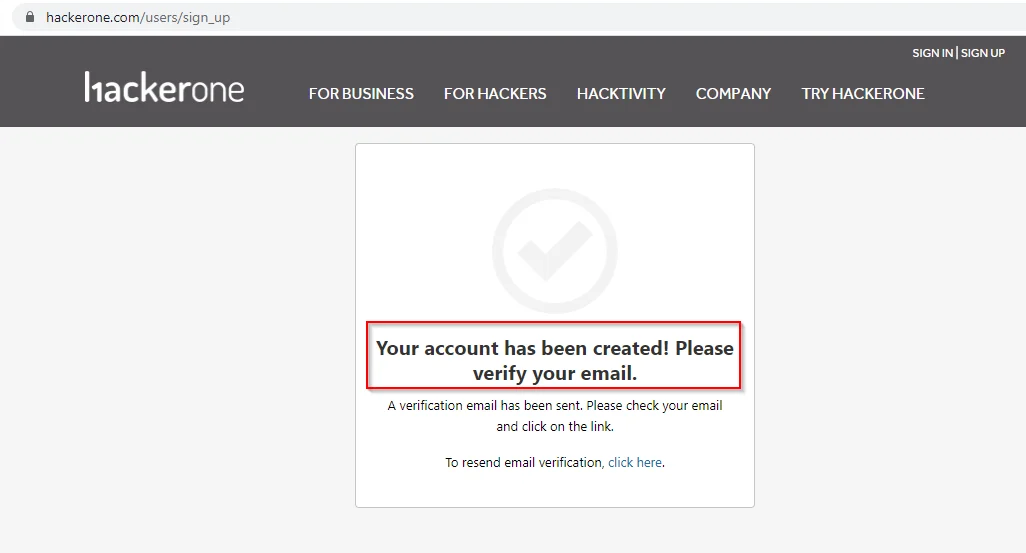
- Even if you try now to login using same above email and password then you will get same message for account is already created and need to verify email
█████ 4. You can not use the same invalid email again, as it will show an error of reuse of that invalid email address
Impact
Garbage value can be stored in database using user account signup form Multiple account can be created, just like if any use has real account with his email address, then also account can be created by adding %0d%0a or % char Account is created using invalid email address, but can not be used
Context
HackerOne's sign-up feature lets a new user create an account by supplying an email address, a password and the usual registration details. Normally the email address is validated and then verified: the account is created in an unverified state and the user has to confirm ownership of the address before the account becomes usable. The report looks at what happens when the email field is fed characters that are not part of a genuine address.
The weakness was classified as a violation of secure design principles, rated low severity, and the program paid a bounty of 3750.00 USD. The report was disclosed on 2024-02-04.
Setup
No special tooling, role or precondition is described. The researcher simply used the public sign-up form on hackerone.com with a new hacker account, then tried to log in with the same credentials. Everything happens through the normal registration and login flows.
Finding it
The researcher noticed that the email address parameter accepted % and the line termination sequence %0d%0a alongside what would otherwise be a genuine email address. The report's framing is that an email field is normally checked for special characters other than @ and ., but here these two inputs passed validation. The result is an account that is created but can never be verified, because no mail can be delivered to such an address.
Exploitation
Step 1: sign up with a new account
Register a new hacker account through the normal sign-up flow.
Step 2: submit an email containing % or %0d%0a
In the email address field, add a character such as % or the sequence %0d%0a to the address. The account is created and an account creation message is returned.
The screenshot shows the account creation message returned after submitting the malformed address.
Step 3: try to log in with the same address
Attempting to log in with the same email and password returns the same message: the account already exists and the email needs to be verified. Because the address is not deliverable, that verification can never complete.
Step 4: reuse the same invalid address
Submitting the same invalid email a second time fails with an error indicating that the invalid address has already been used. So the same invalid email cannot be used again.
Root cause
The email field is validated against special characters except @ and ., but % and the encoded line termination %0d%0a are not rejected. The report does not describe the server-side code, so the exact validation logic is not shown; likely the check is a permissive pattern or a denylist that misses percent-encoding and CRLF sequences. Whatever the mechanism, the value reaches storage and an account record is created for an address that cannot receive mail, while the verification step that would normally gate account use is never satisfiable.
Impact
The report lists three consequences:
- Garbage values can be stored in the database through the user sign-up form.
- Multiple accounts can be created. Even if a user already has a real account tied to their email address, another account can be created by appending
%0d%0aor%to that address. - The account created with an invalid email address exists but cannot be used.
The practical effect is account inflation and junk records. The report does not demonstrate any way to verify such an account.
Fix
The report does not describe the fix that was applied.
Variants to test
- Append
%0d%0ato a valid address at registration and observe whether the account is created. A positive result is a creation message for an address that cannot receive mail. - Append a bare
%to a valid address. A positive result is the same: account created, verification impossible. - Register the same malformed address twice. A positive result is a reuse error on the second attempt, confirming the value was stored.
Hunting notes
This kind of bug hides in registration forms where the email field is validated by a pattern or denylist rather than a strict parser. During recon, look for sign-up flows that accept unusual characters without complaint, and check whether the uniqueness check runs on the raw string rather than a normalised address. The researcher walked through the full flow: creation, the verification message, the failed login and the reuse error, which together show that the record is persisted and that the account cannot be verified. That chain, rather than any single response, is what makes the case.
What happened, in plain words
HackerOne is a website where companies run bug bounty programmes and security researchers report problems to them. To use it, a person creates an account with an email address and a password. Normally the site checks that the email address looks like a real address, and then sends a confirmation email to it. The account stays unverified until the owner clicks the link in that email.
The researcher found that the sign-up form accepted email addresses containing characters that do not belong in a real address: a percent sign % and the sequence %0d%0a. An account was created with such an address, but no email can ever be delivered to it, so the account can never be verified. The report states that multiple accounts can be created this way.
The weakness was classified as a violation of secure design principles, rated low severity, and the programme paid a bounty of 3750.00 USD. The report was disclosed on 2024-02-04.
Background you need
A few ideas come up again and again below, so here they are from scratch.
- Sign-up form: the page where you type your details to create an account. Behind it, the site takes what you typed and stores it in a database, which is an organised collection of records kept by the site.
- Email verification: after sign-up, the site sends a message to the address you gave. The message contains a link. Clicking it proves you own the address, and only then does the account become fully usable. If no message can arrive, the account stays stuck in the unverified state.
- Validation: the checks a site runs on what you type before accepting it. A strict check compares the input against the exact shape of a valid email address. A looser check, sometimes called a denylist, only rejects a list of known-bad characters and lets everything else through. Denylists are easy to get wrong because the list is never complete.
- Percent-encoding: a way of writing characters that are awkward to put in a URL or a form. A character is written as a percent sign followed by two hexadecimal digits. For example,
%0dstands for a carriage return and%0astands for a line feed. Together,%0d%0ais the pair of characters that marks the end of a line in many internet protocols. Percent-encoding is normal and useful in the right place; the problem here is that it was accepted inside an email address, where it has no business being. - Parameter: one named piece of data sent to a website, such as the value of the email field in the sign-up form.
- Root cause: the underlying reason a bug exists, as opposed to the visible symptom.
Setup
No special tooling, role or precondition is described. The researcher simply used the public sign-up form on hackerone.com with a new hacker account, then tried to log in with the same credentials. Everything happens through the normal registration and login flows, so you can follow along with nothing more than a browser.
Finding it
The researcher noticed that the email address parameter accepted % and the line termination sequence %0d%0a alongside what would otherwise be a genuine email address. The report's framing is that an email field is normally checked for special characters other than @ and ., but here these two inputs passed validation. The result is an account that is created but can never be verified, because no mail can be delivered to such an address.
Exploitation
Step 1: sign up with a new account
Register a new hacker account through the normal sign-up flow. This gives you a clean starting point: you are testing what the form does with unusual input, not trying to break into an existing account.
Step 2: submit an email containing % or %0d%0a
In the email address field, add a character such as % or the sequence %0d%0a to the address. The account is created and an account creation message is returned.
The screenshot shows the account creation message returned after submitting the malformed address. In other words, the site did not complain about the strange characters; it treated the address as acceptable and went ahead with registration.
Step 3: try to log in with the same address
Attempting to log in with the same email and password returns the same message: the account already exists and the email needs to be verified. This step matters because it shows the record really was saved. The site remembers the address and the account, and it is now waiting for a confirmation that can never arrive, since the address cannot receive mail.
Step 4: reuse the same invalid address
Submitting the same invalid email a second time fails with an error indicating that the invalid address has already been used. So the same invalid email cannot be used again.
Root cause
The email field is validated against special characters except @ and ., but % and the encoded line termination %0d%0a are not rejected. The report does not describe the server-side code, so the exact validation logic is not shown; likely the check is a permissive pattern or a denylist that misses percent-encoding and CRLF sequences. Whatever the mechanism, the value reaches storage and an account record is created for an address that cannot receive mail, while the verification step that would normally gate account use is never satisfiable.
Impact
The report lists three consequences:
- Garbage values can be stored in the database through the user sign-up form.
- Multiple accounts can be created. Even if a user already has a real account tied to their email address, another account can be created by appending
%0d%0aor%to that address. - The account created with an invalid email address exists but cannot be used.
The practical effect is account inflation and junk records. The report does not demonstrate any way to verify such an account.
Fix
The report does not describe the fix that was applied.
Variants to test
- Append
%0d%0ato a valid address at registration and observe whether the account is created. A positive result is a creation message for an address that cannot receive mail. - Append a bare
%to a valid address. A positive result is the same: account created, verification impossible. - Register the same malformed address twice. A positive result is a reuse error on the second attempt, confirming the value was stored.
Hunting notes
This kind of bug hides in registration forms where the email field is validated by a pattern or denylist rather than a strict parser. During recon, look for sign-up flows that accept unusual characters without complaint, and check whether the uniqueness check runs on the raw string rather than a normalised address. The researcher walked through the full flow: creation, the verification message, the failed login and the reuse error, which together show that the record is persisted and that the account cannot be verified. That chain, rather than any single response, is what makes the case.
Glossary
- Account verification: the step where a user proves they own the email address by following a link sent to it.
- Bounty: a payment a company makes to a researcher who reports a valid security problem.
- CRLF: carriage return plus line feed, the character pair that ends a line in many protocols, written percent-encoded as
%0d%0a. - Database: an organised store of records kept by a website.
- Denylist: a check that rejects a list of known-bad inputs and allows everything else.
- Disclosure: the point at which a bug report is made public.
- Email verification: see account verification.
- Impact: the practical harm a bug can cause.
- Normalisation: converting input to a single standard form before comparing or storing it, so that variants of the same value are treated as one.
- Parameter: a named piece of data sent to a website, such as the email field value.
- Percent-encoding: writing a character as a percent sign plus two hexadecimal digits, for example
%0dfor carriage return. - Recon: the exploratory phase of looking around a target to find features worth testing.
- Root cause: the underlying reason a bug exists.
- Severity: a rating of how serious a bug is, here low.
- Sign-up form: the page where a new user enters details to create an account.
- Validation: the checks a site runs on input before accepting it.
- Violation of secure design principles: a weakness class meaning the design of a feature allowed unsafe behaviour, rather than a single coding slip.




