Deprecated Hacker101 coursework repository mentions Heroku App that is susceptible to takeover
A Heroku app name mentioned in a public Hacker101 coursework repository was no longer claimed, allowing the reporter to register it. An attacker could then serve their own content at that address to new researchers who follow the documentation.
 Originally disclosed on HackerOne
- Triaged in 4 hours
- Fixed in 5 days
- Paid in 5 days
- Disclosed after 11 days
Hi ,
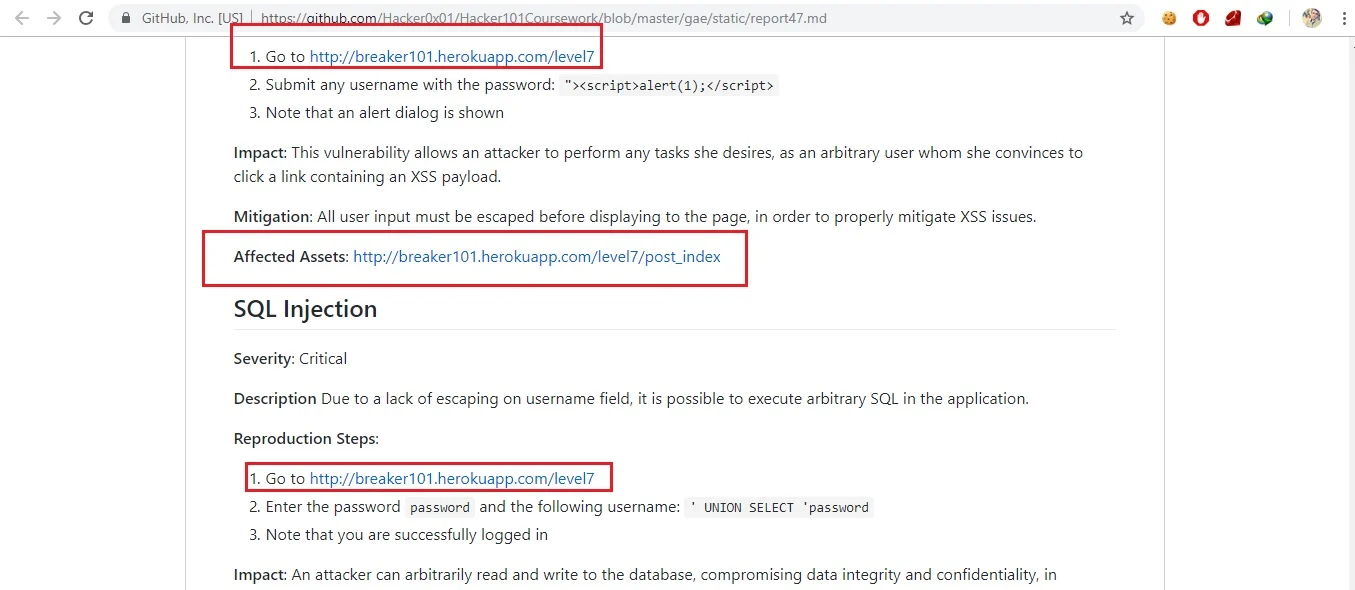
I'm sure this repo on GitHub https://github.com/Hacker0x01 belong to Hackerone,inc. I've found that your docs on it mention a Heroku app breaker101.herokuapp.com which is no longer work and I could takeover it via HeroKu.
Suggested Fix : Remove this app name from your docs or I can remove it from my apps to added it back to your account
#Poc :
http://breaker101.herokuapp.com
Repo https://github.com/Hacker0x01/Hacker101Coursework/blob/master/gae/static/report47.md
Impact
New Researchers can be scammed by this app
What the report shows
The target here is the Hacker101 coursework material, specifically a GitHub repository under the Hacker0x01 organisation that the researcher attributes to HackerOne, Inc. The asset recorded for the report is https://ctf.hacker101.com. The researcher's finding is that the documentation in that repository references a Heroku app, breaker101.herokuapp.com, which no longer worked, and that the researcher was able to claim that app name through Heroku.
The report points to a single file in the repository as the place where the stale reference lives:
https://github.com/Hacker0x01/Hacker101Coursework/blob/master/gae/static/report47.md
The proof of concept is the app itself:
http://breaker101.herokuapp.com
The report includes a screenshot alongside the proof of concept address.
The suggested fix is short and direct: either remove the app name from the documentation, or let the researcher remove the app from their own Heroku account so it can be added back to the organisation's account. The stated impact is that new researchers could be scammed by the app, since the coursework documentation sends them to an address that is now under someone else's control.
The report was disclosed on 4 April 2019 with a bounty of 500.00 USD. The recorded severity is none with a CVSS score of 0.0, and the weakness is classified as an externally controlled reference to a resource in another sphere.
Root cause
The likely root cause is a dangling third-party reference. The coursework documentation named a Heroku app that the organisation no longer owned or maintained. Heroku app names are globally unique within a region and are released when an app is deleted, so once the original app was gone the name became available for anyone to register. The documentation kept pointing at the name, so the link silently changed ownership without any change to the repository itself.
Impact
The report's own framing of impact is that new researchers following the coursework could be scammed by the app. That is the realistic risk with a dangling reference of this kind: the party who registers the name controls whatever the old link now serves, and readers have no way to tell from the documentation that ownership changed. The report does not describe any specific content served from the reclaimed app.
How this kind of bug works
Many services hand out names on a first-come, first-served basis: Heroku app names, cloud storage bucket names, package names on public registries, subdomains under a provider's zone, and similar. When an organisation stops using a name, the name usually returns to the pool. Any document, page, repository, configuration file or client that still refers to the old name now points at a resource controlled by whoever registers it next.
The danger depends on context. A link in a tutorial is a phishing and trust problem. A reference in application code or configuration is worse: the application may fetch content from, send data to, or load scripts from an origin that a stranger now owns, which can turn into data exposure or script execution in users' browsers. The common thread is that the reference outlives the ownership, and nothing in the referring system notices the change.
Defences are mostly about lifecycle discipline: inventory every external name the organisation depends on, keep ownership of names as long as any reference exists, and remove or update references before releasing a name. Monitoring for references to names you no longer own, and registering defensive names for important brands, closes the gap further.
How to test for it
- Collect external hostnames and identifiers from the target's public material: documentation, repositories, blog posts, tutorials, JavaScript bundles, mobile apps, error pages and archived versions of all of these.
- Classify each one by the provider that controls the namespace, for example a Heroku app name, a storage bucket, a package name or a subdomain under a third-party zone.
- Check whether the name is still claimed. For a Heroku app, request the hostname and look at the response: a live app returns the application, while an unclaimed name typically returns the provider's "no such app" page. For storage, an unauthenticated request to the bucket endpoint usually reveals whether it exists and who owns it.
- Confirm the name is actually available before drawing conclusions. Providers differ: some names are reserved, some are held for a grace period, and some are region-specific.
- If the name is available, register it in a minimal, non-abusive way, serve a harmless page that identifies you as the security researcher, and record the response as evidence. Do not serve anything that could harm users of the referring site.
- Report the exact referring location, the provider, and the evidence that the name was unclaimed and is now controlled by you.
A positive result looks like a documented reference to a name that the provider reports as unclaimed, followed by a controlled registration that makes the reference resolve to your content. Common false positives are names that are still owned but temporarily failing, names held in a different region, references that are already dead links nobody follows, and names that the provider will not release to new accounts.
How it is fixed
The standard fix is to remove or update every reference to the released name, as the report suggests, and to stop publishing names the organisation does not intend to keep. Where the name is still wanted, re-register it and keep it under organisational control. Longer term, treat external names as assets with an owner and a review date, and check documentation and code for stale references whenever a service is decommissioned.
Hunting notes
Dangling references cluster in old tutorials, sample code, changelogs, CI configuration, test fixtures and documentation that nobody edits. Repository history and web archives are good sources, because a name removed from the current version may still be referenced in older commits or cached pages. Recon signals include provider-specific error pages for names mentioned by the target, links in the target's material that resolve to a generic "not found" page from a hosting provider, and references to services the target has visibly migrated away from.
To get a report accepted, show the referring location in the target's own material, show the provider's response proving the name was unclaimed, and show the controlled registration. Keep the takeover benign and offer to remove the app so the name can be returned. Impact is strongest when the reference is followed by real users or loaded by application code; a link in archived documentation is weaker, so explain clearly who would follow it and what they would see.
What happened, in plain words
Hacker101 is a learning site run by HackerOne, and it comes with coursework material: lessons, exercises and sample files that new researchers work through. Some of that material lives in a public GitHub repository under the Hacker0x01 organisation, which the researcher attributes to HackerOne, Inc. The asset recorded for the report is https://ctf.hacker101.com.
Inside that repository, one of the documentation files mentioned a web address, breaker101.herokuapp.com. Heroku is a hosting service where you put an application online and it gets a name that ends in herokuapp.com. The researcher found that this particular app no longer worked, and that the name was free to claim through Heroku. So the researcher claimed it.
The report points to the single file where the stale reference lives:
https://github.com/Hacker0x01/Hacker101Coursework/blob/master/gae/static/report47.md
The proof of concept is simply the address itself:
http://breaker101.herokuapp.com
The report includes a screenshot alongside the proof of concept address.
The suggested fix is short and direct: either remove the app name from the documentation, or let the researcher remove the app from their own Heroku account so it can be added back to the organisation's account. The stated impact is that new researchers could be scammed by the app, because the coursework documentation sends them to an address that is now under someone else's control.
The report was disclosed on 4 April 2019 with a bounty of 500.00 USD. The recorded severity is none with a CVSS score of 0.0, and the weakness is classified as an externally controlled reference to a resource in another sphere.
Why it happened
The likely root cause is a dangling third-party reference. Think of it like a shop that prints its old phone number on flyers, cancels the line, and never reprints the flyers: whoever gets that number next answers when customers call. Heroku app names are globally unique within a region and are released when an app is deleted, so once the original app was gone the name became available for anyone to register. The documentation kept pointing at the name, so the link silently changed ownership without any change to the repository itself.
Impact
The report's own framing of impact is that new researchers following the coursework could be scammed by the app. That is the realistic risk with a dangling reference of this kind: the party who registers the name controls whatever the old link now serves, and readers have no way to tell from the documentation that ownership changed. The report does not describe any specific content served from the reclaimed app.
In general, how this kind of bug works
Many services hand out names on a first-come, first-served basis: Heroku app names, cloud storage bucket names, package names on public registries, subdomains under a provider's zone, and similar. When an organisation stops using a name, the name usually returns to the pool. Any document, page, repository, configuration file or client that still refers to the old name now points at a resource controlled by whoever registers it next.
The danger depends on context. A link in a tutorial is a phishing and trust problem. A reference in application code or configuration is worse: the application may fetch content from, send data to, or load scripts from an origin that a stranger now owns, which can turn into data exposure or script execution in users' browsers. The common thread is that the reference outlives the ownership, and nothing in the referring system notices the change.
Defences are mostly about lifecycle discipline: inventory every external name the organisation depends on, keep ownership of names as long as any reference exists, and remove or update references before releasing a name. Monitoring for references to names you no longer own, and registering defensive names for important brands, closes the gap further.
In general, how to test for it
- Collect external hostnames and identifiers from the target's public material: documentation, repositories, blog posts, tutorials, JavaScript bundles, mobile apps, error pages and archived versions of all of these.
- Classify each one by the provider that controls the namespace, for example a Heroku app name, a storage bucket, a package name or a subdomain under a third-party zone.
- Check whether the name is still claimed. For a Heroku app, request the hostname and look at the response: a live app returns the application, while an unclaimed name typically returns the provider's "no such app" page. For storage, an unauthenticated request to the bucket endpoint usually reveals whether it exists and who owns it.
- Confirm the name is actually available before drawing conclusions. Providers differ: some names are reserved, some are held for a grace period, and some are region-specific.
- If the name is available, register it in a minimal, non-abusive way, serve a harmless page that identifies you as the security researcher, and record the response as evidence. Do not serve anything that could harm users of the referring site.
- Report the exact referring location, the provider, and the evidence that the name was unclaimed and is now controlled by you.
A positive result looks like a documented reference to a name that the provider reports as unclaimed, followed by a controlled registration that makes the reference resolve to your content. Common false positives are names that are still owned but temporarily failing, names held in a different region, references that are already dead links nobody follows, and names that the provider will not release to new accounts.
In general, how it is fixed
The standard fix is to remove or update every reference to the released name, as the report suggests, and to stop publishing names the organisation does not intend to keep. Where the name is still wanted, re-register it and keep it under organisational control. Longer term, treat external names as assets with an owner and a review date, and check documentation and code for stale references whenever a service is decommissioned.
In general, where to look
Dangling references cluster in old tutorials, sample code, changelogs, CI configuration, test fixtures and documentation that nobody edits. Repository history and web archives are good sources, because a name removed from the current version may still be referenced in older commits or cached pages. Recon signals include provider-specific error pages for names mentioned by the target, links in the target's material that resolve to a generic "not found" page from a hosting provider, and references to services the target has visibly migrated away from.
To get a report accepted, show the referring location in the target's own material, show the provider's response proving the name was unclaimed, and show the controlled registration. Keep the takeover benign and offer to remove the app so the name can be returned. Impact is strongest when the reference is followed by real users or loaded by application code; a link in archived documentation is weaker, so explain clearly who would follow it and what they would see.
Glossary
- Repository: a project folder hosted on a service such as GitHub, where files and their history are stored publicly or privately.
- Heroku: a hosting service that runs applications online and gives each one a name ending in
herokuapp.com. - Dangling reference: a link or name in a document or system that points at something the owner no longer controls.
- Subdomain takeover: claiming a name under someone else's domain after they stop using it, so their old links now serve your content.
- Proof of concept (PoC): a minimal demonstration that a problem is real, here the reclaimed address answering in a browser.
- Impact: the harm a bug could cause to real people or systems.
- Severity and CVSS: a rating of how serious a bug is; CVSS is a standard scoring scale, and 0.0 is the lowest score.
- Bounty: a payment a company makes to a researcher who reports a valid security problem.
- Disclosure: the point at which a report is made public.
- Phishing: tricking people into trusting a page or message so they hand over information or follow malicious instructions.
- Namespace: a set of names managed by one provider, where each name can only be held by one account at a time.
- False positive: a finding that looks like a bug but is not actually exploitable.
- Recon: the information-gathering phase of security testing, looking at public material for clues.







