HackerOne support disclosing report state without checking user identity
HackerOne support staff disclosed the status of a private, undisclosed report to someone who emailed from a different address than the one used to file it, apparently matching only on the name. An attacker who knows a report's URL and the reporter's name could learn whether the report was closed, disclosed or still pending.

- Triaged in 6 hours
- Fixed in 20 hours
- Paid in 43 hours
- Disclosed after 9 days
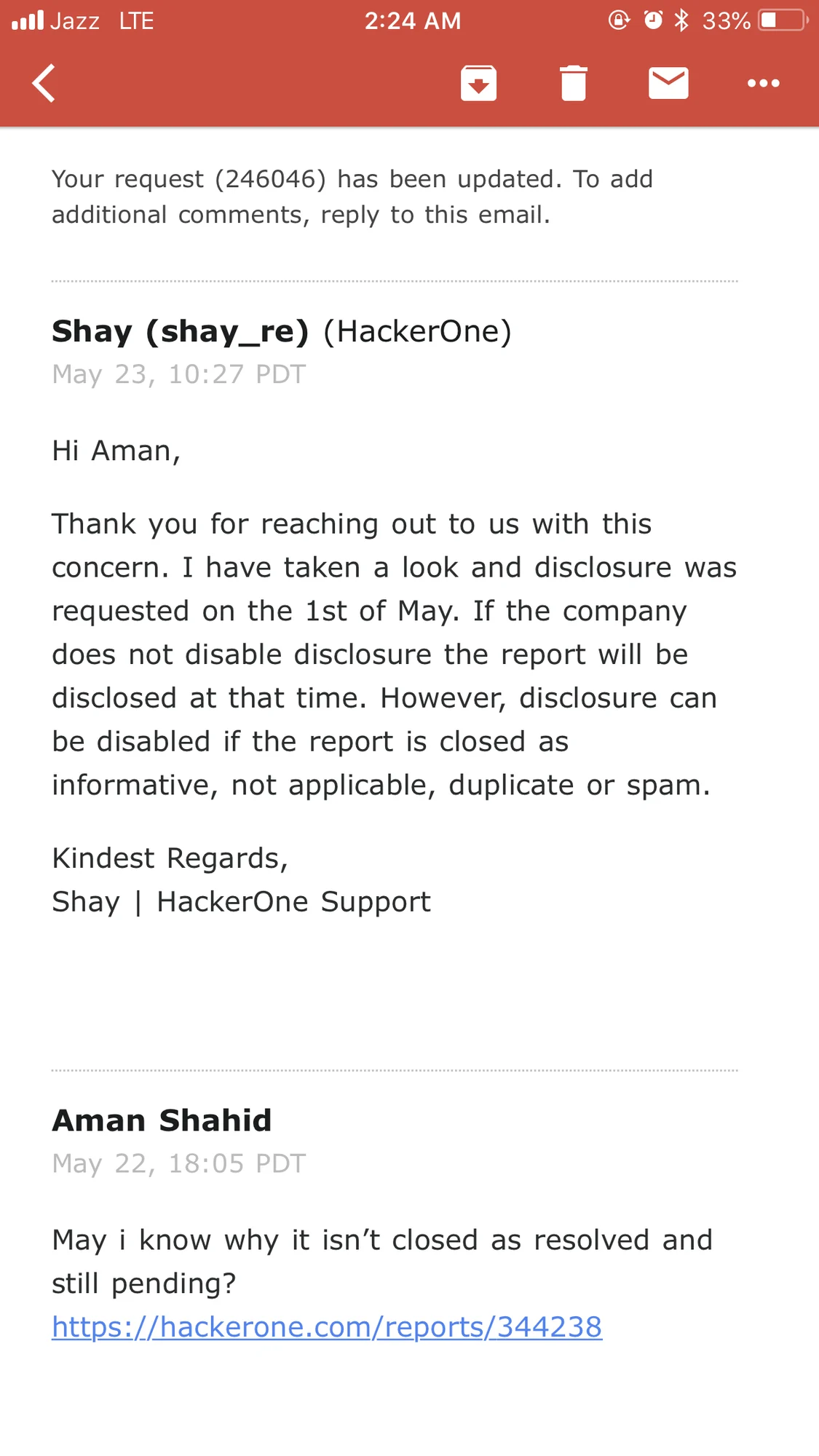
How was i able to to know the state of report using Hackerone Support: I was able to know the state of report using different email address by contacting Hackerone Support. So the thing is this is my report https://hackerone.com/reports/344238 which is not even disclosed and closed as informative and which is reported by with this email address ██████████ . I sent email to hackerone support using this email address ██████ which is totally different from the email i reported the vulnerability from what i wrote in the email was ‘May i know why it isn’t closed as resolved and still pending? https://hackerone.com/reports/344238’ i didn’t even say that this report is closed as informative i just said that ‘why is it not closed as informative yet’ and after 1 day i got email from Hackerone Staff saying: Hi Aman, Thank you for reaching out to us with this concern. I have taken a look and disclosure was requested on the 1st of May. If the company does not disable disclosure the report will be disclosed at that time. However, disclosure can be disabled if the report is closed as informative, not applicable, duplicate or spam. This information about the report is disclosed by support of the report which is not even disclosed yet and by using totally different email and just a same name i was able to get that information by support team. Would recommend hackerone support to verify email first before disclosing any information. Hackerone Support Request # 246046 Also the picture is attached aswell.
Impact
An attacker can know the state of report by using different email address . The report which is not even disclosed we are able to know information about it.
Attachments
Context
HackerOne is a bug bounty platform. Each report on the platform has a state (for example pending, resolved, informative, not applicable, duplicate or spam) and a disclosure setting. A report that has not been disclosed is private: its contents and its state are visible only to the parties involved. HackerOne Support is the channel through which users contact platform staff by email.
The report here concerns a leak of that private state through Support. The researcher, amans, found that Support would answer questions about a report when the request came from an email address that had nothing to do with the report, as long as the name matched.
Setup
The researcher had a report of their own, https://hackerone.com/reports/344238, which had been closed as informative and was not disclosed. It had been submitted from one email address. For the test, the researcher used a second, different email address, and the same name.
No special tooling was involved: the whole interaction was ordinary email to HackerOne Support.
Finding it
The report was already closed as informative, but the researcher did not say so in the message; the question was framed as if the report were still pending.
Exploitation
Step 1: email Support from an unrelated address
The researcher sent an email to HackerOne Support from an address that was totally different from the one used to submit the report. The message asked:
May i know why it isn't closed as resolved and still pending?
https://hackerone.com/reports/344238
The message contains only the report URL and a question about its state. It does not claim ownership, does not include any token or proof tied to the report, and does not mention that the report was closed as informative. The only thing linking the sender to the report was the name.
Step 2: read the reply
One day later, HackerOne staff replied. The reply, quoted in the report, was:
Hi Aman,

Thank you for reaching out to us with this concern. I have taken a look and disclosure was requested on the 1st of May. If the company does not disable disclosure the report will be disclosed at that time. However, disclosure can be disabled if the report is closed as informative, not applicable, duplicate or spam.
The reply confirms the state of the report and adds a detail about it: a disclosure request had been made on 1 May, and the report would be disclosed at that time unless the company disabled disclosure. It also explains the conditions under which disclosure can be disabled. None of this was public, because the report was not disclosed.
The support ticket for this exchange was numbered 246046.
The attached screenshot shows the support exchange, including the reply quoted above.
Root cause
Support answered a question about a specific report without first verifying that the sender's email address matched the one on the report. The identity check appears to have rested on the name alone, which anyone can reuse. The report does not describe any internal process, so the exact mechanism is not stated; what is clear is that the reply was produced for a sender who had no verifiable link to the report.
The platform's normal access control on undisclosed reports was therefore bypassed, not broken: the information left through a human support channel rather than through the application.
Impact
The researcher's summary is that an attacker can learn the state of a report by writing to Support from a different email address, including reports that are not disclosed. In this case the leaked facts were the report's state and the disclosure timeline. The severity was rated low, with a CVSS score of 3.8, and a bounty of 500.00 USD was paid.
It reveals state and disclosure information, not the report's contents.
Fix
The report recommends that HackerOne Support verify the email address before disclosing any information about a report.
Variants to test
- Ask Support about a report from an address unrelated to it, using the reporter's name. A positive result is a reply that confirms the report's state or timeline.
- Ask about a report that is still open rather than closed, to see whether the same channel reveals state for reports in progress.
- Ask a question whose premise is wrong, as here ("why is it still pending?" for a closed report). A positive result is a correction that states the real status.
- Try the same approach through other support channels (ticket forms, chat) with an identifier that is public, such as a report URL, and see whether ownership is checked.
Hunting notes
This kind of bug hides in support and help-desk workflows rather than in the main application: anywhere a human or a ticketing system answers questions about a specific object identified by a URL or ID. During recon, look for support email addresses, ticket portals and contact forms, and note whether they ask for anything that ties the requester to the object. The signal is an object identifier that is guessable or shareable (a report URL, an order number, a ticket ID) combined with a process that seems to rely on names or on the identifier alone.
The researcher showed impact by targeting a report that was not disclosed and asking Support about its state from an unrelated email address. That demonstrated a real leak of non-public information, which is what made the report actionable.
What happened, in plain words
HackerOne is a website where security researchers report bugs to companies and get paid for them. Each report on the site has a status, called a state, such as pending, resolved, informative, not applicable, duplicate or spam. A report also has a disclosure setting: if it has not been disclosed, it is private, and only the people involved can see its contents and its state.
HackerOne Support is the help channel where users email platform staff. The researcher, amans, found that Support would answer questions about a report even when the email came from an address that had nothing to do with that report, as long as the sender used the same name. That meant a private report's state could leak out through a human support conversation rather than through the website itself.
Setup
The researcher had their own report, https://hackerone.com/reports/344238, which had been closed as informative and was not disclosed. It had been submitted from one email address. For the test, the researcher used a second, different email address, and the same name.
No special tools were needed. The whole interaction was ordinary email to HackerOne Support.
Finding it
The report was already closed as informative, but the researcher did not say so in the message; the question was framed as if the report were still pending.
Exploitation
Step 1: email Support from an unrelated address
The researcher sent an email to HackerOne Support from an address that was totally different from the one used to submit the report. The message asked:
May i know why it isn't closed as resolved and still pending?
https://hackerone.com/reports/344238
Line by line, in plain words:
- The first line is a question about the report's state. It says the report is not closed as resolved and is still pending. That is not true: the report was already closed as informative. The researcher chose a wrong premise on purpose, so that any correction from Support would reveal the real state.
- The second line is the report's web address. Anyone who knows the address can open the page, but if the report is not disclosed, the page does not show its private details to outsiders. The address is the only identifier in the message.
The message contains only the report URL and a question about its state. It does not claim ownership, does not include any token or proof tied to the report, and does not mention that the report was closed as informative. The only thing linking the sender to the report was the name.
Step 2: read the reply
One day later, HackerOne staff replied. The reply, quoted in the report, was:
Hi Aman,

Thank you for reaching out to us with this concern. I have taken a look and disclosure was requested on the 1st of May. If the company does not disable disclosure the report will be disclosed at that time. However, disclosure can be disabled if the report is closed as informative, not applicable, duplicate or spam.
Line by line, in plain words:
- The greeting uses the name Aman. The name was the only thing the sender had in common with the real reporter, and it was enough for the reply to be written as if to that person.
- The next sentence says the staff member took a look, which led to the reply about the report.
- The reply then states that disclosure was requested on the 1st of May. This is a private detail about the report's timeline.
- It continues that if the company does not disable disclosure, the report will be disclosed at that time. This tells the sender what will happen to the report and when.
- Finally it explains that disclosure can be disabled if the report is closed as informative, not applicable, duplicate or spam. This describes the conditions under which disclosure can be turned off.
The reply confirms the state of the report and adds a detail about it: a disclosure request had been made on 1 May, and the report would be disclosed at that time unless the company disabled disclosure. It also explains the conditions under which disclosure can be disabled. None of this was public, because the report was not disclosed.
The support ticket for this exchange was numbered 246046.
The attached screenshot shows the support exchange, including the reply quoted above.
Root cause
Support answered a question about a specific report without first verifying that the sender's email address matched the one on the report. The identity check appears to have rested on the name alone, which anyone can reuse. The report does not describe any internal process, so the exact mechanism is not stated; what is clear is that the reply was produced for a sender who had no verifiable link to the report.
The platform's normal access control on undisclosed reports was therefore bypassed, not broken: the information left through a human support channel rather than through the application.
Impact
The researcher's summary is that an attacker can learn the state of a report by writing to Support from a different email address, including reports that are not disclosed. In this case the leaked facts were the report's state and the disclosure timeline. The severity was rated low, with a CVSS score of 3.8, and a bounty of 500.00 USD was paid.
It reveals state and disclosure information, not the report's contents.
Fix
The report recommends that HackerOne Support verify the email address before disclosing any information about a report.
Variants to test
- Ask Support about a report from an address unrelated to it, using the reporter's name. A positive result is a reply that confirms the report's state or timeline.
- Ask about a report that is still open rather than closed, to see whether the same channel reveals state for reports in progress.
- Ask a question whose premise is wrong, as here ("why is it still pending?" for a closed report). A positive result is a correction that states the real status.
- Try the same approach through other support channels (ticket forms, chat) with an identifier that is public, such as a report URL, and see whether ownership is checked.
Hunting notes
This kind of bug hides in support and help-desk workflows rather than in the main application: anywhere a human or a ticketing system answers questions about a specific object identified by a URL or ID. During recon, look for support email addresses, ticket portals and contact forms, and note whether they ask for anything that ties the requester to the object. The signal is an object identifier that is guessable or shareable (a report URL, an order number, a ticket ID) combined with a process that seems to rely on names or on the identifier alone.
The researcher showed impact by targeting a report that was not disclosed and asking Support about its state from an unrelated email address. That demonstrated a real leak of non-public information, which is what made the report actionable.
Glossary
- HackerOne: a bug bounty platform where security researchers report vulnerabilities to companies and receive rewards.
- Bug bounty platform: a website that connects companies with researchers who test their systems for security problems.
- Report: a submission on a bug bounty platform describing a security issue found in a company's system.
- State: the current status of a report, such as pending, resolved, informative, not applicable, duplicate or spam.
- Disclosure: the act of making a report public; an undisclosed report is private.
- Undisclosed report: a report that has not been made public, so its contents and state are visible only to the parties involved.
- HackerOne Support: the help channel where users contact HackerOne staff by email.
- Email address: the unique address used to send and receive email, like a postal address for electronic messages.
- Support ticket: a numbered record of a request sent to a support team, used to track the conversation.
- Access control: the rules that decide who is allowed to see or do something, like a lock on a door.
- Bypass: getting around a protection without breaking it, like walking through an open side door instead of forcing the main one.
- CVSS score: a number from 0 to 10 that rates the severity of a security issue, where higher means more serious.
- Bounty: a reward, usually money, paid to a researcher for reporting a valid security issue.
- Recon: short for reconnaissance, the early phase of looking around a target to find entry points and features worth testing.
- Object identifier: a value such as a URL, order number or ticket ID that points to a specific item in a system.
- Premise: the assumption built into a question; here, the false claim that the report was still pending.
- Root cause: the underlying reason a problem exists, as opposed to its visible symptom.





