Lack warning label when receiving a letter
The ShareReportViaEmail feature allows sending emails from a sandboxed report that appear to come from HackerOne's verification addresses, without any warning that the content is from a sandbox. An attacker could use this to send a convincing phishing email and trick a recipient into replying, thereby revealing their email address.
 Originally disclosed on HackerOne
- Triaged in 6 days
- Fixed in 56 days
- Disclosed after 57 days
Summary:
Hi team,
When using the function ShareReportViaEmail the email is sent to the email address specified by the hacker.This email looks legitimate and comes from verification email addresses, leaving no doubt about it being replaced. This endpoint also applies to sandbox reports which makes it possible to insert any information.
Our team believes that it is worth adding a label that would warn that this email was sent from a sandbox report, which would make it clear about possible social engineering, for example, how is it done when you are invited to a sandbox program
Steps To Reproduce:
- Create sandboxed program
- Create fake asset, for example : https://hackerone.com
- Create report
Asset: https://hackerone.com , Weakness: SQL Injection (cwe-89), Severity: Critical
- GraphQL query:
{"query":"mutation Createvpncredentialsmutation($input0:ShareReportViaEmailInput!) {shareReportViaEmail(input:$input0) {errors{edges{node{field,message,type}}},was_successful,clientMutationId}}","variables":{"input0":{"message":"If you would like to participate in the retest of this report , the payout for retest is 500$, please reply to this email : [[email protected]] and we will send you an invite [HackerOne Retest Team]","emails":"[email protected]","report_id":"gid://hackerone/Report/ID_SANDBOXED_REPORT","clientMutationId":"0"}}}
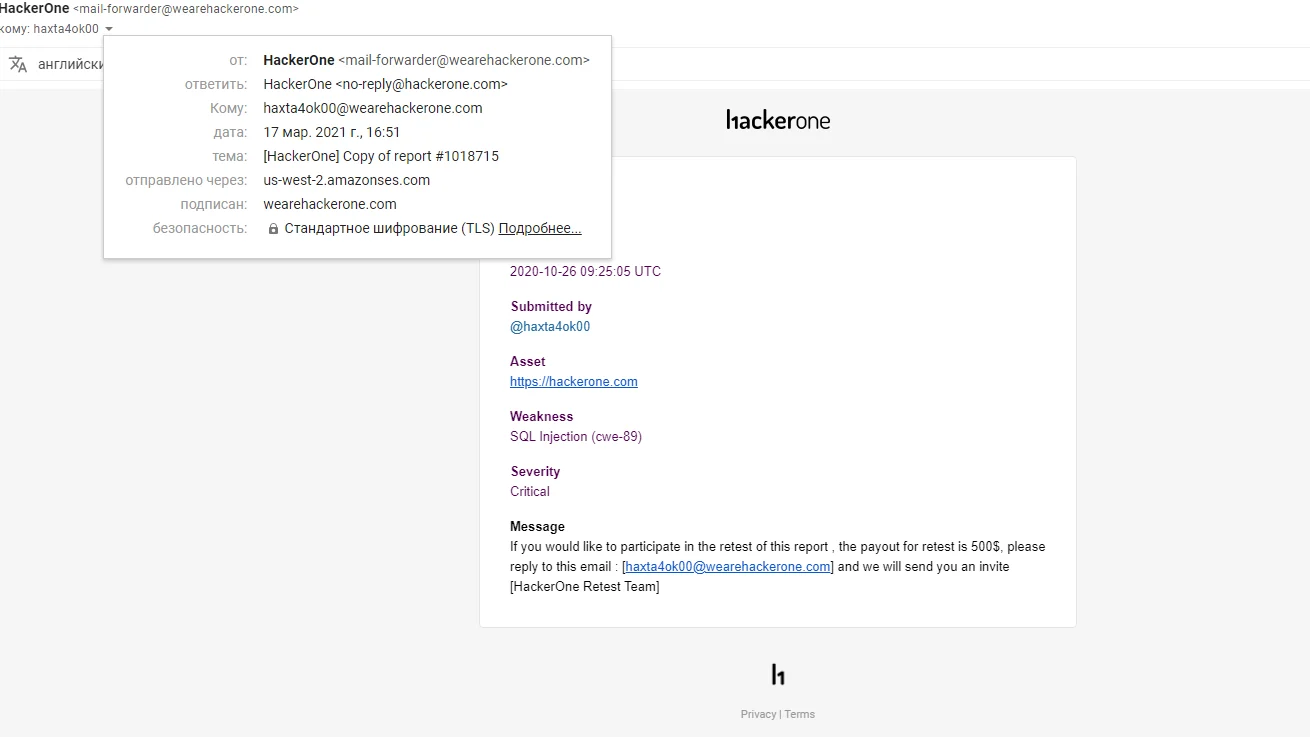
In our opinion, this letter looks very plausible, which may provoke a response to send a response from the original mail to @wearehackerone.com, thereby revealing he email. Because to pay the retest, you will need the original account
Recommendation:
Our team believes that it makes sense to add a warning to this email template, indicating that it was sent from the sandbox and may not be related to the data specified in it
Thanks!
Impact
The ability to get hackers ' email through social engineering
Not written yet. The AI write-up for this report has not been written yet. The Original tab links to the source.
How it worked
Root cause
Likely the email template for ShareReportViaEmail does not include a warning that the report is from a sandbox, so the email appears fully legitimate.
Impact
An attacker could obtain a hacker's email address through social engineering by sending a convincing email from a sandboxed report and receiving a reply.
What the attacker needed
Ability to create a sandboxed program; ability to send emails via ShareReportViaEmail
The fix
The email template should be updated to include a warning that the email was sent from a sandbox and may not be related to the data specified.
How it was found
- Create a sandboxed program.
- Create a fake asset, for example a well-known domain.
- Create a report on that asset with a critical severity.
- Send a GraphQL mutation to share the report via email, specifying the recipient and a message.
Explained by bugbounty.wiki with AI from the original and checked against quotes from it; it can still be wrong. Read the original before relying on a detail.
Not written yet. The AI write-up for this report has not been written yet. The Original tab links to the source.
A sandboxed program is a test environment on a bug bounty platform where reports are not real. The platform lets you send an email about a report, but it does not mark that the report is from a sandbox. So an attacker can send a fake but official-looking email to trick someone into replying, which reveals their email address.
What is Business logic?
The application works as coded but not as intended: a negative price, a skipped payment step, a limit that can be crossed.




