Submitted reports state logs leakage
The HackerOne profile endpoint returned the signal value as a high-precision float, which could be brute-forced to determine the exact counts of N/A and Informative reports for a researcher. This allowed an attacker to infer the full report history of researchers with fewer than about 30 submissions.

- Disclosed after 21 hours
Hi team,
Summary
The endpoint https://hackerone.com/<hacker> returns a JSON response containing some informations about the <hacker>, the parameter signal is returned as a high precision float number (up to 14 digits after the comma), the fractional part of this JSON parameter can be used to disclose some informations including the exact number of Resolved, Informative, and N/A reports submitted by the researcher as demonstrated in the following of the report.
Descpription
The signal is calculated server-side by applying (-5*N/A + 0*Informative + 7*Resolved) / (N/A+Informative+Resolved), self-closed reports and Duplicates are not included in signal calculations, I also ignored Spam reports because it's very rarely submitted by actif researchers. After the calculation is done, the signal value is returned as it is in https://hackerone.com/<hacker> even if only 2 digits after the comma is shown in the hacker profile, for instance, the following GET request to @fransrosen profile
curl -H 'X-Requested-With: XMLHTTPRequest' -H 'Accept: application/json' https://hackerone.com/fransrosen will give us ..."signal":6.47740667976424.
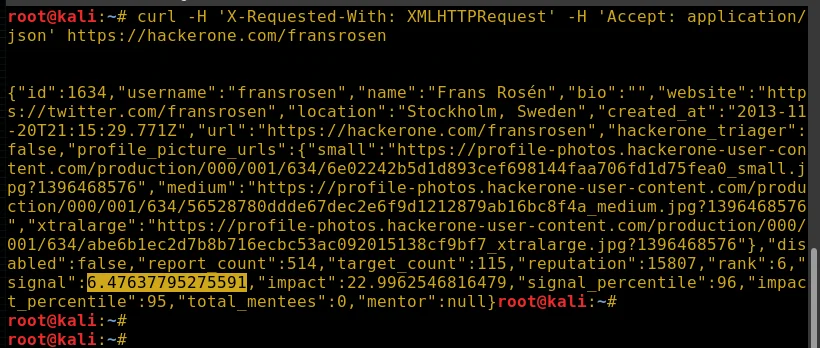
Keeping in mind that the number of Resolved reports are publicly disclosed in the report_count JSON parameter, it's enough to know Informative and N/A reports to have all the details about the hacker. To proceed, one should calculate x and y with signal = x*(-5)+y*(0)+report_count*7 / x+y+report_count, note that the signal is a high precision float number so the equation won't have more than solution, especially if we designate an estimation of the max number of submitted reports, and that's what I did in my exploit.
While this cannot not be accomplished mathematically (AFAIK), it can be easily done brue-force.
Exploitation
I wrote a small python program to exploit this issue, the script can be used with the syntax : python H1-signal.py <hacker> <max-reports>
with <hacker> is the hacker to attack, and <max-reports> is an estimation of the max number of reports submitted by him, the estimation can be made depending on the hacker profile, the script will make a call to https://hackerone.com/<hacker> then recover the necessary parameters, then start the brute-force process, if <hacker> has really submitted less than <max-reports> reports, we will get the exact number of every submitted report by state.
POC
Let's test on my own profile @██████
1- make an estimation of the max report number submitted by @███████, he has only 3 found bugs with 1.35 signal, so let's say 15 reports.
2- lunch python H1-signal.py ███████ 15
3- after a few moments we got :
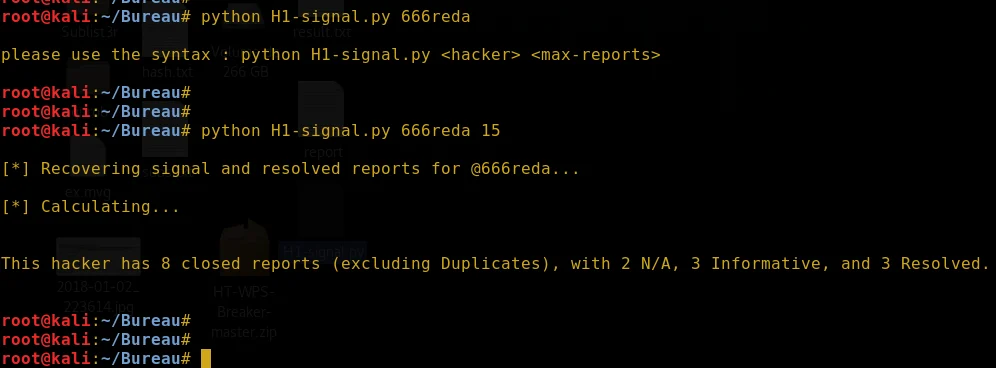
And that's my exact log, because 2 N/A, 3 Informatives and 3 Resolveds is the only combination which produce the signal 1.375
POC 2
Another test with ███████ and ████████ (sorry for this, please redact the names if you plan to publicly disclose the report, I already redacted them from the screenshot)
1- make an estimation of the max report number submitted the researchers.
2- lunch python H1-signal.py ███ 25 && python H1-signal.py █████ 20
3- after a few moments we got :
██████
these will be their submitted reports logs, because they are the only possibilities that can result the returned signal.
Testing Environment
Linux kali 4.9.0 with Python 2.7.13 and curl 7.55.1.
Impact
Information Disclosure via knowing the exact log of submitted reports with no user interation.
Limitations
It takes much time when it's about more that 30 reports, especially if we took into consideration Spam reports, so of course, not all hackers can be targeted by exploiting this bug. However, hundreds of H1 users has submitted less than 30 reports, and can be easily targeted, so I guess you still want to fix this, right ?
Mitigation
Do everything server-side and send back only the signal with 2 digits after the comma which will be directly displayed in the hacker profile, or include Duplicate reports in the signal calculation.
References
https://support.hackerone.com/hc/en-us/articles/207377903-What-are-Signal-and-Impact- https://support.hackerone.com/hc/en-us/articles/205624695-What-are-the-states-of-a-report-
Let me know if you have any additional questions, Regards.
Not written yet. The AI write-up for this report has not been written yet. The Original tab links to the source.
How it worked
Root cause
The server returned the full-precision signal value instead of rounding it to two decimal places, leaking enough information to brute-force the underlying report counts.
Impact
An attacker could disclose the exact number of N/A, Informative, and Resolved reports for researchers with fewer than about 30 submissions, without any user interaction.
What the attacker needed
Target has fewer than ~30 reports; no authentication required
The fix
The signal should be rounded to two decimal places server-side before being returned, or duplicate reports should be included in the calculation.
How it was found
- Estimate the maximum number of reports submitted by the target researcher.
- Run the provided Python script with the hacker's username and the maximum report estimate.
- The script fetches the profile JSON and brute-forces combinations of N/A and Informative counts that match the high-precision signal.
- The script outputs the exact counts of N/A, Informative, and Resolved reports.
Explained by bugbounty.wiki with AI from the original and checked against quotes from it; it can still be wrong. Read the original before relying on a detail.
Not written yet. The AI write-up for this report has not been written yet. The Original tab links to the source.
A website's profile page showed a reputation score with many decimal places. By trying different combinations of report counts, an attacker could work out exactly how many reports of each type a person had submitted, even though only a rounded score was meant to be visible.
What is Info disclosure?
Data the application should keep private (personal data, internal details, other users' records) reaches someone it should not.



