Total Paid Bounty Paid can be disclose
A new interface feature on HackerOne displays the total bounties sent by a program in the last 90 days, which could reveal a program's total paid amount even when the program has chosen not to disclose it. An attacker could monitor this value over time to estimate or exactly calculate the undisclosed total.

- Fixed in 6 months
- Paid in 6 months
- Disclosed after 6 months
Summary:
Hello HackerOne Bug Bounty Team,
I noticed that HackerOne recently updated their interface. Indeed, when a hacker hover his mouse over a program, it now disclose some new information :
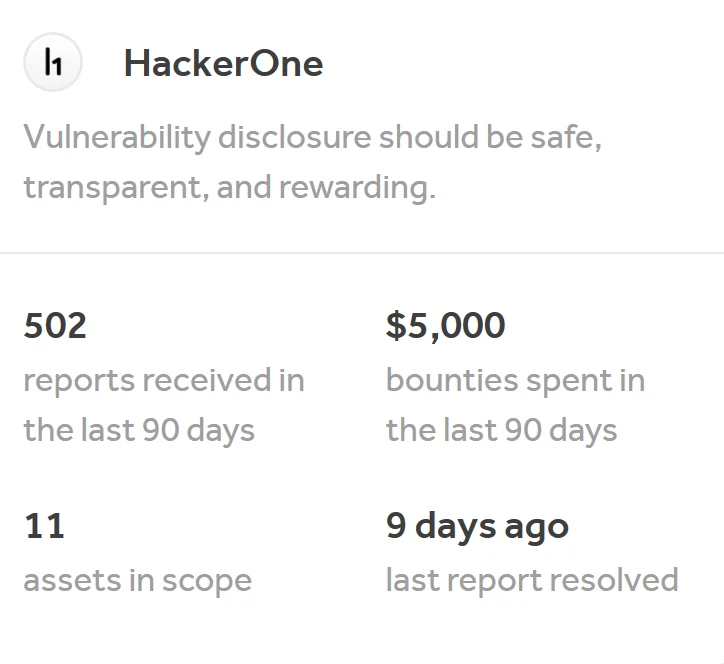
The one that interested us is "Bounties sent in the last 90 days" value
Description:
This new feature could potentially disclose some program information that the team isn't willing to share. Indeed, this can happen in some scenario :
1- The program is 90 days or younger and has choose to not disclose the total paid amount. 2- The program is not 90 days or younger, but an automated script is continually tracking "Bounties sent in the last 90 days" value (note that this would give an exact number since the tracking has started or a very approximate number) (inspired from report #148050)
Impact
Total Paid Bounty Paid can be disclose
What the report shows
The target is the HackerOne platform itself, whose interface had recently been updated. The researcher noticed that hovering the mouse over a program now reveals additional information. The screenshot below shows the updated interface with that hover information.
Among the newly surfaced values, the one that drew the researcher's attention was labelled "Bounties sent in the last 90 days". The concern is that this figure can reveal the total paid bounty for a program whose team has chosen not to disclose it.
The report describes two scenarios in which the disclosure matters:
- The program is 90 days old or younger and has chosen not to disclose the total paid amount. In that case the "last 90 days" figure covers the program's entire lifetime, so it equals the total paid.
- The program is older than 90 days, but an automated script continuously tracks the "Bounties sent in the last 90 days" value. By recording the value over time, the script can derive an exact number since tracking started, or a very approximate one. The researcher credits report #148050 as inspiration for this idea.
The report was filed against hackerone.com, rated low severity, classified as Information Disclosure, and paid a bounty of 500.00 USD. It was disclosed on 2020-02-28. The report does not describe a fix.
Root cause
The report does not state a root cause. The concern is that the new value can reveal a total the program chose not to disclose. The interface exposes an aggregate (bounties sent in a rolling 90-day window) that is a proxy for the undisclosed total, and for young programs it is the total. The mistake is one of data minimisation and authorisation of derived fields: the aggregate was treated as harmless metadata, but it carries the same sensitivity as the underlying figure.
Impact
As the report frames it, the impact is that the total paid bounty can be disclosed for programs that have chosen to keep it private. The researcher hedges: the second scenario gives an exact number since tracking started, or a very approximate number. There is no claim of access to individual bounty amounts, researcher identities or any other data. The severity assigned was low.
How this kind of bug works
Information disclosure through derived or aggregate values is common wherever a product adds convenience features on top of data with different visibility rules. A raw field such as "total paid" may be correctly gated, but a new field such as "paid in the last 90 days", "average response time", "number of reports resolved this month" or a count badge is often built from the same source without reapplying the gate. The leak is indirect: the new field is not the secret, but it is a function of the secret.
Two properties make these leaks exploitable. First, aggregation over a window shorter than the object's lifetime collapses to the object itself, as with a program younger than the window. Second, values that change over time can be sampled repeatedly; differencing successive samples reconstructs the underlying quantity even when each individual sample looks innocuous. Caching, tooltips, hover cards, public API responses, RSS feeds, sitemaps and search previews are all places where such derived fields appear because they are treated as presentation rather than data.
The defences are the same as for any access-controlled field: classify derived values by the sensitivity of their inputs, apply the same authorisation check to them, and avoid publishing aggregates over windows that can equal the whole dataset. Where an aggregate must be shown, coarsening it (buckets, ranges, rounding) or suppressing it below a threshold removes the reconstruction path.
How to test for it
- Identify fields whose visibility is configurable. On bug bounty platforms, that is the disclosed total paid, but the pattern generalises to any profile or listing with a privacy toggle.
- Enumerate every surface that renders data about the same object: the main page, hover cards and tooltips, JSON APIs behind the page, mobile endpoints, feeds, embeds and search results. Compare what each returns for an object whose owner has hidden the sensitive field.
- Look for derived values: rolling windows, averages, counts, percentages, rankings and "recent activity" figures. Ask what each is computed from and whether that input is meant to be private.
- Test the short-lifetime case. Find or create an object younger than the aggregation window and check whether the windowed value equals the hidden total.
- Test the sampling case. Record the derived value at intervals and check whether changes can be differenced to recover the hidden quantity, or whether a single sample already reveals it.
- A positive result is a hidden field whose value, or an exact reconstruction of it, appears on a surface the owner did not authorise. Capture the hidden state, the leaked value and the derivation in one reproducible sequence.
Common false positives: the value is already public elsewhere with the owner's consent; the aggregate is coarsened enough that the hidden total cannot be recovered; the figure is stale or cached from before the privacy setting changed; or the difference is within rounding and does not identify the true value.
How it is fixed
In general, the same authorisation check applied to the derived field would omit the figure when the program has not disclosed its totals. Where the value is kept, coarsen it into ranges or round it, and suppress it entirely when the aggregation window covers the object's whole lifetime. Caching layers and secondary endpoints must be updated together with the primary page, otherwise the value survives in an API response or a cached tooltip. A regression test that compares the rendered output for disclosed and undisclosed objects catches the next field added to the same card.
Hunting notes
This class hides in recently shipped UI: hover cards, badges, dashboards, "insights" panels and public statistics pages are frequent offenders because they are built quickly from existing data sources. Recon signals include changelogs and release notes announcing new profile features, new public API fields appearing in responses for objects with privacy settings, and front-end code that references aggregate endpoints. On any target with per-object privacy toggles, diff the API response for a hidden object against a visible one and look for fields that differ only in presentation.
What happened, in plain words
Each program has a public page, and that page shows some information about the program. Some of that information is optional. In particular, a program can choose whether to make public the total amount of money it has paid out in bounties.
The researcher noticed that HackerOne had recently changed its interface. When you move your mouse pointer over a program, extra information is revealed. The screenshot below shows the updated interface with that hover information.
One of the new values in that pop-up was labelled "Bounties sent in the last 90 days". The researcher's point is simple: even if a program has chosen to keep its total paid amount private, this new number can give that total away.
Why the new number matters
The report describes two situations where the figure leaks something the program wanted hidden.
- The program is 90 days old or younger and has chosen not to disclose the total paid amount. If a program has only existed for 90 days or less, then "bounties sent in the last 90 days" covers its entire life. The windowed figure and the lifetime total are the same number, so the hidden total is effectively published.
- The program is older than 90 days, but someone runs an automated script that keeps checking the "Bounties sent in the last 90 days" value. A script is just a program that visits a page or asks a server for data on a schedule, without a human clicking anything. By recording the value over time, the script can work out an exact number since tracking started, or a very approximate one. The researcher credits report #148050 as the inspiration for this idea.
A useful comparison: imagine a shop that refuses to tell you its yearly revenue, but puts a sign in the window saying "takings in the last 90 days". If the shop opened two months ago, the sign is the yearly figure. If the shop is older, you can still visit every week, note the sign each time, and add up the changes to reconstruct the total.
The report was filed against hackerone.com, rated low severity, classified as Information Disclosure, and paid a bounty of 500.00 USD. It was disclosed on 2020-02-28. The report does not describe a fix.
What probably caused it
The report does not state a cause. The concern is that the new value can reveal a total the program chose not to disclose. The interface shows an aggregate, meaning a summary number calculated from many individual payments rather than the payments themselves. That summary is a stand-in for the undisclosed total, and for young programs it is the total.
The mistake is about two ideas. Data minimisation means showing only the data that is needed and nothing more. Authorisation of derived fields means that a value calculated from protected data deserves the same protection as the data it came from. The aggregate was treated as harmless background information, but it carries the same sensitivity as the underlying figure.
Impact
As the report frames it, the impact is that the total paid bounty can be disclosed for programs that have chosen to keep it private. The researcher hedges: the second scenario gives an exact number since tracking started, or a very approximate number. There is no claim of access to individual bounty amounts, researcher identities or any other data. The severity assigned was low.
In general, how this kind of bug works
Information disclosure through derived or aggregate values is common wherever a product adds convenience features on top of data with different visibility rules. A raw field such as "total paid" may be correctly gated, meaning the server checks who is allowed to see it before sending it. But a new field such as "paid in the last 90 days", "average response time", "number of reports resolved this month" or a count badge is often built from the same source without reapplying the gate. The leak is indirect: the new field is not the secret, but it is calculated from the secret.
Two properties make these leaks exploitable. First, aggregation over a window shorter than the object's lifetime collapses to the object itself, as with a program younger than the window. Second, values that change over time can be sampled repeatedly; comparing successive samples reconstructs the underlying quantity even when each individual sample looks innocuous. Caching (storing a copy of a response so it can be served again quickly), tooltips, hover cards, public API responses, RSS feeds, sitemaps and search previews are all places where such derived fields appear, because they are treated as presentation rather than data.
The defences are the same as for any access-controlled field: classify derived values by the sensitivity of their inputs, apply the same authorisation check to them, and avoid publishing aggregates over windows that can equal the whole dataset. Where an aggregate must be shown, coarsening it (buckets, ranges, rounding) or suppressing it below a threshold removes the reconstruction path.
In general, how to test for it
- Identify fields whose visibility is configurable. On bug bounty platforms, that is the disclosed total paid, but the pattern generalises to any profile or listing with a privacy toggle.
- Enumerate every surface that renders data about the same object: the main page, hover cards and tooltips, JSON APIs behind the page, mobile endpoints, feeds, embeds and search results. Compare what each returns for an object whose owner has hidden the sensitive field.
- Look for derived values: rolling windows, averages, counts, percentages, rankings and "recent activity" figures. Ask what each is computed from and whether that input is meant to be private.
- Test the short-lifetime case. Find or create an object younger than the aggregation window and check whether the windowed value equals the hidden total.
- Test the sampling case. Record the derived value at intervals and check whether changes can be differenced to recover the hidden quantity, or whether a single sample already reveals it.
- A positive result is a hidden field whose value, or an exact reconstruction of it, appears on a surface the owner did not authorise. Capture the hidden state, the leaked value and the derivation in one reproducible sequence.
Common false positives: the value is already public elsewhere with the owner's consent; the aggregate is coarsened enough that the hidden total cannot be recovered; the figure is stale or cached from before the privacy setting changed; or the difference is within rounding and does not identify the true value.
In general, how it is fixed
In general, the same authorisation check applied to the derived field would omit the figure when the program has not disclosed its totals. Where the value is kept, coarsen it into ranges or round it, and suppress it entirely when the aggregation window covers the object's whole lifetime. Caching layers and secondary endpoints must be updated together with the primary page, otherwise the value survives in an API response or a cached tooltip. A regression test that compares the rendered output for disclosed and undisclosed objects catches the next field added to the same card.
In general, where to look while hunting
This class hides in recently shipped UI: hover cards, badges, dashboards, "insights" panels and public statistics pages are frequent offenders because they are built quickly from existing data sources. Recon signals include changelogs and release notes announcing new profile features, new public API fields appearing in responses for objects with privacy settings, and front-end code that references aggregate endpoints. On any target with per-object privacy toggles, diff the API response for a hidden object against a visible one and look for fields that differ only in presentation.
Glossary
- Bug bounty: a programme where an organisation pays people for reporting security flaws in its systems.
- Program: on HackerOne, a company's published bug bounty offer and its associated page.
- Hover card: a small pop-up box that appears when the mouse pointer rests over an element on a page.
- Tooltip: a short piece of text shown on hover or focus to explain an element.
- Interface: the part of a product a person sees and interacts with on screen.
- Information Disclosure: a vulnerability class where data meant to stay private becomes visible to someone not authorised to see it.
- Aggregate: a summary number calculated from many individual records, such as a total or an average.
- Derived field: a value calculated from other data rather than stored on its own.
- Data minimisation: the principle of showing or collecting only the data that is actually needed.
- Authorisation: the check that decides whether a given user is allowed to see or do something.
- Gated field: a piece of data that is only returned after an authorisation check passes.
- Rolling window: a fixed-length period, such as the last 90 days, that moves forward with time.
- Sampling: recording a value repeatedly over time to observe how it changes.
- Differencing: comparing successive samples to work out the underlying quantity from the changes between them.
- Caching: storing a copy of a response so it can be served again quickly without recalculating it.
- API: an interface that lets software request data from a server, usually in a structured format such as JSON.
- JSON: a text format for structured data, made of keys and values.
- Endpoint: a specific address or URL that a server responds to.
- RSS feed: a machine-readable list of recent items published by a site.
- Sitemap: a file listing a site's pages so search engines can find them.
- Coarsening: making a precise value less precise, for example by rounding it or grouping it into ranges.
- Threshold: a minimum size below which a value is not shown at all.
- False positive: a finding that looks like a vulnerability but is not one in practice.
- Regression test: an automated check that confirms a fixed bug stays fixed.
- Recon: the information-gathering phase before testing, where you look for clues about how a system is built.
- Severity: a rating of how serious a vulnerability is, often from low to critical.
- CVSS: a standard scoring system for the severity of vulnerabilities.



