[h1-2102] Improper Access Control at https://shopify.plus/[id]/users/api in operation UpdateOrganizationUserRole
A Shopify Plus admin could change the user identifier in a role-update request to point at a user in another organisation. The request failed, but an email was still sent to the admin containing that user's first name, last name and email address.

- Disclosed after 15 months
Summary:
There is an access control issue that happens when a Shopify Plus admin tries to assign a role to a user in another organisation. While the response shows an error message, an email is sent to the shop admin with the first name, last name and email address of the user.
Steps To Reproduce:
-
Log in to your Shopify Plus account https://shopify.plus/login
-
Go to
Administration->Users->Roles->Create rolethen proceed to create a role -
Go to
Administration->Users->All users->Add usersthen proceed to create a user -
In
Administration->Users->All users, click on the new user to go to the user page (ie. https://shopify.plus/34808573/users/34057938) -
In
Access and permissions, in theRolesection, click onChange accessthenChange role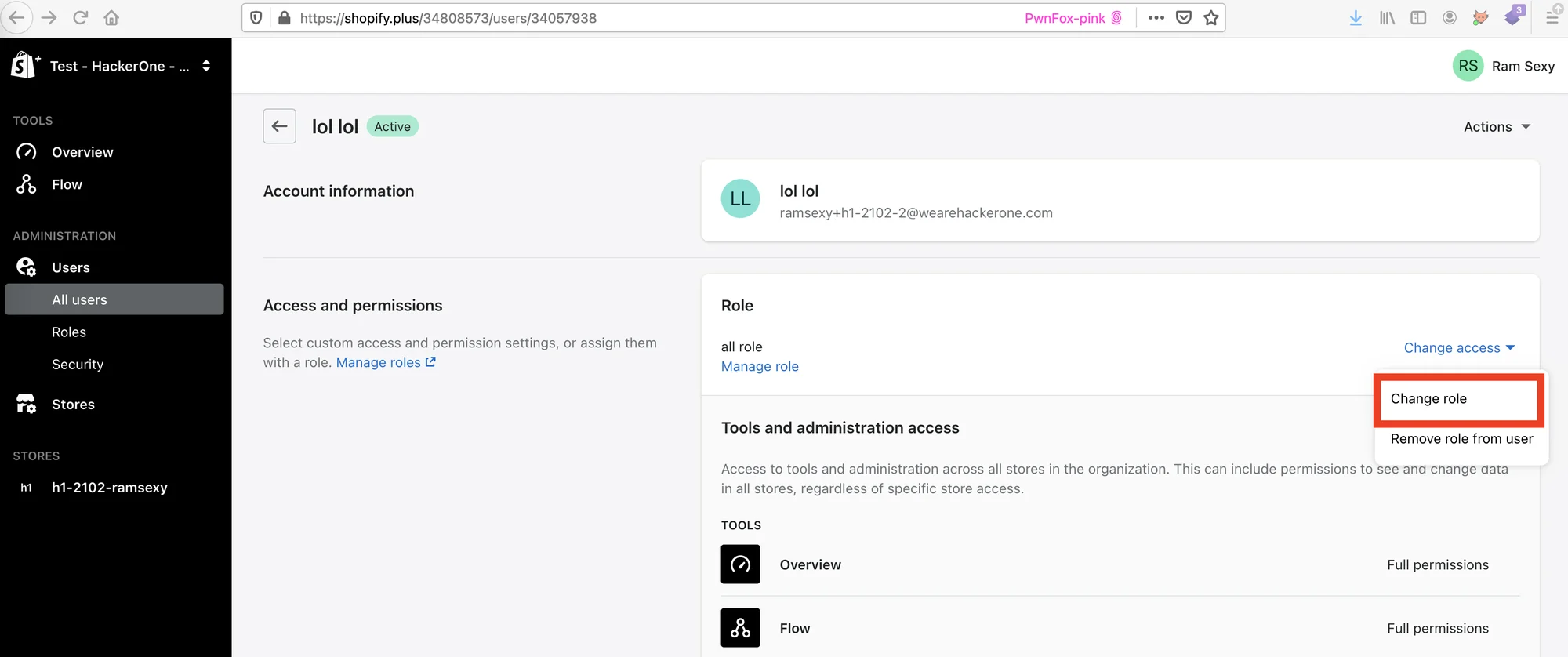
Screen_Shot_2021-01-22_at_10.48.38_AM.png From the original on HackerOne -
Change the role, and notice the following HTTP request :
HTTP
POST /34808573/users/api HTTP/1.1 Host: shopify.plus [...]
{"operationName":"UpdateOrganizationUserRole","variables":{"id":"Z2lkOi8vb3JnYW5pemF0aW9uL09yZ2FuaXphdGlvblVzZXIvMzQwNzE2MzI=","roleId":"Z2lkOi8vb3JnYW5pemF0aW9uL1JvbGUvNjYxAAA="},"query":"mutation UpdateOrganizationUserRole($id: OrganizationUserID!, $roleId: RoleID!) {\n updateOrganizationUserRole(id: $id, roleId: $roleId) {\n organizationUser {\n id\n status\n role {\n id\n name\n __typename\n }\n propertyAccess {\n shops {\n edges {\n node {\n shopUserId\n status\n __typename\n }\n __typename\n }\n __typename\n }\n apps {\n edges {\n node {\n status\n __typename\n }\n __typename\n }\n __typename\n }\n __typename\n }\n __typename\n }\n userErrors {\n field\n message\n __typename\n }\n message\n operationStatus\n __typename\n }\n}\n"}
8. Base64-decode the `id` value and change the user to `34071632` then send the request again
9. The request will fail, but you should receive an email containing Anatoly information (first name, last name and email address).
    {{media:1}}

## Impact

A Shopify Plus admin can retrieve PII from another user outside his organisation (first name, last name and email address).
Not written yet. The AI write-up for this report has not been written yet. The Original tab links to the source.
How it worked
Root cause
Likely the role-update operation looked up the target user by a global identifier without checking that the user belonged to the caller's organisation before sending a notification email.
Impact
A Shopify Plus admin could retrieve limited PII (first name, last name and email address) from a user outside their organisation, though the role change itself failed.
What the attacker needed
A Shopify Plus admin account; ability to create roles and users; a target user identifier from another org
How it was found
- Log in to the Shopify Plus account.
- Create a role under Administration, Users, Roles.
- Add a user under Administration, Users, All users.
- Open the new user's page and use Change access, then Change role.
- Capture the role-update request and swap the user identifier for one from another organisation.
- Send the request; it fails but an email with the other user's details arrives.
Explained by bugbounty.wiki with AI from the original and checked against quotes from it; it can still be wrong. Read the original before relying on a detail.
Not written yet. The AI write-up for this report has not been written yet. The Original tab links to the source.
Shopify Plus is a paid plan for large shops, and admins can give staff roles. When an admin tried to change a role for a user in another organisation, the request failed but a notification email about that user was still sent, leaking their name and email address.
What is IDOR?
One user can read or change another user's data, usually by changing an identifier the server trusts without checking who is asking. One of the most paid bug classes on web programs.





