Reflected XSS online-store-git.shopifycloud.com
 Originally disclosed on HackerOne
- Triaged in 22 hours
- Fixed in 7 days
- Paid in 12 days
- Disclosed after 56 days
Summary:
Hello, I hope you are having a good day!,
There is a feature called "Shopify Github Integration", it helps to associate a GitHub account to a Shopify store. In the Github connection proccess there is a URL https://online-store-git.shopifycloud.com which is vulnerable to XXS reflected.
Shops Used to Test:
- devpresent.myshopify.com
Relevant Request IDs:
- x-request-id: 1cdb077b2d319acccd1237c1142cf89b
Steps To Reproduce:
- Visit the next URL
https://online-store-git.shopifycloud.com/github/setup?installation_id=20913869%7d%7d%7d%29%3b%7d%3balert%281337%29%3bif%281==2%29%7bk=new%20Promise%28function%28%29%7bif%281==2%29%7bv=%7be:%201&setup_action=install
2. Enter an owner or staff credentials.
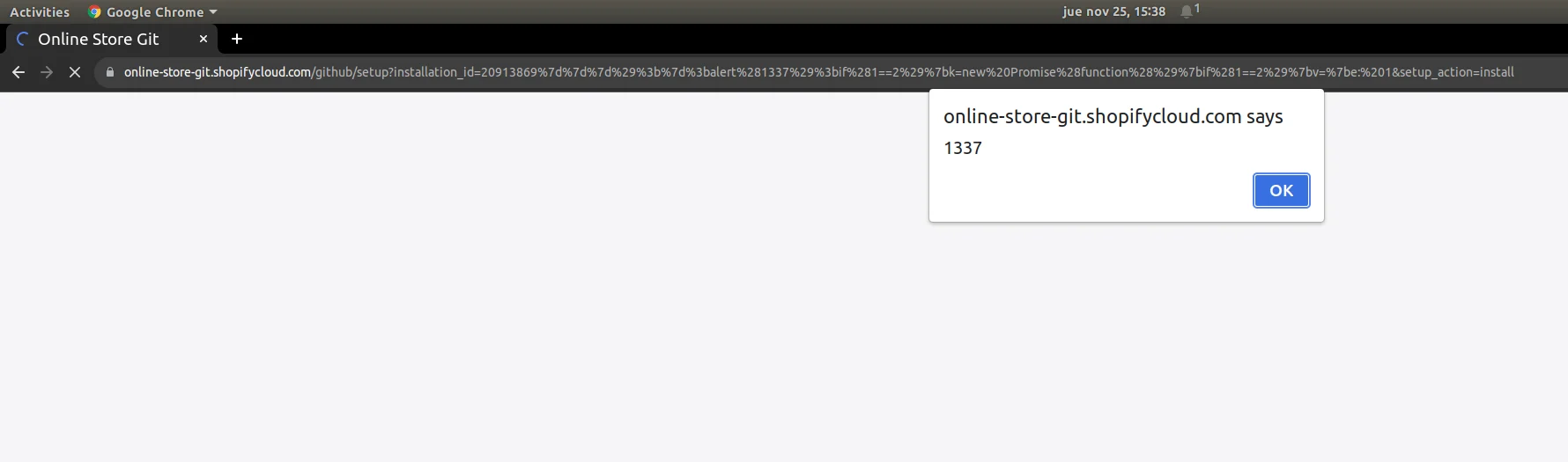
3. The XSS will fire.
Supporting Material:
- xss.png
- poc.mp4
Impact
There are several impacts.
- The attacker could use Javascript in order to do phishing attacks.
- Steal data.
- Reflected JS
May you be well, -Misa
Attachments
Context
Shopify offers a feature called "Shopify Github Integration" that associates a GitHub account with a Shopify store. As part of the GitHub connection process, the store owner is sent to a URL on online-store-git.shopifycloud.com. The report focuses on the /github/setup endpoint of that host, which takes an installation_id and a setup_action as query parameters during the install flow.
The report states that the URL is vulnerable to reflected cross-site scripting (XSS). The report is filed against the wildcard asset *.shopifycloud.com, rated medium severity with a CVSS score of 4.8, and was disclosed on 20 January 2022 with a bounty of 3,500 USD.
Setup
- A Shopify store was used for testing:
devpresent.myshopify.com. - The flow requires an owner or staff account: step 2 of the reproduction is to enter owner or staff credentials, so the payload is triggered in an authenticated context.
- No specific browser, tooling or version is named in the report.
- The relevant request was tagged with the request ID
x-request-id: [redacted].
Finding it
The GitHub connection process links a GitHub account to a Shopify store, and the hand-off happens on online-store-git.shopifycloud.com. The /github/setup endpoint takes an installation_id from the query string. Supplying a crafted installation_id therefore places attacker-controlled content into the page.
Exploitation
Step 1: Visit the crafted setup URL
The researcher supplied a URL whose installation_id parameter contains a URL-encoded JavaScript payload, together with setup_action=install:
https://online-store-git.shopifycloud.com/github/setup?installation_id=20913869%7d%7d%7d%29%3b%7d%3balert%281337%29%3bif%281==2%29%7bk=new%20Promise%28function%28%29%7bif%281==2%29%7bv=%7be:%201&setup_action=install
Decoding the installation_id value shows what is being injected:
The setup_action=install parameter is kept so the request matches the normal install flow.
Step 2: Authenticate
Enter owner or staff credentials when prompted. The report does not describe the login page or the exact redirect chain; it only states that owner or staff credentials are required at this point.
Step 3: The XSS fires
The injected alert(1337) executes in the context of online-store-git.shopifycloud.com. The report includes a screenshot and a screen recording of the proof of concept.
Root cause
The report states the URL is vulnerable to reflected XSS. Because the value is placed directly into executable script rather than encoded for that context, the injected statements run.
The report does not describe any validation, output encoding or Content Security Policy.
Impact
The researcher lists three impacts:
- Using JavaScript for phishing attacks.
- Stealing data.
- Reflected JavaScript execution.
The report says owner or staff credentials are entered before the XSS fires. The report does not go into which cookies or data are reachable from that origin.
Fix
Variants to test
Hunting notes
The report includes a screenshot and a recording of the proof of concept.
What happened, in plain words
Shopify is a platform that lets people run online shops. One of its features is called "Shopify Github Integration": it lets a shop owner connect their GitHub account (GitHub is a website where programmers keep and share code) to their Shopify store. To do that, the owner is sent to a separate web address, online-store-git.shopifycloud.com, where the connection is set up.
A security researcher looked at that setup page and found a problem. The page is vulnerable to reflected cross-site scripting. If that value is ordinary text, nothing bad happens. But if the value is written in a way the browser understands as a small program (JavaScript), the browser will run it. This kind of flaw is called reflected cross-site scripting, or reflected XSS: "reflected" because the value bounces straight back from the address into the page, and "scripting" because the attacker gets to run code in the victim's browser.
The researcher supplied a special link containing a small program; after entering owner or staff credentials, the XSS fires. The report was rated medium severity with a CVSS score of 4.8 (CVSS is a standard 0 to 10 scale for how serious a flaw is), disclosed on 20 January 2022, and paid a bounty of 3,500 USD.
The feature and the page involved
That finishing page lives on online-store-git.shopifycloud.com, a host separate from the main Shopify site.
The page the researcher focused on is the /github/setup endpoint. An endpoint is simply a specific address on a server that does one job, like a counter in a shop that only handles one kind of request. This endpoint accepts two pieces of information in the address, called query parameters (the name=value pairs after the ?):
installation_id, a number that identifies the GitHub installation being connected.setup_action, which says what action is being performed, hereinstall.
The report states the URL is vulnerable to reflected XSS. The report is filed against the wildcard asset *.shopifycloud.com, meaning any host under that domain.
Setting up the test
- The researcher used a Shopify store called
devpresent.myshopify.comfor testing. - The flow needs an owner or staff account: step 2 of the reproduction is to enter owner or staff credentials, so the payload fires while someone is logged in.
- The report does not name a browser, tool or version.
- The relevant request carried the request ID
x-request-id: [redacted]. A request ID is a label the server attaches to a single request so it can be found later in logs, like a ticket number.
Finding it
It is a feature that links an outside account to a Shopify store, and the hand-off happens on a separate host, online-store-git.shopifycloud.com. The /github/setup endpoint takes installation_id from the address. So a crafted installation_id puts content chosen by the attacker into the page.
Exploitation
Step 1: Visit the crafted setup URL
The researcher built a URL whose installation_id contains a JavaScript payload, encoded so it can travel safely inside an address, together with setup_action=install:
https://online-store-git.shopifycloud.com/github/setup?installation_id=20913869%7d%7d%7d%29%3b%7d%3balert%281337%29%3bif%281==2%29%7bk=new%20Promise%28function%28%29%7bif%281==2%29%7bv=%7be:%201&setup_action=install
What this line means, piece by piece:
https://online-store-git.shopifycloud.comis the host where the setup page lives./github/setupis the endpoint that finishes the GitHub connection.?starts the list of query parameters.installation_id=20913869%7d%7d%7d%29%3b%7d%3balert%281337%29%3bif%281==2%29%7bk=new%20Promise%28function%28%29%7bif%281==2%29%7bv=%7be:%201is the value forinstallation_id. The%7d,%29,%3band similar groups are percent-encoding: a way of writing characters that are awkward inside a web address, such as},)and;, as a percent sign plus two characters. The browser decodes them back to the real characters before the page sees them.&separates the first parameter from the next one.setup_action=installtells the page this is the normal install action, so the request looks like the real flow.
Decoding the installation_id value shows what is actually being injected:
Reading this decoded value in plain words:
The setup_action=install parameter is kept so the request matches the normal install flow.
Step 2: Authenticate
Enter owner or staff credentials when prompted. The report does not describe the login page or the exact redirect chain; it only says that owner or staff credentials are required at this point.
Step 3: The XSS fires
The injected alert(1337) runs in the context of online-store-git.shopifycloud.com. The report includes a screenshot and a screen recording of the proof of concept.
Root cause
A JavaScript context means the value lands inside a block of code the browser will execute, not inside ordinary text. Because the value is placed directly into executable script rather than encoded for that context, the injected statements run.
Impact
The researcher lists three impacts:
- Using JavaScript for phishing attacks. Phishing is tricking someone into handing over information, for example by showing them a fake login box; running code on the real site makes such a fake look more convincing.
- Stealing data.
- Reflected JavaScript execution.
The report says owner or staff credentials are entered before the XSS fires. A session is the period a site remembers you as logged in, usually via a cookie, a small piece of data the browser stores and sends back with each request. The report does not go into which cookies or data are reachable from that origin.
Fix
Variants to test
Hunting notes
The report includes a screenshot and a recording of the proof of concept.
Glossary
- Shopify: a platform for running online shops.
- GitHub: a website where programmers store and share code.
- Shopify Github Integration: a Shopify feature that links a GitHub account to a Shopify store.
- Host: a named server on the internet, such as
online-store-git.shopifycloud.com. - Endpoint: a specific address on a server that performs one job.
- Query parameter: a
name=valuepair after the?in a web address. installation_id: the query parameter that identifies the GitHub installation being connected.setup_action: the query parameter that says which action the setup page should perform, hereinstall.- Reflected XSS: cross-site scripting where a value from the request is echoed back into the page and runs as code in the victim's browser.
- Cross-site scripting (XSS): a flaw that lets an attacker run their own code in another user's browser on a trusted site.
- JavaScript: the programming language browsers run to make pages interactive.
- Payload: the piece of code an attacker wants the victim's browser to run.
- Percent-encoding: writing awkward characters in a web address as a percent sign plus two characters, such as
%7dfor}. alert(): a browser function that shows a pop-up box; often used as visible proof that code ran.- JavaScript context: a place in a page where the browser treats content as executable code rather than text.
- Output encoding: converting a value so it is safe for the place it is inserted into, for example so it is shown as text rather than run as code.
- Validation: checking that a value has the expected form, for example that an ID is only digits.
- Content Security Policy (CSP): a rule a site sends to the browser listing which scripts may run.
- CVSS: a standard 0 to 10 scale for rating the severity of a flaw.
- Bounty: money paid by a company for a valid security report.
- Request ID: a label attached to a single request so it can be found in logs later.
- Session: the period a site remembers you as logged in.
- Cookie: a small piece of data the browser stores and sends back to a site, often used to keep you logged in.
- OAuth: a common way for one website to ask another for permission to connect accounts.
- Recon: the early stage of exploring a target to map what exists.
- Phishing: tricking someone into handing over information, for example with a fake login box.
- Wildcard asset: a scope covering every host under a domain, such as
*.shopifycloud.com.




