StoreFront API allows for a brute force attack on customer login by not timing out ALL attempts
The Storefront API's login throttle only counted failed password attempts, so an attacker could keep guessing passwords indefinitely and a correct guess would still succeed. This allowed brute force attacks that could give access to a customer's account, contact information and order history.

- Triaged in under an hour
- Fixed in 3 days
- Paid in 3 days
- Disclosed after 3 days
Summary by the program
@clew noticed that the customerAccessTokenCreate mutation in the Storefront API did not correctly throttle login attempts. The throttle failed to prevent brute force attacks because its counter was only checked & incremented when an invalid password was submitted. We've corrected the problem by applying the throttle to all login attempts, whether the password is valid or invalid.
The report
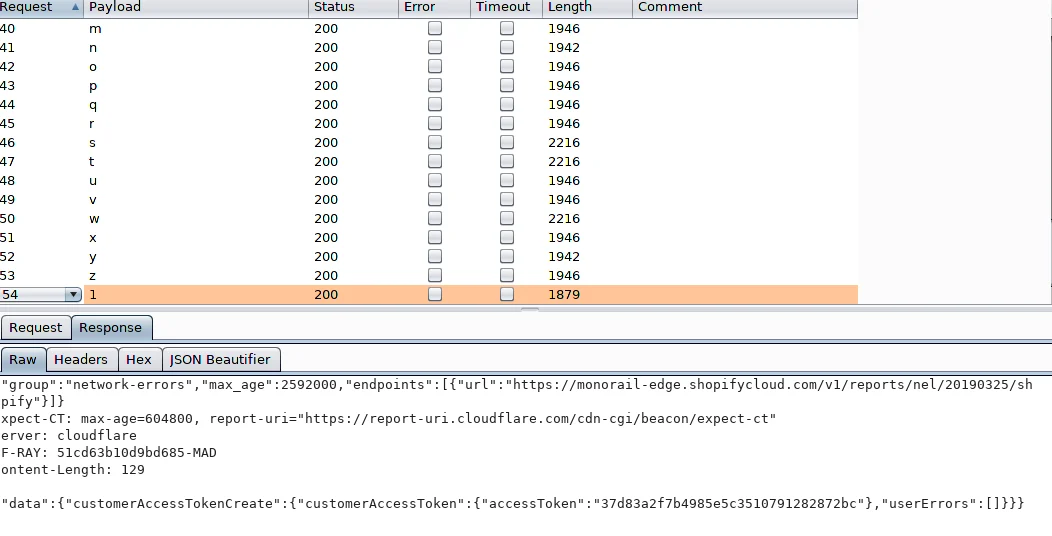
It seems that the service used for login purposes could be brute forced. the system fails when the password is incorrect, after some unsuccessful attempts the following message is shown:
{"data":{"customerAccessTokenCreate":null},"errors":[{"message":"Login attempt limit exceeded. Please try again later.","locations":[{"line":1,"column":10}],"path":["customerAccessTokenCreate"]}]}
However, it still possible to continue brute forcing and if you try with the real password it will work again. So in our case, we have been able to perform brute force attack.
We feel Shopify should enforce the "limit exceeded" error for BOTH valid and invalid passwords.
Impact
If the brute force attack succeeds, the attacker will then gain access to that user's shopify account, including contact information and order history.
Attachments
Not written yet. The AI write-up for this report has not been written yet. The Original tab links to the source.
How it worked
Root cause
The rate limit was only applied to invalid password attempts, so valid attempts bypassed the counter entirely.
Impact
An attacker could brute force customer credentials and, on success, gain access to that user's account including contact information and order history.
What the attacker needed
Access to the Storefront API
The fix
The throttle was fixed by applying it to all login attempts, whether the password is valid or invalid.
How it was found
- Submit login attempts with wrong passwords until the limit-exceeded error appears.
- Continue submitting login attempts despite the error.
- Submit the correct password and observe that login still succeeds.
Explained by bugbounty.wiki with AI from the original and checked against quotes from it; it can still be wrong. Read the original before relying on a detail.
Not written yet. The AI write-up for this report has not been written yet. The Original tab links to the source.
A login form usually slows you down after a few wrong passwords to stop someone guessing thousands of combinations. Here the service only counted wrong guesses, so a correct guess was never blocked and an attacker could keep trying until one worked. That is called a brute force attack: trying many passwords until you get in.
What is Business logic?
The application works as coded but not as intended: a negative price, a skipped payment step, a limit that can be crossed.




