Race Condition in account survey
A race condition in the account creation survey allowed a user to submit the survey multiple times concurrently and receive the associated credit more than once. An attacker could exploit this to obtain extra Slack credits.

- Triaged in 4 days
- Fixed in 13 months
- Paid in 13 months
- Disclosed after 14 months
Summary by the program
@cablej found a race condition in our account creation survey, which allowed a user to receive extra Slack credits. We investigated and fixed the issue. Thanks for the report @cablej!
The report
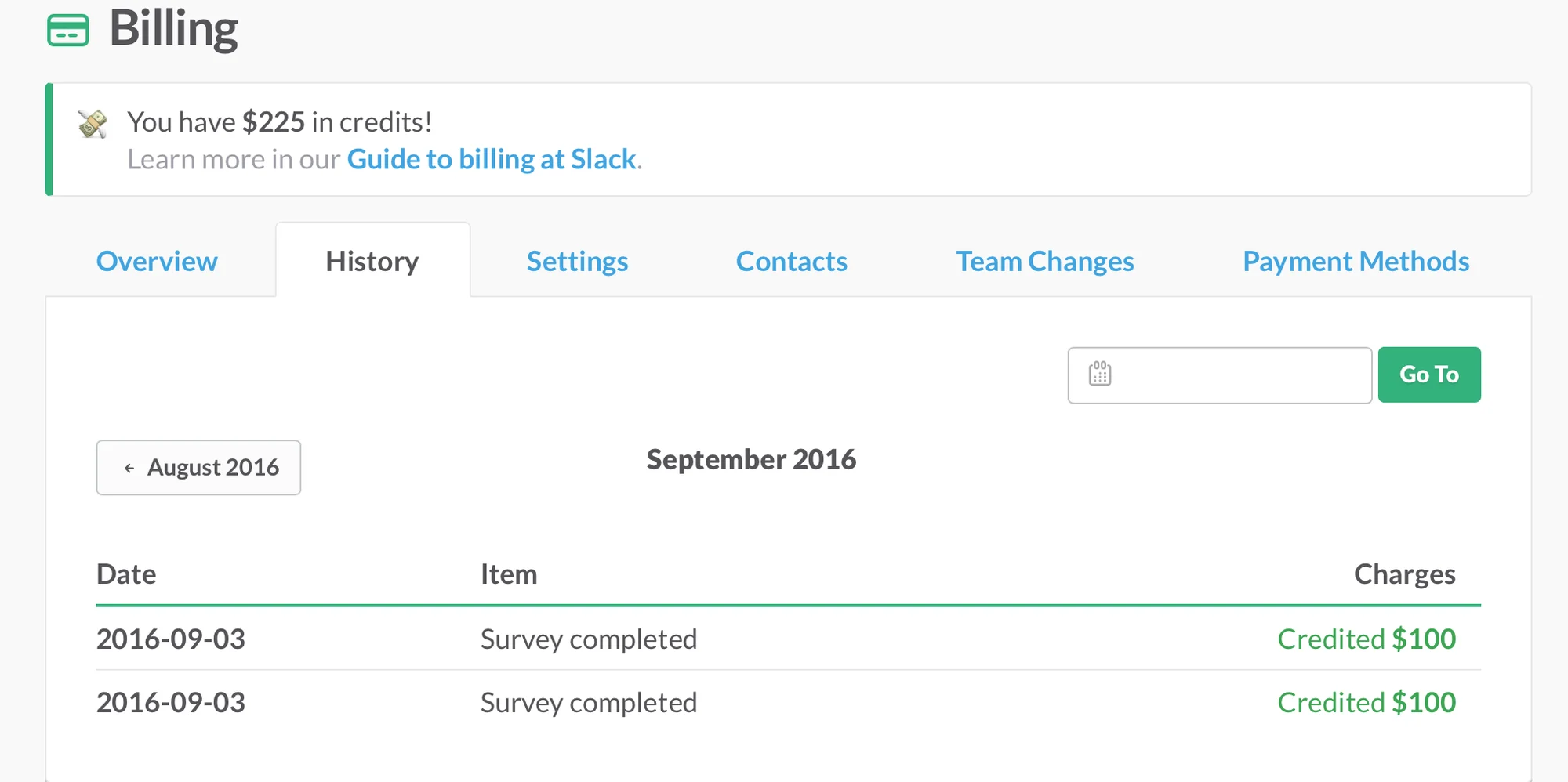
There exists a race condition in the beginning survey, allowing a user to get $100 in credit multiple times. In my example, I made 2 asynchronous requests, and was credited with $200.
POC:
- Create a new slack team.
- Set your password, and find the account creation survey.
- Complete the survey, and intercept the request using a proxy such as BurpSuite.
- Repeat the request asynchronously, such as in the command line by executing
(command) & (command). - The survey will be credited to your account multiple times. See the attached screenshot.
Please let me know if you need any more information.
Attachments
What the report shows
The target is Slack's account creation survey, the short questionnaire a user completes after creating a new team. The researcher, cablej, found that the survey reward could be claimed more than once by sending the same completion request concurrently. In the example given, two asynchronous requests produced $200 of credit instead of the intended $100.
The reproduction steps are short and are reproduced here as written:
- Create a new slack team.
- Set your password, and find the account creation survey.
- Complete the survey, and intercept the request using a proxy such as BurpSuite.
- Repeat the request asynchronously, such as in the command line by executing
(command) & (command). - The survey will be credited to your account multiple times. See the attached screenshot.
The only command in the report is the shell idiom for firing two copies of the same request in parallel:
(command) & (command)
Here (command) stands for whatever tool the researcher used to replay the intercepted survey request; the report does not give the full request, the endpoint, the parameters or the headers. The screenshot is offered as evidence of the duplicated credit.
The screenshot, titled Screen_Shot_2016-09-03_at_3.44.02_PM.png, is attached to show the survey being credited to the account multiple times.
Slack's summary confirms the finding: a race condition in the account creation survey allowed a user to receive extra Slack credits. The team investigated and fixed the issue. The report does not state a bounty amount, a severity rating or a CVSS score.
Root cause
The likely cause is a check-then-act pattern on the server. The survey completion handler probably reads whether the reward has already been granted, then writes the credit, without making that read and write atomic. Two requests that arrive close together both see the reward as unclaimed and both proceed to grant it.
Impact
The impact is extra credit granted to the account: credit meant to be granted once can be multiplied by replaying the request in parallel. The researcher demonstrated a doubling to $200 with two asynchronous requests. The report does not discuss whether the credit could be transferred, spent on paid plans or otherwise converted, so the wider consequences are not established here.
How this kind of bug works
A race condition appears when the correctness of an operation depends on the timing of concurrent requests. The classic form is a non-atomic check-then-act sequence: the application verifies a precondition (has this reward been claimed, is this coupon still valid, is this balance sufficient), and then performs the state change, with a window in between. If two requests interleave inside that window, both pass the check.
Single-use actions are the natural habitat: signup bonuses, referral credits, coupon redemption, gift card activation, voting, withdrawal limits and one-time tokens. The bug is easy to miss in testing because a sequential replay is correctly rejected; only overlapping requests expose it. Defences fall into two groups: making the operation atomic (a conditional database update, a unique constraint, a row lock, or an atomic increment that fails when the precondition no longer holds), and serialising access to the resource (per-account locks or idempotency keys tied to the specific action).
How to test for it
- Identify state-changing endpoints where the application enforces a once-only rule: reward claims, coupon use, referral crediting, vote submission, password reset token consumption, balance transfers.
- Capture a legitimate request in a proxy and note every parameter that identifies the user, the action and any token.
- Replay it sequentially first. If the second request is rejected, the rule exists; the question is whether it is enforced atomically.
- Send many copies simultaneously. Tools that support parallel requests, or a shell loop that backgrounds each invocation, work; the point is to have the requests in flight at the same moment rather than one after another.
- Compare the resulting state (balance, credit, claim count) with the number of successful responses. A positive result is more than one effective application of the action from a set of concurrent requests.
- Vary the timing and the count. Small windows may need many attempts or requests spread across several connections; some bugs only appear when requests hit different backend workers.
Common false positives: the application returns success to every request but only applies the change once (check the state, not the response); the duplicate is blocked by a unique constraint and the error is merely cosmetic; or the effect is idempotent by design, so repeated requests are harmless. Also confirm that the duplicated value is real and usable, not a display artefact.
How it is fixed
The standard fixes are:
- Perform the check and the state change in one atomic database operation, for example a conditional update that only succeeds while the claim flag is unset, or an insert protected by a unique constraint.
- Lock the relevant row or take a per-account lock for the duration of the operation.
- Accept an idempotency key per action so that repeated submissions collapse into one.
- Record each grant with a unique reference so duplicates are rejected at write time.
Hunting notes
Race conditions cluster around anything with monetary or quota value attached to a single action: onboarding rewards, promotional credits, invite bonuses, trial extensions, coupon and gift card redemption, withdrawal and transfer limits, and one-time verification steps. Recon signals include features that grant value automatically after a user action, endpoints whose names suggest claim, redeem, apply or complete, and any flow where the client is trusted to submit a completion request once.
Keep the reproduction minimal and repeatable so the triager can confirm it quickly, and note any limits on how the duplicated value can be used, since that determines how the program will rate the impact.
What happened, in plain words
Slack is a chat product for teams. When someone creates a new team, Slack shows a short questionnaire, called the account creation survey, and rewards the person who completes it with credit. Credit here is value added to the account by completing the survey.
The researcher, cablej, noticed that this reward could be collected more than once. The trick was not to fill in the survey twice, but to send the same "survey completed" message to Slack twice at almost the same instant. In the example, two requests sent in parallel produced $200 of credit instead of the intended $100.
To understand why that works, you need two ideas. A request is the message your browser sends to a website's server when you click a button or submit a form; the server reads it and sends back a response. A race condition is a bug where the result depends on timing: two things happening at once slip past a rule that works fine when they happen one after the other. A simple comparison is a shop with one last item in stock. If two cashiers each check the shelf at the same moment, both see the item and both sell it, because neither check happened after the other sale.
Slack's own summary confirms the finding: a race condition in the account creation survey allowed a user to receive extra Slack credits, and the team investigated and fixed it.
The reproduction steps
The researcher gave five steps, reproduced here exactly as written:
- Create a new slack team.
- Set your password, and find the account creation survey.
- Complete the survey, and intercept the request using a proxy such as BurpSuite.
- Repeat the request asynchronously, such as in the command line by executing
(command) & (command). - The survey will be credited to your account multiple times. See the attached screenshot.
Step by step, and why each one matters:
- Create a new team. The steps begin by creating a new team, which is the setup. This is the setup.
- Set your password and find the survey. This gets you to the feature under test, the questionnaire that grants the credit.
- Complete the survey and intercept the request. A proxy is a tool that sits between your browser and the server and lets you pause, read and edit the traffic. BurpSuite is one such tool. Intercepting matters because you want to capture the exact message that tells Slack "the survey is done, pay out", so you can send it again yourself.
- Repeat the request asynchronously. This is the heart of the bug. Sending copies at the same moment is what defeats the check.
- The credit is applied multiple times. That is the observable result: the account ends up with more credit than the one reward it should have received.
The only command in the report is the shell idiom for launching two copies of the same thing at once:
(command) & (command)
In a Unix-style command line, the & at the end of a command means "run this in the background and move on immediately". So (command) & (command) starts the first copy in the background and then starts the second copy straight away, without waiting for the first to finish. The two are in flight together, which is exactly the overlap needed. (command) is a placeholder for whatever tool the researcher used to resend the captured survey request; the report does not give the full request, the address it was sent to, the parameters or the headers.
The attached screenshot, Screen_Shot_2016-09-03_at_3.44.02_PM.png, is offered as evidence that the survey was credited to the account multiple times.
The report does not state a bounty amount, a severity rating or a CVSS score.
In general, how this kind of bug works
A race condition appears when an operation's correctness depends on the order and timing of requests that arrive together. The usual shape is called check-then-act: the server first checks a condition (has this reward been claimed? is this coupon still valid? is there enough balance?), and then performs the change, with a small gap between the two. If two requests arrive inside that gap, both pass the check before either has recorded its result, and both go ahead.
Actions meant to happen only once are where these bugs live: signup bonuses, referral credits, coupon redemption, gift card activation, voting, withdrawal limits and one-time links. They are easy to miss in ordinary testing because sending the request a second time, after the first has finished, is correctly rejected. Only overlapping requests expose the flaw.
Defences come in two families. The first makes the check and the change a single indivisible step, for example a database update that only succeeds while the claim flag is still unset, a uniqueness rule that rejects a second identical record, or a lock on the relevant row. The second makes repeats harmless, for example by accepting an idempotency key, a unique label attached to one action so that repeated submissions are treated as the same action and collapsed into one.
If you ever test for this yourself, the shape of the work is:
- Find actions with a once-only rule: reward claims, coupon use, referral credit, vote submission, password reset links, balance transfers.
- Capture a genuine request in a proxy and note which values identify the user, the action and any token.
- Replay it once, sequentially. If the second attempt is refused, the rule exists; the open question is whether it is enforced atomically.
- Send many copies at the same moment, using a tool that supports parallel requests or a shell loop that backgrounds each one.
- Compare the resulting state (balance, credit, number of claims) with how many requests appeared to succeed. A real finding means the action took effect more than once.
- Vary the timing and the number of copies, since some bugs only appear when requests land on different backend servers.
Watch for false positives: a site may answer "success" to every request while only applying the change once, so check the actual state rather than the reply; a duplicate may be blocked by a uniqueness rule with a harmless error message; or the action may be safe to repeat by design. Also confirm the extra value is real and usable, not just a number on the screen.
Glossary
- Request: the message a browser or tool sends to a server asking it to do something, such as submit a form.
- Response: the server's reply to a request.
- Server: the computer that runs a website and processes requests from users.
- Proxy: a tool placed between browser and server that can pause, inspect and resend traffic; BurpSuite is one.
- Intercept: to capture a request in a proxy so it can be examined or replayed.
- Race condition: a bug where the outcome depends on the timing of events happening at once.
- Asynchronous: started without waiting for the previous action to finish, so several run at the same time.
- Check-then-act: a pattern where a condition is checked and then acted on, leaving a gap between the two.
- Atomic: done as a single indivisible step, so nothing can slip in between.
- Idempotency key: a unique label attached to an action so repeated submissions are treated as one.
- Credit: money-like value on an account that can be spent on paid features.
- Endpoint: the specific address on a server that a request is sent to.
- Parameter: a named value sent with a request, such as a user identifier or a token.
- Header: extra information attached to a request or response, such as the type of content.
- Token: a value used to prove identity or authorise an action.
- CVSS: a standard scoring system for rating the severity of a security flaw.
- Bounty: a payment made by a company to a researcher who reports a valid security bug.






