XSS vulnerable parameter in a location hash
A parameter in the URL fragment (cvo_sid1) was passed unsanitised to a third-party script, allowing an attacker to inject extra parameters that produced malformed JavaScript and executed arbitrary code. An attacker could steal cookies and potentially take over a victim's account by luring them to a crafted link.
 Originally disclosed on HackerOne
- Disclosed after 3.3 years
Hi!
There is a vulnerability on your pages, using convertro.
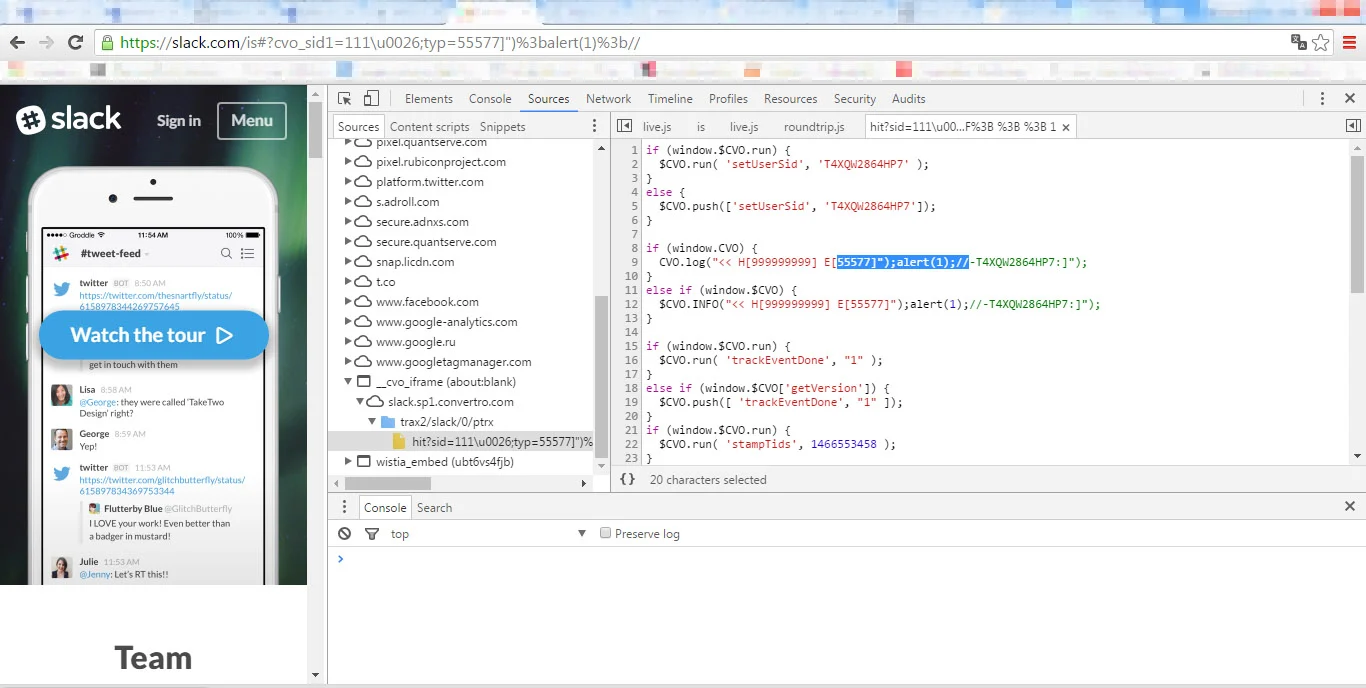
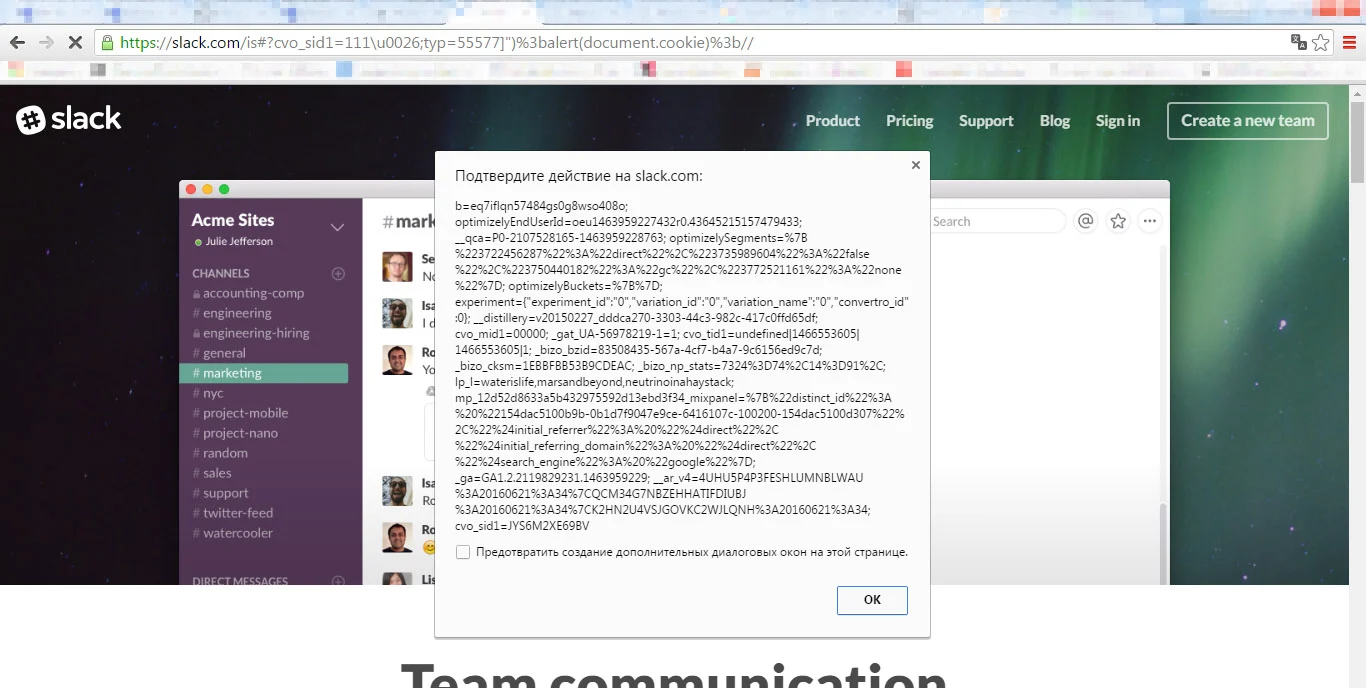
Vulnerable parameter from location hash (cvo_sid1), used in your live.js to call convertro code without sanitizing. On the convertro side it is sanitized, but with help of this parameter you could push another parameter (typ), that leads to generating malformed javascript answer with XSS injection ability. Like this : cvo_sid1=111\u0026;typ=[code injection] , where \u0026; is an ampersand symbol. See screenshots below. There is a restriction on a semicolon use, so i replaced it with %3b.
To reproduce vulnerability, you could try this safe example: https://slack.com/is#?cvo_sid1=111\u0026;typ=55577]")%3balert(document.cookie)%3b//
This vulnerability provides a great opportunity for victim to lose not only cookies, but also control over the account after stealth forwarding to porposely generated link like this. I think, you know ;)
Attachments
Not written yet. The AI write-up for this report has not been written yet. The Original tab links to the source.
How it worked
Root cause
Likely the page took the cvo_sid1 value from the location hash and passed it to the Convertro script without sanitising it, and the script then used it to build JavaScript that was evaluated.
Impact
An attacker could steal cookies and potentially take over the victim's account by sending a crafted link.
What the attacker needed
Victim clicks a crafted link
How it was found
- Craft a URL with the cvo_sid1 parameter containing an encoded ampersand and a typ parameter with injected code.
- Send the crafted URL to a victim.
- When the victim opens the link, the page reads the hash and passes it to the Convertro script, which generates malformed JavaScript containing the injected code.
- The injected code runs in the victim's browser and can read document.cookie.
Explained by bugbounty.wiki with AI from the original and checked against quotes from it; it can still be wrong. Read the original before relying on a detail.
Not written yet. The AI write-up for this report has not been written yet. The Original tab links to the source.
A web page can read part of the address after the # symbol and pass it to another script. Here that value was not checked, so an attacker could add extra instructions that the script would run as code. This let the attacker run their own JavaScript in the victim's browser, which can read cookies and act as the user.
What is XSS?
Script an attacker supplies runs in another user's browser, on the target's origin, with that user's session.



