Yet Another (unexpected) Hack for Bounty
Questions submitted to a Slido event were pushed to every audience member's browser before moderator approval, so unapproved questions could be read by anyone watching the page. An attacker could use a browser console script to capture and log these questions in real time while authors stayed anonymous.
 Published on medium.com
I always wanted to start blog on medium but lacked that interesting story to begin with. So finally here I am with something interesting to share
The full write-up lives on its author's site
It belongs to its author, so we link to it rather than copy it. The other two tabs are our own rewrites, checked against it.
Context
Slido is an audience participation app used at events and meetings to collect questions, comments and opinions from attendees. The researcher encountered it at an event in early January 2019, where the organisers used Slido to gather audience participation.
The normal flow is simple. The organisers give attendees an event code. The attendee opens the sli.do website on any device, enters the event code on the home page, and can then engage with the presenters by asking questions or leaving comments.

Sli.do home page
At this particular event the organisers had enabled the moderator approval feature. On first logging into the event, the researcher was greeted with this message:
Questions will remain anonymous and will not be publicly viewable
With moderator approval enabled, input from the audience is not viewable by the audience until a moderator (an event organiser) approves it. The researcher was curious what fellow audience members were asking the presenters, and how Slido implemented this feature, so opened the browser console to give it a try.
Setup
No special tooling was needed. The researcher was an ordinary attendee with the event code, using a browser against the sli.do site. The only tool involved was the browser's own developer console, used to run a small JavaScript snippet. There were no accounts beyond normal attendee access, and no versions or configurations are described in the report.
Finding it
Looking at the DOM elements made the implementation obvious: whenever someone posted a question, it was pushed to all end users (the audience) and then removed if a moderator had not yet approved it. The researcher judged this not to be the ideal way to handle the use case.
That observation is the whole finding. The report says a posted question was pushed to all end users and removed if a moderator had not yet approved it. Anyone who can watch the page's DOM can see the question before it is approved, even though the interface never shows it.
Exploitation
Step 1: watch the DOM for mutations
With the behaviour understood, the researcher wrote a small JavaScript snippet in the browser console to capture any mutation in the div element whenever a question was posted. The report's hint for developers is that the easiest way to do this is with mutation observers. Once the DOM element mutation event is captured using the observer, it is just a matter of logging whatever details are required from the captured elements to the console.
The report does not reproduce the snippet itself. The effect is that questions can be viewed while the anonymous authors remain anonymous.
Step 2: read the questions in real time
After around 15 minutes of fiddling, the researcher had all questions posted printed in the browser console as log output, in real time.
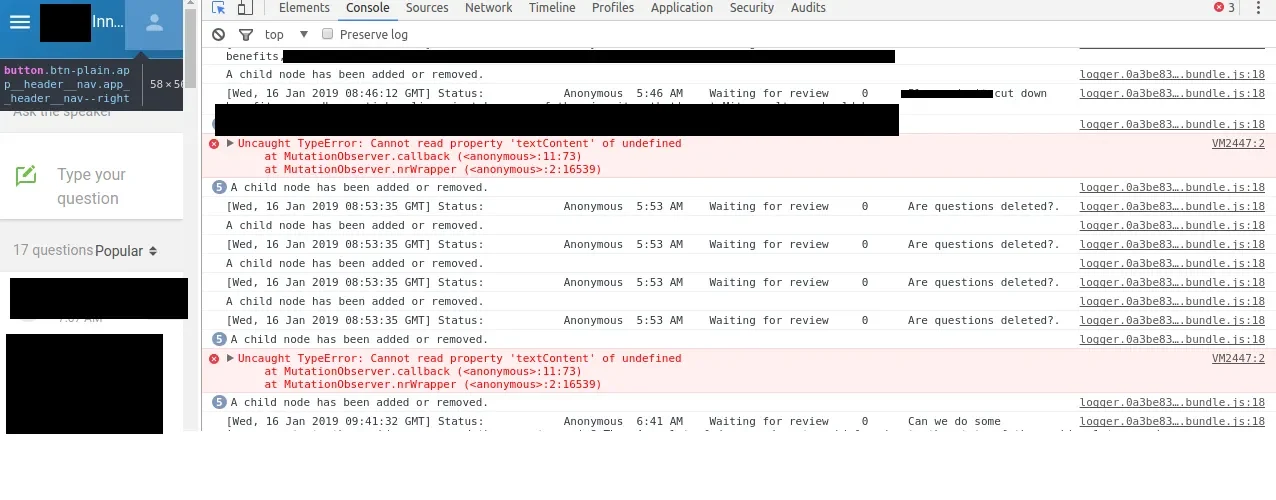
console output with all the questions
After the event ended there was nothing much interesting in the console logs, but the researcher considered the behaviour a feature-breaking vulnerability in Slido and decided to inform the developers.
Step 3: report to the vendor
After the event, the researcher sent an email with the findings, including steps to reproduce, to the Slido security mailing group. Around a day or two later came the reply.
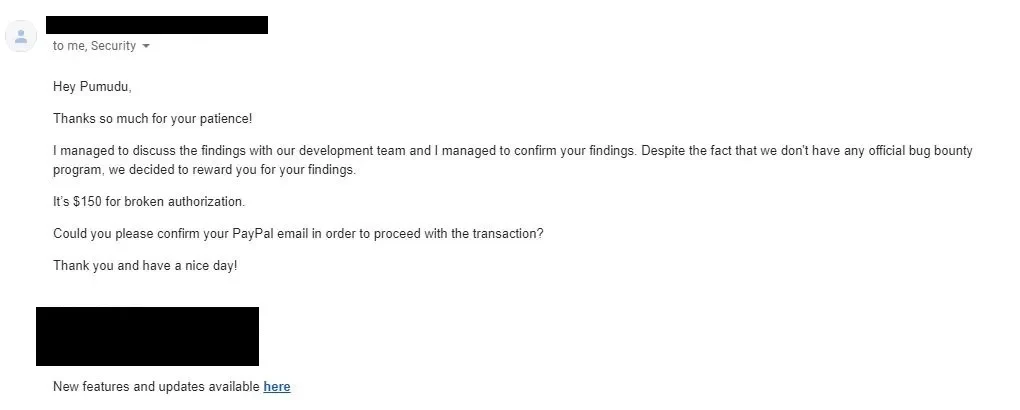
Cool!! $150 for 15 min hack
The vendor estimated the vulnerability disclosure at a $150 bounty. The researcher treated the offer itself as an achievement. Payment, however, ran into a local obstacle: the researcher lives in a country where the government has banned PayPal accounts from receiving money. There are a few grey workarounds, but the researcher did not feel like going through them for $150. After a few back and forth emails, no common platform for the transaction could be agreed, mostly because of limitations where the researcher lives.
Step 4: decline the payment
Since the bounty had been offered and that was the objective, the researcher sent a further email.
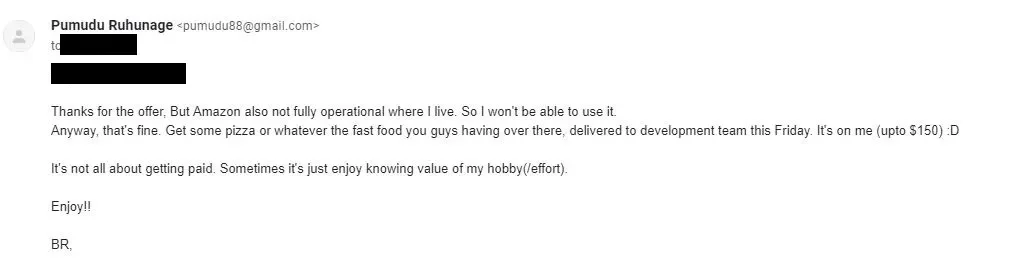
Sometimes it's just enjoy hacking. Hope Slido development team enjoyed their Pizza treat :D
The researcher's closing point is that hacking should not be an unpleasant experience for either businesses or hackers. Sites like HackerOne promote hackers and companies working together. Not all hackers hack just for money, at least in the beginning; it is an addictive art with a great sense of accomplishment when a good exploitable vulnerability is found.
Update: the researcher ended up receiving a generous gift from Slido.
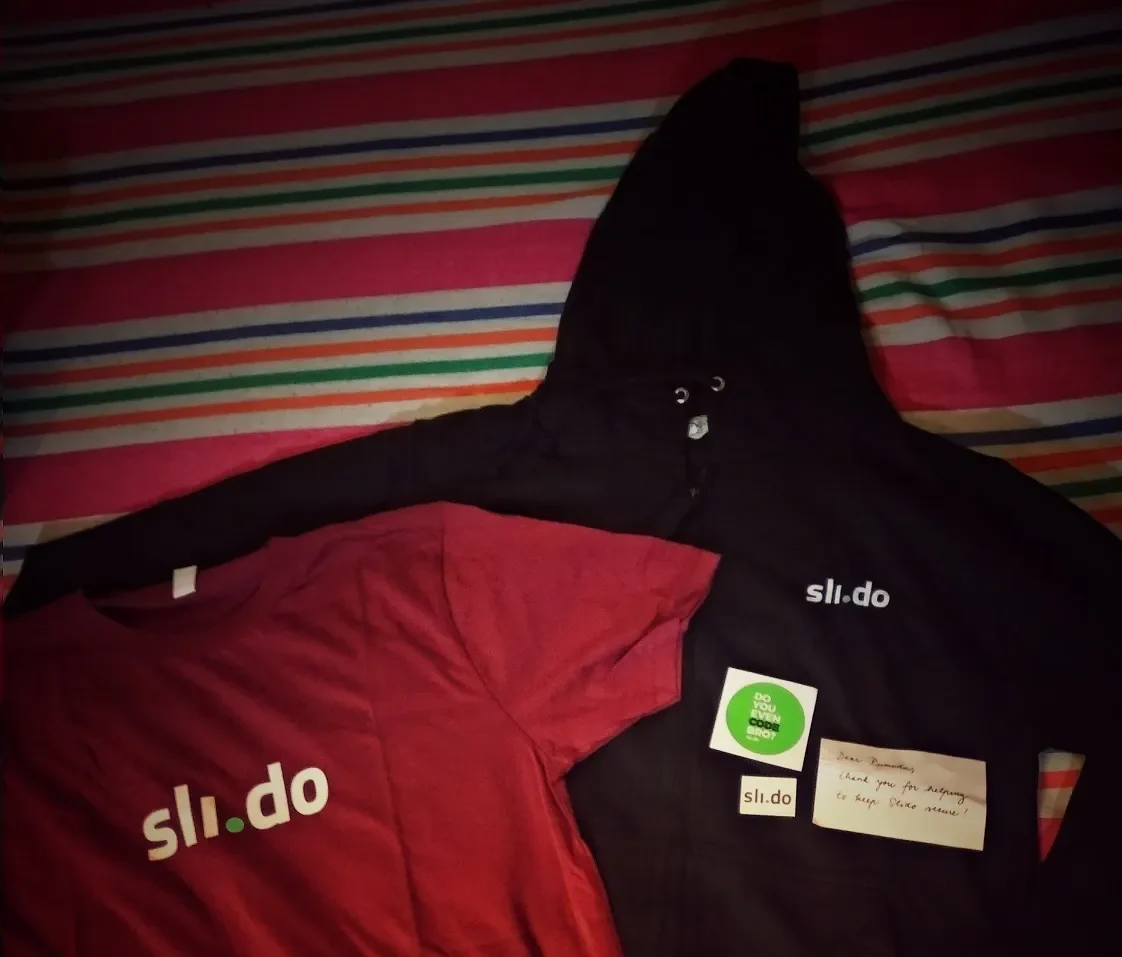
Thanks Slido :)
Root cause
The report describes the design directly: a posted question is pushed to all end users and removed if a moderator has not yet approved it. The report describes a posted question being pushed to all end users and removed if a moderator had not yet approved it. The researcher captured the questions with a mutation observer before they were removed.
Impact
The researcher read questions in real time before a moderator approved them, while the anonymous authors stayed anonymous. The anonymous authors of those questions stay anonymous; what leaks is the question content, not the identity behind it. The researcher's own test produced all questions posted during the event, live, in the browser console. The report does not describe any other impact, any other affected users, or any conditions beyond an event using the moderator approval feature.
Fix
The report does not say what Slido changed, if anything.
Variants to test
- Moderated Q&A and comment feeds. Open an event with approval enabled and watch the DOM while another participant submits content. A positive result is the unapproved text appearing in the page before any approval action.
- Mutation observers on any live-updating list. Attach an observer to the container that receives pushed items and log added nodes. A positive result is content that the interface never displays, such as items removed immediately after insertion.
- WebSocket and polling traffic. Inspect the messages the client receives during moderation. A positive result is unapproved content present in frames or responses delivered to ordinary attendees.
- Other approval-gated features. Apply the same check to anything described as pending review, such as moderated chat, polls or audience reactions. A positive result is pending content reaching non-moderator clients before approval.
What happened, in plain words
At an event in early January 2019, the organisers used a website called Slido so the audience could send in questions and comments. Slido is an audience participation app: instead of raising hands or shouting, people type their questions on their phones and the presenter sees them. The organisers gave everyone an event code. You open the sli.do website on any device, type the code on the home page, and you are in. From there you can ask questions and leave comments.
Sli.do home page
At this particular event the organisers had switched on a feature called moderator approval. A moderator is a person who checks what the audience sends before anyone else can see it, in this case an event organiser. With that feature on, the audience cannot see each other's input until a moderator approves it. When the researcher first logged into the event, the page showed this message:
Questions will remain anonymous and will not be publicly viewable
That message is a promise: your question stays anonymous, and nobody else in the audience sees it until it has been approved. The researcher was curious about two things at once. What were the other people in the room asking the presenter? And how had Slido built this approval feature? So the researcher opened the browser console, a built-in panel in every browser that lets you look at and run code on the page, just to give it a try.
The researcher found that a posted question was pushed to all end users and removed if a moderator had not yet approved it. Anyone who looked at the page's inner workings could read the question before a moderator ever approved it. The researcher reported it, and Slido offered a $150 bounty, which is a reward a company pays someone who reports a security problem. Payment could not be arranged because PayPal was banned where the researcher lives, and no common platform was agreed. Slido later sent a gift instead.
The background: what Slido does and what the message promised
Slido collects questions, comments and opinions from an audience at events and meetings, so that events become more interactive and less boring. The flow is deliberately simple:
- The organisers give attendees an event code.
- The attendee opens the sli.do website on any device.
- The attendee enters the event code on the home page.
- The attendee can now ask questions and leave comments for the presenters.
That is the whole product from the attendee's side. There is no account setup described in the report, no app to install, just a code and a web page.
The important detail for this story is the moderator approval feature. Normally, when you send something to a live audience tool, it appears for everyone straight away. With approval switched on, the organiser wants to read each item first and decide whether it goes out. Until then, the audience should not see it. The message quoted above is the user-facing version of that rule: questions stay anonymous and are not publicly viewable.
The setup: nothing but a browser
No special tools were needed. The researcher was an ordinary attendee who had the event code, using a normal browser against the sli.do site. The only tool involved was the browser's own developer console, used to run a small piece of JavaScript, the programming language that web pages run in the browser. There were no accounts beyond normal attendee access, and the report does not describe any particular version or configuration of anything.
This matters for anyone starting out: you do not need a hacking laptop or a toolkit to find a problem like this. You need to understand what the page is doing and to be curious about where the data goes.
Finding it: the question arrived before approval
To understand the finding, you need one idea: the DOM. When a browser loads a web page, it turns the HTML into a tree of objects it can work with, and that tree is called the Document Object Model, or DOM. Every element on the page, every heading, every button, every box of text, is a node in that tree. When something on the page changes, for example a new question appearing in a list, the browser changes the DOM. That change is called a mutation.
Looking at the DOM elements made the implementation obvious to the researcher. Whenever someone posted a question, it was pushed to all end users, meaning every attendee's browser, and then removed if a moderator had not yet approved it. The researcher judged this not to be the ideal way to handle the use case.
That observation is the whole finding: the question was pushed to all end users and removed if not yet approved. The report says the unapproved question was pushed to all end users and then removed. The researcher watched the page's DOM and captured the question before it was removed.
Exploitation
Step 1: watch the DOM for mutations
With the behaviour understood, the researcher wrote a small JavaScript snippet in the browser console to capture any mutation in the div element whenever a question was posted. A div is simply a generic container element on a page, the kind of box that holds a list of items. The report's hint for developers is that the easiest way to do this is with mutation observers. A mutation observer is a built-in browser feature: you point it at an element and tell it "call me whenever something inside this element changes". Once the DOM element mutation event is captured using the observer, it is just a matter of logging whatever details are required from the captured elements to the console. Logging means printing a value into the console panel so you can read it.
The report does not reproduce the snippet itself, so there is no code to copy here. The effect is that questions can be viewed while the anonymous authors remain anonymous. In other words, you learn what was asked, but not who asked it.
Why take this step? Because the interface hides the question, but the browser has already received it. If you watch the container where questions are inserted, you catch each one at the moment it appears, before the page removes it.
Step 2: read the questions in real time
After around 15 minutes of fiddling, the researcher had all questions posted printed in the browser console as log output, in real time. Real time here means as they were submitted, not afterwards from a saved file.
console output with all the questions
After the event ended there was nothing much interesting in the console logs, but the researcher considered the behaviour a feature-breaking vulnerability in Slido and decided to inform the developers. A vulnerability is a weakness in how something is built that lets it behave in a way its designers did not intend. This one breaks a feature, the approval step, rather than, say, giving access to someone's account.
Step 3: report to the vendor
After the event, the researcher sent an email with the findings, including steps to reproduce, to the Slido security mailing group. Steps to reproduce are the exact sequence of actions that lets someone else see the same result, which is what makes a report useful. Around a day or two later came the reply.
Cool!! $150 for 15 min hack
The vendor, meaning the company that makes the product, estimated the vulnerability disclosure at a $150 bounty. A bounty is a reward paid for reporting a security problem responsibly, so that the company can fix it instead of someone else abusing it. The researcher treated the offer itself as an achievement.
Payment, however, ran into a local obstacle: the researcher lives in a country where the government has banned PayPal accounts from receiving money. There are a few grey workarounds, meaning unofficial ways around the restriction, but the researcher did not feel like going through them for $150. After a few back and forth emails, no common platform for the transaction could be agreed, mostly because of limitations where the researcher lives.
Step 4: decline the payment
Since the bounty had been offered and that was the objective, the researcher sent a further email.
Sometimes it's just enjoy hacking. Hope Slido development team enjoyed their Pizza treat :D
The researcher's closing point is that hacking should not be an unpleasant experience for either businesses or hackers, and that Slido accepts this. Sites like HackerOne promote hackers and companies working together. HackerOne is a platform where companies publish what they want reported and researchers send in findings. Not all hackers hack just for money, at least in the beginning; it is an addictive art with a great sense of accomplishment when a good exploitable vulnerability is found. Exploitable means it can actually be triggered in practice, not just in theory.
Update: the researcher ended up receiving a generous gift from Slido.
Thanks Slido :)
Why it worked
The report describes the design directly: a posted question is pushed to all end users and removed if a moderator has not yet approved it. The report describes a posted question being pushed to all end users and removed if a moderator had not yet approved it. The client side is everything that happens in your own browser, as opposed to the server side, which is the company's computer that stores and sends the data. The researcher captured the question with a mutation observer before it was removed.
A useful comparison is a sealed envelope. If the letter is never put in the envelope and instead handed to everyone with a note saying "do not open until approved", the rule depends entirely on everyone's good behaviour. The safer design is to keep the letter with the moderator and only hand it out after approval.
What it meant
The researcher read questions in real time before a moderator approved them, while the anonymous authors stayed anonymous. The anonymous authors of those questions stay anonymous; what leaks is the question content, not the identity behind it. The researcher's own test produced all questions posted during the event, live, in the browser console. The report does not describe any other impact, any other affected users, or any conditions beyond an event using the moderator approval feature.
How it could be fixed
In the envelope comparison: keep the letter with the moderator until it is approved, and only then hand it out.
Things worth trying yourself
These are the same checks, in the same order, for someone who wants to practise the idea on a site they are allowed to test:
- Moderated Q&A and comment feeds. Open an event with approval enabled and watch the DOM while another participant submits content. A positive result is the unapproved text appearing in the page before any approval action.
- Mutation observers on any live-updating list. Attach an observer to the container that receives pushed items and log added nodes. A positive result is content that the interface never displays, such as items removed immediately after insertion.
- WebSocket and polling traffic. Inspect the messages the client receives during moderation. A WebSocket is a two-way connection that lets a page receive updates from a server as they happen, and polling is the older approach of asking the server again and again for new data. A positive result is unapproved content present in frames or responses delivered to ordinary attendees.
- Other approval-gated features. Apply the same check to anything described as pending review, such as moderated chat, polls or audience reactions. A positive result is pending content reaching non-moderator clients before approval.
Glossary
- Bounty: a reward a company pays someone who reports a security problem to them instead of abusing it.
- Browser console: a built-in panel in a browser where you can see messages from the page and run your own code against it.
- Client side: everything that happens in your own browser, as opposed to on the company's computers.
- DOM (Document Object Model): the tree of elements a browser builds from a page, which it changes whenever something on the page changes.
- div: a generic container element on a web page, often used to hold a list of items.
- Event code: the short code an organiser gives attendees so they can join the right Slido event.
- Exploitable: able to be triggered in practice, not just in theory.
- HackerOne: a platform where companies publish what they want reported and researchers send in findings.
- JavaScript: the programming language that web pages run in the browser.
- Log / console log: printing a value into the console panel so you can read it.
- Moderator: a person, here an event organiser, who checks audience input before it is shown to everyone.
- Moderator approval: a feature where audience input is held back until a moderator approves it.
- Mutation: a change to the DOM, such as a new item appearing in a list.
- Mutation observer: a built-in browser feature that calls your code whenever something inside a chosen element changes.
- Polling: repeatedly asking the server for new data at intervals.
- Real time: as things happen, rather than afterwards from a saved file.
- Server side: the company's computers that store and send the data, as opposed to your browser.
- Steps to reproduce: the exact sequence of actions that lets someone else see the same result.
- Vendor: the company that makes the product.
- Vulnerability: a weakness in how something is built that lets it behave in a way its designers did not intend.
- WebSocket: a two-way connection that lets a page receive updates from a server as they happen.



