How we ‘hacked’ Telenet’s cybersecurity quiz
The quiz revealed the correct answer after each submission and allowed multiple attempts, so participants could use fake email addresses to learn the answers and then score highly. Additionally, a caching issue allowed replaying the last question to increase the score beyond the maximum, which was scriptable due to missing rate limiting.
 Published on mickeydebaets.medium.com
Not so long ago, Telenet Business ran a quiz to find the smartest cyber specialist. The quiz consisted out of 20 questions and your score was based both on whether the answer was correct and your reaction time.
The full write-up lives on its author's site
It belongs to its author, so we link to it rather than copy it. The other two tabs are our own rewrites, checked against it.
Telenet Business ran a quiz to find the smartest cyber specialist. It consisted of 20 questions, and your score depended both on whether the answer was correct and on your reaction time. This is a write-up of how Mickey De Baets and Robin Bruynseels ended up scoring far above the maximum, and what Telenet did about it.
Context
The target was a Telenet Business quiz of 20 questions, scored on correctness and reaction time. The score combined correctness with speed, so a fast, correct participant could climb the leaderboard. The maximum achievable score was 2370.

Quiz by Telenet Business
Setup
No special tooling was needed to start: a browser and an email address were enough. The researchers used fake credentials and the contact details of a colleague to take the quiz more than once. Later, a few lines of Python were used to script the requests. The report gives no versions, no endpoint names and no request or response captures.
Finding it
While looking at the quiz, the researchers quickly found a few things.
- After submitting the answer to a question, the correct answer was revealed.
- Multiple attempts were possible, even with the same email address. The report notes that Telenet later made clear it was in fact monitoring double attempts, but fake email addresses still exist.
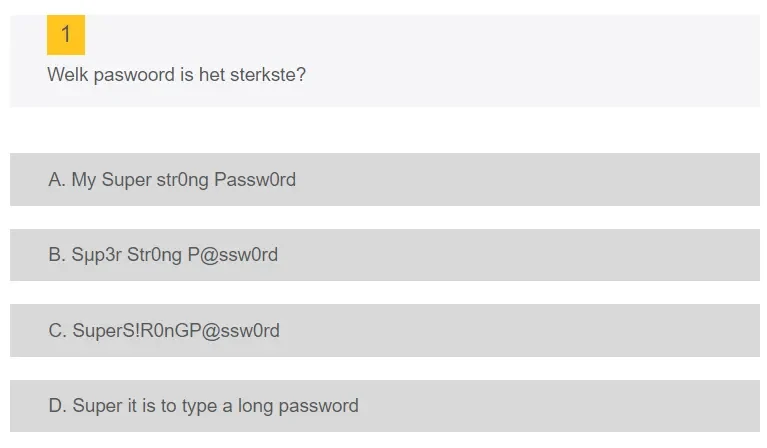
First quiz question

Answer of the question
The first cheating strategy followed directly from those two observations: use either fake credentials or the contact info of a colleague to reveal the correct answers, write them down, and use that information to your advantage. That is what the researchers did, and before long the author was in first place. At that point the competition was more about who could click the fastest.

Getting the maximum score
Exploitation
Step 1: harvest the answers with extra attempts
By registering attempts with fake credentials or a colleague's contact details, the quiz revealed the correct answer after each submission. Writing the answers down turned the quiz into a speed contest: with the answers known, the only remaining variable was reaction time.
Step 2: the accidental discovery
With the answers written down and lightning fast clicks, the reaction time was very hard to beat. So it was a surprise when, on the last day, the author looked at the score again and had dropped to second place.
That was when Robin Bruynseels called. He had been trying to check his score, typed "telenet" in his search bar, and clicked on a link that brought him back to the page of the last question. He clicked next, and his score went up and above the maximum score of 2370. The report credits the discovery of this exploit entirely to him.
Step 3: confirm the cache issue
The author reviewed the technique and confirmed the cache issue.
Step 4: script it
With the technique confirmed, the question became whether the requests could be run from a script. A few lines of Python made it clear very quickly that rate limiting would not be an issue, and Robin's exploit was scriptable.
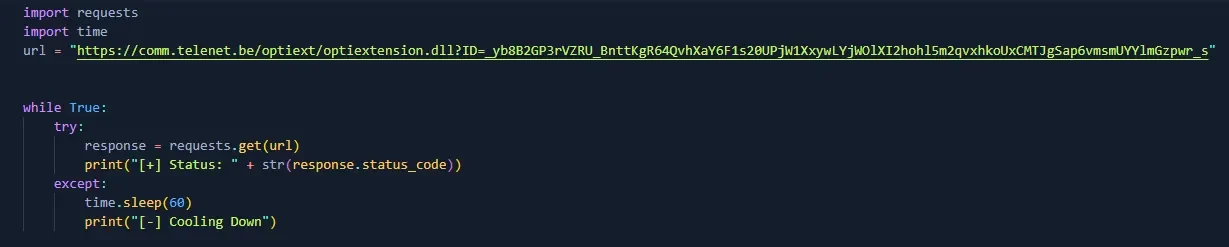
Python script
Result
The author ended up with a score far above the maximum allowed and finished first in the competition.

Scoring way above maximum
Root cause
The report describes the mechanism as a cache issue: revisiting the page of the last question and clicking next again raised the score above the maximum. The report calls it a cache issue but does not explain the mechanism further. The existing defences did not stop it: multiple attempts were possible even with the same email address, and although Telenet was monitoring double attempts, fake email addresses bypassed that monitoring. Rate limiting would not be an issue, since the exploit was scriptable. The report does not go into the server-side implementation, so the exact code-level mistake is not stated.
Impact
The correct answers could be revealed by taking the quiz repeatedly with fake or borrowed email addresses, and the last-question step could be replayed to push a score above the maximum of 2370. In this case the effect was a manipulated leaderboard position in a public competition: the author finished first with a score far above the maximum. The report does not describe any access to other users' data, any account takeover, or any effect beyond the quiz and its ranking. The conditions were simply a public quiz with answer disclosure after submission, multiple attempts allowed, and a scoring step that could be repeated.
Fix
After the competition ended, Robin and the author notified Telenet of what they found and how they were able to get the insanely high score. Telenet deemed their scores invalid because multiple attempts were against the competition guidelines, thanked them for their enthusiastic participation, and was happy that they reported the findings. The report does not say which technical changes, if any, were made to the quiz. The lessons it draws are broader: test everything in every scenario, because the happy path is a myth and someone will almost always find a way to do things you never imagined. Telenet was open to the feedback and scheduled a meeting with the researchers; for a quiz themed around awareness and cybersecurity, the report holds this up as an example of how the smallest things matter and how a receptive attitude towards feedback can improve resilience.
Variants to test
- Answer disclosure after submission. Submit a wrong answer and check whether the correct answer is returned in the response or rendered on the page. A positive result is the correct answer appearing before the quiz is over.
- Repeat attempts with the same identity. Complete the quiz, then start again with the same email address. A positive result is a second scored attempt being accepted.
- Identity checks that only look at the email string. Try disposable or fake addresses and see whether the attempt is accepted and scored. A positive result is a scored attempt with an address that clearly is not a real participant.
- Replaying the final step. Navigate back to the last question, click next, and observe the score. A positive result is the score increasing again, especially above the stated maximum.
- Scripted repetition. Send the same final-step request repeatedly from a script and watch for rate limiting or rejection. A positive result is many accepted requests in a short window with the score climbing each time.
- Cache behaviour around scoring. Compare responses when the page is reached by direct navigation, by browser history, and by a search-engine link. A positive result is a cached response that skips validation and still credits the score.
Big shout out from the authors to Telenet Business and their reaction. If you read this and are wondering whether your own web application, infrastructure or company can be broken into, the authors invite you to talk with them about ethical hacking and penetration testing.
What happened, in plain words
Telenet Business ran a quiz to find the smartest cyber specialist. The quiz had 20 questions. Your score depended on two things: whether you answered correctly, and how fast you reacted. The highest score anyone could legitimately reach was 2370.
Two security researchers, Mickey De Baets and Robin Bruynseels, took part. They noticed a few weaknesses in how the quiz worked, used them to climb the leaderboard, and ended up with a score far above the maximum. They then told Telenet what they had done. Telenet decided their scores were invalid because taking multiple attempts was against the competition rules, but thanked them for reporting the findings.
This article walks through what they found, step by step, in the order it happened. It assumes you can use a browser and nothing more. Every technical term is explained the first time it appears, and there is a glossary at the end.
Quiz by Telenet Business
The target: a public quiz
The thing being tested was a quiz of 20 questions, scored on correctness and reaction time. That matters, because it means there was no real account, no password, and no strong link between a person and their attempt. Think of it like a raffle where you write your name on a ticket: nothing stops you writing a different name on a second ticket.
The score combined correctness with speed. A participant who answered correctly and quickly could climb the leaderboard. The maximum achievable score was 2370.
The setup: a browser and an email address
No special tools were needed to start. A browser and an email address were enough. The researchers used fake credentials and the contact details of a colleague to take the quiz more than once. Later, they used a few lines of Python to automate the requests.
A quick word on two ideas used here:
- Credentials are the details that identify you, such as an email address and a password. In this quiz, the email address was effectively the only credential.
- Python is a programming language. It is popular for small automation tasks because a script can be very short. A script is just a list of instructions a computer follows, like a recipe.
The report gives no software versions, no endpoint names (an endpoint is a specific address on a server that a browser talks to), and no captured requests or responses. So we work with what is described.
Finding the weaknesses
While looking at the quiz, the researchers quickly found a few things.
- After submitting the answer to a question, the correct answer was revealed.
- Multiple attempts were possible, even with the same email address. The report notes that Telenet later made clear it was in fact monitoring double attempts, but fake email addresses still exist.
First quiz question
Answer of the question
Why do these two things matter?
- Revealing the correct answer after submission turns the quiz from a knowledge test into a memory test. If you can see the answer, you can write it down and use it next time. It is like a teacher handing back the answer key after every practice test.
- Allowing multiple attempts means the same person can try again and again. Even if the quiz watches for the same email address being used twice, an email address is easy to invent. There is no cost to creating a fake one.
The first cheating strategy followed directly from those two observations: use either fake credentials or the contact info of a colleague to reveal the correct answers, write them down, and use that information to your advantage. That is what the researchers did, and before long the author was in first place. At that point the competition was more about who could click the fastest.
Getting the maximum score
Exploitation, step by step
Step 1: collect the answers with extra attempts
By registering attempts with fake credentials or a colleague's contact details, the quiz revealed the correct answer after each submission. Writing the answers down turned the quiz into a speed contest: with the answers known, the only remaining variable was reaction time.
This is a logic flaw. A logic flaw is not a broken lock or a crashed program. It is a situation where the software does exactly what it was programmed to do, but the rules it enforces are not the rules the designers intended. The quiz was built to show the answer after each question and to allow retries. Each of those choices is reasonable on its own. Together, they let a participant learn all the answers before the real attempt.
Step 2: the accidental discovery
With the answers written down and lightning fast clicks, the reaction time was very hard to beat. So it was a surprise when, on the last day, the author looked at the score again and had dropped to second place.
That was when Robin Bruynseels called. He had been trying to check his score, typed "telenet" in his search bar, and clicked on a link that brought him back to the page of the last question. He clicked next, and his score went up and above the maximum score of 2370. The report credits the discovery of this exploit entirely to him.
Notice how this happened: not by attacking anything, but by arriving at a page through an unusual route. A search engine link is a different path to the same page than clicking through the quiz normally. That difference is the clue to what went wrong.
Step 3: confirm the cache issue
The author reviewed the technique and confirmed the cache issue. A cache is a stored copy of something, kept so it can be served again quickly without doing the work a second time. Think of a café that keeps a few sandwiches ready at lunchtime: handing one over is fast, but you get yesterday's filling if nobody checks the date.
The report calls it a cache issue but does not explain the mechanism further. The observation was that returning to the page of the last question and clicking next again caused the score to increase beyond the maximum. The report does not explain the mechanism beyond calling it a cache issue.
Step 4: automate it
With the technique confirmed, the question became whether the requests could be run from a script. A request is the message your browser sends to a server when you click a link or submit a form, asking for a page or sending data. A server is the computer that holds the website and answers those requests.
A few lines of Python made it clear very quickly that rate limiting would not be an issue, and Robin's exploit was scriptable. Rate limiting is a defence where a server refuses to answer if the same client sends too many requests too quickly. It is like a bouncer who lets one person in per minute. Without it, a script can send the same request hundreds of times in a row.
Python script
The report does not include the script's contents, so there is no code to walk through here. What matters is the conclusion: the same final step could be repeated automatically, and nothing on the server side slowed it down or rejected it.
Result
The author ended up with a score far above the maximum allowed and finished first in the competition.
Scoring way above maximum
Why it worked
The report describes the mechanism as a cache issue: revisiting the page of the last question and clicking next again raised the score above the maximum.
The existing defences did not stop it:
- Although Telenet was monitoring double attempts, fake email addresses bypassed that monitoring.
- Rate limiting would not be an issue, since the exploit was scriptable.
The report does not go into the server-side implementation, so the exact code-level mistake is not stated.
What the impact was
The correct answers could be revealed by taking the quiz repeatedly with fake or borrowed email addresses, and the last-question step could be replayed to push a score above the maximum of 2370. In this case the effect was a manipulated leaderboard position in a public competition: the author finished first with a score far above the maximum.
The report does not describe any access to other users' data, any account takeover, or any effect beyond the quiz and its ranking. The conditions were simply a public quiz with answer disclosure after submission, multiple attempts allowed, and a scoring step that could be repeated.
What happened next
After the competition ended, Robin and the author notified Telenet of what they found and how they were able to get the insanely high score. Telenet deemed their scores invalid because multiple attempts were against the competition guidelines, thanked them for their enthusiastic participation, and was happy that they reported the findings.
The lessons it draws are broader: test everything in every scenario, because the happy path is a myth and someone will almost always find a way to do things you never imagined. The happy path is the route through a feature that the designer pictured: the user does the expected thing in the expected order. Real users, and real attackers, do not always follow it.
Telenet was open to the feedback and scheduled a meeting with the researchers. For a quiz themed around awareness and cybersecurity, the report holds this up as an example of how the smallest things matter and how a receptive attitude towards feedback can improve resilience.
Things worth testing on your own quiz or form
These are the checks the report's findings suggest. Each one is something you can try in a browser, and each one has a clear sign of success.
- Answer disclosure after submission. Submit a wrong answer and check whether the correct answer is returned in the response or shown on the page. A positive result is the correct answer appearing before the quiz is over.
- Repeat attempts with the same identity. Complete the quiz, then start again with the same email address. A positive result is a second scored attempt being accepted.
- Identity checks that only look at the email string. Try disposable or fake addresses and see whether the attempt is accepted and scored. A positive result is a scored attempt with an address that clearly is not a real participant.
- Replaying the final step. Navigate back to the last question, click next, and watch the score. A positive result is the score increasing again, especially above the stated maximum.
- Scripted repetition. Send the same final-step request repeatedly from a script and watch for rate limiting or rejection. A positive result is many accepted requests in a short window with the score climbing each time.
- Cache behaviour around scoring. Compare responses when the page is reached by direct navigation, by browser history, and by a search-engine link. A positive result is a cached response that skips validation and still credits the score.
Big shout out from the authors to Telenet Business and their reaction. If you read this and are wondering whether your own web application, infrastructure or company can be broken into, the authors invite you to talk with them about ethical hacking and penetration testing.
Glossary
- API: a defined way for one piece of software to talk to another, like a service counter with set questions you are allowed to ask.
- Cache: a stored copy of data or a page kept so it can be served again quickly without repeating the original work.
- Cache issue: a problem where a stored copy is reused when fresh, validated processing was needed.
- Credentials: the details that identify you to a system, such as an email address and password.
- Endpoint: a specific address on a server that a browser or script sends requests to.
- Exploit: a technique that takes advantage of a weakness to produce an unintended result.
- Happy path: the expected route through a feature, where the user does everything in the intended order.
- Leaderboard: a ranked list of participants by score.
- Logic flaw: a weakness where software does exactly what it was programmed to do, but the enforced rules are not the intended ones.
- Python: a programming language often used for short automation scripts.
- Rate limiting: a defence that refuses or slows requests when too many arrive in a short time.
- Request: the message a browser or script sends to a server asking for a page or sending data.
- Response: the message a server sends back after a request.
- Script: a list of instructions a computer follows automatically.
- Server: the computer that holds a website and answers requests.
- Session: a period during which a server remembers who you are across several requests.
- Token: a short piece of data used to prove identity or permission, often stored by the browser.
- Vulnerability: a weakness that can be used to make a system behave in a way its designers did not intend.




