Snowflake server: Leak of TLS packets from other clients
The Snowflake pluggable transport server leaks TLS packets from other clients to a client, which receives them as 'ghost' packets at the KCP layer. An attacker could potentially use these leaked packets to deanonymise users, though the exact impact is not yet confirmed.

- Triaged in 17 days
- Fixed in 21 days
- Disclosed after 22 days
Summary:
This issue is related to the Snowflake pluggable transport server. It seems Snowflake clients receive "ghost" packets at the KCP layer, that encapsulate TLS packets unrelated to the current session. Those TLS packets are from other clients, and contain handshake record, application data, or other TLS stuff.
Steps To Reproduce:
Just run a Snowflake client and it will start receiving ghost packets.
Setting up KCP logging:
- Git clone the Snowflake client
- Open VSCode or similar editor
- In the
torrcfile, setup logging withClientTransportPlugin snowflake exec ./client -log snowflake.log - Open
./lib/snowflake.go, searchkcp.NewConn2, right click thenGo to definition - Search
readLoop, right click thenGo to definition - Right click on
defaultReadLoopthenGo to definition - Now just under the line where it says
s.conn.ReadFrom(buf), add the linelog.Println("kcp <-", buf) - Now start Tor with Snowflake using
tor -f ./torrc - Open
./snowflake.log
Inspecting
Notice that the KCP layer receive bytes not starting with the regular KCP header:
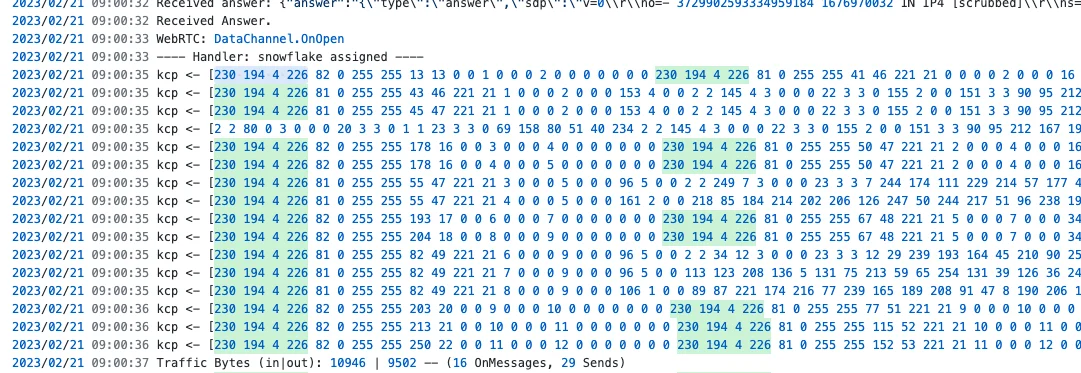
X X X X 81 0 255 255 ...
4 little-endian bytes for the conversation ID, then 81/82 for the command, then 0, then 255 255 (little-endian) for the window size.
This is an issue because KCP packets, just like TCP packets, are segments, and are never segmented themselves.
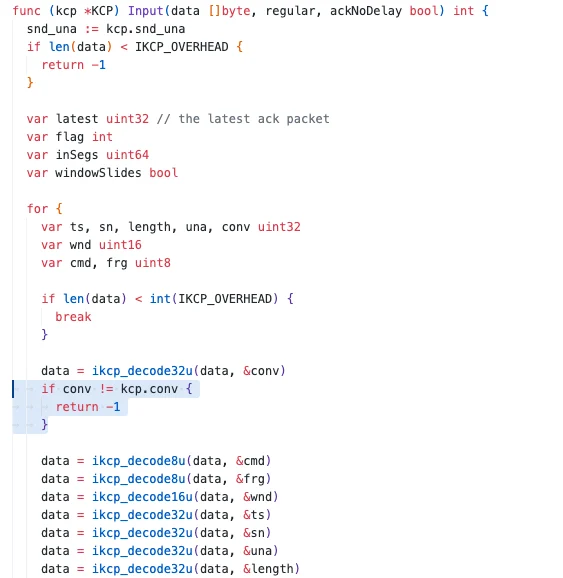
So, KCP doesn't recognize those ghost packets and discard them.
In Input
In kcpInput, which calls Input
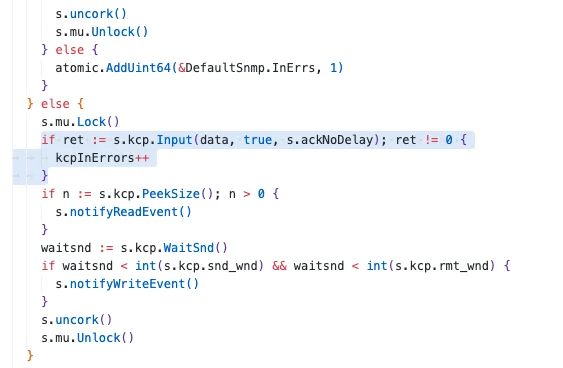
They are completely discarded and never reach the upper layer, that's why this has never been noticed.
So, what are those packets?
Some look like SMUX packets:
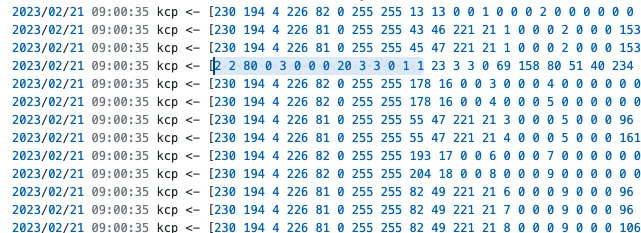
2 2 L L S 0 0 0
2 for the SMUX version, 2 for the psh command, 2 little-endian bytes for the length, and 4 little-endian bytes for the stream.
By the way, the stream ID is always set to 3, which is a proof that those packets are from other clients, as if you change the default SMUX stream ID to something else (in the SMUX code), you will still receive those packets from stream 3.
Some other look like KCP packets, but the conversation ID is not the same as other KCP packets:
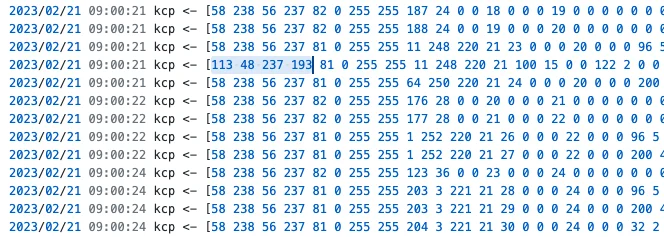
If you Cmd+F these bytes, you will not find any other occurence, so you never had this conversation ID, which is another proof that those packets are from other clients, and not from a previous connection.
Those KCP packets also contains a SMUX packet:
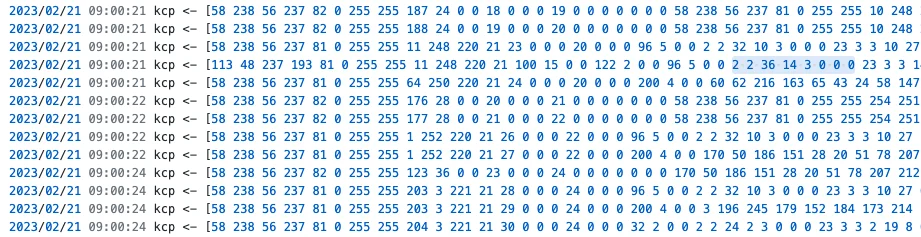
Now, the creepy part is that both those packets contain TLS packets:
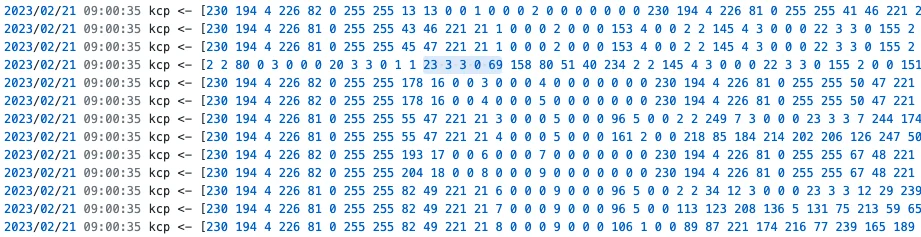
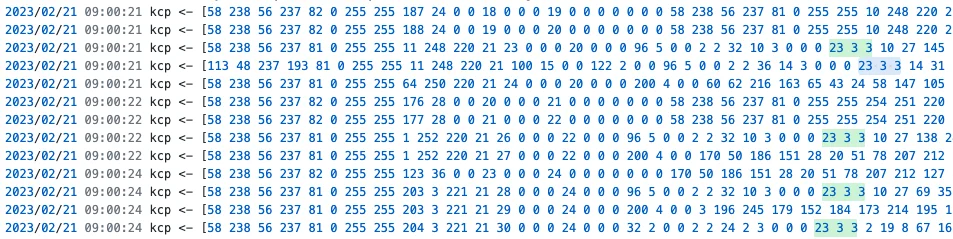
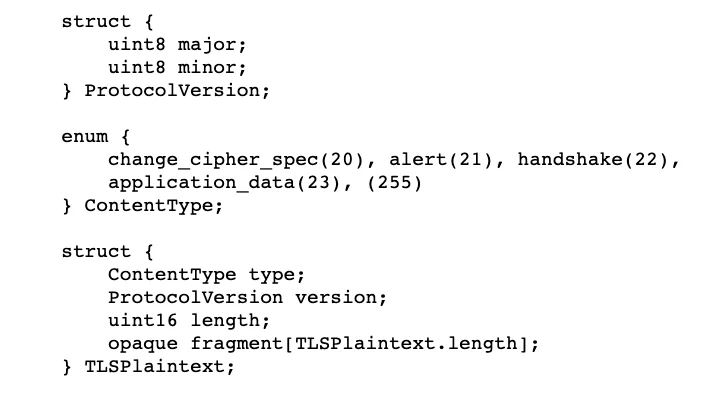
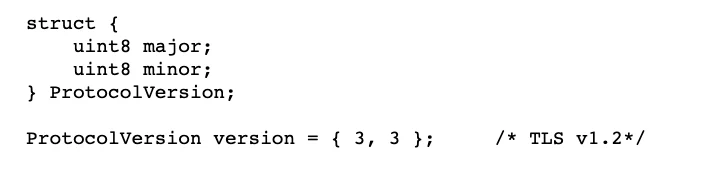
20/21/22/23 for the record type (handshake, application data, ...), then 3 3 (big-endian) for the TLS version (which is 1.2), then the TLS fragment (encrypted if type 23)
Notice that in the following screenshot, we have a ghost packet containing TLS application data (23) before our normal packets containing TLS handshake data (22)
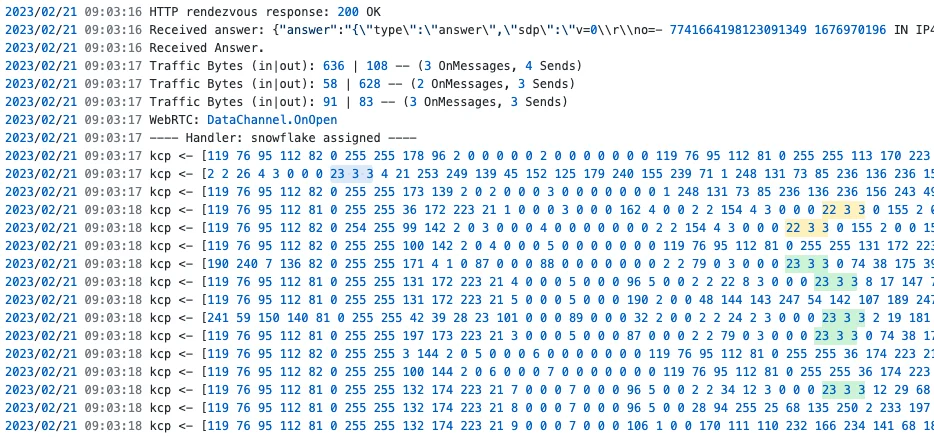
This is another proof that the ghost packets are from another TLS connection, as it would be impossible to get TLS application data before handshake data (except if renegociation, which is not the case here as it's a fresh new connection)
Conclusion
All this leads to the conclusion that the Snowflake server is leaking TLS packets to clients from other clients.
This would still need further investigation:
- Why is this occuring?
- Is the Snowflake client leaking too?
- Can we exploit this? To deanonymize people?
While we don't know those answers, this issue must be considered with high severity.
Impact
Even if it seems we can't modify those packets or exploit the TLS protocol, this issue still needs further investigation in order to show its real impact, as it could possibly deanonymize users.
Not written yet. The AI write-up for this report has not been written yet. The Original tab links to the source.
How it worked
Root cause
Likely a bug in the Snowflake server causes it to mix up packets from different clients, sending some to the wrong recipient.
Impact
The leaked TLS packets could potentially deanonymise users, but the report states that further investigation is needed to confirm the real impact.
What the attacker needed
Run a Snowflake client
How it was found
- Run a Snowflake client.
- Set up KCP logging by modifying the client code to log received bytes.
- Start Tor with Snowflake and observe the log.
- Notice KCP packets that do not start with the regular KCP header.
- Inspect the packets and identify them as SMUX or KCP packets from other clients, containing TLS records.
Explained by bugbounty.wiki with AI from the original and checked against quotes from it; it can still be wrong. Read the original before relying on a detail.
Not written yet. The AI write-up for this report has not been written yet. The Original tab links to the source.
Snowflake is a tool that helps people bypass internet censorship by routing traffic through volunteer proxies. This report found that the server sometimes sends pieces of other users' encrypted traffic to your client, which could reveal information about them. The author isn't sure yet if this can be exploited, but it's a serious privacy leak.
What is Info disclosure?
Data the application should keep private (personal data, internal details, other users' records) reaches someone it should not.



