Authentication bypass on auth.uber.com via subdomain takeover of saostatic.uber.com
A dangling DNS record for saostatic.uber.com pointed to an unclaimed CloudFront distribution, allowing an attacker to take over the subdomain. Because Uber's SSO issued session cookies scoped to *.uber.com, the attacker could steal a victim's session cookie and impersonate them on other Uber subdomains.
 Originally disclosed on HackerOne
- Triaged in 5 days
- Fixed in 2 months
- Paid in 7 days
- Disclosed after 3 months
Summary by the program
subdomain takeover of saostatic.uber.com allowed for access to *.uber.com scoped SSO cookies. In response to this report, we immediately fixed the subdomain takeover and then added additional protections (IP restriction) to our *.uber.com SSO cookies to mitigate ATO possibility of subdomain takeover in the future.
We appreciate @arneswinnen's high quality report and the open interaction on the tradeoffs between various SSO schemes -- we look forward to future reports and interactions with him in the future.
Summary by the researcher
Technical summary: https://www.arneswinnen.net/2017/06/authentication-bypass-on-ubers-sso-via-subdomain-takeover/
The report
Summary
This is not a standard vulnerability, but a chain of two more exotic vulnerabilities leading to a full authentication bypass of your SSO login system at auth.uber.com (via saostatic.uber.com). The root cause of this authentication bypass is two-fold:
- Subdomain saostatic.uber.com was pointing to Amazon Cloudfront CDN, but the hostname was not registered there anymore. This allowed me to fully takeover this domain. It is now serving content of my own webserver, both over http and https (highly similar to 175070 - however, I must disagree with "there are some mitigating factors (cookie scope) that make this not as bad as it might appear at first blush.").
- Your SSO system at auth.uber.com issues session cookies which are temporarily shared between all https://*.uber.com subdomains through its "domain=.uber.com" attribute. Although there were some countermeasures to prevent theft, the current setup still allows leakage of these high-value session cookies to the overtaken subdomain https://saostatic.uber.com in all modern browsers, leading to a full Authentication Bypass (highly similar to 172137).
Security Impact
The security impact of the subdomain takeover is that Uber can be impersonated via this webpage. A valid SSL certificate could easily be generated for this domain via Let's Encrypt, which would make it ideal for e.g. phishing attacks.
The security impact of the SSO system using shared session cookies for https://*.uber.com is, in combination with the subdomain takeover vulnerability, an Authentication Bypass via session hijacking. A victim must be authenticated to auth.uber.com and then visit a webpage under the attacker's control to be exploited successfully - no further interaction is required from the victim, the attack can be performed stealthily without the user noticing or being notified by Uber. The end result is that the attacker can now impersonate the victim on any of the *.uber.com which rely on auth.uber.com for authentication, such as riders.uber.com, partners.uber.com, developer.uber.com, bonjour.uber.com, etc.
1. Subdomain Takeover
The subdomain "saostatic.uber.com" was (and still is) a CNAME pointing to a AWS Cloudfront CDN server (depending on your location, the latter will resolve differently):
# nslookup saostatic.uber.com 8.8.8.8
Server:		8.8.8.8
Address:	8.8.8.8#53

Non-authoritative answer:
saostatic.uber.com	canonical name = d3i4yxtzktqr9n.cloudfront.net.
However, the hostname "saostatic.uber.com" was not claimed anymore on Cloudfront, resulting in a Cloudfront error page when visiting the subdomain before the takeover:
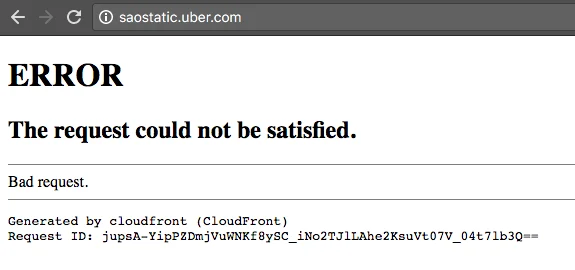
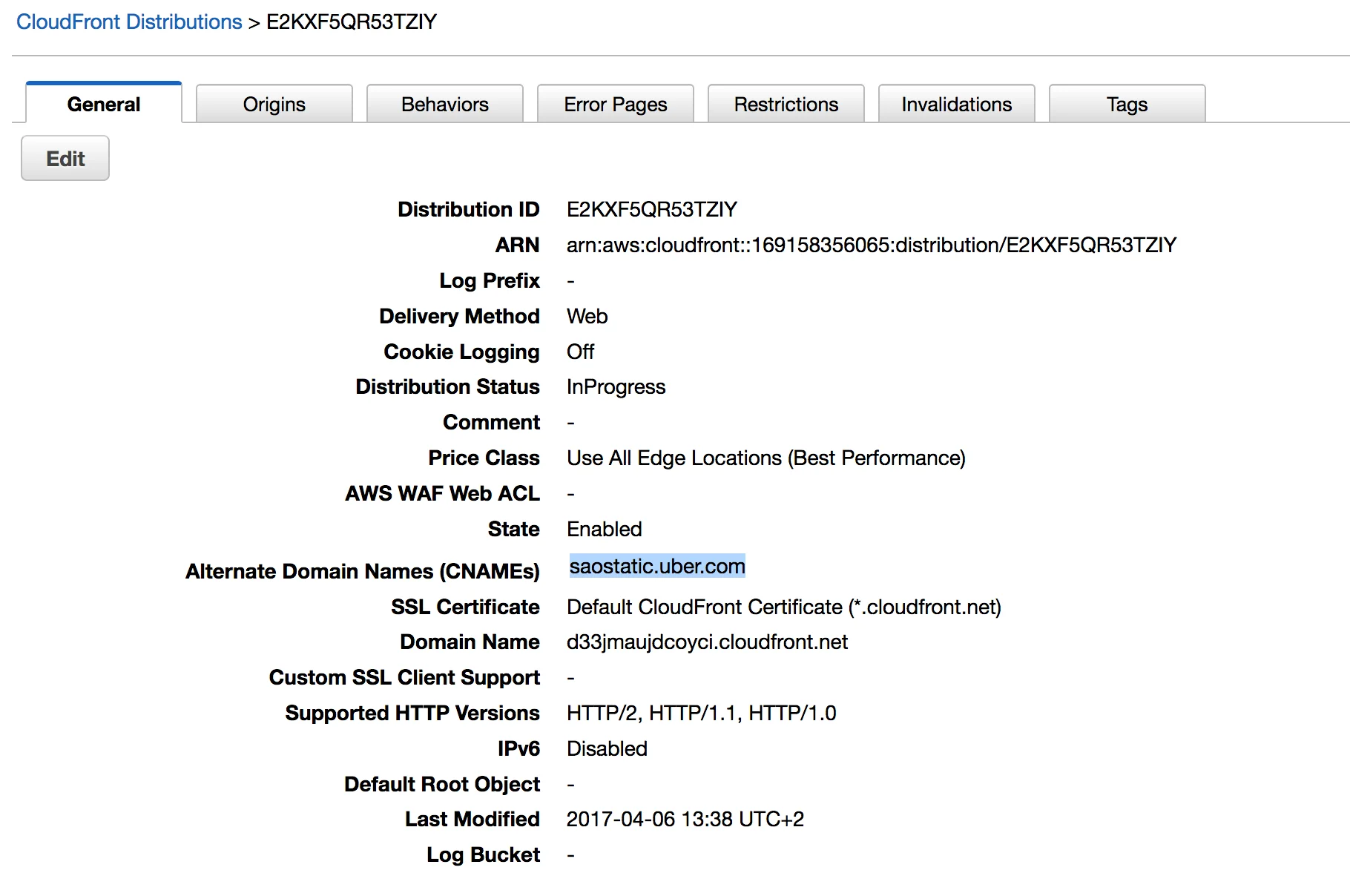
Subsequently, a new Amazon Cloudfront CDN endpoint was created and linked to an attacker-controlled origin server. For the new Cloudfront CDN endpoint, "saostatic.uber.com" was designated as hostname successfully:
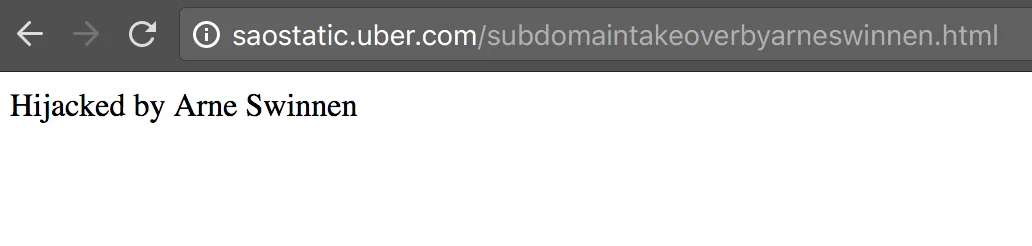
This concluded the subdomain takeover. Visual proof can be found at http://saostatic.uber.com/subdomaintakeoverbyarneswinnen.html (unguessable filename chosen to not negatively affect Uber's reputation during takeover period) :
#2. Authentication Bypass
In Uber's SSO system, auth.uber.com acts as Identity Provider and issues temporarily shared session cookies for https://*.uber.com to communicate identities to Service Providers (e.g. riders.uber.com, partners.uber.com, etc). Service Providers on their end immediately destroy the incoming temporary shared session cookies in case of erroneous (e.g. issued for other Service Provider) or successful authentication, ensuring the window for theft is small:
The precious shared session cookie "_csid" can thus only be stolen between step 9 and 10, which is a very short period (automatic browser redirect). Although not impossible to exploit, a more convenient flaw was identified that allows the shared session cookie to remain alive after step 9 in the browser's cookie store in the diagram above. The issue is that, if the victim is already logged in at https://riders.uber.com (situation after last step 12 in diagram) when receiving a request containing a valid newly generated shared session cookie "_csid", it is simply ignored. Hence it stays alive in the browser until its cookie store is cleared. An attacker simply needs to directly issue another login scenario starting from step 3 in the above diagram, and end with an additional hidden request to https://saostatic.uber.com to steal the precious session cookie:
So now an attacker has his/her hands on the victim's "_csid" shared session cookie for https://riders.uber.com, he/she can execute the normal login flow in their own browser and replace the issued "_csid" cookie value in step 9 of the first Uber SSO Login diagram to be logged in as the victim, right? Wrong. There's another countermeasure in place, namely a variant of login cross-site request forgery protection. This is the actual updated Uber SSO Login 2 diagram:
The problem here are the GET param state=CSRFTOKEN and locally scoped state cookie that are added in step 3 by the Service Provider riders.uber.com and verified in step 11. Since we can't steal these values from the victim's browser, but only the "_csid" shared session cookie, this means game over, right?
No! An attacker can obtain a proper CSRFTOKEN value and accompanying state cookie value from https://riders.uber.com by starting a normal login scenario on their end (e.g. in their own browser or via a simple script). He/she can then relay the auth.uber.com URL to the victim's browser to get the "_csid" shared session cookie for these values, and inject these in his/her own browser login scenario again in step 9. In this manner, the victim effectively generates the "_csid" temporary session token for the attacker's login scenario in a separate browser, but this works flawlessly. This still allows exploitation and thus victim impersonation in the following manner (we still assume that the victim is already logged in to auth.uber.com and visits a webpage under control by the attacker, so we basically continue the flow from the above third and last diagram):
PoC
In the PoC below, the assumption is made that https://saostatic.uber.com is actually serving a valid certificate in the victim's browser, which currently is not the case (so there is currently no actual exposed risk). I figured you might not appreciate that.
- Open the victim's browser & browse to https://riders.uber.com . After being redirected to https://auth.uber.com , login with the victim's credentials so you end up on https://riders.uber.com trips dashboard again.
- Open a second browser tab in the victim's browser and browse to https://saostatic.uber.com/prepareuberattack.php . Accept any certificate warnings that you may receive here - again, we're only simulating that the domain has a valid SSL certificate. Once the page has finished loading you should see a URL, "Cookie: " string and a "Set-Cookie: " strings underneath each other. This is all info gathered under the hood by the attacker's webserver that is required to login as the victim now.
- Open the separate attacker's browser and setup an intercepting proxy tool to intercept requests and responses. Browse to the URL displayed on the prepareuberattack.php page output and intercept this request. Now copy the "Cookie: ..." string displayed on prepareuberattack.php and paste it into the request headers.
- The response should be a redirect to https://riders.uber.com/trips, indicating successful authentication bypass. Last but not least, copy all the "Set-Cookie: " lines from the prepareuberattack.php page output and paste them in the response before forwarding it to the browser. This ensures that the stolen cookies are properly injected in the attacker's browser.
- You are now logged in as the victim in the attacker's browser
In a real attack scenario, an attacker would stealthily load https://saostatic.uber.com/prepareuberattack.php in the victim's browser, e.g. through an iframe. Likewise, he/she would probably not display the URL and all the cookies on the PHP page, but store this on the server-side, ready to be abused in a stealthy fashion.
You can see all these PoC steps executed in attachment "8. Authentication Bypass PoC video.mp4", where browser 1 and browser 2 had separate upstream servers and thus even other IP addresses to prove this is a plausible threat. The code of the https://saostatic.uber.com/prepareuberattack.php and https://saostatic.uber.com/uberattack.php pages is also attached ("9. prepareuberattack.php" and "10. uberattack.php"). This was written quick & dirty for PoC purposes - I know the code is pretty hacky.
Recommendations
- The recommendation for the subdomain takeover is straightforward: remove the dangling DNS CNAME pointer to Amazon CloudFront and the issue is resolved.
- The recommendation for the generic Authentication Bypass issue is a bit more problematic. The fact that identities supplied to Service Providers by the Identity Provider are communicated via shared *.uber.com cookies make them susceptible for all vulnerabilities that allows insight in cookies on any *.uber.com subdomain. This includes remote code execution, subdomain takeover, debug logs, etc and has a very serious impact on Uber's overall security, even when the subdomain is hosted in a completely isolated environment.
For example, all the mentioned out of scope *.uber.com subdomains in the program's listing (bizblog.uber.com, newsroom.uber.com etc) have the inherent ability to bypass authentication of any Uber user, even though they might be remotely managed by an external party with lower security standards than Uber. Ironically enough, any service that wants to benefit from the current Uber SSO system will have to receive a *.uber.com subdomain, as this is required by design. This in its turn increases the attack surface for abuse of the generic Authentication Bypass. On the short term I would recommend fixing the fact that the "_csid" cookie can remain alive in a browser once a user is already logged in (although Jack Whitton already showed that CSP could be abused to prevent a victim to make the request back to the Service Provider and invalidate the token, so I wouldn't put too much trust in that). On the mid-to-long term I would advise Uber to migrate to a real OAuth SSO system that communicates identity secrets and proofs by other means than shared cookies, e.g. GET parameters (OAuth "code" flow) or window.location.hash values (e.g. OAuth "access tokens" flow).
Let me know if anything is unclear.
Cheers,
Arne Swinnen https://www.arneswinnen.net
Not written yet. The AI write-up for this report has not been written yet. The Original tab links to the source.
How it worked
Root cause
Likely the combination of a dangling DNS CNAME record pointing to an unclaimed CloudFront distribution and SSO session cookies scoped to the parent domain, which allowed cookie leakage to the taken-over subdomain.
Impact
An attacker could impersonate the victim on any *.uber.com subdomain that relies on auth.uber.com for authentication, but the report notes that currently no valid certificate is served, so there is no actual exposed risk at the time of writing.
What the attacker needed
Victim logged in to auth.uber.com; victim visits attacker-controlled page; attacker controls taken-over subdomain
The fix
Uber fixed the subdomain takeover and added IP restriction to the SSO cookies.
How it was found
- The victim logs in to auth.uber.com and visits riders.uber.com.
- The victim visits a page on the taken-over subdomain that collects cookies and other information.
- The attacker uses the collected information to start a login flow and intercepts the request.
- The attacker injects the stolen cookie into the request and receives a redirect to riders.uber.com/trips, indicating successful authentication bypass.
- The attacker copies the Set-Cookie headers from the page output and injects them into the response to log in as the victim.
Explained by bugbounty.wiki with AI from the original and checked against quotes from it; it can still be wrong. Read the original before relying on a detail.
Not written yet. The AI write-up for this report has not been written yet. The Original tab links to the source.
A subdomain takeover happens when a company points a subdomain to an external service but forgets to remove the pointer after the service is no longer used. An attacker can claim that service and control the subdomain. Here, the stolen subdomain was part of uber.com, so cookies meant for all uber.com subdomains could be stolen, letting the attacker log in as the victim.
What is Subdomain takeover?
A company's DNS still points at a cloud service it no longer uses, so anyone can claim it and serve content on the company's domain.






