Phone Number Enumeration
An API endpoint used during sign-up to check whether a mobile number already belongs to an account returned different responses for used and unused numbers, allowing an attacker to enumerate all customer phone numbers. The attacker could then use the list for phishing or harassment.

- Disclosed after 54 days
I discovered it is possible to retrieve all Uber's customer's cell phone numbers using an API endpoint.
While going through a sign up form, I noticed that the page was making an ajax call to an API to validate the email address being entered and to make sure it doesn't already belong to an account. I began experimenting with the API and discovered that it will do the same type of validation for mobile numbers.
Response With Unused Mobile Number
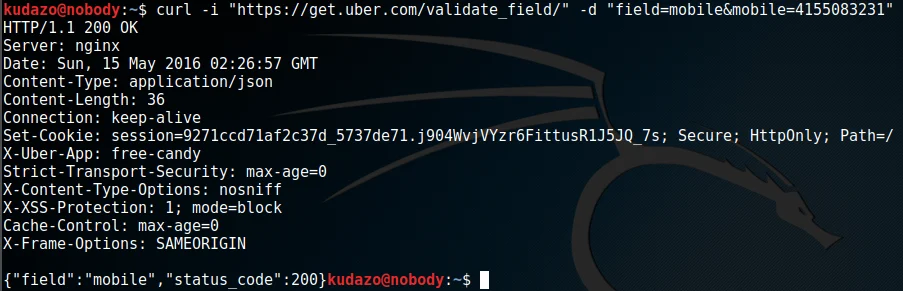
Response With Used Mobile Number (my cell number)
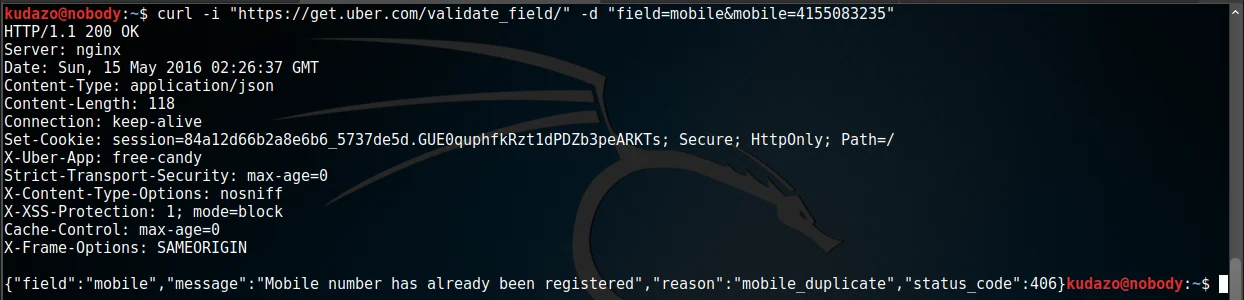
Using this information, it is very easy to loop through numbers and generate a list of Uber's customer's mobile numbers. I created a simple proof-of-concept in Python showing how this can be done and attached it to this report. (Attachment on the original report: uber_number.py)
This screenshot shows the results of my PoC script after running through a small range of numbers above and below my wife's cell phone number. The 8054528808 number is hers. I have no relationship to the other numbers. Other than checking around my wife's and my cell phone numbers, I did not attempt to extract any other numbers or information.
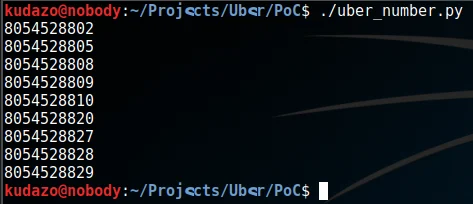
Here is another screenshot after running the PoC script for numbers just above and below my number (4155083235).

Using this information, an attacker could launch a massive phishing campaign or just harass Uber customers. It would probably also be bad PR if someone were to dump all Uber's customer's cell phone numbers out on to the Internet.
Requiring a CSRF token in the API request would slow the process down considerably, but wouldn't completely eliminate it. Maybe requiring a CSRF token and adding some rate limiting might do it.
Thanks!
- Seth
Not written yet. The AI write-up for this report has not been written yet. The Original tab links to the source.
How it worked
Root cause
Likely the API returned distinguishable responses for registered versus unregistered phone numbers, enabling enumeration.
Impact
An attacker could enumerate all customer phone numbers and use them for phishing or harassment; the report suggests a CSRF token and rate limiting would slow but not completely eliminate the attack.
What the attacker needed
Access to the sign-up API endpoint
The fix
The reporter suggests requiring a CSRF token and rate limiting, though this would only slow the process.
How it was found
- Notice the sign-up form makes an AJAX call to validate an email address.
- Experiment with the API and find it also validates mobile numbers.
- Observe different responses for an unused number and a used number.
- Write a script to loop through numbers and collect those that are in use.
Explained by bugbounty.wiki with AI from the original and checked against quotes from it; it can still be wrong. Read the original before relying on a detail.
Not written yet. The AI write-up for this report has not been written yet. The Original tab links to the source.
When you sign up, the site checks if your email or phone number is already registered. The check gave a different answer for numbers that were already in use versus numbers that were not. Because the answers differed, someone could write a script to try many numbers and learn which ones belong to real customers.
What is Info disclosure?
Data the application should keep private (personal data, internal details, other users' records) reaches someone it should not.



