Insufficient validation of sides/modifiers quantity
The online ordering application only enforced the maximum number of sides/modifiers in client-side JavaScript, not on the server. An attacker could intercept the order request and add more sides than allowed, which the restaurant might fulfil at a loss.

- Triaged in 11 hours
- Fixed in 50 days
- Paid in 10 days
- Disclosed after 12 months
Summary by the program
An order could be modified to include more sides/modifiers than was permitted due to a lack of server-side validation.
The report
Summary: The Upserve Online Ordering (OLO) application does not properly verify on the server side the number of sides/modifiers that have been added
Description: Certain items allow for selection of a limited number of sides/modifiers, and the application restricts the number of sides/modifies that can be selected on the client side through javascript, but does not validate the request on the server side for the number of sides/modifiers. By intercepting and modifying the traffic when the order request is sent, an attacker will be able to place an order with more than the allowed number of sides/modifiers.
Steps To Reproduce: The issue can be demonstrated using the test store https://app.upserve.com/s/upserve-lounge-test-providence-2 and the menu item "Char Boil Trou".
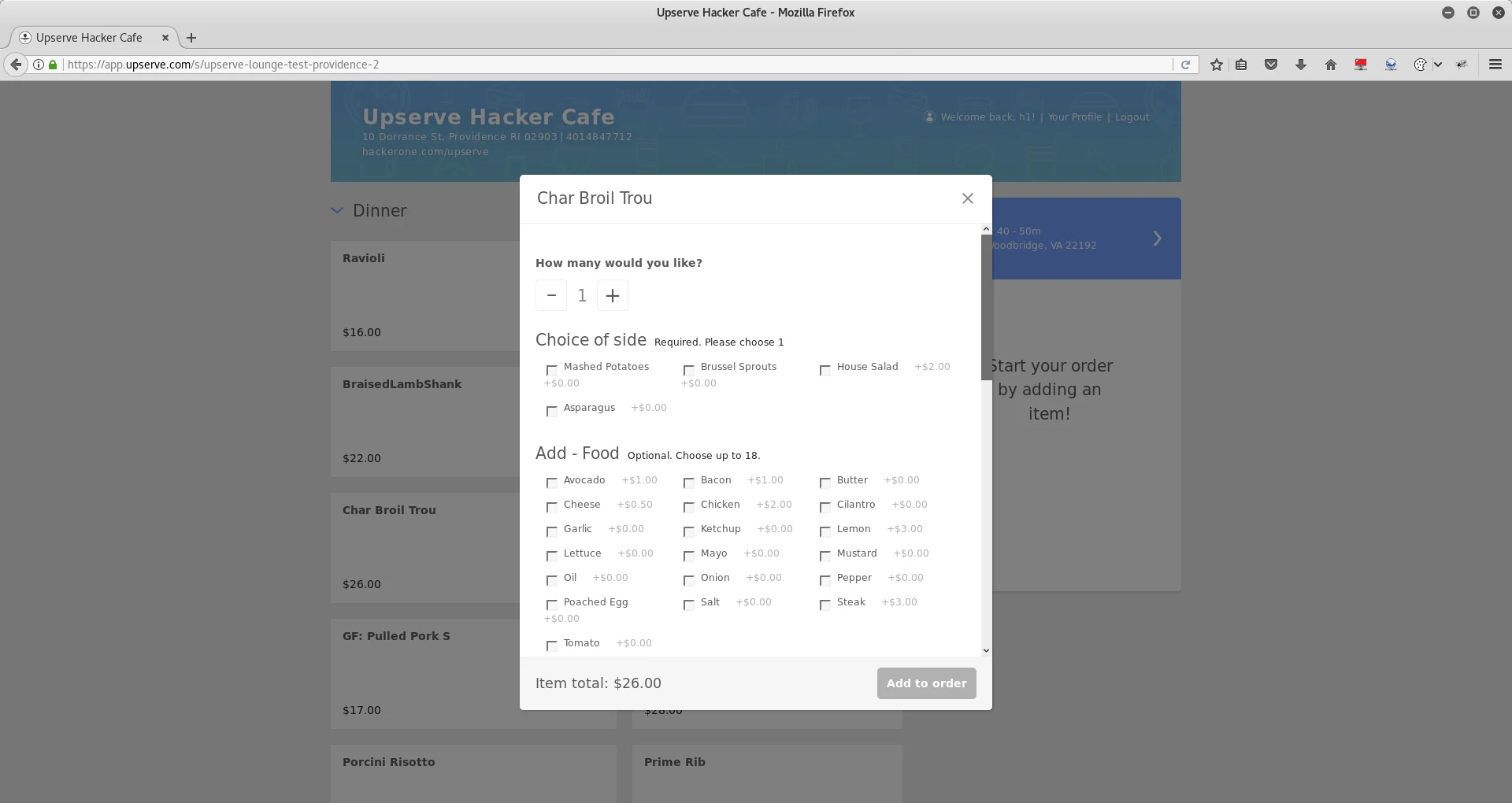
- Select the "Char Boil Trou" option and add it to the cart. Note that only 1 side can be added (exceed-max-sides-1.png)
- Checkout and submit the order
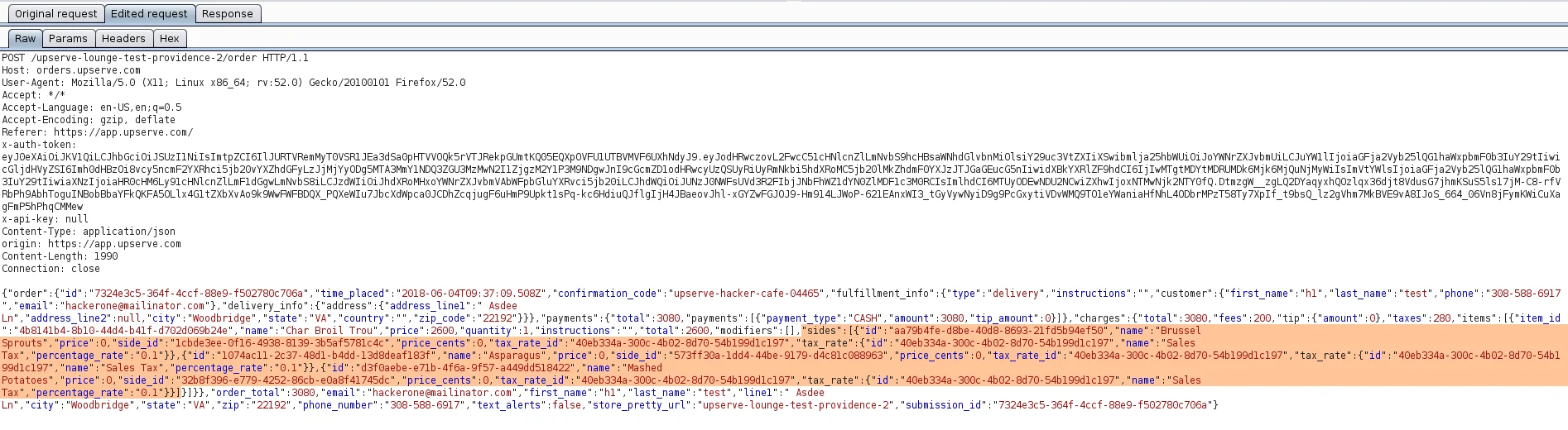
- Intercept the request and add additional sides in the JSON request. In this example 3 sides are added instead of the maximum of 1 by changing the "sides" JSON parameter to (exceed-max-sides-3.png):
"sides":[{"id":"aa79b4fe-d8be-40d8-8693-21fd5b94ef50","name":"Brussel Sprouts","price":0,"side_id":"1cbde3ee-0f16-4938-8139-3b5af5781c4c","price_cents":0,"tax_rate_id":"40eb334a-300c-4b02-8d70-54b199d1c197","tax_rate":{"id":"40eb334a-300c-4b02-8d70-54b199d1c197","name":"Sales Tax","percentage_rate":"0.1"}},{"id":"1074ac11-2c37-48d1-b4dd-13d8deaf183f","name":"Asparagus","price":0,"side_id":"573ff30a-1dd4-44be-9179-d4c81c088963","price_cents":0,"tax_rate_id":"40eb334a-300c-4b02-8d70-54b199d1c197","tax_rate":{"id":"40eb334a-300c-4b02-8d70-54b199d1c197","name":"Sales Tax","percentage_rate":"0.1"}},{"id":"d3f0aebe-e71b-4f6a-9f57-a449dd518422","name":"Mashed Potatoes","price":0,"side_id":"32b8f396-e779-4252-86cb-e0a8f41745dc","price_cents":0,"tax_rate_id":"40eb334a-300c-4b02-8d70-54b199d1c197","tax_rate":{"id":"40eb334a-300c-4b02-8d70-54b199d1c197","name":"Sales Tax","percentage_rate":"0.1"}}]
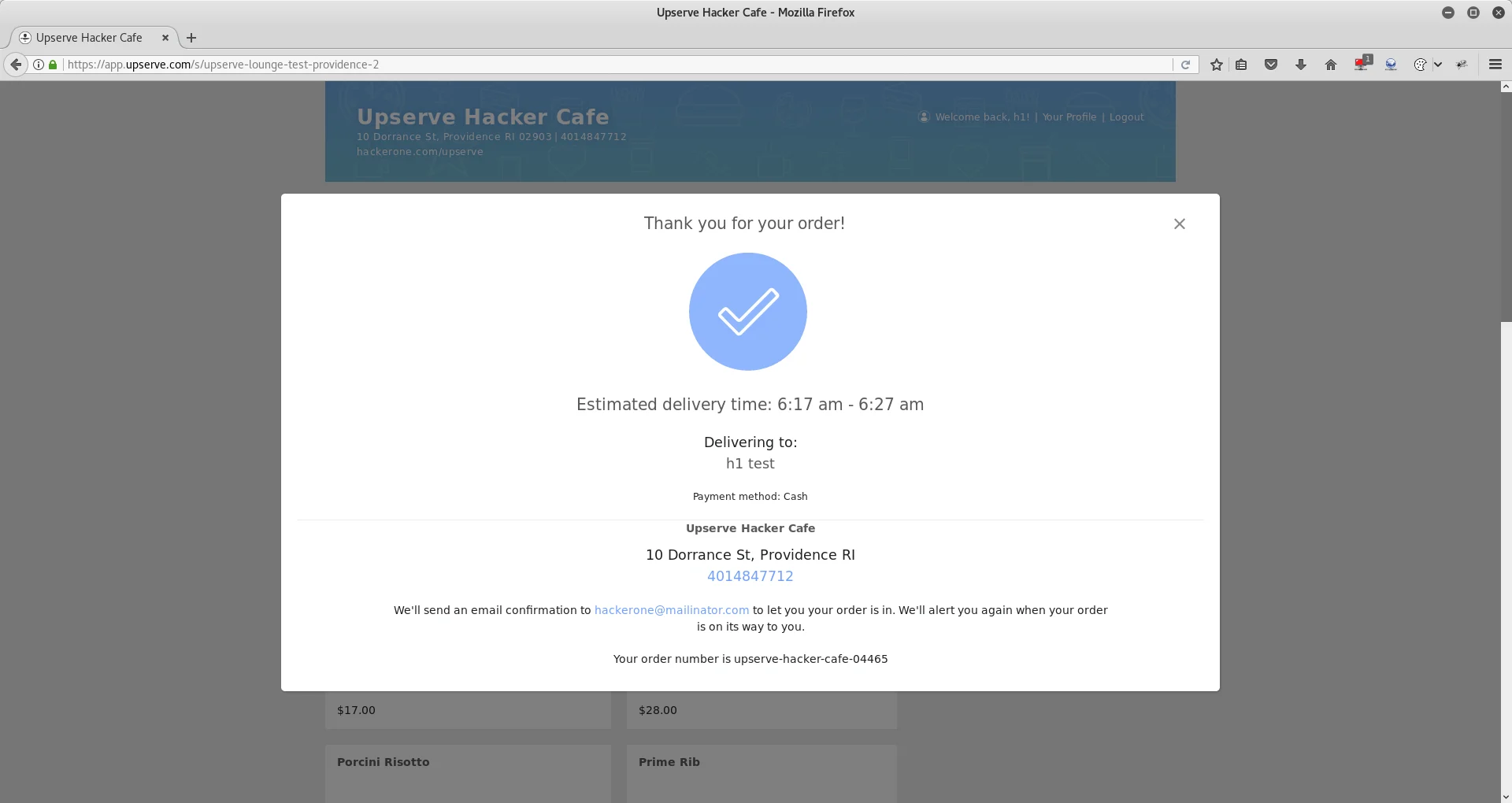
4) The request is accepted by the application (exceed-max-sides-2.png)
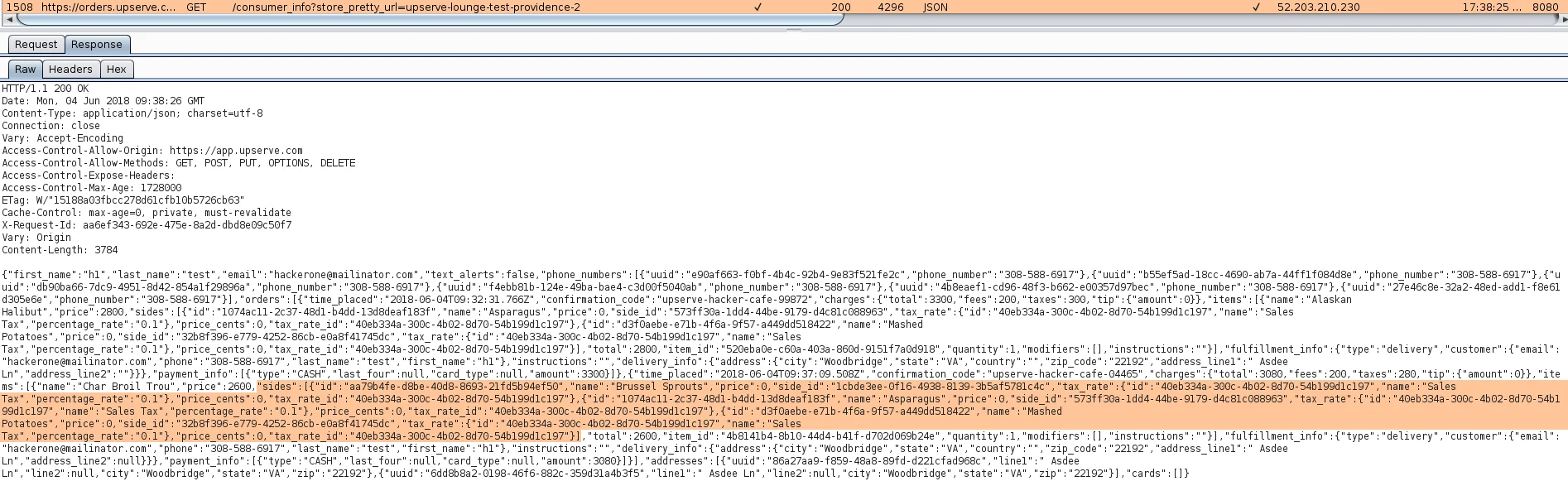
5) Viewing the submitted order in the users profile shows that the order was made with 3 sides (exceed-max-sides-4.png)
Impact
A malicious user will be able to add additional sides/modifiers beyond the maximum number allowed, which the restaurant might include if the discrepancy is not noticed, which would result in monetary loss to the restaurant.
Attachments
Context
Upserve runs an Online Ordering (OLO) application, reachable at orders.upserve.com, that lets customers build an order from a restaurant menu and submit it for fulfilment. Some menu items come with a configurable set of sides or modifiers, and the menu defines a maximum number that may be attached to a single item. For the item used in this report, "Char Boil Trou", the limit is one side.
The application enforces that limit in the browser: JavaScript prevents the customer from selecting more sides than the item allows. The question the researcher asked was whether the same limit is enforced when the order is submitted to the server.
Setup
The work was done against a test store, https://app.upserve.com/s/upserve-lounge-test-providence-2, using the menu item "Char Boil Trou". The only tooling implied is an intercepting proxy, since the technique depends on capturing and editing the order submission request in flight. No account details, roles or software versions are given in the report.
Finding it
The client-side restriction is visible during normal use: when the item is added to the cart, only one side can be selected. That restriction lives in JavaScript, which means it is a convenience for the honest user rather than a security control. The researcher's hypothesis was that the server accepts whatever list of sides arrives in the order request, without checking it against the item's configured maximum. If true, editing the request after the browser has done its validation would produce an order the menu never intended to allow.
Exploitation
Step 1: Add the item and observe the limit
Select the "Char Boil Trou" option and add it to the cart. The interface allows only one side to be added.
Step 2: Checkout and submit the order
Proceed through checkout and submit the order as normal. The submission is the request that will be tampered with.
Step 3: Intercept and modify the sides array
Intercept the order request and add extra sides to the JSON body. In the example, three sides are supplied instead of the maximum of one by replacing the sides parameter with the following array:
"sides":[{"id":"aa79b4fe-d8be-40d8-8693-21fd5b94ef50","name":"Brussel Sprouts","price":0,"side_id":"1cbde3ee-0f16-4938-8139-3b5af5781c4c","price_cents":0,"tax_rate_id":"40eb334a-300c-4b02-8d70-54b199d1c197","tax_rate":{"id":"40eb334a-300c-4b02-8d70-54b199d1c197","name":"Sales Tax","percentage_rate":"0.1"}},{"id":"1074ac11-2c37-48d1-b4dd-13d8deaf183f","name":"Asparagus","price":0,"side_id":"573ff30a-1dd4-44be-9179-d4c81c088963","price_cents":0,"tax_rate_id":"40eb334a-300c-4b02-8d70-54b199d1c197","tax_rate":{"id":"40eb334a-300c-4b02-8d70-54b199d1c197","name":"Sales Tax","percentage_rate":"0.1"}},{"id":"d3f0aebe-e71b-4f6a-9f57-a449dd518422","name":"Mashed Potatoes","price":0,"side_id":"32b8f396-e779-4252-86cb-e0a8f41745dc","price_cents":0,"tax_rate_id":"40eb334a-300c-4b02-8d70-54b199d1c197","tax_rate":{"id":"40eb334a-300c-4b02-8d70-54b199d1c197","name":"Sales Tax","percentage_rate":"0.1"}}]
Each element of the array is a full side object: an id, a human-readable name (Brussel Sprouts, Asparagus, Mashed Potatoes), a side_id identifying the side definition, price and price_cents (both zero here), and the tax metadata (tax_rate_id plus a nested tax_rate object with the name "Sales Tax" and a percentage_rate of 0.1). The array simply carries three of these objects where the menu permits one. The report does not show the surrounding request, its method, path or headers.
Step 4: The server accepts the order
Forward the request. The application accepts it, so the order is created with three sides attached to an item whose maximum is one.
Step 5: Confirm the stored order
View the submitted order in the user's profile. It shows the order was made with three sides.
The screenshot shows the submitted order in the user's profile with three sides.
Root cause
The number of sides or modifiers is validated only in the browser, through JavaScript, and the server does not repeat that check when it processes the order request. The server therefore trusts the sides array as submitted. Because the limit is a property of the menu item rather than of the transport, nothing in the request itself signals that three sides are invalid, and the application has no server-side rule to compare the array length against the item's configured maximum. The report does not describe any other defence that was present or bypassed.
Impact
A malicious user can add sides or modifiers beyond the maximum number allowed for an item. If the restaurant does not notice the discrepancy, it may prepare and include the extra items, resulting in monetary loss to the restaurant. The report frames this conditionally: the loss depends on the extra items being fulfilled without the discrepancy being caught. The severity assigned was medium (CVSS 6.1) under business logic errors, with a bounty of 500 USD.
Fix
The program's own summary states the cause plainly: an order could be modified to include more sides or modifiers than permitted due to a lack of server-side validation.
Variants to test
- Other capped selections. Items with limits on modifiers, toppings, extras or combo choices. Positive result: the server accepts an array longer than the configured maximum and the order is stored with the extra entries.
- Quantity fields. Numeric quantity parameters for line items or modifiers. Positive result: a quantity above the menu maximum is accepted and reflected in the stored order.
- Required versus optional selections. Items that require a minimum number of choices. Positive result: a request with fewer than the minimum, or none, is accepted.
- Price-bearing modifiers. Sides and modifiers that carry a non-zero price. Positive result: extra paid modifiers are accepted, or a price field in the request is trusted and can be altered. The report's example sides are all priced at zero, so this variant is untested there.
- Cross-item reuse. Side identifiers belonging to a different item or store. Positive result: the server accepts a
side_idthat is not valid for the ordered item.
Hunting notes
This class of bug hides wherever the UI presents a constrained choice: maximum sides, maximum toppings, party size, seat counts, ticket quantities. The signal during recon is a client-side counter or disabled button that stops you adding more; if the limit is implemented in JavaScript, it is worth checking whether the submission enforces it. Intercepting the order or cart request and lengthening the relevant array is usually enough to tell.
Proving impact here was straightforward because the effect is durable and visible: the tampered request was accepted, and the order in the user's profile showed the extra sides.
Disclosure
The report was disclosed on 6 June 2019 through HackerOne, credited to the researcher liquid8.
What happened, in plain words
Upserve runs an online ordering system. Restaurants put their menus into it, customers pick items in a web page, and the order is sent to the restaurant to be prepared. Some menu items come with a choice of "sides" or "modifiers": small extras you can attach to a dish, such as a portion of vegetables or a different style of preparation. The menu can say how many of these extras are allowed per item. For the dish used in this report, "Char Boil Trou", the menu allows exactly one side.
The web page enforces that limit. When you add the dish to your cart, the page only lets you tick one side. But that restriction is written in JavaScript, the code that runs inside your own browser. Your browser is under your control, not the restaurant's, so anything it enforces can be changed. The real question is whether the restaurant's server, the computer that actually records the order, checks the same limit when the order arrives.
The researcher found that it does not. By catching the order on its way out of the browser and editing it to carry three sides instead of one, the order was accepted and stored with all three sides. The restaurant might include the extra sides if the discrepancy is not noticed, resulting in monetary loss.
This kind of flaw is called a business logic error: the software works exactly as programmed, but the rules of the business (here, "one side per dish") are not enforced where it matters. Nothing crashes and no alarm goes off; the application simply trusts a number it should have checked.
Context
Upserve's Online Ordering (OLO) application lives at orders.upserve.com. A customer builds an order from a restaurant menu and submits it for fulfilment. Some items come with a configurable set of sides or modifiers, and the menu defines a maximum number that may be attached to a single item. For "Char Boil Trou", that maximum is one side.
The limit is enforced in the browser: JavaScript stops the customer selecting more sides than the item allows. The researcher's question was whether the same limit is enforced when the order is submitted to the server.
A useful comparison: a nightclub bouncer who checks your ticket at the door is a real control, because the bouncer is not you. A sign in your own living room saying "maximum two guests" is not a control, because you can take the sign down. JavaScript in your browser is the sign in your living room. The server is the bouncer.
Setup
The work was done against a test store, https://app.upserve.com/s/upserve-lounge-test-providence-2, using the menu item "Char Boil Trou". The technique depends on capturing and editing the order submission request while it is in flight, which implies an intercepting proxy: a tool that sits between your browser and the website and lets you pause, read and change the traffic passing through it. Think of it as a postal worker who, before delivering your letter, lets you open it, rewrite a line and seal it again.
The report gives no account details, roles or software versions.
Finding it
The client-side restriction is visible during normal use: when the item is added to the cart, only one side can be selected. That restriction lives in JavaScript, which makes it a convenience for the honest user rather than a security control. The hypothesis was that the server accepts whatever list of sides arrives in the order request, without comparing it to the item's configured maximum. If true, editing the request after the browser has done its check would produce an order the menu never intended to allow.
Exploitation
Step 1: Add the item and observe the limit
Select the "Char Boil Trou" option and add it to the cart. The interface allows only one side to be added.
Step 2: Checkout and submit the order
Proceed through checkout and submit the order as normal. This step exists to produce the request that will be tampered with: you need to see a real, valid submission once before you can change it. The submission is the moment the browser hands the order to the server, and it is the only moment where the browser's opinion stops mattering and the server's opinion starts.
Step 3: Intercept and modify the sides array
The order travels to the server as a request: a message from your browser asking the server to do something, here "create this order". The details of the order are carried in the request body, formatted as JSON, a text format for structured data built from names and values. One of those names is sides, and its value is an array, an ordered list written between square brackets.
Intercept the order request and add extra sides to the JSON body. In the example, three sides are supplied instead of the maximum of one by replacing the sides parameter with the following array:
"sides":[{"id":"aa79b4fe-d8be-40d8-8693-21fd5b94ef50","name":"Brussel Sprouts","price":0,"side_id":"1cbde3ee-0f16-4938-8139-3b5af5781c4c","price_cents":0,"tax_rate_id":"40eb334a-300c-4b02-8d70-54b199d1c197","tax_rate":{"id":"40eb334a-300c-4b02-8d70-54b199d1c197","name":"Sales Tax","percentage_rate":"0.1"}},{"id":"1074ac11-2c37-48d1-b4dd-13d8deaf183f","name":"Asparagus","price":0,"side_id":"573ff30a-1dd4-44be-9179-d4c81c088963","price_cents":0,"tax_rate_id":"40eb334a-300c-4b02-8d70-54b199d1c197","tax_rate":{"id":"40eb334a-300c-4b02-8d70-54b199d1c197","name":"Sales Tax","percentage_rate":"0.1"}},{"id":"d3f0aebe-e71b-4f6a-9f57-a449dd518422","name":"Mashed Potatoes","price":0,"side_id":"32b8f396-e779-4252-86cb-e0a8f41745dc","price_cents":0,"tax_rate_id":"40eb334a-300c-4b02-8d70-54b199d1c197","tax_rate":{"id":"40eb334a-300c-4b02-8d70-54b199d1c197","name":"Sales Tax","percentage_rate":"0.1"}}]
Reading it piece by piece:
"sides":[...]is the namesidesfollowed by a colon and then a list. Everything between the outer square brackets is the list of sides attached to the dish.- The list contains three entries, each wrapped in curly braces
{ }. Curly braces group related values together, like a form with labelled fields. "id"is a long string of letters, digits and hyphens. It looks like a unique identifier for this particular side entry, so the server can tell one entry from another."name"is the human-readable label:Brussel Sproutsin the first entry,Asparagusin the second,Mashed Potatoesin the third. These are the three sides the customer will receive."side_id"is another identifier, different fromid. It appears to point at the side as defined on the menu, rather than at this one use of it."price"and"price_cents"are both0in all three entries, so these sides cost nothing extra in this example."tax_rate_id"is an identifier for a tax rule, and"tax_rate"is a nested group (curly braces inside curly braces) describing that rule: anameofSales Taxand apercentage_rateof"0.1".
The change is simple in principle: the array carries three of these objects where the menu permits one. The report does not show the surrounding request, its method, path or headers.
Step 4: The server accepts the order
Forward the request. The application accepts it, so the order is created with three sides attached to an item whose maximum is one.
Step 5: Confirm the stored order
View the submitted order in the user's profile. It shows the order was made with three sides.
The screenshot shows the submitted order in the user's profile with three sides.
Root cause
The number of sides or modifiers is validated only in the browser, through JavaScript, and the server does not repeat that check when it processes the order request. The server therefore trusts the sides array as submitted. Because the limit is a property of the menu item rather than of the transport, nothing in the request itself signals that three sides are invalid, and the application has no server-side rule to compare the array length against the item's configured maximum. The report does not describe any other defence that was present or bypassed.
In everyday terms: the restaurant wrote "one side only" on the customer's own notepad and hoped for the best, instead of checking the order when it reached the kitchen.
Impact
A malicious user can add sides or modifiers beyond the maximum number allowed for an item. If the restaurant does not notice the discrepancy, it may prepare and include the extra items, resulting in monetary loss to the restaurant. The report frames this conditionally: the loss depends on the extra items being fulfilled without the discrepancy being caught.
The severity assigned was medium (CVSS 6.1) under business logic errors, with a bounty of 500 USD. CVSS is a standard scoring system for the seriousness of a security flaw, and bounty is the payment a company makes to a researcher who reports one responsibly.
Fix
The program's own summary states the cause plainly: an order could be modified to include more sides or modifiers than permitted due to a lack of server-side validation.
Variants to test
- Other capped selections. Items with limits on modifiers, toppings, extras or combo choices. Positive result: the server accepts an array longer than the configured maximum and the order is stored with the extra entries.
- Quantity fields. Numeric quantity parameters for line items or modifiers. Positive result: a quantity above the menu maximum is accepted and reflected in the stored order.
- Required versus optional selections. Items that require a minimum number of choices. Positive result: a request with fewer than the minimum, or none, is accepted.
- Price-bearing modifiers. Sides and modifiers that carry a non-zero price. Positive result: extra paid modifiers are accepted, or a price field in the request is trusted and can be altered. The report's example sides are all priced at zero, so this variant is untested there.
- Cross-item reuse. Side identifiers belonging to a different item or store. Positive result: the server accepts a
side_idthat is not valid for the ordered item.
Hunting notes
This class of bug hides wherever the interface presents a constrained choice: maximum sides, maximum toppings, party size, seat counts, ticket quantities. The signal during recon is a client-side counter or a disabled button that stops you adding more. If the limit is implemented in JavaScript, it is worth checking whether the submission enforces it. Intercepting the order or cart request and lengthening the relevant array is usually enough to tell.
Proving impact here was straightforward because the effect is durable and visible: the tampered request was accepted, and the order in the user's profile showed the extra sides.
Disclosure
The report was disclosed on 6 June 2019 through HackerOne, credited to the researcher liquid8.
Glossary
- API: the set of addresses and message formats a website offers so that software can ask it to do things, such as create an order.
- Array: an ordered list of values in JSON, written between square brackets.
- Business logic error: a flaw where the software runs as programmed but the rules of the business are not enforced, so the program can be used in ways the owner never intended.
- Client side: code that runs on the user's own computer, in the browser, and can therefore be changed by the user.
- CVSS: a standard scoring system that rates the seriousness of a security flaw.
- HackerOne: a platform where security researchers report flaws to companies and companies pay bounties for valid reports.
- Intercepting proxy: a tool placed between the browser and the website that can pause, display and modify traffic in both directions.
- JavaScript: the programming language that runs inside web pages in the browser and makes them interactive.
- JSON: a text format for structured data, built from names and values, used to carry information between a browser and a server.
- Modifier: an extra or variation attached to a menu item, such as a choice of side or cooking style.
- Request: a message sent from a browser to a server asking it to do something.
- Response: the server's reply to a request.
- Server side: code that runs on the company's own computers, which the user cannot change, and which is therefore where security checks belong.
- Sides: the extra portions or accompaniments that can be attached to a dish.
- Test store: a demonstration restaurant account set up for trying things out rather than for real customers.
- Validation: checking that data meets the rules before acting on it, for example that a list of sides is not longer than the menu allows.




