DOM XSS through ads
Multiple ads on urbandictionary.com inject the page URL into a JavaScript string without escaping, allowing a crafted URL fragment to break out and execute arbitrary JavaScript. An attacker could run script in the victim's browser under the site's origin, potentially acting on behalf of a logged-in user.

- Fixed in 19 months
- Disclosed after 20 months
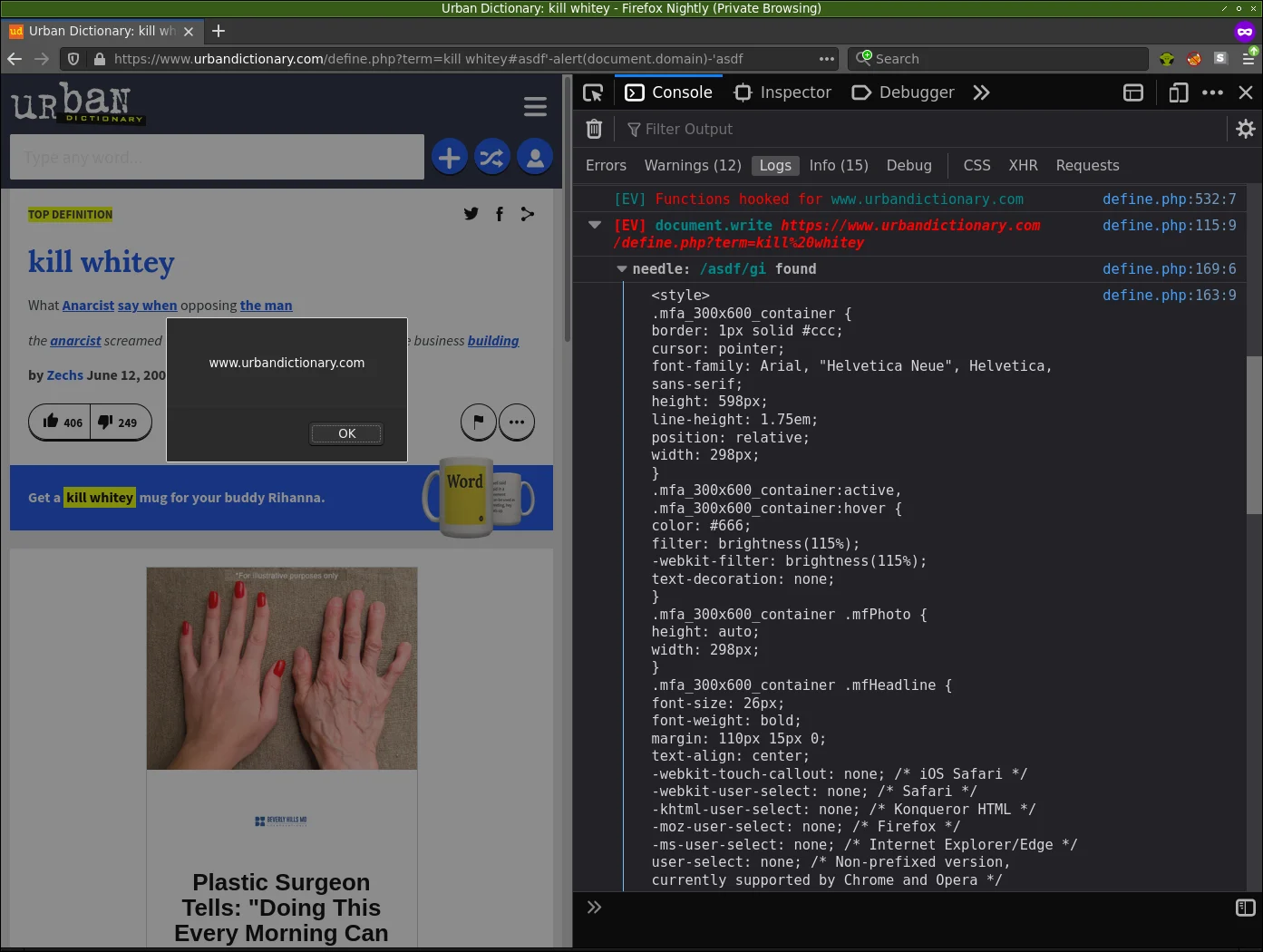
Multiple ads hosted on www.urbandictionary.com make the www.urbandictionary.com origin vulnerable to DOM XSS. Attached is an image of alert(document.domain) executing. The injection works in Firefox and Chrome.
Visiting the following URL will probably cause an alert box displaying the document.domain as www.urbandictionary.com.
https://www.urbandictionary.com/define.php?term=#asdf'-alert(document.domain)-'asdf
I say "probably" because the exploit depends on the loading of certain ads. Doing this from a fresh browser session usually causes the alert box. If not refreshing the page a few times, allowing the page to fully load, usually causes the pop-up. It all depends on which ad loads.
It appears the pwt.js JavaScript file uses the displayCreative function to display a unique ad. This apparently is done by executing document.write in an anonymous function to write the ad into the the www.urbandictionary.com page. Visiting the above link will cause one of the ads to execute document.domain with a string that contains the following:
<script type='text/javascript'>
url='https://vap3ord1.lijit.com/res/sovrn.containertag.new.min.js…252de1&loc=https://www.urbandictionary.com/define.php?term=#asdf'-alert(document.domain)-'',
Many ads want a reference to the website that is loading them, so they inject the URL of the hosting page into the ad source. Since the vulnerable inject the containing page into a JavaScript single quote string, a single quote can be used to escape out of the string. This results in the JavaScript alert function being called.
The stack trace for the above injection follows:
    <anonymous> (index):2
    displayCreative pwt.js:11048
    displayCreative pwt.js:13098
    displayCreative pwt.js:10759
    <anonymous> define.php:1
    apply define.php:347
    <anonymous> (index):2
    <anonymous> (index):2
    Caspr (index):2
    Caspr (index):2
    casprInvocation (index):3
    <anonymous> (index):8
    <anonymous> (index):8
Multiple ads contain the nearly the same vulnerability. The stack trace is always the same. The string passed to document.domain is different depending on the ad. I will try to include a few examples by attaching files showing the entire content being passed to document.write.
I obtained the strings passed to document.domain using the Eval Villain extension for Firefox, which I developed. This extension may assist you in finding the cause of the vulnerability, or verifying it's existence.
Impact
DOM XSS allows an attacker to run arbitrary JavaScript under you origin. Since users can authenticate to this origin, an attacker could use this to perform actions in behalf of a victim using the victim session. I have not yet authenticated to the site, so I don't know exactly what all that would entail.
An attacker could use this vulnerability to add malicious or inappropriate content to your website or takeover the ads seen there.
So far, it appears the urbandictionary.store does not grant the vulnerable origin any CORS privileges. This means an attacker most likely can NOT steal credit card information or modify purchases.
Attachments
Not written yet. The AI write-up for this report has not been written yet. The Original tab links to the source.
How it worked
Impact
An attacker could run arbitrary JavaScript in the context of urbandictionary.com, potentially performing actions on behalf of a logged-in user, but the report notes that CORS protections on urbandictionary.store likely prevent theft of credit card data or purchase modification.
What the attacker needed
Victim visits a crafted URL; specific ad loads on the page
How it was found
- Visit the provided URL with a crafted fragment containing a single quote and JavaScript code.
- The page loads ads that use document.write to insert the page URL into a script.
- The single quote in the URL breaks out of the string, causing the JavaScript to execute.
- If the ad does not load, refresh the page until it does.
Explained by bugbounty.wiki with AI from the original and checked against quotes from it; it can still be wrong. Read the original before relying on a detail.
Not written yet. The AI write-up for this report has not been written yet. The Original tab links to the source.
When you visit a website, it sometimes loads ads from other companies. These ads take the address of the page you are on and put it inside a piece of code. If the address contains special characters like a single quote, it can trick the code into running a malicious script. This lets an attacker run their own JavaScript as if it came from the website, which could let them do things like post comments or change ads.
What is XSS?
Script an attacker supplies runs in another user's browser, on the target's origin, with that user's session.



