Reflected XSS in www.dota2.com
A reflected cross-site scripting vulnerability existed on a Dota 2 website page, where a crafted URL caused JavaScript to execute in the victim's browser. An attacker could trick a user into visiting such a URL to steal cookies or perform other actions.
 Originally disclosed on HackerOne
- Triaged in 15 days
- Fixed in 15 days
- Paid in 15 days
- Disclosed after 6 months
Hi guys,
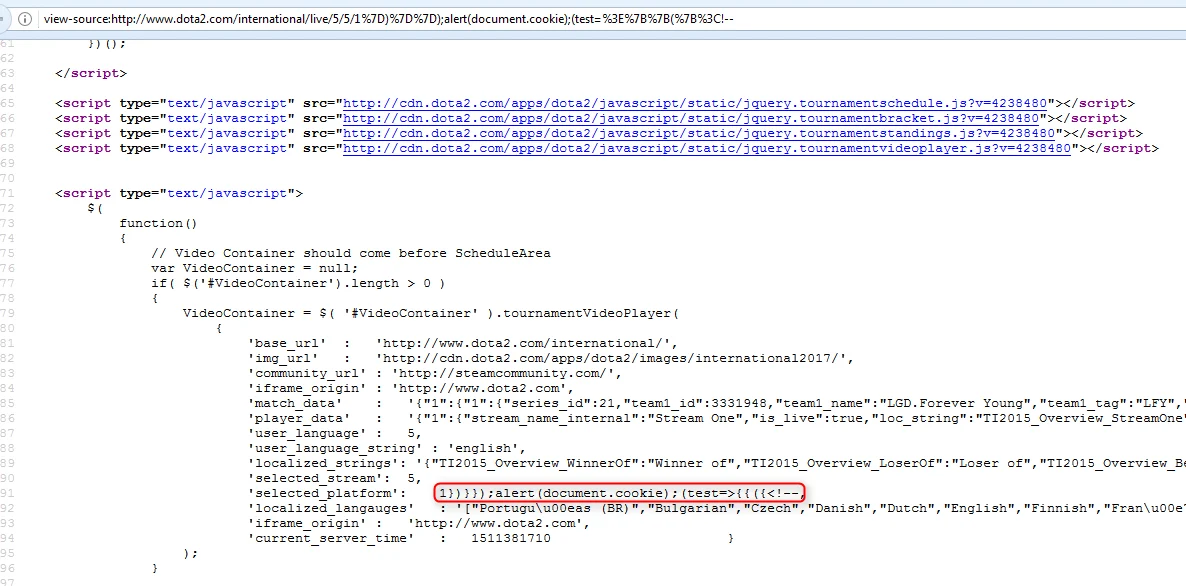
##Description I found another XSS in www.dota2.com. This time it is located in http://www.dota2.com/international/live/5/5/1. However it seems that when you can change the /5/5 folders to any other number (to confirm) and it still worked. I tested this on http://www.dota2.com/international/live/1/1/1 and with other random digits.
##Steps to reproduce
- Using any browser (except IE), go to
www.dota2.com/international/live/5/5/1})}});alert(document.cookie);(test=>{{({<!--
2. You'll see an alert box with your cookie.
I was able to confirm the XSS works in Firefox, Chrome and Opera so the payload successfully bypasses the Chrome XSS filter since the reflection point is directly in a javascript.
Impact
As you know, with a reflected XSS, a malicious user could trick a user into browsing to a URL which would trigger the XSS and steal the user's cookie, capture keyboard strokes, etc and eventually take over a user's account.
Thanks,
JR0ch17
Not written yet. The AI write-up for this report has not been written yet. The Original tab links to the source.
How it worked
Root cause
Likely the application reflected user-controlled input from the URL path directly into a JavaScript context without proper encoding or validation.
Impact
A malicious user could trick a user into browsing to a URL that triggers the XSS and steal the user's cookie, capture keyboard strokes, etc., and eventually take over a user's account.
What the attacker needed
Victim clicks a crafted link; browser other than Internet Explorer
How it was found
- Open a browser (except Internet Explorer) and navigate to the crafted URL on www.dota2.com/international/live/5/5/1 with the payload appended.
- Observe an alert box displaying the user's cookie.
Explained by bugbounty.wiki with AI from the original and checked against quotes from it; it can still be wrong. Read the original before relying on a detail.
Not written yet. The AI write-up for this report has not been written yet. The Original tab links to the source.
Cross-site scripting (XSS) is when a website takes input from a URL and puts it directly into the page without cleaning it, so an attacker can make the page run their own code. Here, the page inserted part of the URL into a JavaScript block, so a specially crafted link would pop up an alert showing the user's cookies. This means an attacker could send a link that, when clicked, runs malicious code in the victim's browser.
What is XSS?
Script an attacker supplies runs in another user's browser, on the target's origin, with that user's session.





