Authenticated XXE
WordPress's Media Library parsed uploaded XML-based files with entity substitution enabled on PHP 8, so an authenticated author could upload a crafted .wav file to trigger XXE. This let the attacker read system files, cause denial of service, perform SSRF, or attempt Phar deserialisation.
 Originally disclosed on HackerOne
- Triaged in 25 days
- Fixed in 3 months
- Paid in 3 months
- Disclosed after 3 months
Summary by the researcher
The WordPress core Media Library did not securely parse XML content when running on PHP 8. By uploading a malicious .wav file, an authenticated attacker could trigger a XXE vulnerability which enabled to read secret system files, DoS the web server, perform SSRF, or aim at Remote Code Execution via Phar Deserialization. Find the technical advisory in our blog: https://blog.sonarsource.com/wordpress-xxe-security-vulnerability.
The report
Description:
The WordPress core Media Library does not securely parse XML content when running on PHP 8. By uploading a malicious .wav file, an authenticated attacker can trigger a XXE vulnerability which enables to read secret system files, DoS the web server, perform SSRF, or aim at Remote Code Execution via Phar Deserialization.
Steps To Reproduce:
Requirements:
- latest WordPress 5.6 installation
- running on PHP 8
- author user privileges in WordPress, or higher
- another web server that is controlled by the attacker to retrieve leaked data
The vulnerability can be exploited by uploading a crafted .wav file. The attached archive contains such a .wav file with a payload for extracting the content of /etc/passwd by loading an external DTD. To reproduce:
- Adapt the address in the 2 files in the attached PoC archive to point to a web server that you control (and that is reachable from the targeted WordPress installation).
- For the .wav file, the address has to be adapted at
0x000338CD(best use a hex editor for this, doing that with a text editor might corrupt the file). - Put the file xxe.dtd at the root of the webserver that you control.
- Login to WordPress as author and upload xxe.wav in the media library.
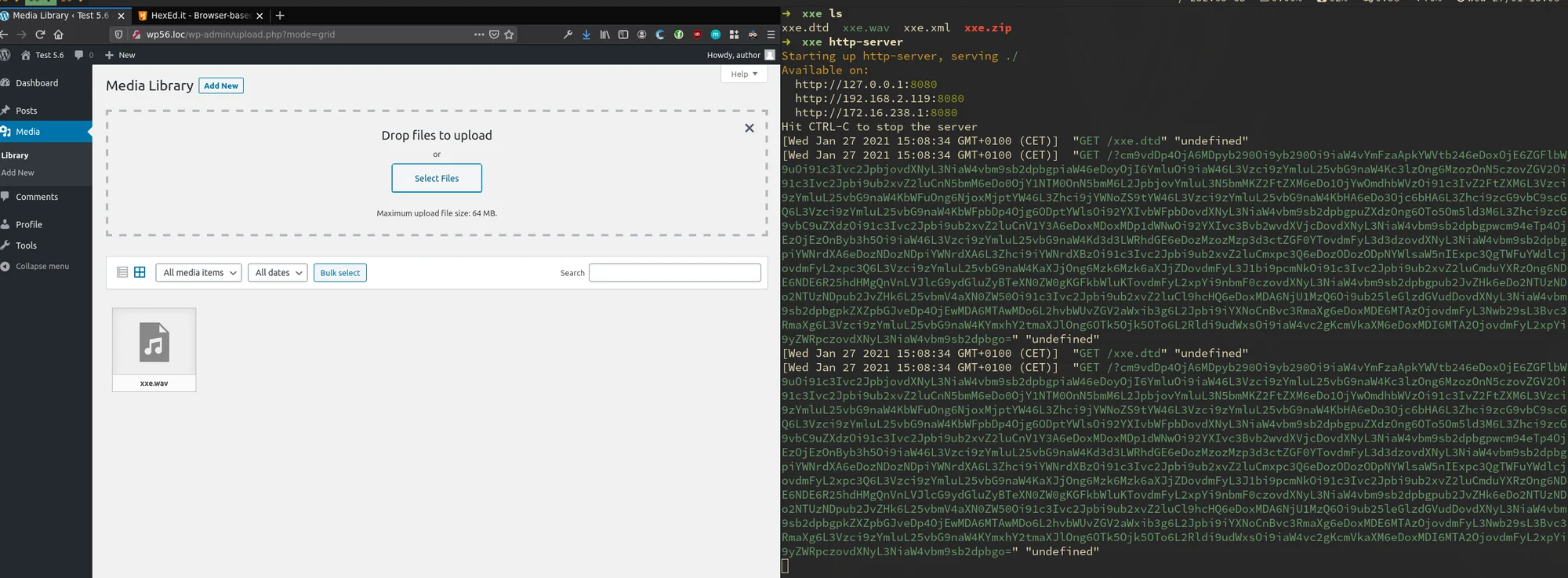
- The content of /etc/passwd will appear in the access logs of the web server base64 encoded (see attached screenshot).
Vulnerable Code:
The vulnerable code commit is the following: https://github.com/WordPress/WordPress/commit/03eba7beb2f5b96bd341255eaa30d6b612e62507
The vulnerable code is:
			if (PHP_VERSION_ID < 80000) {
				// http://websec.io/2012/08/27/Preventing-XEE-in-PHP.html
				// https://core.trac.wordpress.org/changeset/29378
				// This function has been deprecated in PHP 8.0 because in libxml 2.9.0, external entity loading is
				// disabled by default, so this function is no longer needed to protect against XXE attacks.
				$loader = libxml_disable_entity_loader(true);
			}
			$XMLobject = simplexml_load_string($XMLstring, 'SimpleXMLElement', LIBXML_NOENT);
It was recently modified to accommodate for the deprecation of the libxml_disable_entity_loader() function in PHP 8. The mistake here is to rely on the fact that XXE is no longer possible by default in PHP 8 (as it requires libxml version > 2.9). This is true, but using the LIBXML_NOENT flag is certainly not the default. The flag explicitly activates entity substitution (the name of the flag might be a little misleading). So if user input reaches that point as part of the $XMLstring variable, XXE is possible.
Impact
An attacker can:
- read secret system files, such as .htaccess or wp-config.php
- DoS the web server via a malicious XML document, or by loading /dev/urandom via XXE
- fingerprint and exploit services in the internal network by turning the XXE into SSRF
- trigger a Phar Deserialization by using the
phar://stream wrapper within the XXE which can lead to further vulnerabilities, depending on the gadget chains available in the WordPress core and its plugins.
Attachments
Not written yet. The AI write-up for this report has not been written yet. The Original tab links to the source.
How it worked
Root cause
The code relied on PHP 8 disabling external entities by default but still passed the LIBXML_NOENT flag, which explicitly enables entity substitution.
Impact
An attacker could read secret files such as wp-config.php, cause denial of service, use SSRF against internal services, or attempt Phar deserialisation leading to further vulnerabilities depending on available gadget chains.
What the attacker needed
WordPress 5.6 on PHP 8; author-level account or higher; attacker-controlled web server
How it was found
- Adapt the addresses in the two PoC files to point at an attacker-controlled web server reachable from the target.
- Edit the .wav file's embedded address at the given offset using a hex editor.
- Place the DTD file at the root of the attacker-controlled web server.
- Log in to WordPress as an author and upload the crafted .wav file to the media library.
- Observe the base64-encoded contents of the target file in the attacker server's access logs.
Explained by bugbounty.wiki with AI from the original and checked against quotes from it; it can still be wrong. Read the original before relying on a detail.
Not written yet. The AI write-up for this report has not been written yet. The Original tab links to the source.
XXE stands for XML External Entity: when a program reads XML, it can be tricked into fetching extra content named in the document, including files on the server. Here WordPress read an uploaded audio file as XML and allowed those external references, so a logged-in author could make the server hand over files or contact other machines.
What is XXE?
An XML parser resolves entities the attacker defines, reading local files or making the server send requests.





