Business Logic Flaw: Refund Limit Bypass via Support Chatbot
The service limits each account to two refund credits, but this limit is enforced only in the standard return flow and not when refunds are requested through the support chatbot. An attacker could therefore obtain unlimited refunds by using the chatbot after exhausting the normal limit.

medium.com
Published on medium.com
Bug Bounty
The full write-up lives on its author's site
It belongs to its author, so we link to it rather than copy it. The other two tabs are our own rewrites, checked against it.
Context
The target is an audiobook and subscription service, referred to throughout as [REDACTED]. The product lets customers buy digital titles and return them for a refund through a self-service flow, for example from their account or order history. To stop people from buying a title, listening to it and returning it indefinitely at no cost, the service caps refunds at 2 refund credits per account.
The same service also runs a customer support chatbot, reachable at [REDACTED]/contactus, which can process refund requests for a title. The report covers the interaction between these two refund channels: the standard return flow and the chatbot.
The vulnerability class is a business logic error, specifically improper enforcement of a rate limit. The reported component is the customer support chatbot.
Setup
The report does not describe the accounts, roles, tools or versions used. The only precondition that matters is an account that has already used up its 2 refund credits, because that is the state in which the bypass becomes visible. No requests, payloads or commands are shown in the report, so there is nothing to reproduce at the HTTP level from the text alone.
Finding it
The researcher compared the two ways a refund can be issued. In the primary return flow, the cap of 2 refunds per account appears to be enforced correctly. When the same refund is requested through the support chatbot at [REDACTED]/contactus, the refund is processed even though the account has already exceeded its refund credit limit.
That difference is what made it look wrong: the same business rule, applied to the same account and the same kind of order, produced different outcomes depending on which channel the request came through. A limit that exists to prevent abuse is only as strong as its weakest issuing path.
Exploitation
Step 1: Exhaust the normal refund allowance
Use the standard in-app or website return flow to return titles until the account has consumed its 2 refund credits. At this point the primary flow should refuse further refunds, and according to the report it does.
Step 2: Request a refund through the chatbot
Instead of using the standard return flow, submit a request to refund a title through the customer support chatbot at [REDACTED]/contactus. The report notes that chatbot transcripts and screenshots were not included in the submission.
Step 3: Observe the refund being processed
The refund is processed even though the account has already exceeded its refund credit limit. No human customer service agent is involved: the chatbot handles the request on its own.
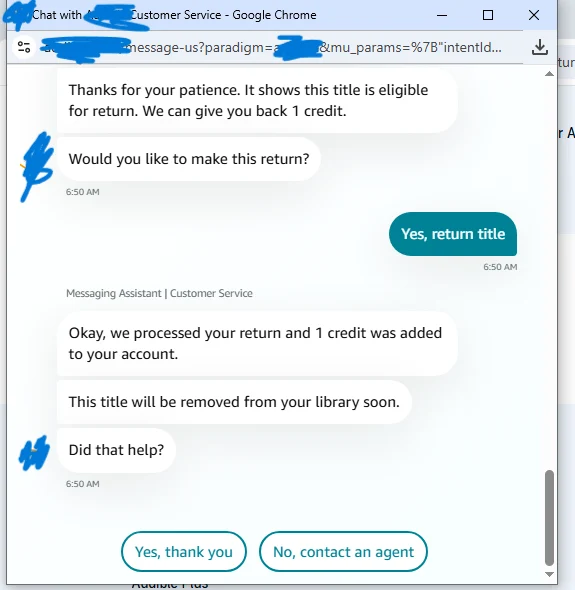
The screenshot accompanies the summary of the bypass: returning titles by initiating the refund through the chat support channel rather than the standard return flow, which bypasses the intended limit without contacting a human agent.
Step 4: Repeat
Because the chatbot path does not check the credit limit, the same approach can be repeated to return an unlimited number of purchased titles. The report states that a user who has exhausted the 2 credits can continue to return an unlimited number of purchased titles through the chat channel.
Root cause
The report's conclusion is that the refund-limit check is enforced at the client or flow level, or only in one backend code path, rather than centrally at the account or order level across all refund-issuing channels. The standard return flow performs the check; the chatbot's refund path does not, so the account-level cap is never consulted when the refund originates from the chatbot.
The existing defence, the 2-credit cap, therefore only protects the channel it was built into. Any second channel that can issue the same state change, here a refund against an order, needs the same check, ideally in one place that every channel calls.
Impact
An authenticated user who has already used both refund credits can keep returning purchased digital titles through the support chatbot, without limit and without needing a human agent. In practice this means a customer can buy a title, listen to it, and get the money back, repeatedly, which is exactly the abuse the 2-credit cap was meant to prevent. The impact is that the 2-credit cap meant to prevent abuse can be bypassed. The report does not state how much money was involved or whether any other account state, such as subscription status, was affected.
Fix
Based on the root cause, the fix is to enforce the refund-credit check centrally, at the account or order level, in the code path that actually issues the refund, so that every channel, the standard return flow and the chatbot alike, goes through the same check. Checking in the client or in a single flow leaves any other refund-issuing path open.
Variants to test
- Other support channels. Try email, live chat with a human agent, a phone flow or a ticketing form, and ask for a refund after the self-service cap is exhausted. A positive result is a refund issued on an account that the standard flow would refuse.
- Partial refunds and credits. Request a partial refund, store credit or voucher through the chatbot after the cap is reached. A positive result is any credit granted past the limit.
- Different order states. Try titles that are outside the normal return window, already returned once, or bought with a promotion. A positive result is a refund the standard flow rejects for the same reason.
- Chatbot intent variations. Phrase the request as a different intent, such as a billing dispute or a failed purchase, rather than a return. A positive result is a refund issued through a path that never runs the limit check.
- Concurrency. Submit chatbot refunds for several titles at once, or in parallel with a standard-flow refund, to see whether the cap is checked before or after the refund is recorded. A positive result is more refunds than credits remaining.
- Other capped actions. Look for the same pattern elsewhere: cancellation limits, promo-code redemption caps, download limits or free-trial abuse, each enforced in one flow but reachable through another. A positive result is the capped action succeeding through the secondary channel after the primary one refuses it.
What happened, in plain words
A company sells audiobooks and subscriptions online. Customers can buy a digital title, and if they change their mind they can ask for their money back through a self-service return button on the website or in the app. To stop people from buying a book, listening to it and then getting a refund, over and over for free, the company allows only 2 refund credits per account. Once those two are used, the normal return button should refuse any further refund.
The company also offers a customer support chatbot, a small automated assistant on its contact page at [REDACTED]/contactus. You type what you want, and the chatbot can handle a refund request by itself, without a human employee reading it.
The researcher found that the 2-refund limit is only checked in the normal return flow. If you ask the chatbot for a refund instead, the refund goes through even when your account has already used both credits. So the limit can be bypassed simply by choosing a different door into the same refund system, and you can keep returning titles without limit.
This kind of bug is called a business logic error. The software is not crashing and no password is stolen; instead the rules of the business (here, "only two refunds per account") are not applied everywhere they should be. More specifically it is improper enforcement of a rate limit: a cap on how many times you can do something is enforced in one place but not in another.
The product and the two refund channels
The target is an audiobook and subscription service, referred to throughout as [REDACTED]. Customers buy digital titles and can return them for a refund through a self-service flow, for example from their account page or their order history. The service caps refunds at 2 refund credits per account, presumably to prevent abuse where someone could purchase, listen to and return titles indefinitely at no cost.
The same service also runs a customer support chatbot at [REDACTED]/contactus, which can process refund requests for a title. The report is about how these two refund channels interact: the standard return flow and the chatbot.
The reported component is the customer support chatbot. The vulnerability class is a business logic error, specifically improper enforcement of a rate limit.
Setup
The report does not describe the accounts, roles, tools or versions used. The only precondition that matters is an account that has already used up its 2 refund credits, because that is the state in which the bypass becomes visible. No requests, payloads or commands are shown in the report, so there is nothing to reproduce at the HTTP level from the text alone.
Finding it
The researcher compared the two ways a refund can be issued. In the primary return flow, the cap of 2 refunds per account appears to be enforced correctly. When the same refund is requested through the support chatbot at [REDACTED]/contactus, the refund is processed even though the account has already exceeded its refund credit limit.
That difference is what made it look wrong: the same business rule, applied to the same account and the same kind of order, produced different outcomes depending on which channel the request came through. A limit that exists to prevent abuse is only as strong as its weakest issuing path.
Exploitation
Step 1: Exhaust the normal refund allowance
Use the standard in-app or website return flow to return titles until the account has consumed its 2 refund credits. At this point the primary flow should refuse further refunds, and according to the report it does.
Why this step: you first need to reach the state where the rule is supposed to block you. Only then can you tell whether another channel ignores the rule.
Step 2: Request a refund through the chatbot
Instead of using the standard return flow, submit a request to refund a title through the customer support chatbot at [REDACTED]/contactus. The report notes that chatbot transcripts and screenshots were not included in the submission.
Why this step: the chatbot is a second way to trigger the same action, a refund against an order. If the limit is checked only in the first way, this second way may skip it.
Step 3: Observe the refund being processed
The refund is processed even though the account has already exceeded its refund credit limit. No human customer service agent is involved: the chatbot handles the request on its own.
The screenshot accompanies the summary of the bypass: returning titles by initiating the refund through the chat support channel rather than the standard return flow, which bypasses the intended limit without contacting a human agent.
Step 4: Repeat
Because the chatbot path does not check the credit limit, the same approach can be repeated to return an unlimited number of purchased titles. The report states that a user who has exhausted the 2 credits can continue to return an unlimited number of purchased titles through the chat channel.
Root cause
The report's conclusion is that the refund-limit check is enforced at the client or flow level, or only in one backend code path, rather than centrally at the account or order level across all refund-issuing channels. The standard return flow performs the check; the chatbot's refund path does not, so the account-level cap is never consulted when the refund originates from the chatbot.
The existing defence, the 2-credit cap, therefore only protects the channel it was built into. Any second channel that can issue the same state change, here a refund against an order, needs the same check, ideally in one place that every channel calls.
Impact
An authenticated user who has already used both refund credits can keep returning purchased digital titles through the support chatbot, without limit and without needing a human agent. In practice this means a customer can buy a title, listen to it, and get the money back, repeatedly, which is exactly the abuse the 2-credit cap was meant to prevent. The impact is that the 2-credit cap meant to prevent abuse can be bypassed. The report does not state how much money was involved or whether any other account state, such as subscription status, was affected.
Fix
Based on the root cause, the fix is to enforce the refund-credit check centrally, at the account or order level, in the code path that actually issues the refund, so that every channel, the standard return flow and the chatbot alike, goes through the same check. Checking in the client or in a single flow leaves any other refund-issuing path open.
Variants to test
- Other support channels. Try email, live chat with a human agent, a phone flow or a ticketing form, and ask for a refund after the self-service cap is exhausted. A positive result is a refund issued on an account that the standard flow would refuse.
- Partial refunds and credits. Request a partial refund, store credit or voucher through the chatbot after the cap is reached. A positive result is any credit granted past the limit.
- Different order states. Try titles that are outside the normal return window, already returned once, or bought with a promotion. A positive result is a refund the standard flow rejects for the same reason.
- Chatbot intent variations. Phrase the request as a different intent, such as a billing dispute or a failed purchase, rather than a return. A positive result is a refund issued through a path that never runs the limit check.
- Concurrency. Submit chatbot refunds for several titles at once, or in parallel with a standard-flow refund, to see whether the cap is checked before or after the refund is recorded. A positive result is more refunds than credits remaining.
- Other capped actions. Look for the same pattern elsewhere: cancellation limits, promo-code redemption caps, download limits or free-trial abuse, each enforced in one flow but reachable through another. A positive result is the capped action succeeding through the secondary channel after the primary one refuses it.
Glossary
- Business logic error: a flaw where the software works as coded but the rules of the business are applied wrongly or inconsistently, so a legitimate feature can be misused.
- Rate limit: a cap on how many times an action can be performed, here 2 refunds per account.
- Improper enforcement of a rate limit: the cap exists but is checked in only some of the places where the capped action can be triggered.
- Refund credit: one allowance to return a purchase and get the money back; the account has 2 of them.
- Self-service flow: a sequence of pages or screens where the customer performs an action themselves, without staff involvement, such as the standard return flow in the account or order history.
- Customer support chatbot: an automated assistant on a support page that reads a typed request and can carry out actions such as processing a refund.
- Channel: one route through which the same action can be requested, for example the standard return flow or the chatbot.
- Endpoint: a specific address on a website or service that a request is sent to;
[REDACTED]/contactusis the support page endpoint in this report. - Backend code path: the part of the server software that actually carries out an action; different features can reach the same action through different code paths.
- Client-side check: a rule enforced in the browser or app rather than on the server, which can be bypassed by using another route that does not run that check.
- Authenticated user: someone logged in to their own account.
- State change: a lasting change to data, such as recording a refund against an order.
- Root cause: the underlying reason the flaw exists, as opposed to its visible symptom.
- Impact: the real-world harm the flaw allows.
- Triage: the process by which a bug bounty programme reviews a report and decides how to handle it.
- Concurrency: two or more actions happening at the same time, which can expose checks that run before or after the action is recorded.
- Promo code: a code that grants a discount or benefit when redeemed, often with its own usage cap.
- Free trial: a period of free access offered before payment, which can be abused if its limits are not enforced everywhere.




