Cómo un falso activador de KMSpico evade antivirus con DLL Side-Loading: Análisis de Malware paso a
A fake KMSpico activator distributed a password-protected RAR containing a legitimate signed executable and a malicious libcurl.dll. When the executable ran, Windows loaded the malicious DLL from the same folder, leading to a UAC bypass via PowerShell and the download of additional software.
 Published on medium.com
Este laboratorio nació de una pregunta simple: ¿qué pasa si alguien busca un “activador” de KMSpico para tener Microsoft 365 gratis? La respuesta es que lo barato sale caro.
The full write-up lives on its author's site
It belongs to its author, so we link to it rather than copy it. The other two tabs are our own rewrites, checked against it.
Context
This is a malware analysis lab, not a vulnerability report. The question behind it is simple: what happens when someone searches for a free "KMSpico" activator to get Microsoft 365 without paying? The answer, in this case, is a chain that elevates privileges, changes the PowerShell execution policy and downloads additional software without the user noticing.
The lure is a site, oficial-kmspico[.]io, that impersonates the official portal and sits behind Cloudflare. The download button promises a .zip file. What arrives is an encrypted RAR containing a legitimate, signed executable and a malicious DLL that the executable loads from its own folder. The technique is DLL side-loading, and it is the reason the executable itself is clean while the package as a whole is not.
Setup
The sample was downloaded and extracted on a virtual machine with a private NAT network, connected over VPN so that no traffic left through the researcher's router. The malware was never executed on that machine: it was only used to extract and scan files. Detonation happened in the ANY.RUN sandbox, and the VM was destroyed afterwards.
Tools used across the analysis: wget and grep for the download page, sha256sum and unrar on Kali, VirusTotal and Hybrid Analysis for scanning, AbuseIPDB for IP reputation, and ANY.RUN for live detonation.
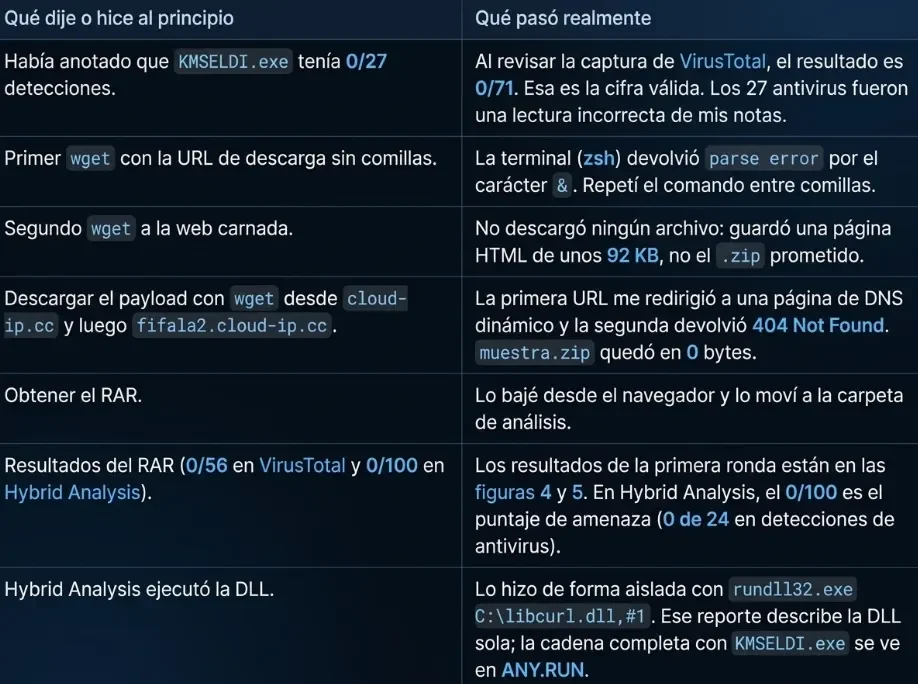
The researcher is explicit that the lab did not go perfectly. The differences between the initial notes and the published article are listed in a table in the original.
Finding it
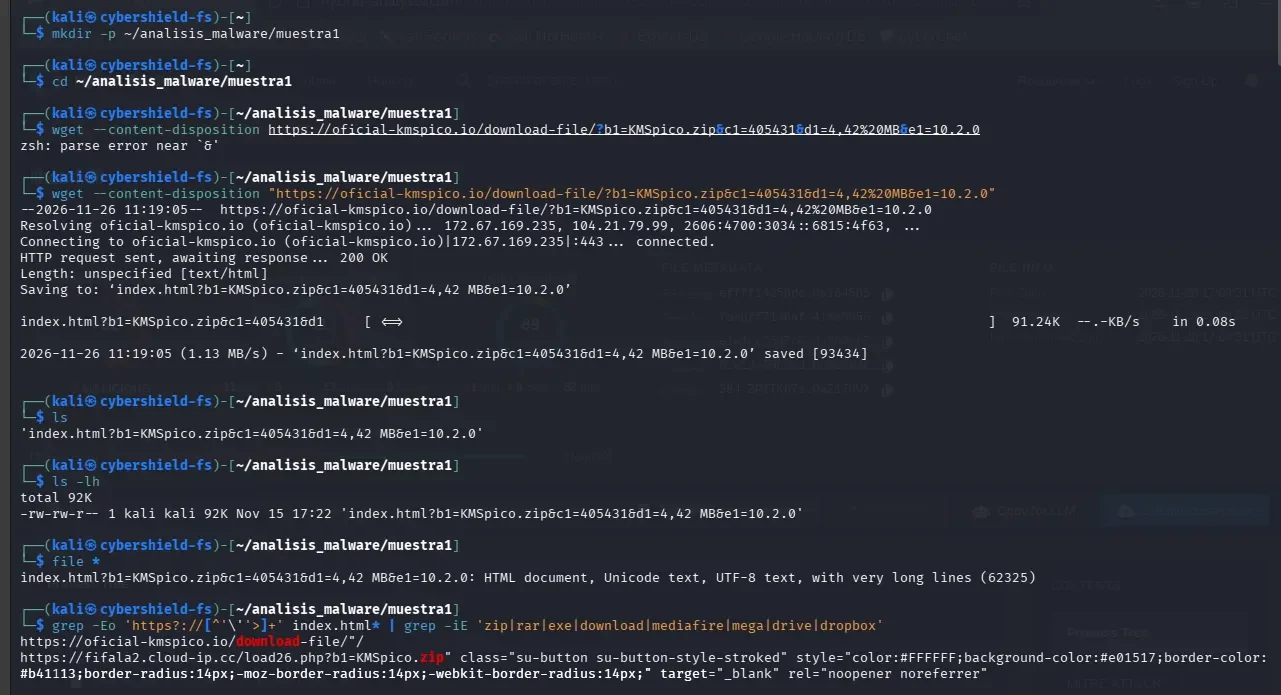
The download page is a fake portal. Fetching it with wget and grepping the HTML for download links shows that the red download button does not point at the page's own domain:
fifala2[.]cloud-ip[.]cc/load26.php?b1=KMSpico.zip
The link advertises a .zip, but what eventually arrives is a .rar. That mismatch between the advertised and delivered container is the first sign that the delivery path is not what the page claims.
Exploitation
Step 1: disposable infrastructure and conditional delivery
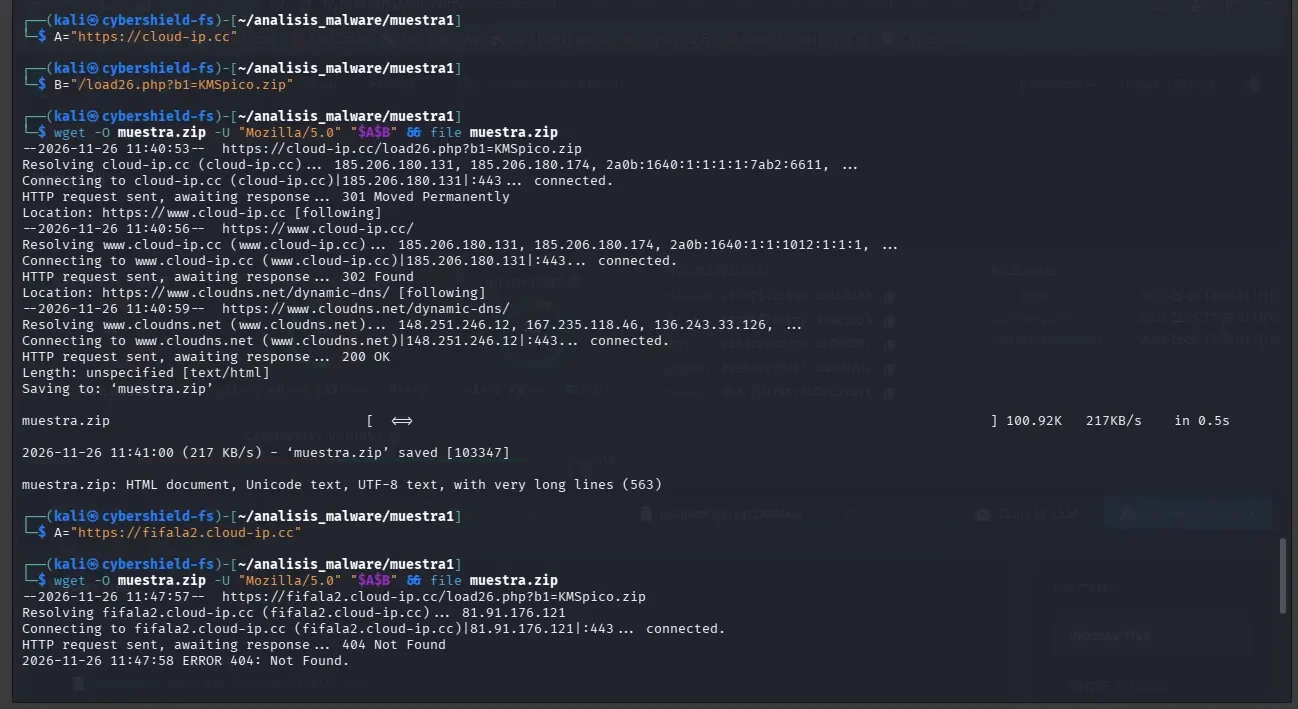
Querying cloud-ip[.]cc without a subdomain redirects to the ClouDNS page, a dynamic DNS service. With a service like that, an attacker can create and discard subdomains at no cost. The subdomain fifala2 resolved to [redacted].
That IP was checked in AbuseIPDB: it belongs to Podaon SIA (AS211381), a hosting provider in the Netherlands, with hostname 81-91-176-121.netherlands-3.vps.ac. It has 0 % abuse confidence and a single report from October 2022 for port scanning, which predates this campaign. The researcher therefore treats it as delivery infrastructure identified by context, not as an IP with confirmed bad reputation: it is a rented VPS, and such machines can change hands.
When the file was requested with wget from Kali, the server answered 404 Not Found and the file stayed at 0 bytes. The cause could not be determined: header or referer filtering, session state, an expired link. The lesson drawn is that payload delivery can be conditional. The researcher notes having tried several times.
Step 2: the encrypted container
The archive, KMSpico-WHMC.rar, is 4.1 MB and is protected with the password windows. The password is not an obstacle for the victim, because the page provides it, but it prevents antivirus engines and sandboxes from inspecting the contents. That is why scanning the RAR itself comes back clean.
sha256sum KMSpico-WHMC.rarunrar x -pwindows KMSpico-WHMC.rar
SHA-256: [redacted]
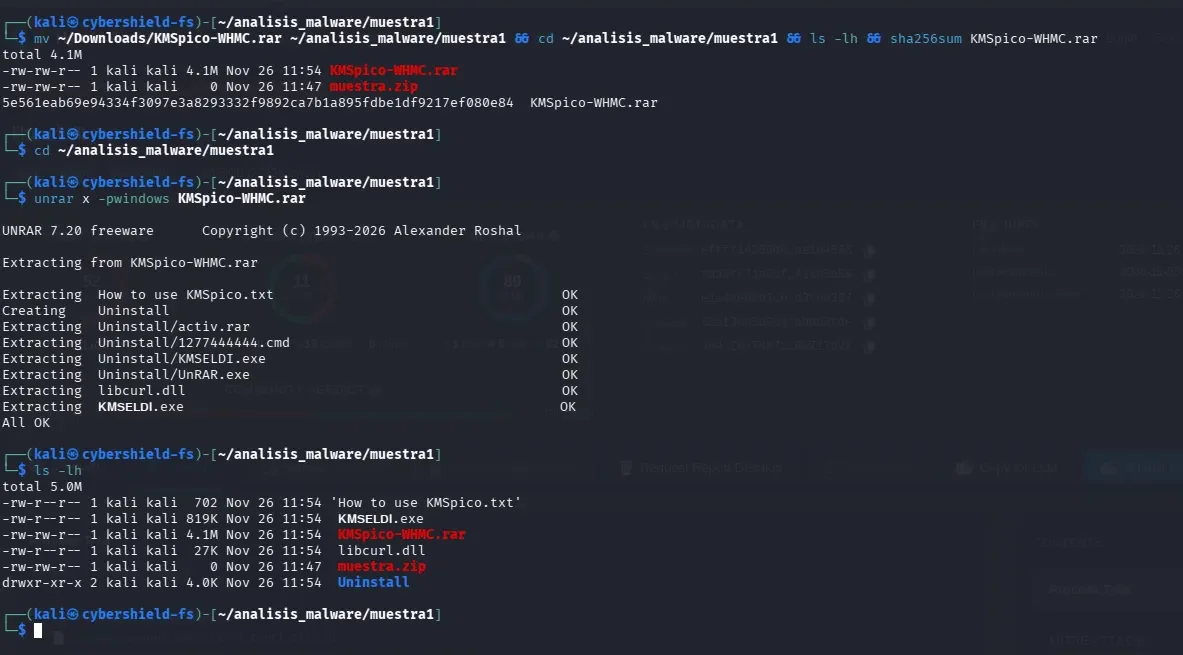
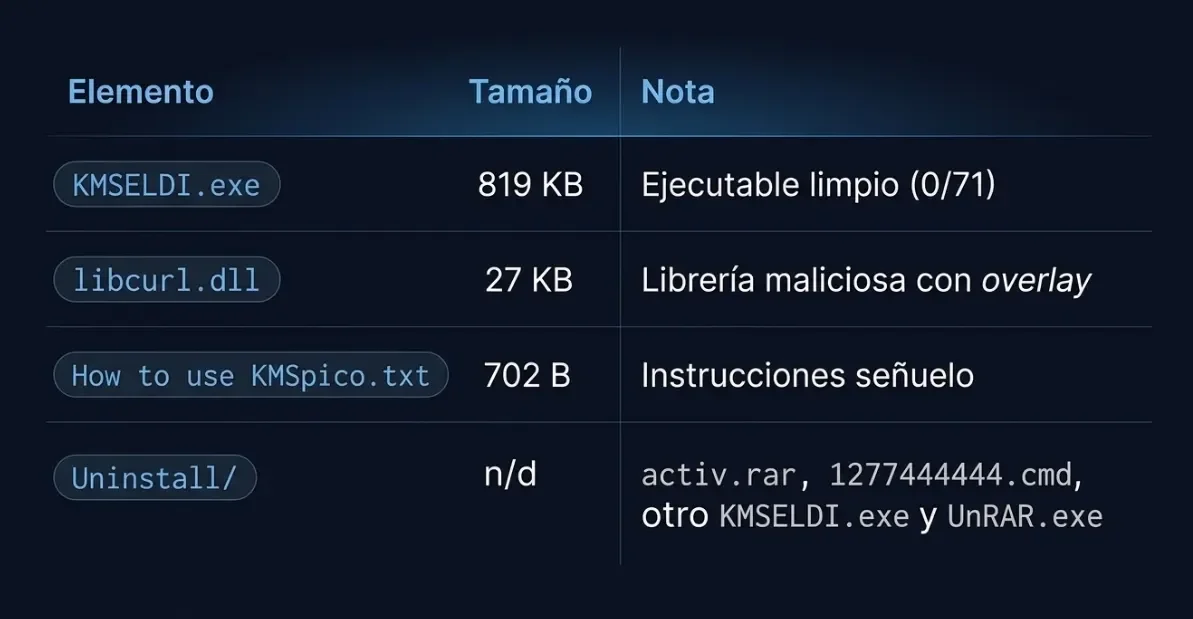
The researcher flags an error here: the contents of Uninstall/ were not analysed separately. A .cmd file and a second level of packaging (activ.rar alongside UnRAR.exe) deserve their own analysis.
Before extraction, the encrypted RAR was clean on both platforms: 0/56 detections on VirusTotal and, on Hybrid Analysis, a threat score of 0/100 with 0 of 24 antivirus detections.
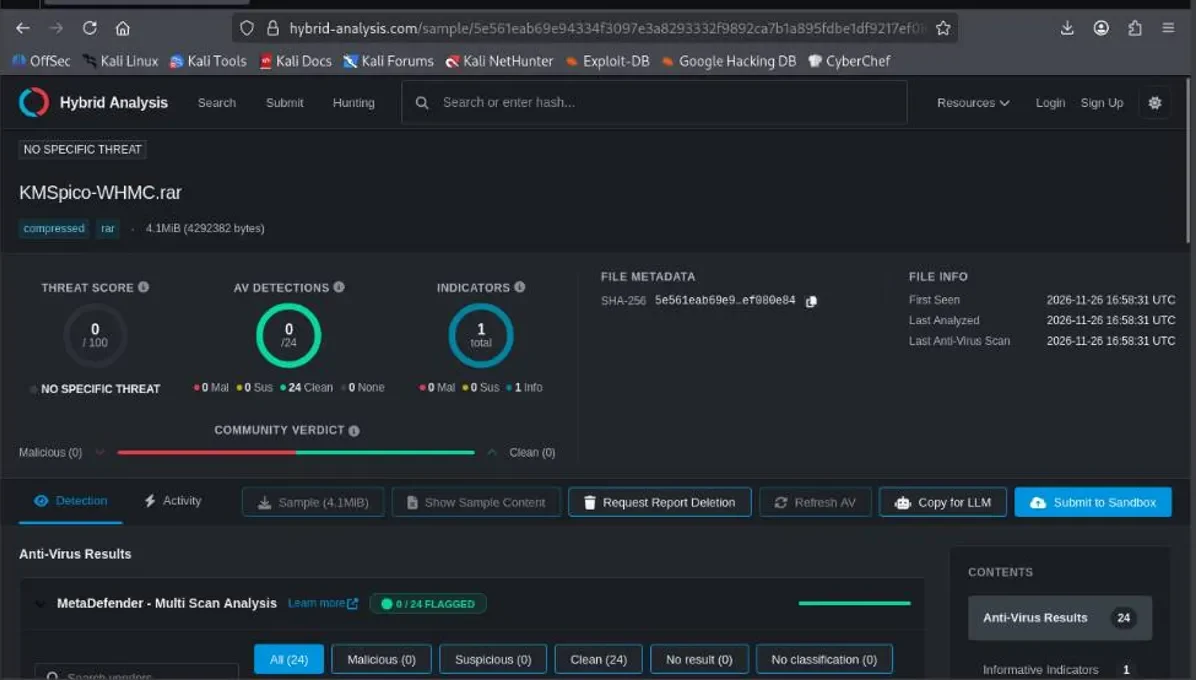
Two rounds of analysis produced two different results. In the first round, what wget returned (the HTML page and a muestra.zip that was really HTML) and the encrypted RAR were scanned on VirusTotal and Hybrid Analysis, and everything was clean on both. After extracting the RAR without executing anything, the extracted files were submitted. The executable stayed clean, but libcurl.dll came back malicious: 36/70 on VirusTotal and 52/100 on Hybrid Analysis. A clean result before extraction does not mean the sample is safe.
Step 3: the executable that scans clean
On VirusTotal the executable had 0/71 detections. The file appears as gup.exe, is signed, and weighs 818.34 KB (837 976 bytes), the same size ANY.RUN shows for KMSELDI.exe. The SHA-256 of KMSELDI.exe was verified on Kali and matches the VirusTotal one ([redacted]), so it is the same file: a legitimate binary renamed and reused. gup.exe is the name of the Notepad++ updater (WinGUp), which loads libcurl.dll from its own folder.
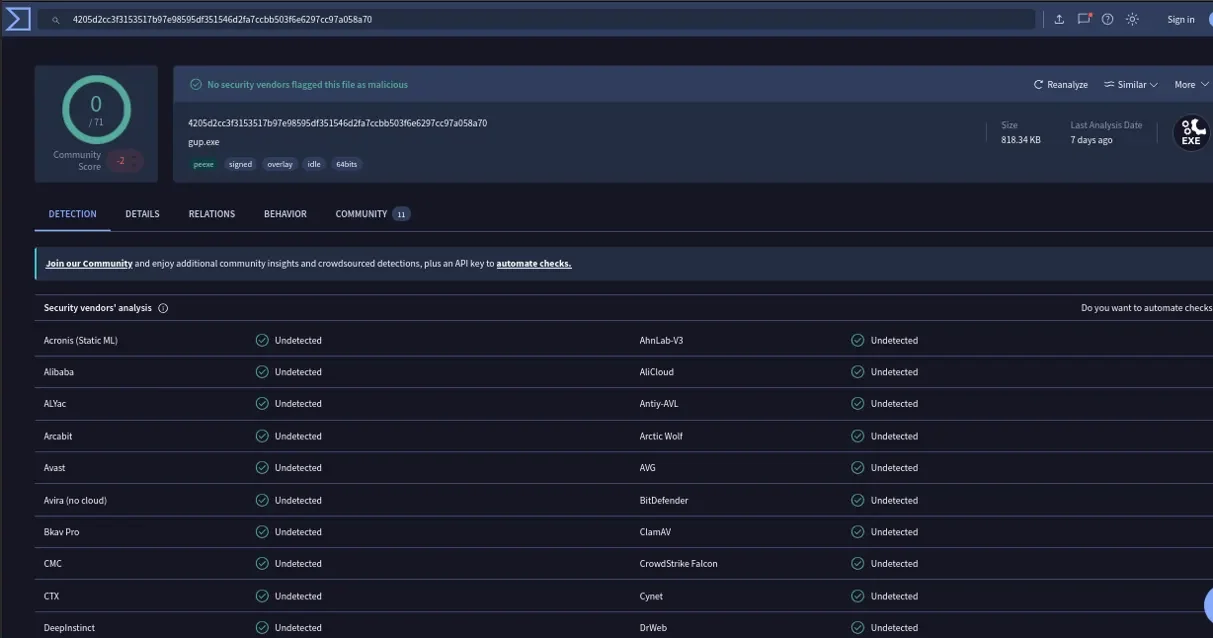
Why does it scan clean? The RAR was encrypted and the executable inside it is genuinely clean. The key is DLL side-loading: the attacker places a malicious library next to a legitimate executable, and when the program starts, Windows automatically loads that DLL from the same folder. The .exe looks harmless while the malicious payload runs inside its process. The executable does nothing hidden on its own: Windows looks for libcurl.dll first in the executable's folder and loads the malicious version without verifying its origin. Static analysis of the executable looks in the wrong place; what has to be examined is the DLL that travels with it.
Step 4: the technique
When a Windows program needs a DLL, it searches a list of paths, and one of the first is its own folder. If the attacker places a DLL with the expected name there, in this case libcurl.dll, the program loads it without validating its origin.
KMSELDI.execontains no malicious code, so no engine flags it.- The encrypted RAR hides the set.
- The malicious code lives in a DLL with the name of a legitimate and very common library.
- The operating system itself loads it inside an apparently benign process.
Step 5: the malicious DLL
On VirusTotal, libcurl.dll has 36/70 detections. The popular label is trojan.dllhijackz/misc, with categories trojan and hacktool, and an overlay mark (data appended to the end of the binary). Several engines name it HackTool.KMS, which links it to trojanised KMS tool families.
SHA-256: [redacted]
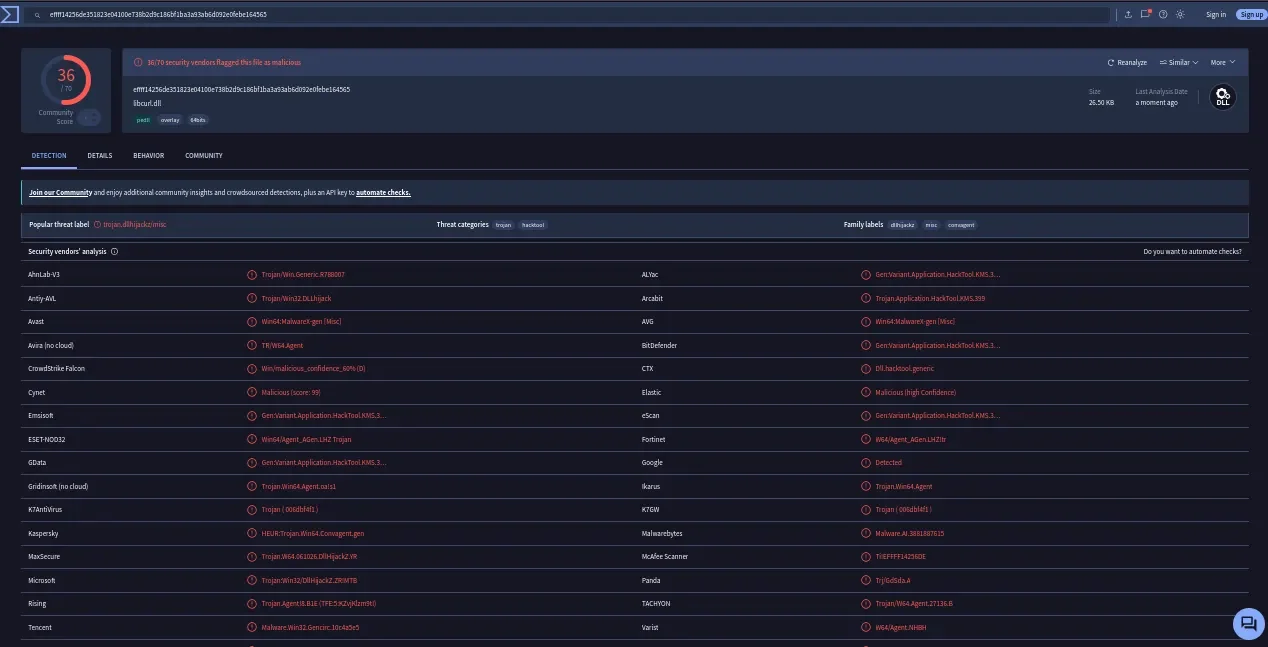
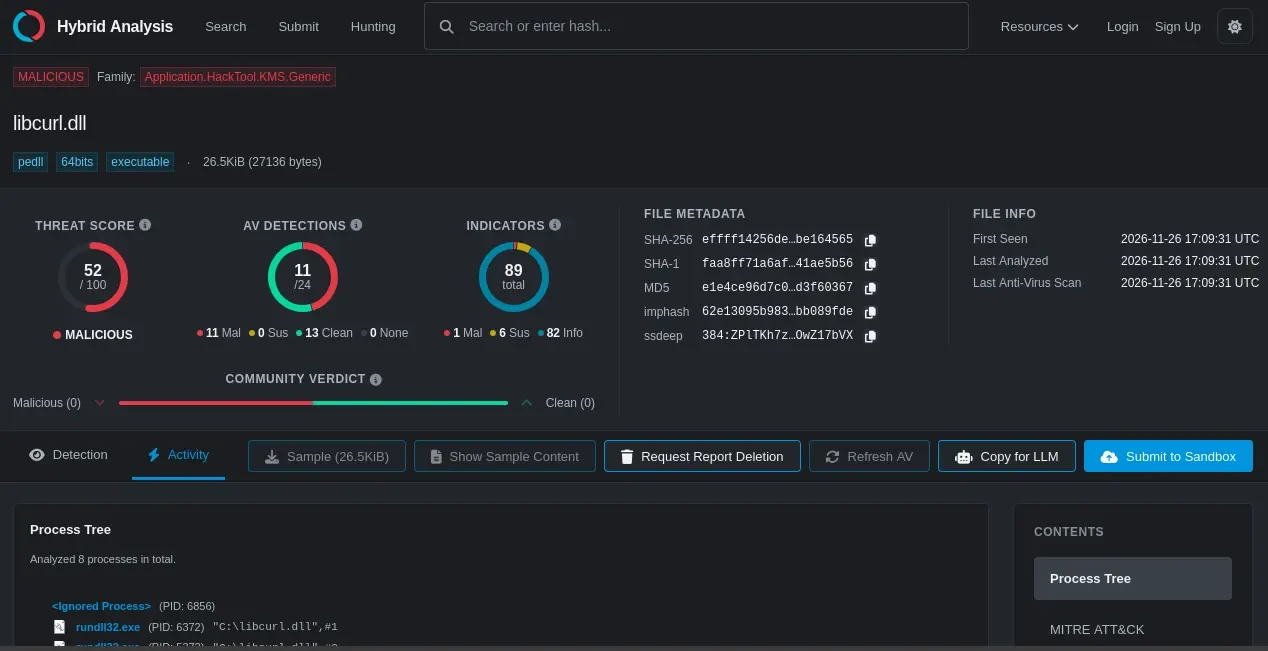
On Hybrid Analysis the verdict is Malicious, with threat score 52/100, family Application.HackTool.KMS.Generic, 11/24 antivirus detections and 89 indicators (1 malicious, 6 suspicious, 82 informational). The process tree shows Hybrid Analysis forced execution of the DLL with rundll32.exe C:\libcurl.dll,#1. That report describes the DLL in isolation, not the full chain.
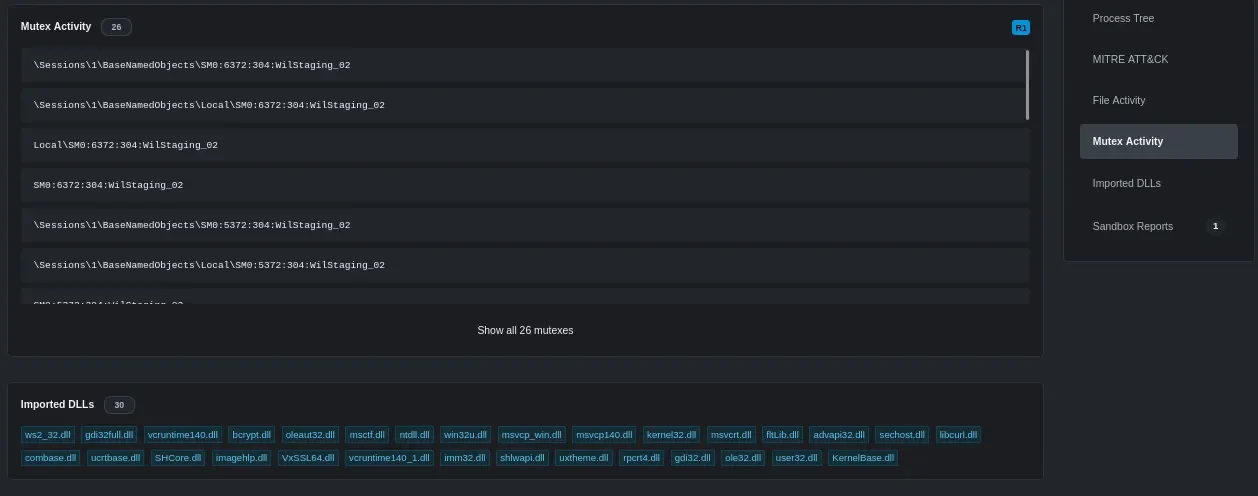
26 mutexes and 30 loaded DLLs were recorded, among them ws2_32.dll (network) and bcrypt.dll (cryptography). The researcher warns against over-interpreting that list: the WilStaging_02 mutexes are common in Windows processes, and the DLLs are those loaded by the running process, not necessarily those imported by the malicious code.
Step 6: live detonation in ANY.RUN
The RAR was opened in an interactive ANY.RUN VM and KMSELDI.exe was executed from the archive. The process tree was:
WinRAR.exe → KMSELDI.exe → cmd.exe → 2.exe (×3) ...
The sandbox flagged Malicious activity with 23 processes.
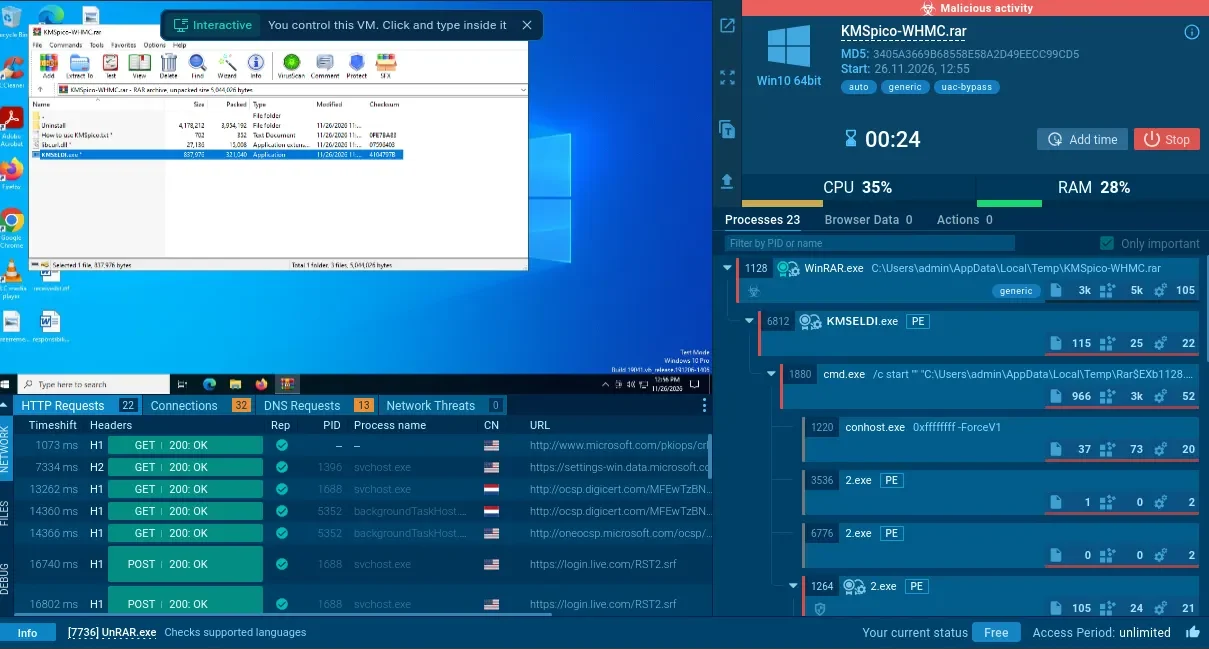
The tags were auto, generic, uac-bypass, ip-check and loader.
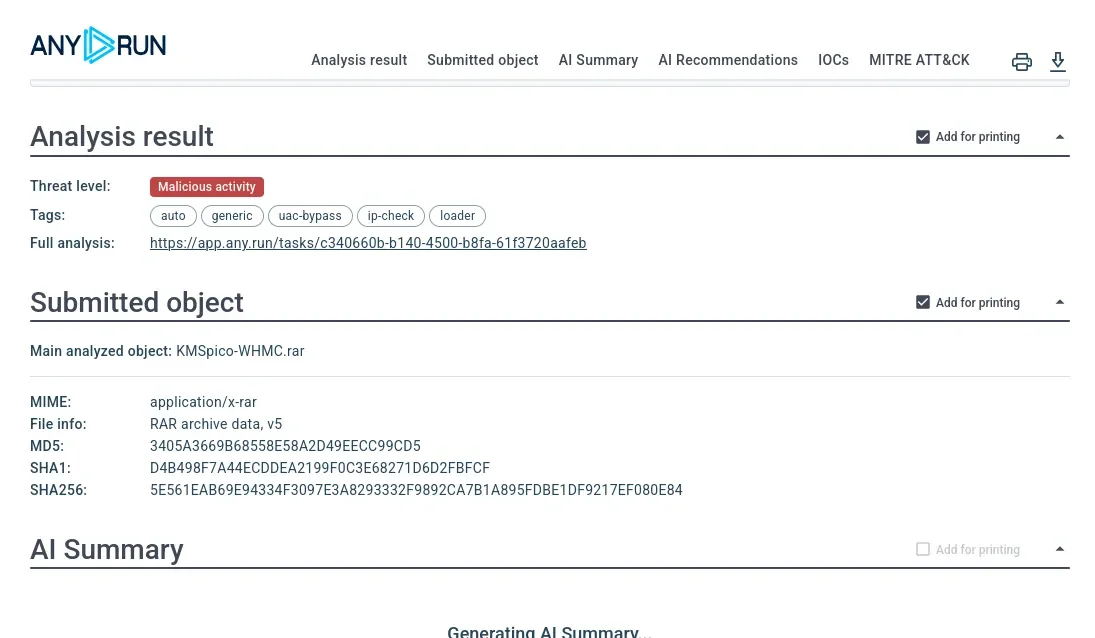
According to the ANY.RUN summary, the chain was:
- The user opens the file with WinRAR.
- It is extracted to
TempandKMSELDI.exeruns. cmd.exelaunches2.exe, dropped from the archive.2.execreates directories, copies files and runs12.cmd.- PowerShell elevates privileges with
Start-Process -Verb RunAsto run12.cmd. 12.cmddownloads files withWebClient, changes the PowerShell execution policy and launchesOperaSetup.exesilently.- More components are downloaded and installed (
activate.exe,installer.exe) and Opera is installed. - Several
timeout.execalls delay execution and simulate activity. - The final phase launches
assistant_installer.exe.
The report also lists the scripts that appeared in Temp during execution: 12.cmd, 1277444444.cmd, UnInstallDriver.cmd, down.cmd, down2.cmd and down2.ps1. Several __PSScriptPolicyTest_*.ps1 files remain as traces of the PowerShell execution policy changes. 12.cmd and UnInstallDriver.cmd did not appear in the Kali unrar listing. Most likely activ.rar (alongside UnRAR.exe) unpacks them during execution, but this was not verified.
The researcher adds a transparency note: the captures show KMSELDI.exe as the root of the malicious chain, with a libcurl.dll (36/70 on VirusTotal) in the same folder. That is consistent with DLL side-loading, but no capture shows the module load event. Proving it directly would require reviewing the modules loaded by KMSELDI.exe.
Step 7: network activity
ANY.RUN recorded 33 IoCs: 0 malicious, 0 suspicious and 33 unknown. None has a reputation verdict, which is why the report itself recommends not blocking them globally without further evidence. Those worth reviewing by context are down-master-speed[.]xyz/fhay7.exe and dl[.]multiextension[.]com/setup-win32-bundle.exe (executable downloads from the chain), together with the IPs [redacted] and [redacted]. The rest is system traffic (Microsoft, DigiCert, Let's Encrypt) or the Opera installer (api.config.opr.gg, autoupdate.opera.com), which is part of the bundleware.
The ip-check tag is explained by a query to ip-api[.]com/json/?fields=countryCode, which returns the machine's country. Droppers and bundleware commonly use this to adjust the payload by region.
Root cause
The technique relies on the Windows DLL search order and on packaging choices that defeat automated inspection. A legitimate, signed executable (gup.exe, the Notepad++ updater, renamed to KMSELDI.exe) loads libcurl.dll from its own folder. Windows resolves that name from the executable's directory before anywhere else, so a malicious library with the expected name is loaded into a trusted process without any origin check.
The scans came back clean for three reasons. The password-protected RAR prevents antivirus engines and sandboxes from inspecting the contents, so the container scans clean. The executable is genuinely legitimate and signed, so it scans clean on its own. The malicious component only surfaces when the DLL is submitted separately, which is why the detections appeared only in the second round of analysis. The researcher notes that a clean result before extraction says nothing about the safety of the sample.
Impact
For a victim who runs the activator, the observed chain performs a UAC bypass through PowerShell (Start-Process -Verb RunAs), changes the PowerShell execution policy, downloads and installs additional components (activate.exe, installer.exe, assistant_installer.exe) and installs Opera as bundleware. The sandbox tagged the sample as a loader. The researcher classifies it as a trojan with dropper functionality: it does not self-replicate, it needs the victim to run it, and when run it pulls more things down. VirusTotal classifies it as trojan and ANY.RUN tags it as loader.
The IP used for delivery has no confirmed bad reputation, and the 33 network IoCs carry no verdict, so blocking them globally is not recommended without more evidence.
Fix
No fix is proposed for a vendor, since this is malware analysis rather than a vulnerability report. The defensive measures the researcher recommends are:
- Treat "0 detections" as not equal to "safe". An encrypted file or a legitimate binary says nothing about real behaviour.
- Look at the set, not the piece. A clean executable next to an unexpected DLL in the same folder is an alert.
- Monitor DLL loads from non-standard paths, especially common libraries such as
libcurl.dlloutside legitimate directories. - Watch chains such as
cmd.exeto an executable inTEMPto a.cmdto elevated PowerShell. - Alert on
Start-Process -Verb RunAsand onExecutionPolicychanges. - Block downloads of activators and cracks, which remain a profitable infection vector.
For analysts, the practical advice is to submit every file separately (executable, DLL, scripts and nested archives) and detonate the full set in a sandbox, and never to run activators or cracks outside an isolated VM, extracting contents without executing them.
Variants to test
- Other signed updaters as side-load hosts. Any signed binary that loads a DLL from its own directory is a candidate. A positive result is a clean VirusTotal score for the host executable and a malicious verdict for the DLL shipped beside it.
- Nested archives inside the outer container. Here
activ.raralongsideUnRAR.exewas not analysed and probably drops12.cmdandUnInstallDriver.cmdat runtime. A positive result is scripts appearing inTempduring detonation that were absent from the staticunrarlisting. - Password-protected containers with the password published on the page. A positive result is a clean scan of the container and detections only after extraction and separate submission.
- Conditional delivery. The 404 returned to
wgetcould be header, referer or session checks, though the cause was not determined. A positive result is a successful download when the request mimics a browser (correct referer, user agent, cookies) where a plainwgetfails. - Region checks before payload. The
ip-api[.]com/json/?fields=countryCodequery is a behaviour droppers and bundleware commonly use to adjust the payload by region. A positive result is different follow-on downloads or behaviour when the sandbox egress IP is changed. - Dynamic DNS subdomains for staging. A positive result is a subdomain under a dynamic DNS provider that resolves to a rented VPS with no abuse history, and that can be discarded and recreated cheaply.
What happened, in plain words
Someone wants Microsoft 365 without paying for it, so they search the web for a free "activator" called KMSpico. They find a site that looks like the official one and click the big red download button. What they get is not a licence key. It is a small package that, once opened and run, quietly gives itself more power on the computer, changes a Windows setting that controls which scripts are allowed to run, and downloads extra software from the internet. The person who clicked never sees most of this happen.
The interesting part for someone learning security is why the package looks harmless to antivirus programs. The download is a password-protected archive (a .rar file, like a .zip). Inside it are a normal, signed program that does nothing bad and a malicious library file (a DLL) that sits next to it, among other files. When the normal program starts, Windows automatically loads the library from the same folder, and that is when the bad code runs. This trick is called DLL side-loading. It means the program itself is genuinely clean, so antivirus engines find nothing wrong with it, while the package as a whole is dangerous.
This article walks through the whole investigation in the order it happened: how the fake site was found, how the download link was extracted, why the archive scanned clean, why the program scanned clean, what the malicious library is, what happened when the package was actually run in a sandbox (a disposable virtual computer used for testing), and what defenders can watch for.
Setting up a safe place to look
Before touching anything, the researcher prepared a virtual machine (a computer running inside another computer, so damage stays contained) with a private network connection, routed through a VPN so that no traffic left through the home router. The malware was never run on that machine. It was only used to unpack and scan files. The actual running of the malware happened later, inside ANY.RUN, an online sandbox service that runs suspicious files on disposable virtual machines and records what they do. When the work was finished, the virtual machine was destroyed.
The tools used along the way were: wget (a command-line program that downloads a web page or file), grep (a command-line program that searches text for a pattern), sha256sum (a command-line program that computes a file's fingerprint), unrar (a command-line program that unpacks .rar archives), VirusTotal (a website where you upload a file or paste a link and dozens of antivirus engines give their opinion), Hybrid Analysis (a similar scanning website that also runs files and reports behaviour), AbuseIPDB (a website that collects reports about IP addresses, the numeric addresses computers use to find each other on the internet), and ANY.RUN for the live run.
The researcher is honest that the lab did not go perfectly and that two rounds of analysis gave different results. A table in the original lists the differences between the first notes and the published article.
Finding the fake download page
The site oficial-kmspico[.]io pretends to be the official portal. The square brackets around the dot are a convention analysts use so that nobody accidentally clicks a live malicious link; the real address is oficial-kmspico.io. The site sits behind Cloudflare, a service that sits in front of websites to protect and speed them up, and which also hides the real server behind it.
The researcher downloaded the page with wget and searched the page's HTML (the code that describes what a web page contains) for download links with grep. The red download button does not point at the page's own domain. It points somewhere else:
fifala2[.]cloud-ip[.]cc/load26.php?b1=KMSpico.zip
Line by line, this is a single web address. fifala2 is a subdomain (a name that sits in front of a main domain). cloud-ip.cc is the main domain. /load26.php is a script on that server that handles the download. ?b1=KMSpico.zip is a parameter, a piece of information passed to the script, here naming the file the page claims to offer. The link advertises a .zip, but what eventually arrives is a .rar. That mismatch between what is promised and what is delivered is the first sign that the download path is not what the page says it is.
Disposable infrastructure and a download that refused to happen
Looking up cloud-ip.cc without the subdomain redirects to the ClouDNS page. ClouDNS is a dynamic DNS service: a company that lets you point a name at an address and change it whenever you like, cheaply and quickly. For an attacker this is useful because subdomains can be created and thrown away at no cost, so if one gets blocked, another appears.
The subdomain fifala2 resolved to [redacted]. That IP address was checked in AbuseIPDB. It belongs to Podaon SIA (AS211381), a hosting provider in the Netherlands, with hostname 81-91-176-121.netherlands-3.vps.ac. It has 0 % abuse confidence and a single report from October 2022 for port scanning, which is older than this campaign. The researcher therefore treats it as delivery infrastructure identified by context, not as an address with a confirmed bad reputation: it is a rented VPS (a virtual private server, a rented machine in a data centre), and such machines can change hands.
When the file was requested with wget from Kali (a Linux distribution popular for security testing), the server answered 404 Not Found and the file stayed at 0 bytes. A 404 is the standard web response for "this page does not exist". The cause could not be determined: it could be filtering by headers (the extra information a browser sends with every request), by referer (the address of the page you came from), by session state, or simply an expired link. The lesson drawn is that payload delivery can be conditional: the server may hand the file only to visitors it likes. The researcher notes having tried several times.
The encrypted container
The archive is called KMSpico-WHMC.rar, is 4.1 MB, and is protected with the password windows. The password is not an obstacle for the victim, because the web page provides it, but it stops antivirus engines and sandboxes from looking inside. That is why scanning the RAR itself comes back clean: the scanners cannot open it.
sha256sum KMSpico-WHMC.rarunrar x -pwindows KMSpico-WHMC.rar
This block contains two commands run one after the other. sha256sum KMSpico-WHMC.rar computes the SHA-256 fingerprint of the archive: a long string of characters that uniquely identifies the file's contents, so that anyone else can check they have exactly the same file. unrar x -pwindows KMSpico-WHMC.rar unpacks the archive; x means extract with full paths, -pwindows supplies the password windows, and the last part is the file to unpack.
The SHA-256 of the archive is [redacted].
The researcher flags an error here: the contents of the Uninstall/ folder were not analysed separately. A .cmd file (a Windows batch script, a list of commands the computer runs in order) and a second level of packaging (activ.rar alongside UnRAR.exe, the program that unpacks RAR files) deserve their own analysis.
Before extraction, the encrypted RAR was clean on both scanning platforms: 0/56 detections on VirusTotal and, on Hybrid Analysis, a threat score of 0/100 with 0 of 24 antivirus detections. "0/56" means zero of the fifty-six engines that checked it flagged it.
Two rounds of analysis produced two different results. In the first round, what wget returned (the HTML page and a muestra.zip that was really HTML) and the encrypted RAR were scanned on VirusTotal and Hybrid Analysis, and everything was clean on both. After extracting the RAR without executing anything, the extracted files were submitted. The executable stayed clean, but libcurl.dll came back malicious: 36/70 on VirusTotal and 52/100 on Hybrid Analysis. A clean result before extraction does not mean the sample is safe.
The executable that scans clean
On VirusTotal the executable had 0/71 detections. The file appears as gup.exe, is signed, and weighs 818.34 KB (837 976 bytes), the same size ANY.RUN shows for KMSELDI.exe. A digital signature is a cryptographic stamp that proves who made a program and that it has not been altered since; it is why a signed file is often trusted by default. The SHA-256 of KMSELDI.exe was verified on Kali and matches the VirusTotal one ([redacted]), so it is the same file: a legitimate binary renamed and reused. gup.exe is the name of the Notepad++ updater (WinGUp), which loads libcurl.dll from its own folder.
Why does it scan clean? The RAR was encrypted and the executable inside it is genuinely clean. The key is DLL side-loading: the attacker places a malicious library next to a legitimate executable, and when the program starts, Windows automatically loads that DLL from the same folder. A DLL (dynamic-link library) is a file full of reusable code that programs load when they need it, rather than carrying every function inside themselves. The .exe looks harmless while the malicious payload runs inside its process. The executable does nothing hidden on its own: Windows looks for libcurl.dll first in the executable's folder and loads the malicious version without verifying its origin. Static analysis of the executable (examining the file without running it) looks in the wrong place; what has to be examined is the DLL that travels with it.
The technique: DLL side-loading
When a Windows program needs a DLL, it searches a list of paths, and one of the first is its own folder. If the attacker places a DLL with the expected name there, in this case libcurl.dll, the program loads it without validating its origin. A useful comparison: imagine a courier who is told to pick up a parcel from the first shop with a given name on the street. If someone opens a shop with that name next door, the courier picks up their parcel without checking who owns the shop.
KMSELDI.execontains no malicious code, so no engine flags it.- The encrypted RAR hides the set.
- The malicious code lives in a DLL with the name of a legitimate and very common library.
- The operating system itself loads it inside an apparently benign process.
The malicious DLL
On VirusTotal, libcurl.dll has 36/70 detections. The popular label is trojan.dllhijackz/misc, with categories trojan and hacktool, and an overlay mark (data appended to the end of the binary). A trojan is a program that pretends to be something useful while doing something harmful; a hacktool is a program designed to break or bypass security controls. Several engines name it HackTool.KMS, which links it to trojanised KMS tool families.
SHA-256: [redacted]
On Hybrid Analysis the verdict is Malicious, with threat score 52/100, family Application.HackTool.KMS.Generic, 11/24 antivirus detections and 89 indicators (1 malicious, 6 suspicious, 82 informational). The process tree (a diagram of which program started which) shows Hybrid Analysis forced execution of the DLL with rundll32.exe C:\libcurl.dll,#1. rundll32.exe is a standard Windows program whose job is to run code inside a DLL; the ,#1 tells it which internal function to call. That report describes the DLL in isolation, not the full chain.
26 mutexes and 30 loaded DLLs were recorded, among them ws2_32.dll (network) and bcrypt.dll (cryptography). A mutex is a flag a program sets so that only one copy of itself runs at a time; seeing one in a report does not by itself mean anything bad. The researcher warns against over-interpreting that list: the WilStaging_02 mutexes are common in Windows processes, and the DLLs are those loaded by the running process, not necessarily those imported by the malicious code.
Running it for real in ANY.RUN
The RAR was opened in an interactive ANY.RUN virtual machine and KMSELDI.exe was executed from the archive. The process tree was:
WinRAR.exe → KMSELDI.exe → cmd.exe → 2.exe (×3) ...
This line reads as a chain of parent and child processes. WinRAR.exe is the archive program the user opened the file with. It starts KMSELDI.exe, the renamed updater. That starts cmd.exe, the Windows command prompt. cmd.exe starts 2.exe three times, and the ellipsis means the chain continues. The sandbox flagged Malicious activity with 23 processes.
The tags were auto, generic, uac-bypass, ip-check and loader. A tag is a short label the sandbox attaches to describe behaviour it recognised. uac-bypass means the sample got around User Account Control, the Windows prompt that normally asks permission before a program gains administrator rights. loader means the sample's job is to fetch and start other programs.
According to the ANY.RUN summary, the chain was:
- The user opens the file with WinRAR.
- It is extracted to
TempandKMSELDI.exeruns.Tempis the temporary folder Windows provides for scratch files. cmd.exelaunches2.exe, dropped from the archive.2.execreates directories, copies files and runs12.cmd.- PowerShell elevates privileges with
Start-Process -Verb RunAsto run12.cmd. PowerShell is a scripting environment built into Windows;Start-Processstarts a program, and-Verb RunAsasks Windows to start it with administrator rights, which normally triggers the UAC prompt. 12.cmddownloads files withWebClient, changes the PowerShell execution policy and launchesOperaSetup.exesilently.WebClientis a .NET class for downloading things over the network; the execution policy is the Windows setting that decides which scripts are allowed to run; "silently" means the installer shows no windows or questions.- More components are downloaded and installed (
activate.exe,installer.exe) and Opera is installed. - Several
timeout.execalls delay execution and simulate activity.timeout.exeis a standard Windows program that simply waits. - The final phase launches
assistant_installer.exe.
The report also lists the scripts that appeared in Temp during execution: 12.cmd, 1277444444.cmd, UnInstallDriver.cmd, down.cmd, down2.cmd and down2.ps1. Several __PSScriptPolicyTest_*.ps1 files remain as traces of the PowerShell execution policy changes. 12.cmd and UnInstallDriver.cmd did not appear in the Kali unrar listing. Most likely activ.rar (alongside UnRAR.exe) unpacks them during execution, but this was not verified.
The researcher adds a transparency note: the captures show KMSELDI.exe as the root of the malicious chain, with a libcurl.dll (36/70 on VirusTotal) in the same folder. That is consistent with DLL side-loading, but no capture shows the module load event. Proving it directly would require reviewing the modules loaded by KMSELDI.exe.
What it did on the network
ANY.RUN recorded 33 IoCs: 0 malicious, 0 suspicious and 33 unknown. An IoC, indicator of compromise, is a piece of evidence such as an address or file name that you can search for on your own systems to see whether the same thing happened to you. None of the 33 has a reputation verdict, which is why the report itself recommends not blocking them globally without further evidence. Those worth reviewing by context are down-master-speed[.]xyz/fhay7.exe and dl[.]multiextension[.]com/setup-win32-bundle.exe (executable downloads from the chain), together with the IPs [redacted] and [redacted]. The rest is system traffic (Microsoft, DigiCert, Let's Encrypt) or the Opera installer (api.config.opr.gg, autoupdate.opera.com), which is part of the bundleware. Bundleware is extra software bundled with something the user wanted, installed without much fuss.
The ip-check tag is explained by a query to ip-api[.]com/json/?fields=countryCode, which returns the machine's country. Droppers and bundleware commonly use this to adjust the payload by region: the same trick a shop uses when it changes what it displays depending on which country you visit from.
Why it worked
The technique relies on the Windows DLL search order and on packaging choices that defeat automated inspection. A legitimate, signed executable (gup.exe, the Notepad++ updater, renamed to KMSELDI.exe) loads libcurl.dll from its own folder. Windows resolves that name from the executable's directory before anywhere else, so a malicious library with the expected name is loaded into a trusted process without any origin check.
The scans came back clean for three reasons. The password-protected RAR prevents antivirus engines and sandboxes from inspecting the contents, so the container scans clean. The executable is genuinely legitimate and signed, so it scans clean on its own. The malicious component only surfaces when the DLL is submitted separately, which is why the detections appeared only in the second round of analysis. The researcher notes that a clean result before extraction says nothing about the safety of the sample.
What it means for a victim
For a victim who runs the activator, the observed chain performs a UAC bypass through PowerShell (Start-Process -Verb RunAs), changes the PowerShell execution policy, downloads and installs additional components (activate.exe, installer.exe, assistant_installer.exe) and installs Opera as bundleware. The sandbox tagged the sample as a loader. The researcher classifies it as a trojan with dropper functionality: it does not self-replicate, it needs the victim to run it, and when run it pulls more things down. VirusTotal classifies it as trojan and ANY.RUN tags it as loader.
The IP used for delivery has no confirmed bad reputation, and the 33 network IoCs carry no verdict, so blocking them globally is not recommended without more evidence.
What defenders can do
No fix is proposed for a vendor, since this is malware analysis rather than a vulnerability report. The defensive measures the researcher recommends are:
- Treat "0 detections" as not equal to "safe". An encrypted file or a legitimate binary says nothing about real behaviour.
- Look at the set, not the piece. A clean executable next to an unexpected DLL in the same folder is an alert.
- Monitor DLL loads from non-standard paths, especially common libraries such as
libcurl.dlloutside legitimate directories. - Watch chains such as
cmd.exeto an executable inTEMPto a.cmdto elevated PowerShell. - Alert on
Start-Process -Verb RunAsand onExecutionPolicychanges. - Block downloads of activators and cracks, which remain a profitable infection vector.
For analysts, the practical advice is to submit every file separately (executable, DLL, scripts and nested archives) and detonate the full set in a sandbox, and never to run activators or cracks outside an isolated VM, extracting contents without executing them.
Things worth testing next
- Other signed updaters as side-load hosts. Any signed binary that loads a DLL from its own directory is a candidate. A positive result is a clean VirusTotal score for the host executable and a malicious verdict for the DLL shipped beside it.
- Nested archives inside the outer container. Here
activ.raralongsideUnRAR.exewas not analysed and probably drops12.cmdandUnInstallDriver.cmdat runtime. A positive result is scripts appearing inTempduring detonation that were absent from the staticunrarlisting. - Password-protected containers with the password published on the page. A positive result is a clean scan of the container and detections only after extraction and separate submission.
- Conditional delivery. The 404 returned to
wgetcould be header, referer or session checks, though the cause was not determined. A positive result is a successful download when the request mimics a browser (correct referer, user agent, cookies) where a plainwgetfails. A cookie is a small piece of data a website stores in your browser to remember who you are between requests. - Region checks before payload. The
ip-api[.]com/json/?fields=countryCodequery is a behaviour droppers and bundleware commonly use to adjust the payload by region. A positive result is different follow-on downloads or behaviour when the sandbox egress IP is changed. - Dynamic DNS subdomains for staging. A positive result is a subdomain under a dynamic DNS provider that resolves to a rented VPS with no abuse history, and that can be discarded and recreated cheaply.
Glossary
- 404 Not Found: the standard web response meaning the requested page or file does not exist at that address.
- AbuseIPDB: a website that collects reports about IP addresses so people can check whether one has been used for abuse.
- ANY.RUN: an online sandbox service that runs suspicious files on disposable virtual machines and records what they do.
- AS211381: an autonomous system number, an identifier for a network owned by one organisation, here the hosting provider Podaon SIA.
- Bundleware: extra software installed alongside something the user wanted, often without much choice.
- ClouDNS: a dynamic DNS provider that lets people point names at addresses and change them cheaply.
- Cloudflare: a service that sits in front of websites to protect and speed them up, and hides the real server behind it.
- cmd.exe: the Windows command prompt, a program that runs commands and batch scripts.
- Cookie: a small piece of data a website stores in your browser to remember who you are between requests.
- DLL (dynamic-link library): a file full of reusable code that programs load when they need it.
- DLL side-loading: placing a malicious DLL next to a legitimate program so that Windows loads it from the program's own folder.
- Dropper: a program whose job is to drop and run other programs on the machine.
- Dynamic DNS: a service that lets a name be pointed at an address and changed quickly and cheaply.
- Execution policy: the Windows PowerShell setting that decides which scripts are allowed to run.
- grep: a command-line program that searches text for a pattern.
- Hacktool: a program designed to break or bypass security controls.
- Hybrid Analysis: a scanning website that runs files and reports their behaviour.
- Indicator of compromise (IoC): a piece of evidence, such as an address or file name, you can search for on your own systems.
- IP address: the numeric address computers use to find each other on the internet.
- Kali: a Linux distribution popular for security testing.
- KMSpico: a tool that pretends to activate Microsoft products without a licence.
- Loader: a program whose job is to fetch and start other programs.
- Mutex: a flag a program sets so that only one copy of itself runs at a time.
- Overlay: data appended to the end of a binary file, often used to hide something.
- Parameter: a piece of information passed to a script or web page, usually after a
?in the address. - PowerShell: a scripting environment built into Windows.
- Process tree: a diagram of which program started which.
- RAR: a compressed archive format, like a
.zip. - Referer: the address of the page you came from, sent by browsers with requests.
- rundll32.exe: a standard Windows program whose job is to run code inside a DLL.
- Sandbox: a disposable virtual computer used to run suspicious files safely.
- SHA-256: a fingerprint of a file's contents, a long string that uniquely identifies it.
- Signature (digital): a cryptographic stamp proving who made a program and that it has not been altered.
- Static analysis: examining a file without running it.
- Subdomain: a name that sits in front of a main domain, such as
fifala2infifala2.cloud-ip.cc. - Tag: a short label a sandbox attaches to describe behaviour it recognised.
- Temp: the temporary folder Windows provides for scratch files.
- timeout.exe: a standard Windows program that simply waits.
- Trojan: a program that pretends to be useful while doing something harmful.
- UAC (User Account Control): the Windows prompt that asks permission before a program gains administrator rights.
- UAC bypass: getting around that prompt without the user agreeing.
- unrar: a command-line program that unpacks
.rararchives. - VirusTotal: a website where you upload a file or paste a link and dozens of antivirus engines give their opinion.
- Virtual machine (VM): a computer running inside another computer, so damage stays contained.
- VPS (virtual private server): a rented machine in a data centre.
- VPN: a service that routes your traffic through another location so it does not leave from your own network.
- WebClient: a .NET class for downloading things over the network.
- wget: a command-line program that downloads a web page or file.


