CoRover.ai leaked two million phone calls. Yours might be one.
An unprotected cloud storage bucket belonging to CoRover.ai exposed close to two million call recordings, support ticket screenshots and financial spreadsheets to anyone with a browser. An attacker could use the audio and personal details to impersonate callers, for example through voice cloning, and combine the records into an identity kit.
 Published on medium.com
Cybersecurity
The full write-up lives on its author's site
It belongs to its author, so we link to it rather than copy it. The other two tabs are our own rewrites, checked against it.
Context
CoRover.ai is described in the report as one of the largest conversational AI providers in the world. Banks, retailers and insurers rent its conversational agents rather than building their own, so when a customer calls and speaks to an automated voice, that voice may be running on CoRover.ai's platform. The product records calls by design: the report notes that an AI agent captures, transcribes and often screenshots each call into a support ticket, because that is how the system is trained and billed. The data involved here is therefore not incidental logging but the core working material of the service: audio of both halves of each conversation, support ticket screenshots, financial transaction screenshots and financial statement spreadsheets.
Setup
The report does not describe any accounts, roles, tooling or versions used during the research. What it does describe is the precondition for the finding: the data was held in cloud storage, specifically an Azure bucket, with no protection on it at all, reachable by anyone with a browser. No credentials, endpoints, bucket names or parameters are given; the authors state explicitly that they have held back the technical specifics that would help anyone locate or re-expose the data.
Finding it
The researchers came across close to two million call recordings sitting in the open Azure bucket. The exposure was not limited to the assistant's side of the conversation: both halves were present, so a listener could hear the assistant read back an address and hear the caller give their name, their date of birth and the reason they called. Alongside the audio were screenshots of support tickets and financial transactions, and a second set of files containing financial statements as spreadsheets.
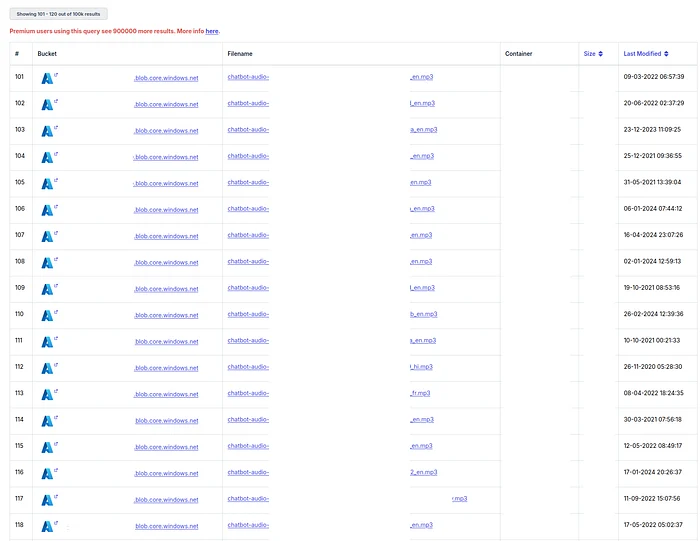
The screenshot shows the open Azure bucket holding the phone calls, as captioned in the report.
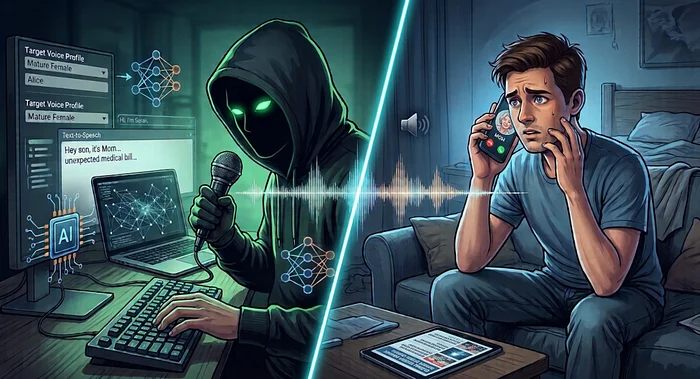
The report frames the significance of the audio in terms of voice cloning, which it says now costs almost nothing. Combined with the tickets and financial records, the material amounts, in the authors' words, to a ready made identity kit, two million people deep. The image below is captioned as an example of a voice cloning attack.
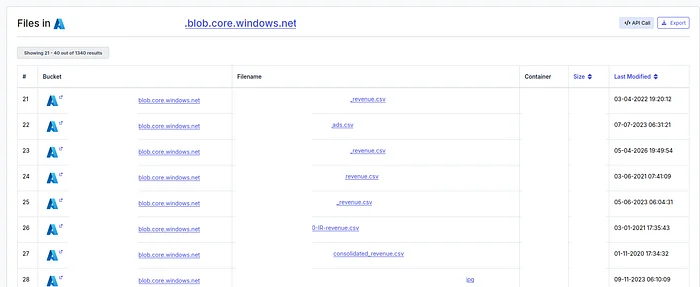
The support ticket and transaction screenshots, and the financial spreadsheets, are shown in the next image.
Exploitation
The report does not publish a step by step exploitation sequence, and deliberately withholds the technical specifics that would let anyone locate or re-expose the data. What it documents is the disclosure process and the response, which is the part of the timeline it considers most important.
Step 1: Email the privacy contact
The researchers emailed CoRover.ai's privacy contact. Nobody replied.
Step 2: Follow up a week later
A follow-up email was sent a week after the first. Again there was no reply.
Step 3: Report to the national CERT
The researchers filed what they describe as a clear, detailed report with the national computer emergency response team, the body they say is supposed to step in exactly here. They made more than one attempt. Nothing came back from them either.
Step 4: Message the CEO on LinkedIn
The report says the team messaged the CEO on LinkedIn, where he was posting several times a day, every day. There was no reply to them. A few days later, the folder quietly went dark.
Throughout this period, which the report describes as dragging on for months, the folder stayed open.
Root cause
The report does not analyse the configuration mistake itself, so the precise cause is not stated. What it does establish is the outcome: an Azure bucket holding call recordings, ticket screenshots, transaction screenshots and financial spreadsheets was readable by anyone with a browser, and remained so for months. The report's argument about why existing defences did not help is organisational rather than technical. CoRover.ai holds SOC 2 and ISO 27001 (both focused on information security), ISO 27701 (the data privacy management framework) and a CERT-In certification. The authors' point is that a certification records that a company passed an audit on a given day, within whatever scope it chose, and does not mean the storage is actually locked. They add a particular sting to the CERT-In certification, since it comes from the same body that, in their account, did not respond to their report.
Impact
The exposed material covers close to two million call recordings, each containing both sides of a conversation, including names, dates of birth and the reason for the call, plus support ticket screenshots, financial transaction screenshots and financial statement spreadsheets. The report's stated concern is that a recording of a person's voice discussing their private business is permanent, unlike a leaked password that can be reset in a minute, and that voice cloning is now cheap. Someone holding that audio has both the person's details and a way to sound like them when calling their bank. The authors characterise the combined dataset as a ready made identity kit, two million people deep.
The report also stresses that the affected callers were never told. It notes that warning the victims would be required under the GDPR because of the risk to the data subjects, and that the team has no information about any report to a supervisory authority; based on their experience, they say they would be surprised if one happened. The folder went dark a few days after the CEO was contacted, with no statement and, as far as the report says, no word to the callers.
The report does not say which organisations' customers were affected, and notes that individuals cannot check for themselves whether they are affected, because the data sits with a supplier most people have never heard of.
Fix
It records only that the folder went dark a few days after the CEO was contacted on LinkedIn, and that the exposure is now closed. The authors' criticism is that the fix addressed the embarrassment and skipped victim notification, which they say the GDPR would require given the risk to data subjects. They also argue more broadly that a row of certifications is not a substitute for the storage actually being locked.
Variants to test
These are generalisations from the pattern, not steps the report describes.
- Cloud storage belonging to AI and BPO vendors. Enumerate storage accounts and containers tied to conversational AI, contact centre and transcription providers, and test whether any allow anonymous listing or object reads. A positive result is a listing that returns call audio, transcripts or ticket exports without credentials.
- Bucket contents beyond the obvious media. When a recording store is open, check for sibling prefixes holding screenshots, transaction exports and spreadsheets. A positive result is financial or support data in the same container as the audio, which is what turned this exposure into a full identity kit.
- Both sides of recorded conversations. Confirm whether stored audio contains the caller as well as the agent. A positive result is audio in which the customer's own voice gives identifiers such as name, date of birth or address, which is the material a voice cloning attack needs.
- Certification claims as a scoping question. For vendors advertising SOC 2, ISO 27001, ISO 27701 or CERT-In, ask what the audit scope covered and whether storage configuration was inside it. A positive result is a certified vendor whose storage is nonetheless publicly readable, which is the gap the report highlights.
- Notification behaviour after closure. After a vendor closes an exposure, check whether affected data subjects are informed. A positive result, in the report's framing, is silence towards the callers alongside a quiet fix.
What happened, in plain words
A company called CoRover.ai runs automated phone assistants for banks, shops and insurance companies. When you ring one of those companies and a friendly robot voice answers, that voice may be CoRover.ai's software doing the talking. The report describes CoRover.ai as one of the largest conversational AI providers in the world, and says that banks, retailers and insurers rent its assistants rather than building their own.
Here is the part that matters for you. The system records the calls. Not by accident, but on purpose: the report explains that an AI agent captures, transcribes and often screenshots each call into a support ticket, because that is how the system is trained and billed. So the recordings are not a forgotten log file. They are the working material of the service.
What the researchers found was close to two million of those recordings sitting in cloud storage with no protection on it at all. Anyone with a browser could open the folder. The recordings held both halves of each conversation: you could hear the assistant read back an address, and you could hear the real person give their name, their date of birth and the reason they called. Next to the audio were screenshots of support tickets and financial transactions, and a second set of files holding financial statements as spreadsheets.
The screenshot shows the open Azure bucket holding the phone calls, as captioned in the report.
The report's main point is that the people on those calls were never told. It argues that a leaked password can be reset in a minute, but a recording of your voice discussing your private business is permanent, and voice cloning now costs almost nothing. Someone with that audio has your details and a way to sound like you when they call your bank. Put the calls, the tickets and the financial records together, the authors say, and you do not have a data leak so much as a ready made identity kit, two million people deep.
This image is captioned in the report as an example of a voice cloning attack.
Before going further, a few ideas from the report need unpacking, because the rest of the story depends on them.
Cloud storage and buckets. Cloud storage is disk space you rent from a large provider instead of keeping on your own machine. A bucket is simply a named folder inside that storage. It is meant to be private by default, and you give access to specific people or programs. If a bucket is left open, the folder behaves like a public web page: no login, no password, just a browser.
Azure. Azure is Microsoft's cloud platform. The report says the data sat in an Azure bucket.
Conversational AI. Software that holds a spoken conversation with a person, usually over the phone. The company that rents it does not build it; it plugs the vendor's assistant into its own phone lines.
Transcription. Turning speech into written text. The report says calls are transcribed as part of normal operation.
Voice cloning. Software that learns how a person sounds from recordings of their voice and then produces new speech in that voice. The report says it now costs almost nothing.
GDPR. The European data protection law. Among other things it requires an organisation to warn people when their personal data has been exposed in a way that puts them at risk. The report refers to this obligation and to a supervisory authority, which is the regulator that oversees it.
Setup
The report does not describe any accounts, roles, tooling or versions used during the research. What it does describe is the precondition for the finding: the data was held in cloud storage, specifically an Azure bucket, with no protection on it at all, reachable by anyone with a browser. No credentials, endpoints, bucket names or parameters are given; the authors state explicitly that they have held back the technical specifics that would help anyone locate or re-expose the data.
In plain terms, the researchers are not telling you how to find the folder. They are telling you what was in it and what happened when they tried to get it closed. That is a deliberate choice, and it is the reason this article contains no addresses or commands to copy: there is nothing here that would let a reader go and look at other people's call recordings.
Finding it
The researchers came across close to two million call recordings sitting in the open Azure bucket. The exposure was not limited to the assistant's side of the conversation: both halves were present, so a listener could hear the assistant read back an address and hear the caller give their name, their date of birth and the reason they called. Alongside the audio were screenshots of support tickets and financial transactions, and a second set of files containing financial statements as spreadsheets.
Why does "both halves" matter so much? Because a recording of only the robot voice tells an attacker very little. A recording where the customer says their own name, date of birth and reason for calling is a different thing entirely: it is the raw material a voice cloning tool needs, paired with the facts that a bank uses to identify you on the phone.
The report frames the significance of the audio in terms of voice cloning, which it says now costs almost nothing. Combined with the tickets and financial records, the material amounts, in the authors' words, to a ready made identity kit, two million people deep. The image below is captioned as an example of a voice cloning attack.
The support ticket and transaction screenshots, and the financial spreadsheets, are shown in the next image.
Notice the shape of the problem. The audio alone is sensitive. The tickets and transaction screenshots alone are sensitive. The spreadsheets alone are sensitive. Sitting together in one open folder, they reinforce each other: the audio gives a voice and a set of personal details, the tickets confirm which company the person dealt with and why, and the financial records add account level information. That combination is what the authors mean by an identity kit.
Exploitation
The report does not publish a step by step exploitation sequence, and deliberately withholds the technical specifics that would let anyone locate or re-expose the data. What it documents is the disclosure process and the response, which is the part of the timeline it considers most important.
Disclosure, in this context, means telling the organisation that owns the data, and then the authorities, so that the problem can be fixed and the affected people warned. Here is how that went.
Step 1: Email the privacy contact
The researchers emailed CoRover.ai's privacy contact. Nobody replied.
Why start there? A privacy contact is the address a company publishes for exactly this kind of message. It is the polite, correct first move, and it creates a written record that the company was told.
Step 2: Follow up a week later
A follow-up email was sent a week after the first. Again there was no reply.
A week is a reasonable gap: long enough for a busy team to respond, short enough that an open folder is not left sitting there for a month. The follow-up also removes the excuse that the first message was missed.
Step 3: Report to the national CERT
The researchers filed what they describe as a clear, detailed report with the national computer emergency response team, the body they say is supposed to step in exactly here. They made more than one attempt. Nothing came back from them either.
A national CERT is a government team that coordinates responses to computer security incidents. When a company will not answer, the CERT is the next rung on the ladder: it has the standing to contact the company and the duty to take serious reports seriously. The report says more than one attempt was made, and that nothing came back.
Step 4: Message the CEO on LinkedIn
The report says the team messaged the CEO on LinkedIn, where he was posting several times a day, every day. There was no reply to them. A few days later, the folder quietly went dark.
This is the step that worked, and the report is pointed about why it is telling you. The chief executive was visibly active in public, yet did not answer the message. The folder was closed a few days later, with no thank you, no statement and, as far as the report says, no word to the callers. The report's reading is that the fix addressed the embarrassment rather than the harm.
Throughout this period, which the report describes as dragging on for months, the folder stayed open.
Root cause
The report does not analyse the configuration mistake itself, so the precise cause is not stated. What it does establish is the outcome: an Azure bucket holding call recordings, ticket screenshots, transaction screenshots and financial spreadsheets was readable by anyone with a browser, and remained so for months.
Configuration, here, means the settings that decide who can read what in cloud storage. A bucket that is readable by anyone is a settings problem, not a clever attack: nobody broke in, the door was simply unlocked. The report does not say which setting was wrong or how it came to be that way.
The report's argument about why existing defences did not help is organisational rather than technical. CoRover.ai holds SOC 2 and ISO 27001 (both focused on information security), ISO 27701 (the data privacy management framework) and a CERT-In certification. The authors' point is that a certification records that a company passed an audit on a given day, within whatever scope it chose, and does not mean the storage is actually locked. They add a particular sting to the CERT-In certification, since it comes from the same body that, in their account, did not respond to their report.
A certification is a bit like a restaurant's hygiene certificate on the wall: it says an inspector looked at the kitchen on a particular day and found it acceptable, within the areas the inspection covered. It does not tell you whether the fridge is cold tonight. The report's point is that a row of badges is exactly why a bank or an insurer picks one vendor over a cheaper one, and that none of the badges stopped two million recordings from sitting open for months.
Impact
The exposed material covers close to two million call recordings, each containing both sides of a conversation, including names, dates of birth and the reason for the call, plus support ticket screenshots, financial transaction screenshots and financial statement spreadsheets. The report's stated concern is that a recording of a person's voice discussing their private business is permanent, unlike a leaked password that can be reset in a minute, and that voice cloning is now cheap. Someone holding that audio has both the person's details and a way to sound like them when calling their bank. The authors characterise the combined dataset as a ready made identity kit, two million people deep.
The report also stresses that the affected callers were never told. It notes that warning the victims would be required under the GDPR because of the risk to the data subjects, and that the team has no information about any report to a supervisory authority; based on their experience, they say they would be surprised if one happened. The folder went dark a few days after the CEO was contacted, with no statement and, as far as the report says, no word to the callers.
That last point is worth pausing on. If your bank's data leaks, you know which bank to ring. Here the data sat with a supplier behind the bank, so a customer has no way to look up whether their own call was in the folder. The report's practical advice follows from that: you cannot check, so you make yourself a harder target instead.
- Be suspicious of any call or message that already knows your details. Hang up and call the company back on a number you looked up yourself.
- Do not trust a voice on its own anymore, including one that sounds like someone you know.
- Turn on protections that do not rely on your voice or your known details: app based two factor, alerts on transactions, a freeze you control.
- If you have used a service that might run on CoRover.ai, tell your bank to watch the account. You do not need proof to ask.
Fix
It records only that the folder went dark a few days after the CEO was contacted on LinkedIn, and that the exposure is now closed. The authors' criticism is that the fix addressed the embarrassment and skipped victim notification, which they say the GDPR would require given the risk to data subjects. They also argue more broadly that a row of certifications is not a substitute for the storage actually being locked.
So the ending is a locked door and silence. The exposure is closed, which is the good part. The people whose voices were in it were not told, which is the part the report wants you to remember.
Variants to test
These are generalisations from the pattern, not steps the report describes. They are written for people who test systems for a living, and each one is explained in plain words first.
- Cloud storage belonging to AI and BPO vendors. BPO stands for business process outsourcing: companies that run call centres and back office work for other firms. The idea is to look at the storage accounts and containers tied to conversational AI, contact centre and transcription providers, and check whether any of them let an anonymous visitor list the folder or read a file. A positive result is a listing that returns call audio, transcripts or ticket exports without credentials.
- Bucket contents beyond the obvious media. When a recording store is open, look at the neighbouring folders in the same container. A positive result is financial or support data sitting next to the audio, which is what turned this exposure into a full identity kit.
- Both sides of recorded conversations. Confirm whether the stored audio contains the caller as well as the agent. A positive result is audio in which the customer's own voice gives identifiers such as name, date of birth or address, which is the material a voice cloning attack needs.
- Certification claims as a scoping question. For vendors advertising SOC 2, ISO 27001, ISO 27701 or CERT-In, ask what the audit scope covered and whether storage configuration was inside it. A positive result is a certified vendor whose storage is nonetheless publicly readable, which is the gap the report highlights.
- Notification behaviour after closure. After a vendor closes an exposure, check whether the affected people are told. A positive result, in the report's framing, is silence towards the callers alongside a quiet fix.
Glossary
- API: a defined way for one piece of software to ask another for data or an action, like a service counter where you make a request and get a response.
- Audit: a formal review of a company's practices against a standard, carried out on a particular day and within a particular scope.
- Azure: Microsoft's cloud computing platform, named in the report's description of the open bucket.
- BPO: business process outsourcing; a company that runs call centres or back office work on behalf of another organisation.
- Bucket: a named folder in cloud storage that holds files and has its own access settings.
- CERT: computer emergency response team; a national team that coordinates responses to computer security incidents.
- CERT-In: the Indian computer emergency response team, named in the report as one of CoRover.ai's certifications.
- Cloud storage: disk space rented from a large provider over the internet instead of kept on your own machine.
- Configuration: the settings that control how a system behaves, including who is allowed to read what.
- Conversational AI: software that holds a spoken or written conversation with a person, such as an automated phone assistant.
- Credentials: the proof a system uses to decide you are allowed in, such as a username and password or a key.
- Data subject: the person whose personal data is being held, in the language of data protection law.
- Disclosure: telling the organisation that owns the data, and then the authorities, about a security problem so it can be fixed and people warned.
- Endpoint: a specific address on a system that accepts requests, such as a particular web address or storage location.
- GDPR: the European data protection law, which among other things requires warning people when their data is exposed in a way that puts them at risk.
- Identity kit: the report's phrase for a combined set of voice recordings, personal details and financial records that is enough to impersonate someone.
- ISO 27001: an international standard for managing information security, awarded after an audit.
- ISO 27701: an international standard for managing privacy of personal data, awarded after an audit.
- Parameter: a named value passed along with a request to tell the system what you want, such as a folder name or a file identifier.
- Prefix: a leading part of a storage path, effectively a subfolder inside a bucket.
- SOC 2: an audit report confirming that a service organisation meets certain information security controls.
- Supervisory authority: the regulator that oversees compliance with data protection law such as the GDPR.
- Transcription: turning recorded speech into written text.
- Voice cloning: software that learns how a person sounds from recordings and produces new speech in that voice.
- Vulnerability: a weakness in a system that lets someone do something they should not be able to do, such as read files they were never given access to.



