CVE-2026–92744 — Unauthenticated SYSTEM RCE in the Delinea Privilege Manager Agent
The Windows agent for Delinea Privilege Manager used a custom certificate validator that accepted any certificate without checking it, and the callback service allowed unauthenticated callers to invoke registration and task-queue operations. An attacker could use this to add their own certificate to the agent's trust store and then queue a task that executed a PowerShell script as SYSTEM.
 Published on medium.com
Cve
The full write-up lives on its author's site
It belongs to its author, so we link to it rather than copy it. The other two tabs are our own rewrites, checked against it.
Context
Delinea Privilege Manager ships a Windows agent that runs as NT AUTHORITY\SYSTEM. Part of its job is to talk to the management server: it receives registration results, policy changes and queued tasks through a WCF callback service. The agent also retrieves client items (commands, scripts) from the server and checks their signatures.
CVE-2026-92744 is a remote code execution vulnerability in that agent. The root of it is how the agent authenticates its management server: a custom certificate validator accepts certificates without checking them, and that decision carries through to the policy and task execution paths. The researcher reproduced code execution as SYSTEM on a clean installation without authenticating to the agent.
Delinea released fixed Windows agent versions 12.0.5804 and 13.0.2064 on October 28, 2026.
Setup
- Target: default installation of the Delinea Privilege Manager Windows agent, running as SYSTEM.
- Test host: a sandbox that only provided loopback, so every request was sent from
[redacted]. The researcher states plainly that no second-host network test was performed. - No security settings were relaxed on the installation.
- The registry configuration on the test machine was:
HKLM\SOFTWARE\Policies\Arellia\AMS BaseUrl = https: InstallCode = testinstallcode BaseUrlOverride = https:
BaseUrl pointed at localhost in this environment, which did not change how the callback listener was bound.
- A self-signed client certificate was generated for the tests, with subject
CN=attacker.invalid. - A test server endpoint was set up to answer the agent's normal registration and client-item requests.
Finding it
The listener
The callback listener was found on TCP 5593:
:::5593 pid=4 proc=System <- all interfaces (http.sys) [Domain, Private, Public] Arellia Agent (SSTP-In) | dir=Inbound action=Allow port=5593 prog=System
It was bound to all interfaces, and the installer-created inbound firewall rule covered the Domain, Private and Public profiles.
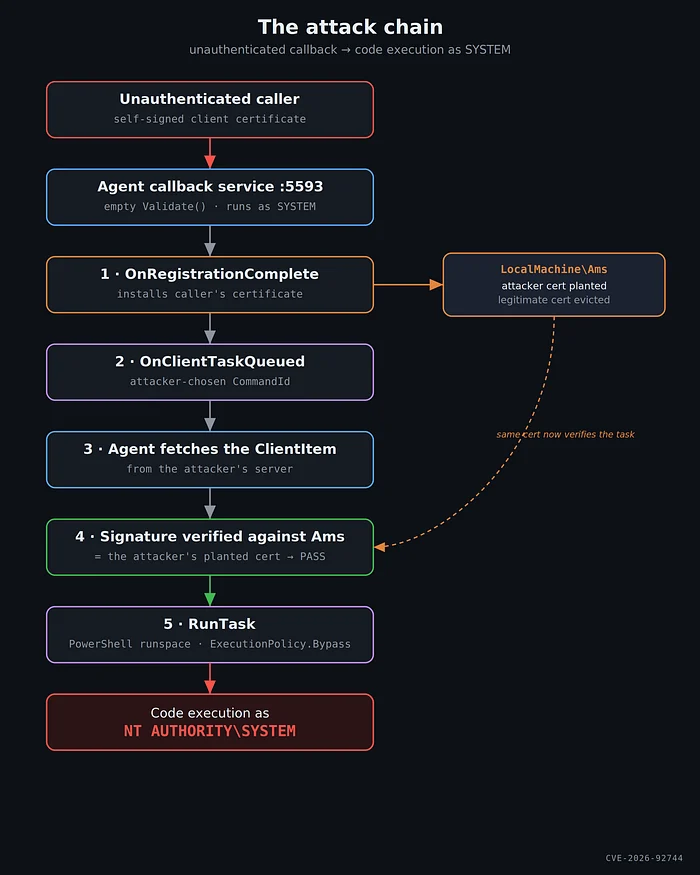
Unauthenticated callback to SYSTEM, end to end.
The certificate validator
The first thing that stood out in the code was AmsServerCertValidator:
internal class AmsServerCertValidator : X509CertificateValidator{ public override void Validate(X509Certificate2 certificate) { }}
That is the entire Validate() method: it returns without checking the certificate.
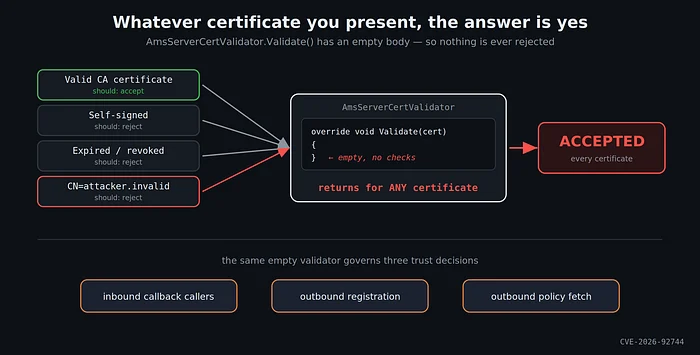
"CertificateValidationMode.Custom hands the whole decision to one empty method."
The validator was found used in three places:
+-------------------------------------------------------+-----------------------------+| Where it's assigned | What it affects |+-------------------------------------------------------+-----------------------------+| _serviceHost.Credentials.ClientCertificate. | Incoming callback || Authentication.CustomCertificateValidator | connections |+-------------------------------------------------------+-----------------------------+| AgentRegistration2Client.CreateClient(...) | Outbound registration |+-------------------------------------------------------+-----------------------------+| ClientBaseFactory.CreateClient<ClientItems2Client, | Outbound policy retrieval || ...> | |+-------------------------------------------------------+-----------------------------+
The callback host explicitly chooses custom certificate validation:
_serviceHost.Credentials.ClientCertificate.Authentication.CertificateValidationMode = X509CertificateValidationMode.Custom;_serviceHost.Credentials.ClientCertificate.Authentication.CustomCertificateValidator = new AmsServerCertValidator();
This is not an additional check layered on top of WCF's normal certificate validation. CertificateValidationMode.Custom delegates the decision to that method, and since the method does nothing, a self-signed client certificate is accepted.
The callback contract also specifies ProtectionLevel.None:
[ServiceContract(Namespace = "http://schemas.arellia.com/agent/services/", Name = "IAgentRegistration", SessionMode = SessionMode.NotAllowed, ProtectionLevel = ProtectionLevel.None)]public interface IAgentRegistrationCallback{ void OnRegistrationComplete(PlatformRegistration platformDetails); void OnApplicablePolicyChange(ClientItemDigest[] applicablePolicyDigests); void OnClientTaskQueued(PendingTaskExecutionInstance[] pendingTasks); void OnBadRegistration(Guid suggestedNewId);}
That disables message-level signing for these operations. In the configuration examined, the client certificate was supposed to establish the caller's identity, but the custom validator was establishing nothing.
Confirming the callbacks were reachable
All four operations exposed by IAgentRegistrationCallback were tested with a self-signed certificate. The registration and task-queue operations were reachable, and the other two callbacks also accepted the caller:
Already proven reachable: OnRegistrationComplete, OnClientTaskQueued OnApplicablePolicyChange accepted=True OnBadRegistration accepted=True
Two errors during testing helped locate where validation was happening:
Could not establish trust relationship for the SSL/TLS secure channelcame from the researcher's own .NET client rejecting the agent's self-signed server certificate. It was not the agent rejecting the client certificate.ContractFilter mismatch at the EndpointDispatcherappeared after using the interface name instead of the contract's declaredNamein the SOAP action. The request had already passed the message security stage by the time it reached dispatch; fixing the action let the operation be called.
Exploitation
Step 1: change the agent's trusted certificates through OnRegistrationComplete
OnRegistrationComplete takes certificates from the registration response and passes them to the certificate manager:
foreach (string serverCertificate in platformDetails.ServerCertificates){ byte[] raw = Convert.FromBase64String(serverCertificate); ICertificate2 certificate2 = _cert2Factory.Create(raw); list.Add(certificate2);}_certMgr.SaveServerCertificates(list);
SaveServerCertificates() opens LocalMachine\Ams for writing, removes certificates that are not in the supplied list, and then adds the supplied certificates. The researcher could not find a chain check, pinning check, or comparison against an already trusted registration authority in this path. The exception handling around the parsing only covered malformed base64.
The test was run twice on separate clean installations. Relevant output from one run:
[16:21:46] LocalMachine\Ams before: 0 cert(s):[16:21:52] attacker cert: [redacted] CN=attacker.invalid[16:21:53] --- INVOKING OnRegistrationComplete with our certificate ---[16:21:54] call returned without exception[16:22:06] LocalMachine\Ams after: 1 cert(s): [redacted]
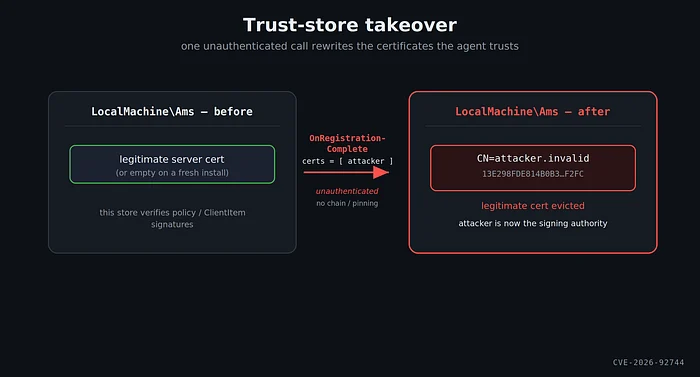
Before the call the Ams store was empty; after it, it contained the self-signed certificate just generated (CN=attacker.invalid).
This is more serious than simply accepting an untrusted caller. The agent uses this store when verifying signed client items, so if an unauthenticated registration callback can populate or replace the certificates in that store, subsequent signature checks can trust the caller's key. Enabling RequireSignedClientItems does not solve that underlying trust problem.
Step 2: queue a task and follow it into RunTask
The other useful callback was OnClientTaskQueued. Execution was traced through AgentController.RunTask:
clientItem = ClientItemManager.GetRawClientItem(taskInstance.CommandId);...if (clientItem == null) throw new Exception($"Failed to get ClientCommand {taskInstance.CommandId}"); RunspaceConfiguration runspaceConfiguration = RunspaceConfiguration.Create();Runspace runspace = RunspaceFactory.CreateRunspace(runspaceConfiguration);runspace.Open();...runspaceDispatcher.SetExecutionPolicy(ExecutionPolicy.Bypass, ExecutionPolicyScope.Process);runspaceDispatcher.ImportModule("Arellia.Agent");...AgentPowershellScriptContract agentPowershellScriptContract = (AgentPowershellScriptContract)clientItem.InnerContract;pSCommand.AddScript(agentPowershellScriptContract.Script);
The task carries a CommandId. The agent uses it to look up a client item; if the item is found, the code eventually creates a PowerShell runspace, sets the process execution policy to Bypass, and calls AddScript() with the script from the item.
For an initial test, a task was queued using a newly generated GUID that was not present in any item database or configuration. The callback returned, and the marker set for the task path was observed:
[18:03:10] --- calling OnClientTaskQueued (unauthenticated) ---[18:03:12] call returned without exception[18:03:22] MARKER SEEN after 10s
The unresolved command was expected to fail. The agent reached the GetRawClientItem() lookup and threw because the item did not exist. This test showed that the unauthenticated callback could cause the agent to process an attacker-chosen task identifier; it did not, by itself, demonstrate script execution.
While investigating the command lookup, these requests were captured:
POST /TMS/Agent/AgentRegistration4.svcPOST /TMS/Agent/ClientItems2.svc <- went to fetch the commandPOST /TMS/Agent/AgentRegistration4.svc <- reported the result
The agent reported the failing command ID back in its own fault response:
<b:ExceptionMessage>Failed to get ClientCommand c68751d5-62d1-46ed-b3e2-c253d6341f06 because of exception Failed to RefreshClientItemType: 00000000-... (GetDigests)</b:ExceptionMessage><b:InstanceState>Faulted</b:InstanceState>
That ID had been generated during the test. The fault confirmed the task had made it to the command-resolution path, even before the signed client item was working.
Step 3: reproduce SYSTEM execution
The remaining piece was the client item. A queued task alone is not enough: the item has to be available when the agent retrieves it, and it has to pass signature verification.
In the test environment, a server endpoint was used that responded to the agent's normal registration and client-item requests. The observed sequence:
- The agent registered and processed a response containing the attacker certificate, which was written into
LocalMachine\Ams. OnClientTaskQueuedwas sent to the callback listener with the task identifier.- The agent requested the corresponding client item from the configured endpoint.
- The signed item was checked against the certificate now in
Ams. - The task reached the PowerShell execution path, running under the agent's SYSTEM account.
The result:
EXECUTED as: nt authority\system at 2026-09-12T20:30:02*** UNAUTHENTICATED CODE EXECUTION AS SYSTEM - CONFIRMED ***
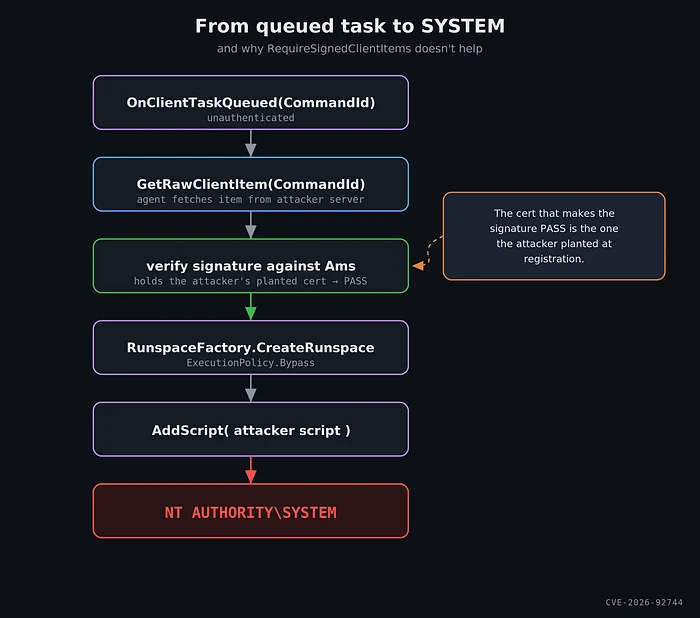
That was the point where end-to-end code execution could be confirmed, rather than only callback access or task scheduling.
An agent restart did not fix the underlying issue. In the test, re-registration and subsequent item retrieval caused the trust store and verifier state to be loaded again, so the same chain remained possible.
Two details that mattered during testing
taskInstance.Inputneeded to be a non-null, empty collection.RunTask()iterates over it after adding the script. Passingnullcaused aNullReferenceExceptionafter the execution point, making a successful run look like a failure.- The signature verifier could hold an older view of
Ams. Restarting the agent, or allowing its normal cycle to reload the store, made the newly added certificate available to verification.
Root cause
CertificateValidationMode.Custom hands the entire client-certificate decision to AmsServerCertValidator.Validate(), and that method is empty. A self-signed certificate is therefore accepted on the callback service. Because the callback contract uses ProtectionLevel.None, message-level signing does not compensate for the missing identity check.
That alone would be a serious authentication bypass, but the impact comes from what the accepted caller can do. OnRegistrationComplete feeds attacker-supplied certificates into SaveServerCertificates(), which rewrites LocalMachine\Ams without a chain check, pinning check, or comparison against an already trusted registration authority. The agent then uses that store to verify signed client items, so the unauthenticated caller can become the verification authority for later signature checks. RequireSignedClientItems does not help, because the trust store itself is under the caller's control.
Once a signed client item passes verification, RunTask builds a PowerShell runspace, sets the process execution policy to Bypass, and runs the script from the item in the SYSTEM process.
Impact
An unauthenticated caller who can reach the callback service can register, replace the agent's trusted certificates, queue a task, and have the agent fetch and execute an attacker-signed client item as NT AUTHORITY\SYSTEM.
The reproduction was performed over loopback only. The listener was bound to :::5593 and the installer created an inbound allow rule for that port across all three Windows Firewall profiles. Those findings support a network-reachable attack surface, but they are not a substitute for a direct remote test, and the researcher says so explicitly.
The researcher's own CVSS 3.1 view of the two scenarios, alongside Delinea's published rating:
+--------------------------------------+---------------------------------------------------+------------+| Scenario | CVSS vector | Score |+--------------------------------------+---------------------------------------------------+------------+| Network exposure indicated by | CVSS:3.1/AV:N/AC:L/PR:N/UI:N/S:U/C:H/I:H/A:H | 9.8 || configuration (CVSS 3.1) | | |+--------------------------------------+---------------------------------------------------+------------+| Loopback/local path directly | CVSS:3.1/AV:L/AC:L/PR:N/UI:N/S:U/C:H/I:H/A:H | 7.8 || demonstrated (CVSS 3.1) | | |+--------------------------------------+---------------------------------------------------+------------+| Published by Delinea (CVSS 4.0) | CVSS:4.0/AV:N/AC:H/AT:P/PR:H/UI:A/VC:H/VI:H/VA:H/ | 8.7 (High) || | SC:H/SI:H/SA:H | |+--------------------------------------+---------------------------------------------------+------------+
Delinea's published vector uses AV:N. It also includes PR:H, despite the CVE being described as unauthenticated. The researcher kept the published vector rather than presenting his own estimate as the official score. For the CVSS 3.1 scenarios he used S:U: the vulnerable agent already runs as SYSTEM, and the script executes in that process context.
Other issues noticed in the same codebase
These were observations from code review, not separate end-to-end RCE demonstrations.
For an agent using a servicebus.windows.net endpoint, GetRequireSignedClientItems() returns false, weakening the client-item signing requirement on the relay path:
internal static bool GetRequireSignedClientItems(){ bool result = true; if (IsInternetClientUri(GetAmsBaseUrl())) result = false; ...}public static bool IsInternetClientUri(Uri clientUri){ return clientUri.Host.EndsWith("servicebus.windows.net", StringComparison.InvariantCultureIgnoreCase);}
The signature verification path can fail open:
if (failedWithException){ if (CoreManagementAgent.GetRequireSignedClientItems()) { ...; return false; } return true;}
When signature verification throws, the return value depends on GetRequireSignedClientItems(). If signing is not required, this branch returns true.
Outbound TLS certificate validation is disabled by default in the on-premises configuration inspected. When ValidateServerCertificate and ValidateCertChain are unset, the ServerCertificateValidationCallback accepts the server certificate. Enabling ValidateCertChain=1 alone did not reject a self-signed certificate where Subject == Issuer and the chain reported UntrustedRoot.
The registration data is not encrypted at the message level. The registration payload is signed, but InstallCode and the machine SID are not separately encrypted by that payload protection, which matters particularly when the transport peer's certificate is not verified.
Fix
Delinea fixed the issue in Windows agent 12.0.5804 for v12 and 13.0.2064 for v13, released with Privilege Manager 13.0.2 on October 28, 2026. Updating is the fix for affected agents. Delinea also lists blocking inbound TCP 5593 as an interim mitigation; agents can continue using scheduled pulls.
From the researcher's review, the broader lessons are about preserving the trust boundary rather than changing one line. The callback caller should be authenticated against a known certificate, and a registration callback should not be able to replace the verification authority without that authentication. Message signing, a more restrictive listener and firewall configuration, signed-item verification that fails closed, and server certificate validation are also relevant hardening measures.
Variants to test
- Other WCF callback services with
CertificateValidationMode.Custom. Search agent and management binaries forX509CertificateValidationMode.Customand inspect the assigned validator. A positive result is aValidate()implementation that returns without checking the certificate, combined with a listener reachable from an untrusted network. ProtectionLevel.Noneon service contracts that carry trust decisions. Look for contracts whose operations change configuration, trust stores or task queues. A positive result is an operation that accepts a self-signed client certificate and returns without error.- Registration handlers that write certificates to a local store. Trace what happens to certificates in registration responses. A positive result is a store such as
LocalMachine\Amsgoing from empty to containing an attacker-generated certificate after one unauthenticated call. - Task queue callbacks that resolve identifiers into executable content. Send a task with a fresh GUID and watch for the agent fetching a client item. A positive result is the agent reaching the item lookup and reporting the attacker-chosen ID in a fault.
- Signature verification that fails open. Look for
catchbranches around signature checks whose return value depends on a configuration flag. A positive result is a verification exception that returnstruewhen signing is not required. - Signing requirements disabled for relay endpoints. Check whether host suffixes such as
servicebus.windows.netswitch offRequireSignedClientItems. A positive result is a code path where the signing requirement is dropped based only on the endpoint host. - Outbound TLS validation defaults. On a default install, point the agent at a server with a self-signed certificate and see whether it connects. A positive result is a successful connection with
ValidateServerCertificateandValidateCertChainunset, or withValidateCertChain=1alone against aSubject == Issuercertificate reportingUntrustedRoot.
Disclosure timeline
2026-09-12 Reproduced end to end, clean default install (SYSTEM proof)2026-09-14 Reported to Delinea (case #01416021)2026-09-16 CVE-2026-92744 reserved2026-09-29 Answered the dev team2026-10-28 Fixed in agent 12.0.5804 / 13.0.2064 (Privilege Manager 13.0.2)2026-10-29 CVE-2026-92744 published, 8.7 High
Research credit: Isuka Sanuj (lead), Ishan Nim (contributor), CyberCrew Inc.
The empty Validate() method was the starting point, but the real impact came from how much trust the agent placed in the result. Once the callback accepted an unverified certificate, the registration path could change the trusted certificates used for later signature checks, and those checks then protected execution with a trust store the untrusted caller had been allowed to control.
What happened, in plain words
Delinea Privilege Manager is a product that companies install on their Windows computers to control who is allowed to do what on them. It works with a small program called an agent that sits on each computer and follows instructions from a central management server. The agent runs with the highest level of permission Windows has, an account called NT AUTHORITY\SYSTEM (often shortened to SYSTEM). The agent runs with the highest level of permission Windows has, an account called NT AUTHORITY\SYSTEM (often shortened to SYSTEM), so anything that can make the agent run a command runs it with those rights.
A security researcher, Isuka Sanuj, found a way to make that agent run commands of his choosing without logging in to it at all. The flaw is in how the agent checks the identity of the server it talks to. In the configuration examined, a certificate (a digital ID card) presented by whoever connects to it was supposed to establish that caller's identity. The code that should do the checking is an empty function: it looks at the certificate and then does nothing. So the agent accepts any certificate, including one the researcher made up himself.
That alone would be bad, but the researcher followed the consequences further. Once the agent trusts a fake caller, that caller can tell the agent to replace the list of certificates the agent trusts for later checks. The agent then uses that list to decide whether the commands it downloads are genuine. Because the attacker now controls the list, later signature checks can trust his key.
The researcher reproduced this on a clean, default installation. He sent every request from the same machine (the loopback address [redacted]), because his test environment did not give him a second computer. The listener was open on all network interfaces and the installer had created a firewall rule allowing that port on all three Windows firewall profiles, which suggests the same attack would work from another machine over the network, but he did not test that directly and says so.
Delinea fixed the problem in Windows agent versions 12.0.5804 and 13.0.2064, released on October 28, 2026.
The pieces you need to know before reading on
A few everyday comparisons will make the rest of this article much easier.
- Agent and management server. Think of a company's head office (the management server) and its local staff (the agents). The head office sends instructions; the staff carry them out. The staff must be sure that a message really comes from head office and not from someone pretending.
- Certificate. A digital ID card. It contains a name and a public key, and it is signed by someone trusted. When two computers talk securely, each can show its certificate so the other knows who it is. A self-signed certificate is an ID card someone printed for themselves: it says whatever they want and nobody has vouched for it.
- Certificate validation. The act of checking an ID card: is it signed by someone I trust, has it expired, does the name match? If the check is skipped, any card is accepted.
- WCF. Windows Communication Foundation, a Microsoft framework for building services that talk to each other over a network. A service contract is the list of operations a service offers, like a menu. A callback is a service where the server calls back into the client, rather than the client only asking questions.
- API. An interface that lets one program ask another to do something, without knowing how it works inside. A restaurant menu is a good comparison: you order by name, the kitchen handles the details.
- Port. A numbered door on a computer through which network traffic for a particular service arrives. Port 5593 is the door used here.
- Firewall rule. A rule that says which doors are open to whom. An inbound allow rule on all profiles means the door is open whether the computer is on a home, work or public network.
- Registry. A database inside Windows where programs store settings.
HKLM\SOFTWARE\Policies\Arellia\AMSis a folder in it holding this product's settings. - PowerShell. A scripting tool built into Windows. A script is a list of commands; running one is how an attacker turns access into actions.
- Execution policy. A PowerShell safety setting that decides whether scripts may run.
Bypassmeans run them regardless. - Signature. A cryptographic stamp proving that a file or message was made by the holder of a particular key, and was not altered afterwards. Checking a signature requires knowing which key to trust, which is where the certificate store comes in.
- Certificate store. A folder in Windows holding trusted certificates.
LocalMachine\Amsis the store this product uses. - GUID. A long random-looking identifier, like
c68751d5-62d1-46ed-b3e2-c253d6341f06, used to name things uniquely. - CVSS. A scoring system that turns the severity of a vulnerability into a number from 0 to 10, with a vector string showing how the number was reached.
- CVE. A public catalogue number for a known vulnerability. CVE-2026-92744 is this one.
- RCE. Remote code execution: an attacker somewhere else can make the target computer run their code.
- Loopback. The address
[redacted], which always means "this same computer". Traffic to it never leaves the machine.
The setup
The researcher worked on a default installation of the Delinea Privilege Manager Windows agent, running as SYSTEM. He did not relax any security settings, which matters: the problem exists out of the box.
His test machine was a sandbox that only offered loopback, so every request came from [redacted]. He states plainly that he did not perform a test from a second computer.
The registry settings on the test machine were:
HKLM\SOFTWARE\Policies\Arellia\AMS BaseUrl = https: InstallCode = testinstallcode BaseUrlOverride = https:
Line by line: HKLM\SOFTWARE\Policies\Arellia\AMS is the registry folder holding the agent's settings. BaseUrl is the address of the management server the agent should talk to; here it pointed at localhost. InstallCode is a code used during installation to identify the installation; the value shown is a test value. BaseUrlOverride is a second setting for the same address. The important point is that pointing BaseUrl at localhost did not change how the callback listener was bound, so the listener's exposure was not an artefact of the test setup.
He also generated a self-signed client certificate with the name CN=attacker.invalid to use as his fake ID card, and set up a small test server that answered the agent's normal registration and client-item requests.
Finding the door: the listener
The first step was to find where the agent listens for callbacks. He found it on TCP port 5593:
:::5593 pid=4 proc=System <- all interfaces (http.sys) [Domain, Private, Public] Arellia Agent (SSTP-In) | dir=Inbound action=Allow port=5593 prog=System
Reading this line: :::5593 means the listener is bound to all network interfaces, not just localhost. pid=4 and proc=System are the process identifiers shown for the listener. http.sys is the Windows component that handles HTTP traffic. [Domain, Private, Public] lists the three Windows firewall profiles, meaning the rule applies on all of them. Arellia Agent (SSTP-In) is the name of the firewall rule. dir=Inbound action=Allow port=5593 prog=System says incoming traffic to port 5593 for the System process is allowed.
Unauthenticated callback to SYSTEM, end to end.
Why this matters: a service that accepts connections from anywhere, on a port the firewall opens on every profile, is reachable by anyone who can reach the machine on the network. That is the surface an attacker would use.
The empty check: the certificate validator
The next step was to read the code that decides whether to trust a connecting client. The first thing that stood out was a class called AmsServerCertValidator:
internal class AmsServerCertValidator : X509CertificateValidator{ public override void Validate(X509Certificate2 certificate) { }}
Line by line: internal class AmsServerCertValidator : X509CertificateValidator declares a class that inherits from the standard .NET certificate validator, so it is meant to plug into the normal validation machinery. public override void Validate(X509Certificate2 certificate) is the method that receives the certificate to check. The braces { } are empty, so the method does nothing at all and returns immediately. In other words, the code that should say yes or no says nothing, and the caller treats that as yes.
"CertificateValidationMode.Custom hands the whole decision to one empty method."
He then looked for where this validator is used, and found three places:
+-------------------------------------------------------+-----------------------------+| Where it's assigned | What it affects |+-------------------------------------------------------+-----------------------------+| _serviceHost.Credentials.ClientCertificate. | Incoming callback || Authentication.CustomCertificateValidator | connections |+-------------------------------------------------------+-----------------------------+| AgentRegistration2Client.CreateClient(...) | Outbound registration |+-------------------------------------------------------+-----------------------------+| ClientBaseFactory.CreateClient<ClientItems2Client, | Outbound policy retrieval || ...> | |+-------------------------------------------------------+-----------------------------+
This is a table. The left column names the code location where the validator is attached; the right column says what that location does. The first row is the incoming callback service, the door other machines knock on. The second row is the client the agent uses to register itself with the management server. The third row is the client the agent uses to fetch policies. So the same do-nothing check is used in both directions: when the agent accepts callers, and when the agent decides whether to trust the server it is talking to.
The callback host explicitly chooses this custom validation:
_serviceHost.Credentials.ClientCertificate.Authentication.CertificateValidationMode = X509CertificateValidationMode.Custom;_serviceHost.Credentials.ClientCertificate.Authentication.CustomCertificateValidator = new AmsServerCertValidator();
Line by line: the first line sets the certificate validation mode to Custom, which tells WCF "do not use your built-in checks; I will supply my own". The second line supplies the empty validator as that custom check. The crucial point is that Custom does not add an extra check on top of the normal ones; it replaces them. Since the replacement does nothing, a self-signed certificate is accepted.
The callback contract also declares ProtectionLevel.None:
[ServiceContract(Namespace = "http://schemas.arellia.com/agent/services/", Name = "IAgentRegistration", SessionMode = SessionMode.NotAllowed, ProtectionLevel = ProtectionLevel.None)]public interface IAgentRegistrationCallback{ void OnRegistrationComplete(PlatformRegistration platformDetails); void OnApplicablePolicyChange(ClientItemDigest[] applicablePolicyDigests); void OnClientTaskQueued(PendingTaskExecutionInstance[] pendingTasks); void OnBadRegistration(Guid suggestedNewId);}
Line by line: the [ServiceContract(...)] block describes the service. Namespace and Name give it its identity on the wire; Name = "IAgentRegistration" is the name that must appear in requests. SessionMode.NotAllowed means each call stands alone, with no ongoing session. ProtectionLevel.None means messages are not signed at the message level. The interface then lists four operations: OnRegistrationComplete (registration finished), OnApplicablePolicyChange (policies changed), OnClientTaskQueued (a task is waiting) and OnBadRegistration (registration failed).
Because ProtectionLevel.None disables message signing, the only thing that could establish who is calling is the client certificate, and the empty validator establishes nothing. The two weaknesses combine.
Checking that the callbacks could actually be reached
Before going further, he tested all four operations with his self-signed certificate. Two were already known to be reachable, and the other two also accepted him:
Already proven reachable: OnRegistrationComplete, OnClientTaskQueued OnApplicablePolicyChange accepted=True OnBadRegistration accepted=True
This output simply records that each operation answered without rejecting the caller. accepted=True means the call went through.
Two errors along the way helped him understand where checks were happening:
Could not establish trust relationship for the SSL/TLS secure channelcame from his own .NET client rejecting the agent's self-signed server certificate. It was his tool being strict, not the agent rejecting him. This is a useful reminder that error messages tell you which side refused.ContractFilter mismatch at the EndpointDispatcherappeared when he used the interface name instead of the contract's declaredNamein the SOAP action. A SOAP action is a label on the request saying which operation is wanted; if the label does not match the menu, the service cannot route it. The request had already passed the security stage by then, so fixing the label let the call through. This confirmed that security checks were not what was stopping him.
Step 1: replacing the agent's trusted certificates
The next question was what an accepted caller can actually do. The operation OnRegistrationComplete turned out to be the important one, because it takes certificates from the registration response and hands them to the certificate manager:
foreach (string serverCertificate in platformDetails.ServerCertificates){ byte[] raw = Convert.FromBase64String(serverCertificate); ICertificate2 certificate2 = _cert2Factory.Create(raw); list.Add(certificate2);}_certMgr.SaveServerCertificates(list);
Line by line: foreach (string serverCertificate in platformDetails.ServerCertificates) loops over every certificate supplied in the registration details. Convert.FromBase64String(serverCertificate) turns the text form of the certificate back into raw bytes; base64 is just a way of writing binary data as letters. _cert2Factory.Create(raw) builds a certificate object from those bytes. list.Add(certificate2) adds it to a list. Finally _certMgr.SaveServerCertificates(list) saves the whole list. Nothing in this loop asks whether the certificates are trustworthy; it simply converts and stores whatever arrived.
He then traced SaveServerCertificates(). It opens LocalMachine\Ams for writing, removes certificates that are not in the supplied list, and adds the supplied ones. He could not find a chain check (does this certificate lead back to a trusted authority?), a pinning check (is this the specific certificate we expect?) or a comparison against an already trusted registration authority. The only error handling around the parsing covered malformed base64, meaning bad text, not bad trust.
He ran the test twice on separate clean installations. Output from one run:
[16:21:46] LocalMachine\Ams before: 0 cert(s):[16:21:52] attacker cert: [redacted] CN=attacker.invalid[16:21:53] --- INVOKING OnRegistrationComplete with our certificate ---[16:21:54] call returned without exception[16:22:06] LocalMachine\Ams after: 1 cert(s): [redacted]
Line by line: at 16:21:46 the Ams store held zero certificates. At 16:21:52 the attacker certificate was generated, with fingerprint [redacted] and name CN=attacker.invalid. At 16:21:53 the registration callback was invoked with that certificate. At 16:21:54 the call returned without an exception, meaning it was accepted. At 16:22:06 the store held one certificate: the attacker's.
Why this is worse than simply accepting an unknown caller: the agent uses this store when checking the signatures on client items, which are the commands and scripts it downloads. If an unauthenticated caller can fill or replace that store, later signature checks will trust the caller's key. Turning on the setting RequireSignedClientItems does not fix this, because the list of trusted signers is itself under the caller's control.
Step 2: queueing a task and following it into RunTask
The other useful callback was OnClientTaskQueued. To see where a queued task leads, he traced the code path through AgentController.RunTask:
clientItem = ClientItemManager.GetRawClientItem(taskInstance.CommandId);...if (clientItem == null) throw new Exception($"Failed to get ClientCommand {taskInstance.CommandId}"); RunspaceConfiguration runspaceConfiguration = RunspaceConfiguration.Create();Runspace runspace = RunspaceFactory.CreateRunspace(runspaceConfiguration);runspace.Open();...runspaceDispatcher.SetExecutionPolicy(ExecutionPolicy.Bypass, ExecutionPolicyScope.Process);runspaceDispatcher.ImportModule("Arellia.Agent");...AgentPowershellScriptContract agentPowershellScriptContract = (AgentPowershellScriptContract)clientItem.InnerContract;pSCommand.AddScript(agentPowershellScriptContract.Script);
Line by line: GetRawClientItem(taskInstance.CommandId) looks up the client item whose identifier is in the task. If nothing is found, the next lines throw an exception saying the command could not be found. If something is found, the code creates a PowerShell runspace (a place to run PowerShell), opens it, sets the process execution policy to Bypass so scripts run regardless of policy, imports the agent's own module, takes the script out of the client item and adds it to the command to run. In short: a task names an item, the item contains a script, and the script runs.
For a first test he queued a task using a freshly generated GUID that existed nowhere in any database or configuration. The callback returned and his marker appeared:
[18:03:10] --- calling OnClientTaskQueued (unauthenticated) ---[18:03:12] call returned without exception[18:03:22] MARKER SEEN after 10s
Line by line: at 18:03:10 the unauthenticated task callback was called. At 18:03:12 it returned without an exception. At 18:03:22 the marker was seen, ten seconds later, showing the agent had processed the task.
The command did not exist, so it was expected to fail. The agent reached the lookup and threw because the item was missing. This test proved that an unauthenticated caller could make the agent process a task identifier of the caller's choosing. It did not, by itself, prove that a script ran.
While investigating the lookup, he captured these requests:
POST /TMS/Agent/AgentRegistration4.svcPOST /TMS/Agent/ClientItems2.svc <- went to fetch the commandPOST /TMS/Agent/AgentRegistration4.svc <- reported the result
Line by line: the first request is the agent registering with the server. The second is the agent asking for the client item, which is where it went to fetch the command. The third is the agent reporting the result back. The comments after the arrows are the researcher's notes on what each request was for.
The agent also reported the failing command identifier in its own error response:
<b:ExceptionMessage>Failed to get ClientCommand c68751d5-62d1-46ed-b3e2-c253d6341f06 because of exception Failed to RefreshClientItemType: 00000000-... (GetDigests)</b:ExceptionMessage><b:InstanceState>Faulted</b:InstanceState>
Line by line: ExceptionMessage contains the error text, saying the command c68751d5-62d1-46ed-b3e2-c253d6341f06 could not be fetched because refreshing the item type failed. InstanceState is Faulted, meaning the operation ended in an error. That identifier had been generated during the test, so the error itself proved the agent had taken the attacker-chosen identifier all the way to the command lookup, before any signed item was working.
Step 3: getting code to run as SYSTEM
The last piece was the client item itself. A queued task is not enough: the item must be available when the agent asks for it, and it must pass the signature check.
In the test environment he used a server endpoint that answered the agent's normal registration and client-item requests. The sequence he observed:
- The agent registered and processed a response containing his certificate, which was written into
LocalMachine\Ams. - He sent
OnClientTaskQueuedto the callback listener with the task identifier. - The agent requested the matching client item from the configured endpoint.
- The signed item was checked against the certificate now in
Ams. - The task reached the PowerShell execution path, running under the agent's SYSTEM account.
The result:
EXECUTED as: nt authority\system at 2026-09-12T20:30:02*** UNAUTHENTICATED CODE EXECUTION AS SYSTEM - CONFIRMED ***
Line by line: the first line records that the code ran as nt authority\system at the given time. The second line is the researcher's confirmation that unauthenticated code execution as SYSTEM had been achieved.
This was the point where end-to-end code execution was confirmed, rather than only callback access or task scheduling.
Restarting the agent did not fix the underlying problem. In his test, re-registration and the next item retrieval caused the trust store and verifier state to be loaded again, so the same chain still worked.
Two details that mattered during testing
taskInstance.Inputhad to be a non-null, empty collection.RunTask()loops over it after adding the script. Passingnullcaused aNullReferenceExceptionafter the execution point, which made a successful run look like a failure. In plain terms: a missing list caused an error after the code had already run, so the error was misleading.- The signature verifier could hold an older view of
Ams. Restarting the agent, or letting its normal cycle reload the store, made the newly added certificate visible to verification.
Why it works: the root cause
CertificateValidationMode.Custom hands the entire client-certificate decision to AmsServerCertValidator.Validate(), and that method is empty. A self-signed certificate is therefore accepted on the callback service. Because the callback contract uses ProtectionLevel.None, message-level signing does not make up for the missing identity check.
That alone would be a serious authentication bypass, but the impact comes from what the accepted caller can do. OnRegistrationComplete feeds attacker-supplied certificates into SaveServerCertificates(), which rewrites LocalMachine\Ams without a chain check, pinning check or comparison against an already trusted registration authority. The agent then uses that store to verify signed client items, so the unauthenticated caller can become the verification authority for later signature checks. RequireSignedClientItems does not help, because the trust store itself is under the caller's control.
Once a signed client item passes verification, RunTask builds a PowerShell runspace, sets the process execution policy to Bypass, and runs the script from the item in the SYSTEM process.
What an attacker could do
An unauthenticated caller who can reach the callback service can register, replace the agent's trusted certificates, queue a task, and have the agent fetch and execute an attacker-signed client item as NT AUTHORITY\SYSTEM.
The reproduction was performed over loopback only. The listener was bound to :::5593 and the installer created an inbound allow rule for that port across all three Windows Firewall profiles. Those findings support a network-reachable attack surface, but they are not a substitute for a direct remote test, and the researcher says so explicitly.
His own CVSS 3.1 view of the two scenarios, alongside Delinea's published rating:
+--------------------------------------+---------------------------------------------------+------------+| Scenario | CVSS vector | Score |+--------------------------------------+---------------------------------------------------+------------+| Network exposure indicated by | CVSS:3.1/AV:N/AC:L/PR:N/UI:N/S:U/C:H/I:H/A:H | 9.8 || configuration (CVSS 3.1) | | |+--------------------------------------+---------------------------------------------------+------------+| Loopback/local path directly | CVSS:3.1/AV:L/AC:L/PR:N/UI:N/S:U/C:H/I:H/A:H | 7.8 || demonstrated (CVSS 3.1) | | |+--------------------------------------+---------------------------------------------------+------------+| Published by Delinea (CVSS 4.0) | CVSS:4.0/AV:N/AC:H/AT:P/PR:H/UI:A/VC:H/VI:H/VA:H/ | 8.7 (High) || | SC:H/SI:H/SA:H | |+--------------------------------------+---------------------------------------------------+------------+
How to read this table: each row is a scenario, its CVSS vector and its score. In a CVSS vector, AV is the attack vector (N for network, L for local), AC is attack complexity, PR is privileges required, UI is user interaction, S is scope, and C, I, A are the impact on confidentiality, integrity and availability. The first row is the network view suggested by the configuration, scoring 9.8. The second row is the loopback path he actually demonstrated, scoring 7.8. The third row is Delinea's published rating, 8.7 High.
Delinea's published vector uses AV:N. It also includes PR:H, even though the CVE is described as unauthenticated. The researcher kept the published vector rather than presenting his own estimate as the official score. For his CVSS 3.1 scenarios he used S:U: the vulnerable agent already runs as SYSTEM, and the script runs in that same process context.
Other issues noticed in the same codebase
These were observations from reading the code, not separate end-to-end demonstrations of code execution.
For an agent using a servicebus.windows.net endpoint, GetRequireSignedClientItems() returns false, which weakens the client-item signing requirement on the relay path:
internal static bool GetRequireSignedClientItems(){ bool result = true; if (IsInternetClientUri(GetAmsBaseUrl())) result = false; ...}public static bool IsInternetClientUri(Uri clientUri){ return clientUri.Host.EndsWith("servicebus.windows.net", StringComparison.InvariantCultureIgnoreCase);}
Line by line: the method starts by assuming signing is required (result = true). If the configured server address is an "internet client URI", it sets the result to false. The helper IsInternetClientUri returns true when the host name ends with servicebus.windows.net, ignoring case. So simply using a relay endpoint with that suffix switches the signing requirement off.
The signature verification path can fail open:
if (failedWithException){ if (CoreManagementAgent.GetRequireSignedClientItems()) { ...; return false; } return true;}
Line by line: if verification failed with an exception, the code checks whether signed items are required. If they are, it returns false (reject). If they are not, it returns true (accept). "Fail open" means an error leads to acceptance rather than rejection, which is the opposite of what a security check should do.
Outbound TLS certificate validation is disabled by default in the on-premises configuration he inspected. When ValidateServerCertificate and ValidateCertChain are unset, the ServerCertificateValidationCallback accepts the server certificate. He also found that enabling ValidateCertChain=1 alone did not reject a self-signed certificate where Subject == Issuer and the chain reported UntrustedRoot. In plain terms: the agent does not check the server's ID card by default, and one of the settings meant to turn that check on is not enough on its own.
The registration data is not encrypted at the message level. The registration payload is signed, but InstallCode and the machine SID are not separately encrypted by that protection, which matters particularly when the transport peer's certificate is not verified.
The fix
Delinea fixed the issue in Windows agent 12.0.5804 for v12 and 13.0.2064 for v13, released with Privilege Manager 13.0.2 on October 28, 2026. Updating is the fix for affected agents. Delinea also lists blocking inbound TCP 5593 as an interim mitigation; agents can continue using scheduled pulls.
From the researcher's review, the broader lessons are about preserving the trust boundary rather than changing one line. The callback caller should be authenticated against a known certificate, and a registration callback should not be able to replace the verification authority without that authentication. Message signing, a more restrictive listener and firewall configuration, signed-item verification that fails closed, and server certificate validation are also relevant hardening measures.
Things worth testing in similar products
- Other WCF callback services with
CertificateValidationMode.Custom. Search agent and management binaries forX509CertificateValidationMode.Customand inspect the assigned validator. A positive result is aValidate()implementation that returns without checking the certificate, combined with a listener reachable from an untrusted network. ProtectionLevel.Noneon service contracts that carry trust decisions. Look for contracts whose operations change configuration, trust stores or task queues. A positive result is an operation that accepts a self-signed client certificate and returns without error.- Registration handlers that write certificates to a local store. Trace what happens to certificates in registration responses. A positive result is a store such as
LocalMachine\Amsgoing from empty to containing an attacker-generated certificate after one unauthenticated call. - Task queue callbacks that resolve identifiers into executable content. Send a task with a fresh GUID and watch for the agent fetching a client item. A positive result is the agent reaching the item lookup and reporting the attacker-chosen ID in a fault.
- Signature verification that fails open. Look for
catchbranches around signature checks whose return value depends on a configuration flag. A positive result is a verification exception that returnstruewhen signing is not required. - Signing requirements disabled for relay endpoints. Check whether host suffixes such as
servicebus.windows.netswitch offRequireSignedClientItems. A positive result is a code path where the signing requirement is dropped based only on the endpoint host. - Outbound TLS validation defaults. On a default install, point the agent at a server with a self-signed certificate and see whether it connects. A positive result is a successful connection with
ValidateServerCertificateandValidateCertChainunset, or withValidateCertChain=1alone against aSubject == Issuercertificate reportingUntrustedRoot.
Timeline
2026-09-12 Reproduced end to end, clean default install (SYSTEM proof)2026-09-14 Reported to Delinea (case #01416021)2026-09-16 CVE-2026-92744 reserved2026-09-29 Answered the dev team2026-10-28 Fixed in agent 12.0.5804 / 13.0.2064 (Privilege Manager 13.0.2)2026-10-29 CVE-2026-92744 published, 8.7 High
Line by line: on 12 September 2026 the researcher reproduced the issue end to end on a clean default installation, with proof of SYSTEM execution. On 14 September he reported it to Delinea under case number 01416021. On 16 September the CVE number was reserved. On 29 September he answered the development team. On 28 October the fix shipped in agent 12.0.5804 and 13.0.2064, part of Privilege Manager 13.0.2. On 29 October the CVE was published with a rating of 8.7 High.
Research credit: Isuka Sanuj (lead), Ishan Nim (contributor), CyberCrew Inc.
Final thoughts
The empty Validate() method was the starting point, but the real impact came from how much trust the agent placed in the result. Once the callback accepted an unverified certificate, the registration path could change the trusted certificates used for later signature checks, and those checks then protected execution with a trust store the untrusted caller had been allowed to control.
That is what made this worth tracing past the first callback. Accepting a self-signed certificate was one bug; following that decision through registration, item verification and task execution showed its actual impact.
Glossary
- Agent: a program installed on each managed computer that carries out instructions from a central server.
- API: an interface that lets one program ask another to do something without knowing its internals.
- Base64: a way of writing binary data using only text characters.
- Callback: a service where the server calls into the client, rather than the client only asking questions.
- Certificate: a digital ID card containing a name and a public key, usually signed by a trusted authority.
- Certificate store: a folder in Windows holding trusted certificates, here
LocalMachine\Ams. - Certificate validation: checking whether a certificate is signed by someone trusted, unexpired and correctly named.
- Chain check: verifying that a certificate leads back to a trusted authority through a series of signatures.
- Client item: a command or script the agent downloads from the server and acts on.
- CVSS: a scoring system that turns vulnerability severity into a number from 0 to 10, with a vector showing how it was reached.
- Execution policy: a PowerShell setting that decides whether scripts may run;
Bypassmeans run them regardless. - Fail open: a security check that accepts when it hits an error, instead of rejecting.
- Firewall rule: a rule saying which network doors are open to whom.
- GUID: a long random-looking identifier used to name things uniquely.
- http.sys: the Windows component that handles HTTP traffic.
- Loopback: the address
[redacted], meaning this same computer. - Management server: the central server that sends instructions to agents.
- Message signing: cryptographically stamping a message so the receiver can tell who sent it and that it was not altered.
- NT AUTHORITY\SYSTEM: the built-in Windows account the agent runs as.
- Pinning: requiring one specific known certificate rather than any certificate that chains to a trusted authority.
- Port: a numbered door on a computer through which traffic for a particular service arrives.
- ProtectionLevel.None: a WCF setting meaning messages are not signed at the message level.
- RCE: remote code execution, an attacker elsewhere making the target run their code.
- Runspace: a PowerShell environment in which scripts run.
- Self-signed certificate: a certificate signed by its own key, vouched for by nobody.
- Service contract: the list of operations a WCF service offers.
- Signature: a cryptographic stamp proving who made a file or message and that it was not altered.
- SOAP action: a label on a SOAP request saying which operation is wanted.
- TLS: the protocol that secures connections between computers.
- WCF: Windows Communication Foundation, a Microsoft framework for services that talk over a network.



