Finding Initial Access on a real life Penetration Test
A vulnerable VMware vCenter was exploited through a file upload flaw to gain root, then its certificate store was used to forge a SAML login as the built-in administrator. From there the tester found an unauthenticated VM, relayed a privileged account's credentials, and reached domain admin.
 Published on medium.com
On a recent internal Penetration Test I was faced with the above scenario and had to work a little harder for Domain Admin. So finding initial access.
The full write-up lives on its author's site
It belongs to its author, so we link to it rather than copy it. The other two tabs are our own rewrites, checked against it.
Context
This is an account of an internal penetration test in which the tester had to work harder than usual for Domain Admin. The report frames the problem in general terms: to get initial access without red team tactics such as phishing, you need one of two things.
- Something vulnerable.
- Credentials.

Either you steal, sniff or crack credentials, or you find something vulnerable, ideally a useful CVE, that gives you a beacon or session on the initial target. The target environment itself is described only as a client network that had been tested multiple times, including by the same team, and that had pushed a new password policy. The product that provided the way in was VMware vCenter.
Setup
The tester's tooling and preconditions, as described in the report:
- Responder and mitm6 for credential capture and relay attempts.
- An AWS-hosted hashcat instance for cracking.
- A Kali VM used as the relay and hosting point later in the engagement.
- kpartx to map VMDK partitions, plus secretsdump against the copied registry hives.
- The horizon3ai
vcenter_saml_logintool to turn the vCenterdata.mdbfile into a UI cookie. - Hook Detector to enumerate hooked Windows APIs before running payloads on disk.
- Cobalt Strike for the final beacon, delivered through a custom C# process injector.
Preconditions that mattered: the vCenter version in scope was vulnerable to CVE-2021-22005, VM backups or stopped VMs were available for download, at least one VM allowed console access without a password, and Sophos was running on the hosts the tester later touched.
Finding it
The usual first moves did not work. Responder, mitm6 and other man-in-the-middle approaches are the usual first move to steal credentials and relay or crack them. That approach often finds weak passwords, but here the client had been tested repeatedly and had tightened its password policy, so even with an AWS hashcat instance the captured credentials were hard to crack. Relaying credentials produced nothing either. That left the other route: find something vulnerable.
A version of vCenter was found that was vulnerable to CVE-2021-22005. The vulnerability is a file upload in VMware vCenter Server's analytics and telemetry (CEIP) service, which can be used to write a system crontab and execute shell commands as the root user.
Exploitation
Step 1: Root shell on vCenter via CVE-2021-22005
Exploiting the CEIP file upload gave a root shell on the vCenter appliance.
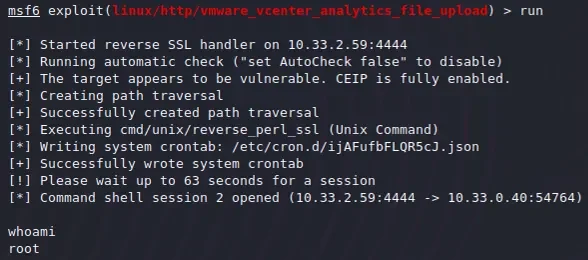
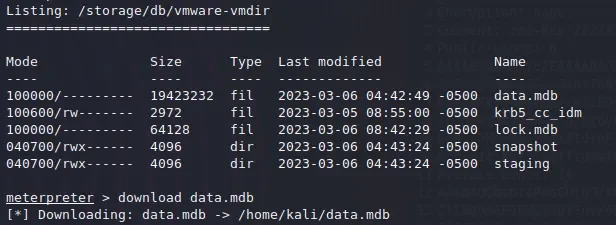
With root on vCenter, the next target was the data.mdb file. It contains certificates stored in cleartext that can be used to sign any SAML authentication request for any user, including the builtin Administrator. A root shell is what allows the file to be downloaded.
Step 2: Forge a vCenter UI session
With data.mdb in hand, the tester used a tool created by horizon3ai, vcenter_saml_login, to create a cookie for the vCenter UI.

Injecting that cookie into a browser session on the vCenter /ui URL authenticated the tester to the vSphere GUI as administrator.
Step 3: Two routes from the vSphere GUI
Once on vSphere, the tester considered two scenarios.
- Dump VMDKs, mount them locally, and grab SYSTEM, SAM and SECURITY to dump hashes.
- Open every VM to see whether any of them gave some form of access.
The first route was tried first. Downloading VMDKs has to be done on VM backups or on VMs that have been stopped. A few were available, but the download size was often quite large.
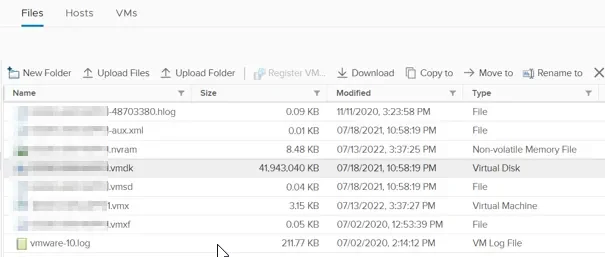
The process was:
- Download the VMDK file.
- Use kpartx to create device maps from the VMDK partition tables.
- Mount the partition.
- Copy the SAM, SECURITY and SYSTEM files.
- Run secretsdump on them.
This yielded hashes for some RID 500 accounts and Domain Cached Credentials, which the tester notes are pretty slow to crack. The RID 500 accounts had no access on the rest of the domain, so the exercise was useful but did not lead further. A detailed write-up of the VMDK credential technique is linked at drmarmar.com/vmdk-credentials.
Step 4: A VM with no login prompt
The second route was to open every single VM and check whether any did not require a password to log in. One VM dropped the tester straight onto the desktop with no password prompt. Sophos was found to be running on it, so the priority was to get something running quickly.
Responder and ntlmrelay were set up. From the VM, the tester navigated to the Kali VM, captured and relayed the hash. The account was privileged, and the relay successfully dumped credentials from two management servers. The haul included many hashes, among them LSA secrets in cleartext for an account configured to start a service. That account was a domain admin.
Step 5: Beacon on the Domain Controller
Wanting a Cobalt Strike Beacon, the tester used wmiexec to reach the Domain Controller. Sophos was running there too. Before dropping any file on disk, Hook Detector was run to see which Windows APIs were hooked.
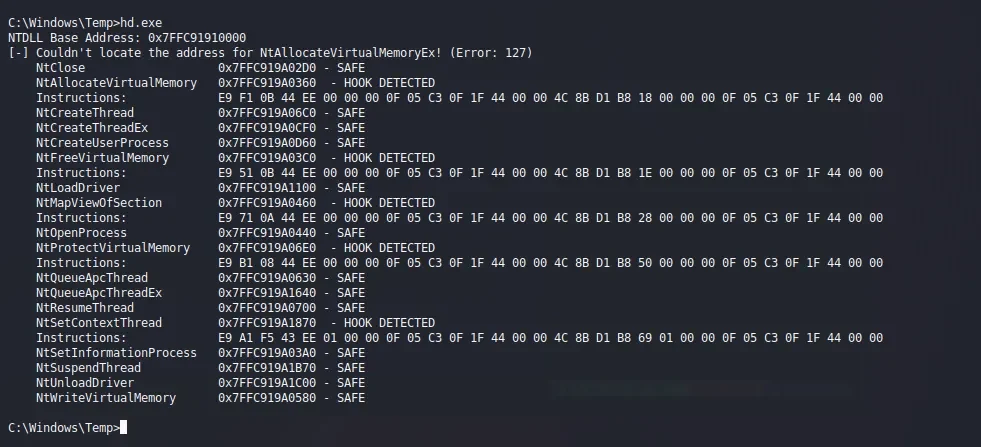
Several Windows APIs were hooked, but some were not, including NTQueueApcThread. Using a little C#, the tester built a process inject executable that downloaded a bin file and injected a payload, the Cobalt Strike Beacon, into memory. The bin file was hosted, the executable was uploaded and run, and the result was a high-integrity Cobalt Strike beacon.
From there, a DCSYNC of the krbtgt NTLM and AES hash gave domain dominance.
Root cause
Two weaknesses combined. The first is an unpatched vCenter vulnerable to CVE-2021-22005, a file upload in the CEIP analytics and telemetry service that lets an attacker write a system crontab and run commands as root. Root on the appliance exposes data.mdb, whose certificates are stored in cleartext and can sign SAML assertions for any user, including the builtin Administrator. That turns appliance compromise into administrative access to the vSphere UI.
The second is operational: a VM whose console allowed login without a password, on a network where a privileged account could be relayed. The password policy had been strengthened, which defeated cracking, but the relay path did not depend on password strength. Endpoint protection was present on the later hosts, but the tester worked around it by checking which APIs were hooked and injecting in memory rather than writing payloads to disk.
Impact
Under the conditions seen here, an attacker could obtain root on the vulnerable vCenter appliance, forge an administrator session for the vSphere UI, and from there reach VM backups and stopped VMs. Downloaded VMDKs yielded RID 500 hashes and Domain Cached Credentials, which in this case gave no further domain access. A console with no password prompt on one VM, combined with a privileged account that could be relayed, produced credentials from two management servers, including cleartext LSA secrets for a service account that was a domain admin. That led to the Domain Controller, a high-integrity beacon, and a DCSYNC of the krbtgt hashes, which is domain dominance. The report does not describe any data exfiltration or persistence beyond the beacon.
Fix
The report does not state which of these the client implemented.
Variants to test
- Check vCenter builds against CVE-2021-22005 and related CEIP issues. A positive result is command execution as root on the appliance.
- After any vCenter compromise, retrieve
data.mdband tryvcenter_saml_login. A positive result is a cookie that authenticates to/uias administrator. - Enumerate VM backups and stopped VMs for download. A positive result is a VMDK whose mounted partitions contain SAM, SECURITY and SYSTEM files that secretsdump can parse.
- Open every VM console and look for one that logs in without a password. A positive result is a desktop with no prompt.
- From such a VM, run Responder and ntlmrelay against privileged accounts. A positive result is dumped hashes or cleartext LSA secrets for a service account with high privileges.
- Before running payloads on a host with endpoint protection, run Hook Detector. A positive result is an unhooked API such as
NTQueueApcThreadthat allows in-memory injection.
What happened, in plain words
A security tester was hired to break into a company's internal network, the way a burglar might be hired to test whether a house's locks actually work. The goal was to reach the most powerful account in a Windows network, called Domain Admin, which is roughly the master key to the whole building. This time the tester could not use tricks like sending fake emails to staff (that is called phishing), so the job came down to two possible doors: find something broken, or find a password.
The tester's credential attacks failed. The company had been tested many times before and had recently forced everyone to use stronger passwords, so even with serious cracking hardware the captured passwords would not fall. Then the tester found a broken piece of software: an old version of VMware vCenter, a tool companies use to manage their virtual machines (the pretend computers that run inside one big physical server). That version had a known flaw that let an attacker run commands as the most powerful user on that machine. From there the tester climbed step by step: forged an administrator login for the vCenter web page, downloaded copies of virtual machines, found one virtual machine that let anyone log in without a password, used it to capture a powerful account's credentials, and finally reached the Domain Admin level.
This article walks through each step in the same order as the tester did, explaining every term from scratch.
The starting problem
On a recent internal penetration test the tester was faced with this scenario and had to work a little harder for Domain Admin. So, finding initial access. What do we need to do? As a rule, one of two things:
a) Something vulnerable b) Credentials
Those two words need unpacking.
Initial access means the very first foothold inside the target network. Before you can explore, you have to get in somewhere, the way a tester of a building's security first has to get past the front door before checking the cupboards.
Something vulnerable means a piece of software with a mistake in it that an attacker can abuse. The mistake might let someone read files they should not, or run their own commands on the machine. Such a mistake is called a vulnerability, and when it has been written up publicly with an identifying number it is called a CVE (Common Vulnerabilities and Exposures). A CVE is like a case number for a known flaw, so everyone can refer to the same bug unambiguously.
Credentials means the username and password (or other proof of identity) that a system accepts. If you can obtain someone else's credentials, you can simply log in as them, no flaw required.
Putting red team tactics to one side (so that means no phishing and similar tricks), one of the above is often the only route to gaining initial access. Basically you need to steal, sniff or crack some credentials, or you find something vulnerable (a juicy CVE will do nicely) to get a beacon or session on your initial target.
A few more terms from that paragraph:
- Red team tactics are the aggressive, people-focused techniques of a simulated attack, such as tricking staff with convincing emails. Here they were off the table.
- Steal credentials means obtaining them from where they are stored or used, for example by reading a file that contains them.
- Sniff means listening to network traffic as it passes, hoping to catch a password or a password equivalent travelling in the clear.
- Crack means taking a scrambled form of a password (a hash, explained later) and guessing the original password by trying enormous numbers of candidates until one produces the same scramble.
- A beacon or session is a live connection from the attacker's machine to a program running on the victim's machine, through which the attacker can give commands. Think of it as a remote-control channel that stays open.
Often the first thing that comes to mind is Responder, mitm6 or some sort of man-in-the-middle attack to steal credentials and relay or crack them. This is often a great step and usually finds some weak passwords, but in this case the client had been tested multiple times, including by the same team, and had worked hard to push a new password policy. Even with an AWS hashcat instance these credentials were tough to crack.
What those tools do, in plain words:
- Responder is a program that pretends to be other machines on the network so that computers will send it their login attempts. It is a form of man-in-the-middle attack: the attacker places themselves between two parties and quietly listens or interferes, like a postal worker who opens letters in transit.
- mitm6 does something similar for a specific Windows network service that helps computers find each other.
- Relay means forwarding a captured login attempt to a different machine so that the victim's own credentials are used to log in there, without ever knowing the password. It is like photocopying someone's key card while they use it and then swiping the copy at another door.
- Hashcat is a popular password-cracking program. It runs on very fast hardware and tries candidate passwords at enormous speed. The tester ran it on an AWS instance, meaning a rented computer in Amazon's cloud, because that gives more computing power than a laptop.
- A password policy is the set of rules a company enforces about passwords, such as minimum length and complexity. A stronger policy makes cracking much harder.
Relaying credentials also did not produce any joy. So the tester was left with only one route: finding something vulnerable.
Finding the vulnerable product
Enter vCenter. A version of vCenter was found that was vulnerable to CVE-2021-22005, which exploits a file upload in VMware vCenter Server's analytics and telemetry (CEIP) service to write a system crontab and execute shell commands as the root user. Great, a shell is possible.
CVE-2021-22005 Root Shell
This paragraph is dense, so here is each piece:
- vCenter is VMware's management console for virtual machines. An administrator uses it through a web page to start, stop, copy and inspect the virtual machines running on the company's servers. Because it controls all those machines, it is a very valuable target: whoever controls vCenter controls the virtual estate.
- CVE-2021-22005 is the public identifier of this particular flaw. The number encodes the year it was catalogued (2021) and a sequence number.
- File upload means a feature that lets a user send a file to the server. If the server does not check what kind of file it is or where it puts it, an attacker can send a file that the server will later execute as a program.
- Analytics and telemetry (CEIP) is a feature that collects usage statistics and sends them back to the vendor. It exists to help the vendor understand how the product is used. The flaw lives in the part of the product that receives this data.
- A crontab is a schedule file on Linux and Unix systems that tells the computer which commands to run automatically at which times. Writing to it is a way of making the computer run your command later, on its own.
- Root is the name of the all-powerful administrator account on Linux and Unix systems, the equivalent of Domain Admin on a Windows network but for a single machine. A root shell means a command prompt running with those unlimited rights.
- Shell commands are instructions typed (or sent) to the operating system, such as "list the files here" or "copy this file there".
The screenshot shows the moment the tester had a root shell on the vCenter appliance, the result of exploiting that upload flaw.
Stealing the keys to vCenter
Gaining access to vCenter as root, the tester could retrieve the data.mdb file, which contains certificates stored in cleartext that can be used to sign any SAML authentication request for any user, including the builtin Administrator. A root shell is what allows the file to be downloaded.
Data.mdb file
Again, the terms:
data.mdbis a database file used by vCenter to store security material. The name is the file's name on disk.- A certificate here is a cryptographic key pair used to prove identity and to put a tamper-proof seal on a message. The private half of the pair is the part that must be kept secret.
- Cleartext means stored without encryption, readable by anyone who can open the file. A secret kept in cleartext is like a house key left under the doormat: safe only as long as nobody looks.
- SAML is a standard way for one system to tell another "this user is who they claim to be". When you click "log in with your company account" on a website, SAML is often what happens behind the scenes. The system sends a signed statement, called an assertion, saying who you are.
- Signing an assertion means attaching a cryptographic seal made with the private key. The receiving system checks the seal and, if it is valid, trusts the contents. If an attacker has the signing key, they can write an assertion for anybody, including the builtin Administrator, the default all-powerful account.
So the chain is: root on the machine lets you read the file; the file contains the signing keys; the signing keys let you claim to be any user, including the administrator. The screenshot shows the data.mdb file that was retrieved.
Forging an administrator login
With this file there is a tool created by horizon3ai, found here, that allows the tester to create a cookie for the vCenter UI.
Cookie Created
What a cookie is, from zero: when you log in to a website, the server usually sends your browser a small piece of data called a cookie. The browser stores it and sends it back with every later request, so the server can recognise you without asking for your password again. A cookie is like the wristband you get at an event: show it at the door and you are let back in without queuing again. If someone can create a valid wristband, they can walk in as you.
Here the tool takes the stolen signing keys and produces a cookie that the vCenter web interface will accept as belonging to the administrator. The screenshot shows the cookie being created.
With this cookie injected into a browser session on the vCenter /ui URL, the tester was authenticated onto the vSphere GUI as administrator.
- Injecting a cookie means placing it into the browser's stored cookies by hand, for example with a browser developer tool or an extension, so that the browser presents it to the site.
/uiis the path of the vCenter web interface, the address you would visit in a browser.- vSphere GUI is the graphical web console of the virtualisation platform, the screens where virtual machines are listed and managed.
At this point the tester had gone from a command prompt on the appliance to the full graphical administrator console, without ever knowing a password.
Two ways onward from the console
Once on vSphere the tester looked at two different scenarios.
- Dump VMDKs and mount them locally, grab SYSTEM, SAM and SECURITY and dump hashes.
- Open all VMs to see if any gave some sort of access.
Unpacking the first scenario:
- A VMDK is the file that holds a virtual machine's virtual hard disk. To the guest operating system it looks like a physical disk; to the host it is just a big file. Dumping one means copying it out.
- Mounting a disk image means attaching it to your own computer so its contents appear as ordinary files and folders, the way plugging in a USB stick makes its files appear.
- SYSTEM, SAM and SECURITY are three files in a Windows installation that together hold the local user accounts and their password hashes. The SAM is the database of local accounts; the SYSTEM file holds the key needed to make sense of the scrambled passwords; the SECURITY file holds further security settings and cached secrets.
- Dumping hashes means extracting those scrambled passwords so they can be cracked offline, at leisure, on the attacker's own hardware.
The second scenario is simpler: open the console of every virtual machine and see whether any of them lets you in without a password.
The tester started with download dumps. This has to be done on VM backups or VMs that have been stopped. Fortunately a few were available, but the download size was often quite large.
Downloading vmdks
Why stopped machines? A running virtual machine has its disk open and changing constantly, so copying the file while it runs can produce an inconsistent, unusable image. A stopped machine or a backup is a clean snapshot, like photocopying a document only when nobody is writing on it. The screenshot shows VMDK files being downloaded.
The process involved downloading the VMDK file, using kpartx to create device maps from the VMDK partition tables, mounting the partition, copying the SAM, SECURITY and SYSTEM files, and then running secretsdump on them.
Step by step, in plain words:
- Download the VMDK file. Copy the virtual disk image from vCenter to the tester's own machine.
- Use kpartx to create device maps from the VMDK partition tables. A disk image is divided into partitions, separate regions each formatted as its own filesystem, much like a filing cabinet with several drawers.
kpartxis a Linux tool that reads the image's table of contents and makes each drawer appear as a separate device you can open. - Mount the partition. Attach that drawer to the filesystem so its files can be browsed.
- Copy the SAM, SECURITY and SYSTEM files. Take the three Windows account files out of the mounted image.
- Run secretsdump on them. secretsdump is a well-known tool that reads those files and prints the account names and their password hashes.
This gave the tester some RID 500 account hashes and Domain Cached Credentials (DCC), which the tester notes are pretty slow to crack. The RID 500 accounts had no access on the rest of the domain, but it was a useful exercise. A detailed write-up of the technique is linked at drmarmar.com/vmdk-credentials.
- RID 500 is the identifier Windows gives to the very first local account created on a machine, which is the built-in local administrator. Seeing a RID 500 hash means you have the local admin's password hash.
- Domain Cached Credentials (DCC) are a special form in which Windows stores the hashes of domain accounts that have logged on to that machine, so they can log in even when the domain controller is unreachable. They are deliberately made very slow to test, which is why cracking them takes a long time.
- A domain here means the centrally managed Windows network, with a domain controller as the server that checks logins for everyone.
So this route produced hashes, but the accounts they belonged to had no rights elsewhere on the network. Useful practice, no further progress.
A virtual machine with no password prompt
Next the tester opened every single VM to see if any did not need a password to log in. To their surprise, one VM dropped them straight onto the desktop with no password prompt. After an initial look around, Sophos was found to be running, so the priority was to get something running quickly.
- Sophos is an endpoint protection product, antivirus and anti-malware software that watches what programs do on a machine and tries to block malicious behaviour. Its presence means the tester had to be careful and quick.
The tester set up Responder and ntlmrelay. Using the VM, they navigated to the Kali VM, captured and relayed the hash. This was a privileged account, so credentials were successfully dumped from two management servers. Quite a lot of hashes were in there, including LSA secrets in cleartext for an account that was configured to start a service. That account was a domain admin.
What happened here, in order:
- Set up Responder and ntlmrelay. Responder listens on the network and pretends to be a server that other machines trust. ntlmrelay is the part that takes a login attempt caught by Responder and forwards it to a real server, so the victim's own credentials authenticate there.
- From the open VM, navigate to the Kali VM. Kali is a Linux distribution preloaded with security tools; the tester had one on the network. Navigating to it from the victim VM caused the victim to try to authenticate, and that attempt was captured.
- Capture and relay the hash. Windows does not send the password itself when authenticating to another machine; it sends a hash, a scrambled derivative of the password. Capturing the hash is enough to relay it, because the server accepts the hash as proof.
- The account was privileged. The captured account had high rights, so the relay succeeded against two management servers, which are servers used to administer other systems.
- LSA secrets in cleartext. LSA is the Windows component that manages local security. LSA secrets are pieces of secret data it stores, and here some were stored in cleartext, including the password of an account configured to start a service (a background program that runs automatically). That account was a domain admin, one of the most powerful accounts on the network.
This is the pivotal moment: a virtual machine that let anyone in without a password, combined with a privileged account that could be relayed, handed over domain administrator credentials.
Reaching the Domain Controller
Always wanting to go the extra mile, and loving a Cobalt Strike Beacon, the tester used wmiexec to reach the Domain Controller. Again Sophos was running. Before dumping any file on disk, the tester ran Hook Detector to see which Windows APIs were hooked.
Windows APIS hooked
Terms:
- Cobalt Strike is a commercial tool used by security teams (and attackers) to control compromised machines. A Beacon is its agent, the small program that runs on the victim and phones home for instructions.
- wmiexec is a technique and tool that uses WMI (Windows Management Instrumentation), a built-in Windows service for managing computers remotely, to run commands on another machine. It is like using the building's official maintenance channel to ask a machine to do something.
- Domain Controller is the central server that holds the accounts and checks logins for the whole Windows domain. Compromising it means compromising everyone.
- An API (Application Programming Interface) is a defined set of functions that programs use to ask the operating system to do things, such as create a process, read a file or open a network connection. Think of it as the service counter of the operating system: programs queue up and ask for what they need.
- Hooking an API means placing a small interception in front of it, so that security software sees every call and can inspect or block it. It is like a security guard standing at the service counter checking every request. Hook Detector is a tool that lists which APIs currently have such a guard in front of them.
The screenshot shows the list of Windows APIs and which ones were hooked.
Seems there are a few Windows APIs hooked, but a few that are not, including NTQueueApcThread. Utilising a little C#, the tester created a process inject executable that downloaded a bin file and injected a payload (the Cobalt Strike Beacon) into memory. After hosting the bin file, uploading and running the exe, the tester was presented with a high-integrity beacon for Cobalt Strike. From here a DCSYNC of the krbtgt NTLM and AES hash gave domain dominance.
This final paragraph needs the most unpacking:
NTQueueApcThreadis the name of one Windows API function. Because it was not hooked, calls to it went unobserved by Sophos. The tester used it as the unguarded door.- C# is a programming language commonly used on Windows. The tester wrote a small program in it.
- Process inject means starting a harmless-looking process and then placing your own code inside it, so the malicious code runs under the cover of a legitimate program. It is like hiding a passenger inside a delivery van.
- Payload is the code you want to run, here the Cobalt Strike Beacon.
- In memory means the payload is never written to disk as a file. Antivirus products often scan files on disk, so code that only ever exists in memory is harder to catch.
- Hosting the bin file means putting it on a web server the tester controlled, so the small program could download it.
- High integrity means the beacon was running with administrator-level rights on that machine, not as an ordinary user.
- DCSYNC is a technique that asks a Domain Controller to replicate its account database, as a backup server would. It is a legitimate feature, but in the wrong hands it hands over every account hash, including that of krbtgt.
- krbtgt is the special account whose hash underpins the entire domain's authentication. Its NTLM and AES hashes are two different scrambled forms of its secret. With them, an attacker can forge tickets that grant access to anything in the domain, which is what domain dominance means: the whole network is effectively under control.
Why it worked
Two weaknesses combined. The first is an unpatched vCenter vulnerable to CVE-2021-22005, a file upload in the CEIP analytics and telemetry service that lets an attacker write a system crontab and run commands as root. Root on the appliance exposes data.mdb, whose certificates are stored in cleartext and can sign SAML assertions for any user, including the builtin Administrator. That turns appliance compromise into administrative access to the vSphere UI.
The second is operational: a VM whose console allowed login without a password, on a network where a privileged account could be relayed. The password policy had been strengthened, which defeated cracking, but the relay path did not depend on password strength. Endpoint protection was present on the later hosts, but the tester worked around it by checking which APIs were hooked and injecting in memory rather than writing payloads to disk.
What the impact was
Under the conditions seen here, an attacker could obtain root on the vulnerable vCenter appliance, forge an administrator session for the vSphere UI, and from there reach VM backups and stopped VMs. Downloaded VMDKs yielded RID 500 hashes and Domain Cached Credentials, which in this case gave no further domain access. A console with no password prompt on one VM, combined with a privileged account that could be relayed, produced credentials from two management servers, including cleartext LSA secrets for a service account that was a domain admin. That led to the Domain Controller, a high-integrity beacon, and a DCSYNC of the krbtgt hashes, which is domain dominance. The report does not describe any data exfiltration or persistence beyond the beacon.
How to fix it
The report does not state which of these the client implemented.
Things to check on your own network
- Check vCenter builds against CVE-2021-22005 and related CEIP issues. A positive result is command execution as root on the appliance.
- After any vCenter compromise, retrieve
data.mdband tryvcenter_saml_login. A positive result is a cookie that authenticates to/uias administrator. - Enumerate VM backups and stopped VMs for download. A positive result is a VMDK whose mounted partitions contain SAM, SECURITY and SYSTEM files that secretsdump can parse.
- Open every VM console and look for one that logs in without a password. A positive result is a desktop with no prompt.
- From such a VM, run Responder and ntlmrelay against privileged accounts. A positive result is dumped hashes or cleartext LSA secrets for a service account with high privileges.
- Before running payloads on a host with endpoint protection, run Hook Detector. A positive result is an unhooked API such as
NTQueueApcThreadthat allows in-memory injection.
Glossary
- API (Application Programming Interface): a defined set of functions a program uses to ask the operating system to do something, such as create a process or open a connection.
- Assertion (SAML): a signed statement saying who a user is, used to log them in to another system.
- AWS instance: a rented computer in Amazon's cloud, used here for extra cracking power.
- Beacon: the agent program of Cobalt Strike that runs on a compromised machine and takes orders from the attacker.
- Certificate: a cryptographic key pair used to prove identity and to sign messages so tampering can be detected.
- CEIP: VMware's analytics and telemetry service, which collects usage data; the flawed upload lived here.
- Cleartext: stored or sent without encryption, readable by anyone who can access it.
- Cobalt Strike: a commercial tool for controlling compromised machines.
- Cookie: a small piece of data a website stores in your browser so it can recognise you on later requests.
- Cracking: guessing a password from its hash by trying enormous numbers of candidates.
- Credentials: the proof of identity a system accepts, usually a username and password.
- Crontab: a Linux schedule file that makes the computer run commands automatically at set times.
- CVE: a public identifier for a known software vulnerability.
- C#: a programming language commonly used on Windows.
- DCC (Domain Cached Credentials): a slow-to-crack form in which Windows stores domain account hashes locally so logins work offline.
- DCSYNC: abusing the Domain Controller's replication feature to copy out every account hash.
- Domain: a centrally managed Windows network whose logins are checked by a domain controller.
- Domain Admin: the most powerful account type in a Windows domain.
- Domain Controller: the central server that holds accounts and checks logins for the domain.
- Dumping: copying data out of a system, here password hashes or disk images.
- Endpoint protection: software on a machine that watches for and blocks malicious behaviour, such as Sophos.
- File upload: a feature that lets a user send a file to a server; if unchecked, it can be abused to run code.
- Hash: a scrambled derivative of a password that a system can check without storing the password itself.
- Hashcat: a fast password-cracking program.
- High integrity: running with administrator-level rights on a Windows machine.
- Hook / hooking: placing an interception in front of an API so security software can inspect every call.
- Hook Detector: a tool that lists which Windows APIs are currently hooked.
- Initial access: the first foothold obtained inside a target network.
- Injecting a cookie: placing a cookie into a browser by hand so the browser presents it to a site.
- kpartx: a Linux tool that turns the partitions inside a disk image into separate devices you can mount.
- krbtgt: the special domain account whose secret underpins all authentication in the domain.
- Kali: a Linux distribution preloaded with security tools.
- LSA secrets: secret data stored by the Windows Local Security Authority, sometimes in cleartext.
- Man-in-the-middle: an attack where the attacker sits between two parties and listens or interferes.
- mitm6: a tool that impersonates a Windows network service to capture logins.
- Mounting: attaching a disk or disk image so its files appear as ordinary files.
- NTLM: a Windows authentication scheme that sends a hash rather than the password, which is why relaying works.
- ntlmrelay: a tool that forwards a captured Windows login attempt to another server.
- Partition: a separate region of a disk, each formatted as its own filesystem.
- Payload: the code an attacker wants to run on a victim machine.
- Phishing: tricking people with fake messages into giving up credentials or running malicious files.
- Process injection: placing your own code inside a legitimate running program so it runs under cover.
- Red team tactics: aggressive, people-focused attack techniques such as phishing.
- Relay: forwarding a captured login attempt to another machine so the victim's own credentials authenticate there.
- Responder: a tool that impersonates network services to capture login attempts.
- RID 500: the identifier of the built-in local administrator account on a Windows machine.
- Root: the all-powerful administrator account on Linux and Unix systems.
- SAML: a standard for one system to tell another, with a signed statement, who a user is.
- SAM: the Windows database of local user accounts and their password hashes.
- secretsdump: a tool that extracts account names and hashes from Windows registry files.
- Service: a background program that runs automatically on a Windows machine.
- Shell: a command prompt through which you give instructions to the operating system.
- Sniffing: listening to network traffic to capture secrets travelling in it.
- Sophos: an endpoint protection product.
- Tier-zero asset: a system so important that compromising it means compromising everything beneath it.
- vCenter: VMware's management console for virtual machines.
- vcenter_saml_login: a tool that turns the vCenter
data.mdbfile into a valid UI cookie. - VMDK: the file that holds a virtual machine's virtual hard disk.
- vSphere GUI: the graphical web console of VMware's virtualisation platform.
- Vulnerability: a mistake in software that an attacker can abuse.
- wmiexec: a technique that uses Windows Management Instrumentation to run commands on another machine.
- WMI (Windows Management Instrumentation): a built-in Windows service for managing computers remotely.


