Other notes
The hotel phone system displayed the name and room number of the called party before the call was answered, allowing anyone with access to a hotel phone to enumerate guests' names and room numbers by dialling sequential extensions. An attacker could build a directory of guests in minutes.

medium.com
Published on medium.com
While in at a hotel in Abu Dhabi (which I won’t be naming) I noticed something rather strange that I haven’t seen in other hotels. It was the phone system (as some of you know, I rather like phone systems) This one allowed me to find out the name and room number of the people staying there without talking to anyone.
The full write-up lives on its author's site
It belongs to its author, so we link to it rather than copy it. The other two tabs are our own rewrites, checked against it.
Context
The target here is the in-room telephone system of a hotel in Abu Dhabi. The author does not name the hotel. The feature under examination is the internal dialling plan: the hotel's phones can call each other by extension, and the phone displays the name of the person being called before the call is answered. That display, which normally helps staff and guests reach each other, turns the phone into a directory lookup tool.
The author notes an interest in phone systems generally and links to earlier work on elevator phone phreaking. The technique described is basic hand scanning, described in the report as war dialling without a computer.
Setup
The only precondition is access to a phone on the hotel's internal phone network. The report lists several ways to get one: a phone in the lobby, a phone next to the elevators, or the phone inside your own room. No tools, accounts or special privileges are needed beyond that handset.
The author had a friend, Justin, staying in the hotel and gave permission for his room number to be found. While the two were in the elevator, the author pressed floor 12 and Justin selected floor 21. The author told him that the floor alone was enough to work out the room number, and said he would call later to explain.
Finding it
The author noticed that the hotel's phone system behaved differently from others he had seen: it would reveal the name of the guest being called without any conversation taking place. The key observation is that the display shows the callee's name as soon as the call starts ringing, before anyone picks up. That means a caller can harvest names by dialling extensions and hanging up, without the callee needing to answer.
Exploitation
Step 1: learn the dialling plan
The internal dialling plan is 8 followed by the room number.
8-XXXX
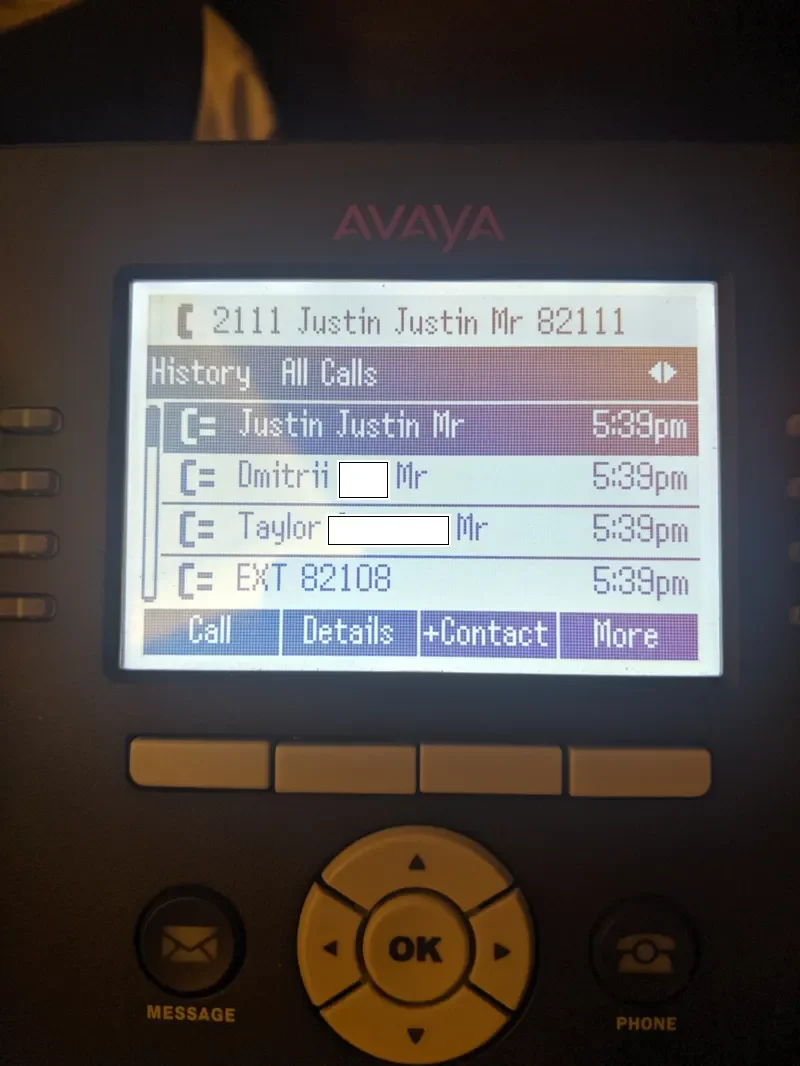
The image shows the dialling plan for calls inside the hotel: 8, then the room number.
Step 2: dial the range for the target floor
Knowing Justin was on floor 21, the author called the extensions in sequence:
8-2100, 8-2101, 8-2102, 8-2103… 8-2111
As each call started to ring the other room, the name of the person being called appeared on the display. When the author reached the right extension, his friend's name came up as Justin Justin Mr., which the report notes was entered incorrectly by the hotel.
The whole scan took seconds: the report points out that the clock still read 5:39PM between the first and last call. The author tried several times to hang up as fast as possible, but could not prevent the other person's phone from ringing at least once. The caller's own name also appears on the callee's phone during that ring.
Step 3: skip invalid rooms
If an extension is not a valid room number, the call does not go through, so the scanner can move to the next number even faster. The report uses room 2108 as an example of a number that might not be valid.
For readers who want to understand the handset itself, the report links to a tutorial video that gives an overview of the phone's capabilities.
Other observations
- When two people share a room, only the name listed first is shown. Justin had a second person in his room, and the author could not find that person's name with this method.
- The author could see the call history of the previous guest from the phone.
- The author suspects the hotel maids use the phones to set room status, for example clean or ready to be inspected, and offers to write that up separately.
The author is explicit about what he did not try: emulating an Avaya phone on a computer to war dial the hotel and build a directory of guests, going through the contacts button, or checking whether the phone's default password was its extension.
Root cause
The weakness is in the design of the internal phone system rather than in any single bug. The handset displays the callee's name as soon as the call is placed, and the dialling plan is predictable: a fixed prefix followed by the room number. Together these let anyone with a handset on the network enumerate guests by floor. The report describes the system as doing all the work for you, and characterises the attack as a phreaking technique that is rarely used today but still valid.
Impact
An attacker with access to any phone on the hotel's internal network can map names to room numbers for guests on a floor, and by extension for the whole hotel. The author estimates he could have built a directory of first and last names and room numbers in an hour or less. The information is limited: only the first-listed name in a shared room is revealed, and the callee's phone rings at least once per attempt, so the scan is not silent. The report does not describe any further use of the data beyond the demonstration with the consenting friend.
Fix
The report does not describe a fix applied by the hotel. It does offer mitigations from the guest's side:
- Check in under someone else's name or a fake name. The report cites a discussion of this on The Privacy, Security, & OSINT Show, Episode 101, and quotes a listener who says he presented a gym ID after claiming to have lost his passport, and was accepted at several hotels in Germany. The author notes he has not tried this himself.
- Before booking, use OSINT to see what phones the hotel uses. Photos people have taken of the rooms can show the handset model before you check in.
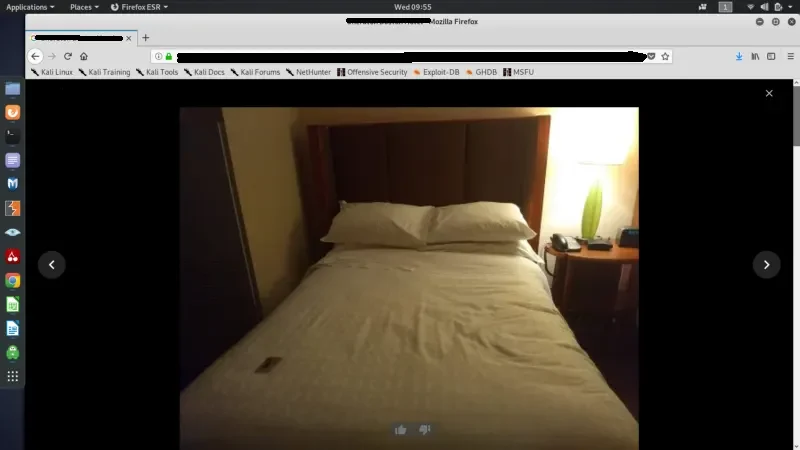
The image illustrates using guest photos to identify the phone in a room. The report warns that such photos are not always good quality, so you may need to check several sites or go through many images; the author prefers Google review photos for this. The example image shows an older phone, on which the described technique would not work.
Variants to test
- Predictable extension plans at other hotels. Dial a fixed prefix followed by room numbers on a floor you know a guest is on. A positive result is the callee's name appearing on the display before the call is answered.
- Name disclosure on ring. Place a call and hang up immediately. If the name still appears, the disclosure happens at call setup rather than on answer, and the scan can be done quickly.
- Invalid-extension behaviour. Dial numbers that are not rooms. A fast failure, such as the call not going through, lets you skip gaps in the numbering quickly.
- Shared-room enumeration. Compare the name shown for a room known to hold two guests. If only one name appears, the method is limited to the first-listed guest.
- On-device history and status. Check the handset's call history and any room-status functions. A positive result is previous guests' call records or staff status codes being visible to a guest.
- Default credentials on the handset. The author did not test whether the phone's default password is its extension; trying it on another property would show whether the handset configuration is reachable from the room.
TL;DR Dial phone numbers from a hotel room phone until the name of the person you are looking for comes up.
What happened, in plain words
A security researcher stayed at a hotel in Abu Dhabi and noticed that the phones in the rooms behaved in an unusual way. When you dialled another room from a hotel phone, the screen showed the name of the person you were calling before they picked up. Because room numbers follow a simple pattern, anyone standing at a hotel phone could dial a run of numbers and read off the names of the guests staying there, without ever speaking to them. The researcher tested this on a friend who was staying in the same hotel and gave permission, and found his name and room number in a matter of seconds.
This article walks through the same story for someone who has never looked at security before. Nothing here needs special software: the whole technique is done with a telephone keypad and a bit of patience. Along the way I will explain the ideas behind it, such as what an extension is, what "war dialling" means, and why a phone that shows a name is a privacy problem.
Background: what a hotel phone system is
A hotel has its own internal telephone network. Every room has a handset, and those handsets can call each other without going out to the public telephone network. Each handset has a short number, called an extension, that other handsets on the same network can dial. For example, the phone in room 2108 might be reachable by dialling a short code that ends in 2108.
Think of it like the intercom in an apartment building: you press a button for a flat and the person inside hears it ring. The difference here is that the hotel's system also shows a name on the little screen of the phone making the call, so the caller knows who they are about to reach.
That name display is meant to be helpful. But helpful features can leak information when they show more than they should, and that is exactly what happened here.
The researcher mentions that he is interested in phone systems in general and links to earlier writing about "elevator phone phreaking". Phreaking is the old hobby of exploring and manipulating telephone systems, usually to understand how they work rather than to cause harm. The technique in this report is a very simple version of that idea.
Setting up
The only thing you need is access to a phone that sits on the hotel's internal network. The report lists several places you can find one:
- A phone in the lobby.
- A phone next to the elevators.
- The phone inside your own room.
No tools, no accounts and no special permissions are required beyond picking up a handset. This is worth pausing on: the barrier to entry is essentially zero. If you can stand next to a phone, you can try the technique.
The researcher had a friend, Justin, staying in the same hotel, and Justin gave permission for his room number to be found. While the two of them were in the elevator, the researcher pressed the button for floor 12 and Justin pressed the button for floor 21. The researcher told Justin that knowing the floor was already enough to work out the room number, and said he would call later to explain.
Why does knowing the floor matter? Because hotel room numbers usually start with the floor number. A room on floor 21 is likely to be numbered 2100, 2101, 2102 and so on. If you know which floor someone is on, you have narrowed the search from hundreds of rooms to a few dozen.
Finding it
The researcher noticed that this hotel's phone system behaved differently from others he had seen. It would reveal the name of the guest being called without any conversation taking place. The key observation is that the display shows the name of the person being called as soon as the call starts ringing, before anyone picks up.
That timing is the whole trick. If the name only appeared after the person answered, you would have to talk to them, and they would know someone was probing. Because the name appears during ringing, a caller can dial an extension, read the name, hang up, and move on. The person in the room hears a brief ring, but the caller never has to speak.
Exploitation
Step 1: learn the dialling plan
The internal dialling plan is 8 followed by the room number.
8-XXXX
This block is a pattern, not a real number. The 8 is a fixed prefix that tells the phone system "this call is internal, route it to a room". The XXXX stands for the four digits of the room number. So to reach a room on floor 21, you would dial 8 followed by the room number.
The image shows the dialling plan for calls inside the hotel: 8, then the room number. In plain terms, the hotel has made the internal numbering completely predictable. There is no secret code and no random element: once you know the prefix, every room is one short dial away.
Step 2: dial the range for the target floor
Knowing Justin was on floor 21, the researcher called the extensions in sequence:
8-2100, 8-2101, 8-2102, 8-2103… 8-2111
This line is a list of phone numbers to try, one after another. Each one starts with the internal prefix 8, then the floor number 21, then a two-digit room suffix: 00, 01, 02, 03, and so on up to 11. The ellipsis (…) means "and the numbers in between", so the run goes from 2100 up to 2111.
As each call started to ring the other room, the name of the person being called appeared on the display. When the researcher reached the right extension, his friend's name came up as Justin Justin Mr., which the report notes was entered incorrectly by the hotel. That mistake is a small detail but a useful one: it shows the name on the screen comes straight from the hotel's guest records, typos and all.
The whole scan took seconds. The report points out that the clock still read 5:39PM between the first and last call. The researcher tried several times to hang up as fast as possible, but could not prevent the other person's phone from ringing at least once. The caller's own name also appears on the callee's phone during that ring.
That last point matters for anyone thinking about detection. The scan is fast, but it is not silent: each attempt makes a phone ring somewhere in the hotel, and the person in the room may see a name on their own display. A guest who is paying attention could notice a string of short rings.
Step 3: skip invalid rooms
If an extension is not a valid room number, the call does not go through, so the scanner can move to the next number even faster. The report uses room 2108 as an example of a number that might not be valid.
Why does this help? Hotel floors often have gaps: some numbers are skipped, or a room does not exist. When you dial a number that is not a real room, the call does not go through instead of ringing. That failure is a signal to move on, and it means the scan does not waste time waiting for a ring that will never come.
For readers who want to understand the handset itself, the report links to a tutorial video that gives an overview of the phone's capabilities. Watching how a particular model of phone works can help you recognise what its screen shows and what buttons it offers.
Other observations
The researcher noticed a few extra things during the visit:
- When two people share a room, only the name listed first is shown. Justin had a second person in his room, and the researcher could not find that person's name with this method. So the leak is partial: you learn one name per room, not everyone staying there.
- The researcher could see the call history of the previous guest from the phone. In other words, the handset kept records from whoever stayed there before, and those records were visible to the next guest.
- The researcher suspects the hotel maids use the phones to set room status, for example clean or ready to be inspected, and offers to write that up separately. If true, it would mean the phones are used for staff workflows as well as guest calls, which is another reason to look closely at what the handsets can do.
The researcher is also explicit about what he did not try:
- Emulating an Avaya phone on a computer to war dial the hotel and build a directory of guests. Avaya is a company that makes business telephone systems, and emulating means making one device pretend to be another. War dialling is the old practice of automatically calling a long list of numbers to see which ones answer. Doing this with a computer would let someone scan far faster than by hand, but the researcher did not do it.
- Going through the contacts button on the handset.
- Checking whether the phone's default password was its extension. Many devices ship with a default password, and if nobody changes it, anyone who knows the default can get in. The researcher did not test this here.
Root cause
The weakness is in the design of the internal phone system rather than in any single bug. Two things combine to cause the problem:
- The handset displays the name of the person being called as soon as the call is placed, before anyone answers.
- The dialling plan is predictable: a fixed prefix followed by the room number.
Together, these let anyone with a handset on the network enumerate guests by floor. Enumerate simply means to go through a list one item at a time and record what you find. The report describes the system as doing all the work for you, and characterises the attack as a phreaking technique that is rarely used today but still valid.
It is worth being clear about what kind of problem this is. There is no broken password and no crashed server. The system is working as designed; the design just happens to reveal information it should not. Security people sometimes call this an information disclosure: the system gives away data to someone who should not have it, without anyone breaking in.
Impact
An attacker with access to any phone on the hotel's internal network can map names to room numbers for guests on a floor, and by extension for the whole hotel. The researcher estimates he could have built a directory of first and last names and room numbers in an hour or less.
The information is limited in two ways. Only the first-listed name in a shared room is revealed, and the callee's phone rings at least once per attempt, so the scan is not silent. The report does not describe any further use of the data beyond the demonstration with the consenting friend.
Why does this matter in practice? A list that connects a name to a room number tells someone which room a named person is staying in. That is sensitive on its own, even if nothing further is done with it. The report does not claim any harm occurred; it demonstrates that the information was available.
Fix
The report does not describe a fix applied by the hotel. It does offer mitigations from the guest's side:
- Check in under someone else's name or a fake name. The report cites a discussion of this on The Privacy, Security, & OSINT Show, Episode 101, and quotes a listener who says he presented a gym ID after claiming to have lost his passport, and was accepted at several hotels in Germany. The researcher notes he has not tried this himself.
- Before booking, use OSINT to see what phones the hotel uses. OSINT stands for open source intelligence: information you can gather from public sources such as photos, reviews and social media. Photos people have taken of the rooms can show the handset model before you check in.
The image illustrates using guest photos to identify the phone in a room. The report warns that such photos are not always good quality, so you may need to check several sites or go through many images; the researcher prefers Google review photos for this. The example image shows an older phone, on which the described technique would not work.
That last sentence is the practical takeaway for a traveller: not every hotel phone leaks names, and a quick look at photos of the room can tell you whether the handset is the kind that shows a caller's name before pickup.
Variants to test
If you want to check whether another hotel has the same weakness, these are the things to look at. Each one is a small experiment you can run with a handset.
- Predictable extension plans at other hotels. Dial a fixed prefix followed by room numbers on a floor you know a guest is on. A positive result is the callee's name appearing on the display before the call is answered.
- Name disclosure on ring. Place a call and hang up immediately. If the name still appears, the disclosure happens at call setup rather than on answer, and the scan can be done quickly.
- Invalid-extension behaviour. Dial numbers that are not rooms. A fast failure, such as the call not going through, lets you skip gaps in the numbering quickly.
- Shared-room enumeration. Compare the name shown for a room known to hold two guests. If only one name appears, the method is limited to the first-listed guest.
- On-device history and status. Check the handset's call history and any room-status functions. A positive result is previous guests' call records or staff status codes being visible to a guest.
- Default credentials on the handset. The researcher did not test whether the phone's default password is its extension; trying it on another property would show whether the handset configuration is reachable from the room.
TL;DR Dial phone numbers from a hotel room phone until the name of the person you are looking for comes up.
Glossary
- Extension: a short internal phone number that reaches one handset on a private phone network, such as a hotel's.
- Phreaking: the hobby of exploring and manipulating telephone systems, usually to understand how they work.
- War dialling: automatically calling a long list of phone numbers to find out which ones answer or behave in a particular way.
- Emulating: making one device or program pretend to be another, so the network treats it as the real thing.
- Avaya: a company that makes business telephone systems and handsets.
- Enumerate: to go through a list one item at a time and record what you find.
- Information disclosure: a weakness where a system gives away data to someone who should not have it, without anyone breaking in.
- OSINT (open source intelligence): information gathered from public sources such as photos, reviews and social media.
- Default password: the password a device ships with, which stays the same unless someone changes it.
- Call history: the record a phone keeps of calls made and received.
- Dialling plan: the rules that decide what a dialled number means, such as which prefix reaches which kind of phone.



