From Duplicate Badges to a NASA P1
A publicly downloadable archive on a NASA subdomain contained internal engineering files and a database backup, exposing internal references and development environment details. Separately, a NASA-hosted GitLab instance was affected by a GraphQL method-invocation flaw, and a science API trusted client-supplied object IDs for both reading and writing photos.

medium.com
Published on medium.com
Cybersecurity
The full write-up lives on its author's site
It belongs to its author, so we link to it rather than copy it. The other two tabs are our own rewrites, checked against it.
Context
NASA runs a Vulnerability Disclosure Program (VDP) on Bugcrowd, offering safe harbour for good-faith research against in-scope, internet-facing NASA systems. There is no bounty attached to the programme; the outcome of a valid report is triage, a fix, and in the case described here, a Letter of Recognition signed by NASA's Senior Agency Information Security Officer.
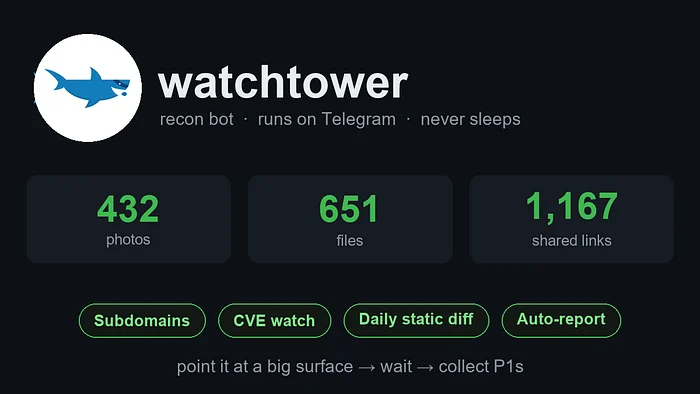
The author, Mohammad Hossein Sadeghian (m4sh_wacker), pointed a self-built recon bot at the in-scope assets. The bot is called watchtower, runs on Telegram, and has a shark for a face. Its job is continuous recon: subdomain discovery, CVE watching, daily static-asset checks, and auto-reporting of anything worth a human look.

Over the course of the engagement watchtower produced the following scoreboard against NASA:
| Severity | Status | Finding |
|---|---|---|
| P1 | Resolved | Publicly exposed internal archive containing a database backup |
| P1 | Duplicate | Unauthenticated GitLab GraphQL method invocation (CVE-2026-19478) |
| P2 | Duplicate | IDOR, write side, on a NASA science API |
| P2 | Duplicate | IDOR, read side, on the same API |
| N/A | Out of scope | Missing rate limiting on a file-upload endpoint |
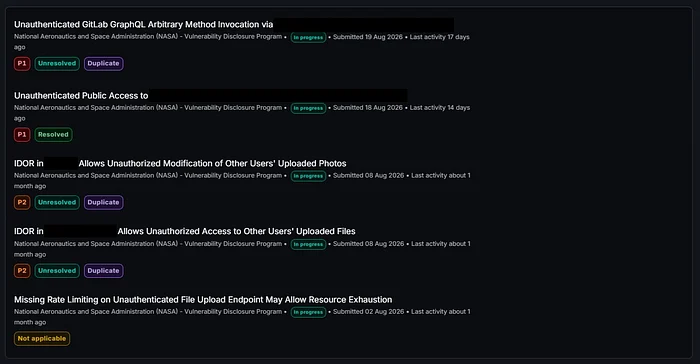
The report deliberately omits target hostnames, paths and internal data. The techniques are public; the evidence is not.
Setup
The tooling is watchtower, a Telegram bot with four functions:
- Subdomain discovery: continuously pulls subdomains for configured targets.
- CVE watching: flags affected targets quickly when a CVE drops.
- Daily static-asset checks: re-checks the static files of each subdomain every day.
- Auto-reporting: pushes findings to the operator.
No accounts, roles or specific versions are described beyond this. The author aimed watchtower at the in-scope assets of NASA's VDP, which covers internet-facing systems. The author describes the archive and GitLab confirmations as non-destructive: the archive was downloaded and opened locally, and no internal system was touched.
Finding it
The winning finding came from the daily static-asset check. Re-checking the same static files every day is what surfaced it: a publicly downloadable archive sitting on a NASA subdomain, reachable with no login. The author says continuous recon caught what point-in-time recon misses.

Opening the archive locally showed it was not merely a pile of files. It contained internal engineering files and a database backup. The backup carried internal references and history that mapped out part of NASA's internal development environment, so a single stray archive leaked two categories of material at once.
Exploitation
Step 1: Detect the archive
watchtower's daily static-asset diff flagged a downloadable archive on a NASA subdomain. No authentication was required to fetch it.
Step 2: Confirm non-destructively
The author downloaded the archive and opened it locally. That was the entire confirmation step. No internal system was queried or modified, and the file names, paths and internal details are intentionally left out of the write-up.
Step 3: Report and triage
The archive was reported through the VDP, rated P1 (Critical), triaged quickly, and fixed. This is the finding that earned the Letter of Recognition.
Step 4: The CVE sprint (P1, Duplicate)
Separately, the CVE watcher flagged a NASA-hosted GitLab instance affected by CVE-2026-19478. The root cause: GitLab's GraphQL API, combined with the @gl_introduced directive, would resolve an unknown field by falling back to Ruby's public_send() on the underlying object. That gives arbitrary zero-argument method invocation on publicly reachable objects, with no authentication needed.
The proof of concept used a harmless method, touch:
query { project(fullPath: "<public/project>") { name touch @gl_introduced(version: "999.0.0") }}
If the response contains "touch": true, the server executed Project#touch on the caller's behalf. Depending on which methods are reachable on the object, the effect ranges from annoying to genuinely destructive, which is why it is rated P1. The author confirmed it non-destructively and reported it about six hours after someone else had already done so. The report was closed as a Duplicate.

Step 5: The IDOR twins (P2 x2, Duplicate)
These two were found by hand, not by the bot, while poking a NASA science API. Both share one root cause: the API trusted a client-supplied object ID without checking who owned the object.
- Write side:
POST /<photo-upload>accepted asite_idin the body and never verified that the caller owned that site. Swapping the ID allowed uploading or overwriting photos on someone else's site. - Read side:
GET /<photo>/{id}returned any object, plus a direct file URL, with no authorisation check. Incrementing the ID allowed reading other users' uploads.
Both were accepted as valid and rated P2, and both were closed as Duplicate. The author filed an appeal arguing that the read bug and the write bug are two distinct issues; the original says the jury is still out.
Step 6: The one that got away (N/A)
Also found by hand: an unauthenticated file-upload endpoint that ran server-side processing on every request with no throttling. Repeating the request enough times would exhaust resources. The programme lists DoS and rate-limiting as explicitly out of scope, so the report was closed as N/A.

Root cause
The three technical findings have distinct causes:
- Exposed archive (P1): an internal archive, including a database backup, was placed on a publicly reachable static location with no access control. Static hosting typically has no authentication layer of its own, so anything dropped there is world-readable unless the deployment process keeps it out. The report does not describe how the file got there.
- GitLab GraphQL (P1): the
@gl_introduceddirective combined with GraphQL field resolution fell back to Ruby'spublic_send()for unknown fields, turning a schema lookup into arbitrary zero-argument method invocation on the underlying object. The report does not describe the patch. - IDOR (P2 x2): the API used a user-controlled identifier (
site_idin the body,{id}in the path) as the authorisation decision. Ownership was never checked against the authenticated principal, so any caller could act on any object by changing the identifier.
Impact
- Exposed archive: internal engineering files and a database backup were downloadable by anyone on the internet, with no login. The backup carried internal references and history that mapped out part of NASA's internal development environment. The archive was rated P1 (Critical) and has been fixed.
- GitLab GraphQL: unauthenticated arbitrary zero-argument method invocation on publicly reachable objects. The author describes the range as "annoying to genuinely destructive" depending on which methods are reachable. Closed as Duplicate; the author reported it about six hours after someone else.
- IDOR write side: an attacker could upload or overwrite photos on another user's site by swapping
site_id. - IDOR read side: an attacker could read other users' uploads, including the direct file URL, by incrementing the object ID.
- Rate limiting: resource exhaustion by repeating requests to an unauthenticated upload endpoint. Out of scope under the programme's DoS exclusion.
Fix
For the IDORs, the report states the principle rather than the fix: never trust a user-controlled identifier as an authorisation decision. The rate-limiting report was closed as out of scope, so no fix is described.
Variants to test
- Daily static-asset diffing on any large programme. Re-fetch the static files of each subdomain on a schedule and diff the results. A positive result is a new file appearing that was not there before, especially an archive, backup or configuration file reachable without authentication.
- Archive and backup hunting on static hosts. Look for downloadable archives on subdomains that serve static content. A positive result is an archive that opens locally to reveal internal paths, engineering files or database dumps.
- GraphQL unknown-field resolution on self-hosted GitLab. Send a query with a harmless zero-argument method and the
@gl_introduceddirective as shown above. A positive result is a response containing"touch": true, meaning the method executed server-side. - CVE watching against self-hosted instances. Track CVEs for products you know are deployed (GitLab, Jenkins, Confluence and similar) and test in-scope instances as soon as a CVE drops. A positive result is a version or behaviour matching the advisory, confirmed non-destructively.
- IDOR on write endpoints. Take any
POSTorPUTthat carries an object identifier in the body, such assite_id, and swap it for an identifier belonging to another account. A positive result is a successful write to an object you do not own. - IDOR on read endpoints. Take any
GETwith an object ID in the path and increment or decrement it. A positive result is another user's object, or a direct file URL, returned without an authorisation error. - Rate-limit checks on unauthenticated upload endpoints. Repeat a request that triggers server-side processing and observe whether throttling kicks in. A positive result is sustained processing with no rate limit, though check the programme's scope first, since DoS and rate-limiting are commonly excluded.
The payoff
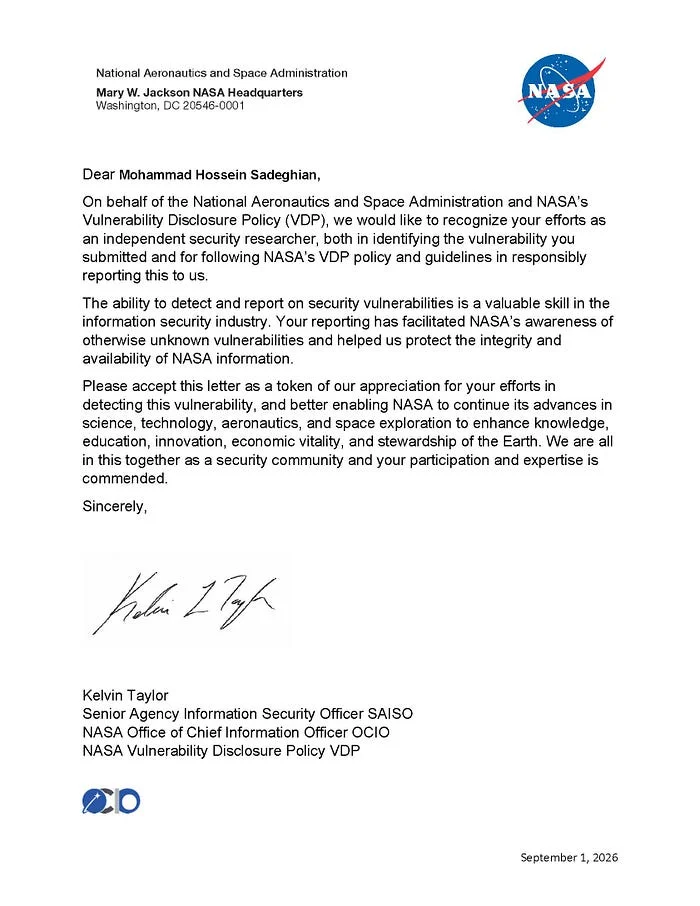
The P1 was marked Resolved. Not long after, the Letter of Recognition arrived, dated 1 September 2026 and signed by NASA's Senior Agency Information Security Officer. The timeline: reported 18 August 2026, triaged, marked Resolved, letter on 1 September 2026.

The author's closing points: automate the boring parts and watch the fresh ones, because the winning bug came from daily diffs; CVE speed matters, since the gap between a CVE dropping and everyone patching is measured in hours; duplicates are calibration rather than failure; recognition follows the fix, since a VDP has nothing to pay you with; and tools should outlive your motivation, because watchtower only needs to be right once. Both P1-level findings came from watchtower, one Resolved and one Duplicate; the IDORs were found by hand.
What happened, in plain words
A security researcher called Mohammad Hossein Sadeghian, who goes by the handle m4sh_wacker, built a small robot program. In this context a "bot" is just a program that runs on a schedule and does a repetitive job without a person watching it. He pointed that bot at NASA's public websites, the ones NASA says people are allowed to test, and let it run in the background while he got on with his life.
The bot is called watchtower. It lives inside Telegram, a messaging app, so it can send him messages the way a friend would. Its profile picture is a shark. Its job is to keep looking at NASA's websites over and over and tell him when something changes that looks interesting.
One day it told him about a file that anyone on the internet could download, with no password and no login. When he opened that file on his own computer, it turned out to contain internal NASA engineering documents and a backup of a database. A database is an organised store of information that a website uses; a backup is a copy kept in case the original is lost. Neither should ever be downloadable by a stranger.
He reported it through NASA's official channel for this kind of thing. NASA rated it P1, which is the most serious priority level, fixed it, and later posted him an official Letter of Recognition signed by NASA's Senior Agency Information Security Officer.
Along the way he also filed four other reports. Three were marked Duplicate, and one was marked N/A. One was a real weakness too, but the kind of weakness NASA had explicitly said it did not want reported, so it was marked N/A, meaning not applicable. This article walks through all of it slowly, explaining each idea as it comes up.
Some words you will need first
Before the story makes sense, here are a few ideas in everyday terms.
- A vulnerability is a mistake in how a website is built that lets someone do something they should not be able to do. Think of a window that was painted shut but never actually latched: it looks closed, but push it and it opens.
- A bug bounty is a scheme where a company pays strangers for telling it about vulnerabilities. A VDP, or Vulnerability Disclosure Program, is the same idea without money: the company promises not to sue you if you report in good faith, and in return you tell it what you found. NASA runs a VDP, so there is no cash prize here.
- In scope means the company has listed which of its systems you are allowed to test. Anything not on the list is out of bounds, and testing it can get you into trouble. This matters enormously: the researcher only ever touched systems NASA had said were fair game.
- Non-destructive means you prove a problem exists without breaking anything, deleting anything or changing anything. Downloading a file and opening it on your own laptop is non-destructive. Editing the file on the server would not be.
- Recon, short for reconnaissance, means looking around to see what exists before you try anything. It is the online equivalent of walking around a building to count the doors before trying the handles.
- A subdomain is a smaller address inside a company's main web address. If the main site is
example.com, thenshop.example.comandhelp.example.comare subdomains. Large organisations have hundreds of them, and each one is a separate thing that can be misconfigured. - A CVE is a public catalogue number for a known vulnerability in widely used software. When a CVE is published, it means the details are now public and anyone can look them up. The race that follows is between companies installing the fix and attackers trying the trick.
- An API is the part of a website that programs talk to, rather than people. When you use a website, your browser asks for a page and gets back something to look at. When a program uses an API, it asks for data and gets back data. Think of a restaurant: the dining room is the website for humans, and the kitchen hatch where waiters collect plates is the API.
- An ID is a number or label that identifies one particular thing, such as one photo or one user account. If photos are numbered 1, 2, 3 and so on, the ID of a photo is just its number.
- Authentication means proving who you are, usually by logging in. Authorisation means checking whether the person who just proved who they are is allowed to do the thing they are asking for. These are two separate checks, and forgetting the second one is the source of a whole family of bugs.
- IDOR, or Insecure Direct Object Reference, is exactly that mistake: the website takes an ID from the user and fetches whatever that ID points to, without checking that the user owns it. It is like a hotel that gives you a key card for room 214, and the card also opens room 215 because nobody checks the number against your booking.
- Rate limiting means refusing to serve too many requests too quickly from the same source. Without it, someone can hammer a feature over and over until the server runs out of capacity, which is called a denial of service, or DoS.
- GraphQL is a way for programs to ask an API for exactly the data they want, in a single request, by describing the shape of the answer. Instead of many fixed addresses, there is usually one address and you send a query describing what you want back.
- Ruby is a programming language.
public_send()is a Ruby feature that runs a named method on an object, where the name is supplied as text. If you can control that text, you can make the program run things it never intended to expose. - P1, P2 and N/A are priority labels. P1 is the most severe, P2 is serious but less so, and N/A means the report was not accepted as a valid issue at all.
The bot, and what it does
watchtower has four jobs, and each one exists to solve a specific problem.
- Subdomain discovery. It keeps pulling lists of subdomains for the targets the researcher has configured. The reason is simple: you cannot test what you do not know exists, and new subdomains appear all the time as organisations add services.
- CVE watching. When a new CVE is published, the bot checks whether any of the targets appear to be running the affected software, and flags them quickly. The reason is that the window between a CVE becoming public and everyone patching is short, so speed decides who finds the problem first.
- Daily static-asset checks. It re-checks the static files of each subdomain every single day. Static files are things like images, documents and archives that are served as-is, without any program generating them on the fly. The reason for doing this daily rather than once is that a file which was not there yesterday can appear today, and a one-off look would never notice.
- Auto-reporting. It pushes anything worth a human look straight to the researcher's phone. The reason is that the bot is not smart enough to decide what matters; it just narrows thousands of changes down to a handful a person can judge.
The image above is a cartoon of SpongeBob lying in bed doing nothing while the work happens elsewhere. That is the point of the whole setup: the researcher is not sitting at a screen for eighteen hours a day. The bot does the boring watching, and the person does the thinking when something arrives.
The card above summarises the bot's activity: 432 photos, 651 files, 1,167 shared links, and tags for subdomains, CVE watch, daily static diff and auto-report. "Daily static diff" means comparing today's version of the static files against yesterday's and highlighting what changed. That comparison is the single most important feature in this story.
The target, and the rules
NASA runs a VDP on a platform called Bugcrowd. Bugcrowd is a website where organisations publish their programmes and researchers submit reports through a standard form. The programme gives safe harbour for good-faith research on in-scope, internet-facing NASA systems. "Internet-facing" means reachable from the open internet, as opposed to internal systems that only NASA staff can reach. "Safe harbour" means NASA promises not to take legal action against someone who follows the rules.
There is no money in this programme. What a valid report gets you is triage, a fix, and sometimes recognition. Triage is the process where the organisation's security team reads your report, confirms the problem is real, and assigns it a priority.
The image above is a cartoon of a mouse sleeping peacefully while time passes. Again, the theme is patience: the bot was pointed at the in-scope assets and left to run.
The scoreboard
Over the engagement, the bot and the researcher together produced five reports. Here they are, with the priority NASA assigned and what happened to each.
| Severity | Status | Finding |
|---|---|---|
| P1 | Resolved | Publicly exposed internal archive containing a database backup |
| P1 | Duplicate | Unauthenticated GitLab GraphQL method invocation (CVE-2026-19478) |
| P2 | Duplicate | IDOR, write side, on a NASA science API |
| P2 | Duplicate | IDOR, read side, on the same API |
| N/A | Out of scope | Missing rate limiting on a file-upload endpoint |
The screenshot above shows the Bugcrowd submissions list for NASA's programme: one resolved P1, one duplicate P1, two duplicate P2 IDORs, and one not-applicable rate-limiting report. "Resolved" means NASA fixed it. "Duplicate" means the bug was real but somebody else had already reported it. "Out of scope" means the report described something the programme had said it did not want.
The write-up deliberately leaves out target hostnames, paths and internal data. The techniques described are all publicly known; the specific evidence is not. That is standard practice: you explain how you found something without handing anyone a map to the vulnerable system.
The big one: a downloadable archive (P1, Resolved)
Step 1: the bot notices a file
watchtower's daily static-asset check flagged a publicly downloadable archive on a NASA subdomain. No login was required to fetch it. This is where the daily comparison matters: the author says continuous recon caught what point-in-time recon misses.
Why this step was taken: because static files are often forgotten. A developer drops a file on a web server to move it somewhere, or to share it with a colleague, and then never removes it. Because static hosting usually has no login layer of its own, anything placed there is readable by the whole internet unless someone actively prevents it.
Step 2: confirm without touching anything
The researcher downloaded the archive and opened it locally, on his own machine. That was the entire confirmation. He did not query any internal system and did not modify anything.
Why this step was taken: because the goal is to prove the problem exists, not to cause harm. Downloading a file that the server freely offers to anyone is not an intrusion; it is the same thing any visitor's browser could do. Opening it locally means the analysis happens on his own equipment, where nothing can break.
Opening it showed it was not merely a pile of files. It contained internal engineering files and a database backup. The backup carried internal references and history that mapped out part of NASA's internal development environment. So one stray archive leaked two categories of material at once: documents, and a picture of how the internal systems fit together.
Step 3: report it and let triage happen
The archive was reported through the VDP. NASA rated it P1 (Critical), triaged it quickly, and fixed it. This is the finding that earned the Letter of Recognition.
Why this step was taken: because a VDP only works if you tell the organisation. Finding a problem and saying nothing helps nobody; the file stays exposed and someone with worse intentions may find it next.
The CVE sprint: GitLab (P1, Duplicate)
Separately, the CVE watcher flagged a NASA-hosted GitLab instance affected by CVE-2026-19478. GitLab is a popular piece of software that teams use to store and manage source code. It has a GraphQL API, which is the part programs talk to.
The root cause is worth understanding even if the details are technical. GitLab's GraphQL API, combined with something called the @gl_introduced directive, would resolve an unknown field by falling back to Ruby's public_send() on the underlying object. A directive in GraphQL is an instruction attached to part of a query that changes how it is handled. The effect of this particular combination was that asking for a field that does not exist did not produce an error; instead, the server tried to run a method with that name on the object. That gives arbitrary zero-argument method invocation on publicly reachable objects, with no authentication needed. In plain terms: a stranger could make the server run certain built-in operations of their choosing, without logging in.
The proof of concept used a harmless method, touch:
query { project(fullPath: "<public/project>") { name touch @gl_introduced(version: "999.0.0") }}
Line by line, in plain words:
query {opens the request. It says: this is a query, meaning a request to read or do something, and everything inside the braces belongs to it.project(fullPath: "<public/project>") {asks for one specific project, identified by its full path. The angle brackets are a placeholder where the real project path would go; the researcher has replaced it so as not to name a real target.nameasks for the project's name, which is an ordinary, harmless field that any query could request.touch @gl_introduced(version: "999.0.0")is the interesting part.touchis not a normal field of a project; it is the name of a method that exists on the underlying object. The@gl_introduceddirective with a made-up version number is what triggers the fallback behaviour.- The closing braces end the project selection and then the query.
If the response contains "touch": true, the server executed Project#touch on the caller's behalf. In other words, the server ran a method because a stranger asked for it by name, and reported back that it had done so. Depending on which methods are reachable on the object, the effect ranges from annoying to genuinely destructive, which is why it is rated P1.
Why this step was taken: because a CVE had just been published, and the bot's job is to check quickly whether any in-scope target is affected. Testing with a harmless method proves the mechanism works without causing damage. Depending on which methods are reachable on the object, the effect ranges from annoying to genuinely destructive.
The researcher confirmed it non-destructively and reported it about six hours after someone else had already done so. The report was closed as a Duplicate.
The image above is a cat being patted on the head repeatedly. It captures the feeling of doing everything right and still being on the receiving end: the finding was real, the report was good, and the answer was still "someone got here first".
The IDOR twins: a science API (P2 x2, Duplicate)
These two were found by hand, not by the bot, while the researcher was poking at a NASA science API himself. Both share one root cause: the API trusted an object ID supplied by the client without checking who owned the object.
Write side
POST /<photo-upload> accepted a site_id in the body and never verified that the caller owned that site. Swapping the ID allowed uploading or overwriting photos on someone else's site.
In plain words: POST is the kind of request a browser makes when it is sending data to be stored, as opposed to GET, which asks for data to be returned. The path /<photo-upload> is the address of the feature that handles photo uploads, with the real name replaced by a placeholder. The body is the part of the request that carries the actual data, here including a site_id, which says which site the photo belongs to. The server took that number at face value. Change the number to somebody else's site, and the upload lands on their site instead of yours.
Why this step was taken: because any time a request carries an identifier that the user controls, it is worth asking whether the server checks that the identifier belongs to the user. Here it did not.
Read side
GET /<photo>/{id} returned any object, plus a direct file URL, with no authorisation check. Incrementing the ID allowed reading other users' uploads.
In plain words: GET asks for something to be returned. The path ends in {id}, a placeholder for the photo's number. The server looked up whatever number was in the address and handed back the photo, along with a direct link to the file itself. Counting upwards through the numbers walked through other people's uploads.
Why this step was taken: because the read side and the write side are two separate features, and a fix applied to one does not automatically cover the other. Testing both is how you find out whether the same mistake was made twice.
Both were accepted as valid and rated P2, and both were closed as Duplicate. The researcher filed an appeal arguing that the read bug and the write bug are two distinct issues; the original says the jury is still out.
The lesson the researcher draws is the general principle: never trust a user-controlled identifier as an authorisation decision. The server should look up who is logged in, then check whether that person owns the object being asked for, rather than believing the number in the request.
The one that got away: missing rate limiting (N/A)
Also found by hand: an unauthenticated file-upload endpoint that ran server-side processing on every request with no throttling. "Unauthenticated" means no login was needed. "Server-side processing" means the server did real work each time, such as converting or analysing the file, rather than just storing it. "No throttling" means nothing slowed down repeated requests.
Repeating the request enough times would exhaust resources. That is the definition of a denial of service: not breaking in, but making the service unavailable to everyone by overwhelming it.
Why this step was taken: because a feature that does expensive work for anyone who asks, with no limit, is a real weakness. But the programme lists DoS and rate-limiting as explicitly out of scope, so the report was closed as N/A. The weakness was real; it was simply not something this programme wanted to hear about. Checking the scope before testing is what prevents wasted effort.
The image above shows a face shifting from a hopeful smile to visible disappointment: the moment of going from "this is definitely a P2" to reading the words "out of scope".
Why each of these happened
It helps to separate the causes, because they are genuinely different mistakes.
- The exposed archive (P1). An internal archive, including a database backup, was placed on a publicly reachable static location with no access control. Static hosting typically has no authentication layer of its own, so anything dropped there is world-readable unless the deployment process keeps it out. How the file got there is not described.
- The GitLab GraphQL issue (P1). The
@gl_introduceddirective combined with GraphQL field resolution fell back to Ruby'spublic_send()for unknown fields, turning a schema lookup into arbitrary zero-argument method invocation on the underlying object. A schema lookup is supposed to be a read-only description of what fields exist; this turned it into an instruction to run something. The patch is not described. - The IDORs (P2 x2). The API used a user-controlled identifier,
site_idin the body and{id}in the path, as the authorisation decision. Ownership was never checked against the logged-in user, so any caller could act on any object by changing the identifier.
What the impact was
- Exposed archive: internal engineering files and a database backup were downloadable by anyone on the internet, with no login. Rated P1 (Critical) and fixed.
- GitLab GraphQL: unauthenticated arbitrary zero-argument method invocation on publicly reachable objects. The researcher describes the range as "annoying to genuinely destructive" depending on which methods are reachable. Closed as Duplicate; the author reported it about six hours after someone else.
- IDOR write side: an attacker could upload or overwrite photos on another user's site by swapping
site_id. - IDOR read side: an attacker could read other users' uploads, including the direct file URL, by incrementing the object ID.
- Rate limiting: resource exhaustion by repeating requests to an unauthenticated upload endpoint. Out of scope under the programme's DoS exclusion.
What was fixed
The exposed archive was fixed; the change itself is not described. The GitLab issue is tracked as CVE-2026-19478; the patch is not described. For the IDORs, the write-up states the principle rather than the fix: never trust a user-controlled identifier as an authorisation decision. The rate-limiting report was closed as out of scope, so no fix is described.
Things worth trying, if you are learning
These are the general techniques, written so that someone starting out can understand what to look for. Only ever try them on systems you are authorised to test.
- Daily static-asset diffing on any large programme. Re-fetch the static files of each subdomain on a schedule and compare the results. A positive result is a new file appearing that was not there before, especially an archive, backup or configuration file reachable without authentication.
- Archive and backup hunting on static hosts. Look for downloadable archives on subdomains that serve static content. A positive result is an archive that opens locally to reveal internal paths, engineering files or database dumps.
- GraphQL unknown-field resolution on self-hosted GitLab. Send a query with a harmless zero-argument method and the
@gl_introduceddirective as shown above. A positive result is a response containing"touch": true, meaning the method executed server-side. - CVE watching against self-hosted instances. Track CVEs for products you know are deployed, such as GitLab, Jenkins or Confluence, and test in-scope instances as soon as a CVE drops. A positive result is a version or behaviour matching the advisory, confirmed non-destructively.
- IDOR on write endpoints. Take any
POSTorPUTthat carries an object identifier in the body, such assite_id, and swap it for an identifier belonging to another account. A positive result is a successful write to an object you do not own. - IDOR on read endpoints. Take any
GETwith an object ID in the path and increment or decrement it. A positive result is another user's object, or a direct file URL, returned without an authorisation error. - Rate-limit checks on unauthenticated upload endpoints. Repeat a request that triggers server-side processing and observe whether throttling kicks in. A positive result is sustained processing with no rate limit, though check the programme's scope first, since DoS and rate-limiting are commonly excluded.
The payoff
The P1 was marked Resolved. Not long after, the Letter of Recognition arrived, dated 1 September 2026 and signed by NASA's Senior Agency Information Security Officer. The timeline: reported 18 August 2026, triaged, marked Resolved, letter on 1 September 2026.
The image above is the Letter of Recognition itself, on Mary W. Jackson NASA Headquarters letterhead, addressed to Mohammad Hossein Sadeghian and signed by NASA's Senior Agency Information Security Officer, dated September 1, 2026.
The image above is a pigeon strutting confidently along a ledge and then dropping off the edge. It stands in for the duplicates: you walk up full of confidence, and gravity files a duplicate.
What the researcher took away from it
- Automate the boring parts and watch the fresh ones. The winning bug came from daily comparisons of static files. Continuous recon catches what a single look misses.
- CVE speed matters. The gap between a CVE dropping and everyone patching is measured in hours, and those were the same six hours that cost him a P1.
- Duplicates are calibration, not failure. A duplicate still means the bug was real. Keep the bot running and eventually you are the one who is first.
- Recognition follows the fix. A VDP has nothing to pay you with. A resolved critical finding is the outcome, and how you handle triage is what gets you there.
- Build tools that outlive your motivation. watchtower has no feelings. It just keeps working, and it only needs to be right once.
Both P1-level findings came from watchtower, one Resolved and one Duplicate. The IDORs were found by hand. Everything described here was reported through NASA's official VDP on Bugcrowd and kept confidential per programme policy: no target hostnames, no internal data, and nothing beyond what is already public.
Glossary
- API: the part of a website that programs talk to, rather than people, exchanging data instead of pages.
- Archive: a single file that bundles several files together, often compressed, so it can be downloaded or moved as one item.
- Authentication: proving who you are, usually by logging in.
- Authorisation: checking whether the person who has proved who they are is allowed to do what they are asking.
- Body: the part of a web request that carries the actual data being sent, as opposed to the address.
- Bot: a program that runs automatically and repeatedly, without a person driving it.
- Bug bounty: a scheme where an organisation pays strangers for reporting vulnerabilities.
- CVE: a public catalogue number for a known vulnerability in widely used software.
- Database: an organised store of information that a website uses.
- Database backup: a copy of a database kept in case the original is lost or damaged.
- Denial of service (DoS): making a service unavailable to everyone by overwhelming it with requests.
- Directive: in GraphQL, an instruction attached to part of a query that changes how it is handled.
- Duplicate: a report of a real bug that someone else had already reported first.
- GET: the kind of web request that asks for something to be returned.
- GraphQL: a way for programs to ask an API for exactly the data they want, in a single request, by describing the shape of the answer.
- ID: a number or label that identifies one particular thing, such as one photo or one user account.
- IDOR (Insecure Direct Object Reference): a bug where the site takes an ID from the user and fetches whatever it points to, without checking that the user owns it.
- In scope: listed by the organisation as allowed to be tested.
- Internet-facing: reachable from the open internet, as opposed to internal systems only staff can reach.
- Method: in programming, a named operation that an object can perform.
- N/A: not applicable; here, a report that was not accepted as a valid issue.
- Non-destructive: proving a problem exists without breaking, deleting or changing anything.
- Out of scope: not listed by the organisation as allowed to be tested, or explicitly excluded.
- P1 / P2: priority labels, where P1 is the most severe and P2 is serious but less so.
- POST: the kind of web request that sends data to be stored or acted on.
public_send(): a Ruby feature that runs a named method on an object, where the name is supplied as text.- Rate limiting: refusing to serve too many requests too quickly from the same source.
- Recon (reconnaissance): looking around to see what exists before trying anything.
- Resolved: fixed by the organisation.
- Ruby: a programming language.
- Safe harbour: a promise not to take legal action against someone who follows the programme's rules.
- Schema: the description of what fields and types an API offers.
- Static file: a file served exactly as stored, without a program generating it on the fly.
- Subdomain: a smaller address inside an organisation's main web address, such as
shop.example.com. - Throttling: deliberately slowing or limiting repeated requests.
- Triage: the process where an organisation's security team reads a report, confirms the problem is real, and assigns it a priority.
- Unauthenticated: reachable without logging in.
- VDP (Vulnerability Disclosure Program): a scheme where an organisation accepts vulnerability reports in good faith, usually without paying a reward.
- Vulnerability: a mistake in how a system is built that lets someone do something they should not be able to do.
- Zero-argument method invocation: running a named operation that takes no inputs, chosen by whoever supplies the name.



