From IDOR to Fraud: Breaking Access Control in a Travel Booking Platform
Two booking API endpoints returned other users' booking data when the bookingId parameter was changed, because no ownership check was enforced server-side. An attacker with a valid session could read other customers' names, emails, phone numbers and travel details, and the author says this could be chained into phishing, impersonation and fraud.
 Published on medium.com
Cybersecurity
The full write-up lives on its author's site
It belongs to its author, so we link to it rather than copy it. The other two tabs are our own rewrites, checked against it.
Context
This write-up comes from an application security assessment carried out within a professional engagement against a production travel booking platform. The platform is French-facing: the affected endpoints sit under a /fr/account/ path. The feature involved is the account area where a logged-in traveller retrieves their own booking and flight information. Normally the server takes the bookingId supplied by the client, looks up the booking, and returns the details of that booking to the authenticated user who owns it.
The researcher, Mohtadi Romene, describes the finding as a critical Broken Access Control (IDOR) vulnerability. What began as simple parameter manipulation turned into a multi-step attack chain with real-world implications, including potential account takeover and financial fraud.

Setup
The only precondition stated is a valid user session. The researcher used an authenticated session to capture a request against the account endpoints, then modified the identifier in it. No specific tooling, software versions or additional roles are described in the report.
Finding it
The issue lies in multiple API endpoints that expose user data based on a bookingId parameter:
GET /fr/account/getbooking?bookingId=XXXXGET /fr/account/getbookingFlight?bookingId=XXXX
Both endpoints take the booking identifier straight from the query string. The identifier is client-controlled and, as the exploitation showed, the server performed no ownership validation on it. That is the classic Insecure Direct Object Reference pattern, categorised under Broken Access Control in the OWASP Top 10.
Exploitation
Step 1: Authenticated request interception
A valid user session is used to capture a request:
GET /fr/account/getbookingFlight?bookingId=180845
Step 2: Parameter manipulation
The bookingId is modified to another valid identifier:
GET /fr/account/getbookingFlight?bookingId=180844
Step 3: Unauthorized access
The server returns another user's data, including:
- Full name
- Email address
- Phone number
- Travel details
- Booking / ticket information
This confirms a complete failure of object-level authorization: the server checked that the caller was authenticated but never checked that the caller owned the object being requested.
Root cause
The report attributes the vulnerability to four factors:
- Missing server-side authorization checks
- Trust in client-controlled identifiers (
bookingId) - Lack of object ownership validation
- Inconsistent access control enforcement across modules
Because the same weakness appears in more than one endpoint, the researcher characterises it as a systemic Broken Access Control issue rather than an isolated flaw. No ownership validation was enforced server-side: a logged-in user could name another booking and the server returned it.
Impact
Sensitive data exposure (PII)
The vulnerability allows access to personally identifiable information, travel itineraries and booking details. This creates a direct privacy breach and potential regulatory risk.
From data leak to attack chain
The real impact goes beyond data exposure. Using leaked information, an attacker can perform:
- Targeted phishing using real booking context
- User impersonation when interacting with support
- Credential theft via social engineering
- Account takeover
- Fraud through booking modification or refund abuse
These are the researcher's projected downstream scenarios, built on the leaked data; the report does not demonstrate each of them being executed. The threat model below illustrates how the vulnerability propagates across the application:
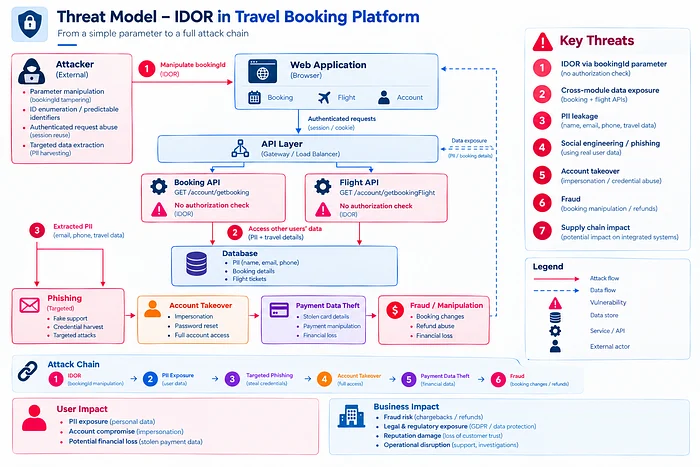
Figure: Threat model illustrating IDOR exploitation and attack chain progression
The diagram highlights how a lack of authorization control enables data exposure, which can be leveraged in downstream attack scenarios leading to account compromise and fraud.
Fix
The report does not say what the platform changed. It recommends the following mitigations:
- Enforce strict object-level authorization checks
- Implement centralized access control policies (RBAC / ABAC)
- Avoid exposing predictable identifiers without validation
- Validate resource ownership on every request
- Log and monitor access to sensitive endpoints
The key takeaway is that access control must never rely on client input and must be consistently enforced across all application layers. A single missing validation can lead to data exposure, account compromise, financial abuse, and business and reputational impact. Disclosure was handled responsibly prior to publication.
Variants to test
- Sequential numeric identifiers on other account endpoints. Walk identifiers around your own value on every endpoint that accepts one. A positive result is a response containing another user's name, email, phone or booking details while your own session is unchanged.
- The sibling endpoint. The report lists both
getbookingandgetbookingFlight; test each separately, since access control is often enforced inconsistently across modules. A positive result is one endpoint rejecting the foreign identifier while the other returns data. - Identifier type changes. Try the same manipulation with other identifier formats the API accepts (for example booking references rather than numeric IDs) where the application exposes them. A positive result is any foreign record returned without an ownership check.
- Write operations on the same object. If booking modification or cancellation endpoints take the same identifier, test whether they also lack ownership validation. A positive result is a state change on a booking you do not own.
- Response differences as an oracle. Compare status codes and body sizes for your own versus foreign identifiers. A positive result is a 200 with a populated body for an identifier that should not be visible to you.
What happened, in plain words
A security researcher was hired to test a travel booking website, the kind of site where you search for a flight, book it, and later log in to your account to see your trip. While testing the logged-in account area, he found that the site asked for a booking number and then simply handed back whatever booking matched that number, without checking whether the person asking actually owned it. By changing the booking number, he could read other travellers' names, email addresses, phone numbers and trip details.
That sounds like a small mistake, but the researcher shows how it can be chained into bigger attacks: using real booking details to make convincing phishing messages, pretending to be a customer with support, stealing credentials, taking over accounts, and committing fraud through booking changes or refund abuse. The report calls this a critical Broken Access Control (IDOR) vulnerability and explains the cause, the impact and the fixes.
This article walks through the same finding from the beginning, explaining every term as it appears, so you can follow it even if you have never done security testing.
Introduction
The assessment was carried out within a professional engagement, meaning the researcher had permission to test the platform. The target was a production travel booking platform, so a live system that real customers use, not a practice copy.
What initially appeared as a simple parameter manipulation quickly evolved into a multi-step attack chain with real-world implications, including potential account takeover and financial fraud. In plain words: a tiny change to a value in a web request opened the door to a series of abuses that could cost real people and the business real money.
Vulnerability Overview
What an API is
When you use a website, your browser does not do all the work itself. It sends requests to a server, a computer somewhere else that holds the data and the logic. Many modern sites expose an API (Application Programming Interface): a set of addresses the browser (or a mobile app) can call to fetch or change data. Each address is called an endpoint. Think of an API as a restaurant menu: the endpoints are the dishes you can order, and the server is the kitchen that prepares them. You are not allowed to walk into the kitchen yourself; you order by name.
What a parameter is
An endpoint often needs extra information to know what you want. That extra information is passed as a parameter. In a web address, parameters usually appear after a question mark, as name=value pairs. For example, ?bookingId=180845 tells the server: give me the booking whose identifier is 180845. The identifier is a number that uniquely points to one record in the database, like a ticket number at a cloakroom.
The vulnerable endpoints
The issue lies in multiple API endpoints that expose user data based on a bookingId parameter:
GET /fr/account/getbooking?bookingId=XXXXGET /fr/account/getbookingFlight?bookingId=XXXX
Line by line:
GETis the HTTP method. It means "read something", as opposed to methods that create or change data. When you type a web address in your browser and press Enter, your browser sends a GET request./fr/account/getbookingis the path of the first endpoint. The/fr/part suggests a French-language version of the site, and/account/tells us this is inside the logged-in account area.?bookingId=XXXXis the parameter.bookingIdis the name of the value the server expects, andXXXXis a placeholder for a real number.- The second line is a sibling endpoint,
/fr/account/getbookingFlight, which presumably returns flight-specific details for the same booking.
The two endpoints are written on one line in the report; in practice they are two separate requests.
By modifying the bookingId, it was possible to access data belonging to other users. No ownership validation was enforced server-side. Ownership validation means the server checks: does the booking named in this request belong to the user who is logged in? Here it did not check.
This is a classic Insecure Direct Object Reference (IDOR), categorised under Broken Access Control (OWASP Top 10).
What IDOR and Broken Access Control mean
Access control is the set of rules that decides who is allowed to see or do what. In a booking site, access control should say: you may see your own bookings, not anyone else's. Broken Access Control means those rules are missing or wrong.
IDOR stands for Insecure Direct Object Reference. It happens when an application lets you refer to an object (a booking, a user profile, an invoice) directly by an identifier, and does not check that you are allowed to access that particular object. A simple everyday comparison: imagine a hotel where room keys are numbered, and the reception hands you key number 12 for your room. If the hotel never checks that key 12 is yours, you can simply ask for key 13 and walk into someone else's room. The key number is the direct object reference; the missing check is the insecurity.
OWASP Top 10 is a widely used list of the ten most serious categories of web application security risks, published by the Open Worldwide Application Security Project. Broken Access Control is one of its categories.
Technical Details
Step 1: Authenticated Request Interception
A valid user session is used to capture a request:
GET /fr/account/getbookingFlight?bookingId=180845
What this means, piece by piece:
- A session is the state of being logged in. When you log in, the server gives your browser a small piece of data, often stored in a cookie, which the browser sends back with every subsequent request so the server recognises you. A cookie is a small text file a website stores in your browser. Think of it as a wristband at an event: you show it at the door and you are let in without showing your ID again.
- Authenticated means the request carries that proof of login.
- Interception means capturing a request so you can look at it and change it before sending it again. Your browser normally hides this from you, but developer tools (built into every browser) or a proxy tool let you see and edit requests. A proxy sits between your browser and the server, like a translator who can also change the words.
bookingId=180845is the identifier used in the captured request, sent with a valid user session. This step establishes a baseline: a known-good request that works.
Why this step: before changing anything, you need to see what a normal, legitimate request looks like. You cannot spot an anomaly without a normal case to compare against.
Step 2: Parameter Manipulation
The bookingId is modified to another valid identifier:
GET /fr/account/getbookingFlight?bookingId=180844
Line by line:
- The method, path and session are unchanged. The researcher is still logged in as himself.
- Only the number changed: from
180845to180844, another valid identifier. - The request is sent again.
Why this step: the researcher wants to know whether the server ties the booking to the logged-in user. If it does, changing the number should produce an error or an empty result. If it does not, the server will happily return someone else's booking. Changing a value that the client controls is called parameter manipulation, or parameter tampering.
Step 3: Unauthorized Access
The server returns another user's data, including:
- Full name
- Email address
- Phone number
- Travel details
- Booking / ticket information
This confirms a complete failure of object-level authorization. Authorization is the process of deciding what a logged-in user is allowed to do. Object-level authorization is the finer check: not just "are you logged in?" but "are you allowed to access this specific object?". The server checked the first and skipped the second.
Why this matters: the response is proof. The researcher did not guess; the server itself handed over the data. That is what turns a suspicion into a confirmed vulnerability.
Impact Analysis
Sensitive Data Exposure (PII)
The vulnerability allows access to:
- Personally Identifiable Information (PII)
- Travel itineraries
- Booking details
PII means information that can identify a specific person: name, email, phone number and similar. A travel itinerary is the plan of a trip: where and when someone flies, and often with whom. This creates a direct privacy breach and potential regulatory risk. Regulatory risk means the possibility of legal consequences, because many countries have laws about how personal data must be protected.
From Data Leak to Attack Chain
The real impact goes beyond data exposure. An attack chain is a series of steps where each one makes the next possible, like dominoes. The leaked data is the first domino.
Using leaked information, an attacker can perform:
- Targeted phishing using real booking context. Phishing is a fake message designed to trick someone into revealing information or clicking a malicious link. Targeted means it is tailored to the person. If the attacker knows your real flight number and dates, a fake email about that flight looks far more believable than a generic one.
- User impersonation when interacting with support. Impersonation means pretending to be someone else. With your name, email and booking details, an attacker can contact customer support and claim to be you.
- Credential theft via social engineering. Credentials are your username and password (or similar login secrets). Social engineering is manipulating people rather than machines: convincing someone to hand over information or perform an action.
- Account takeover. Account takeover means an attacker gains control of your account and can act as you.
- Fraud through booking modification or refund abuse. Fraud means deception for financial gain. If an attacker can change or cancel your booking, or request a refund, the money can end up in the wrong hands.
These are the researcher's projected downstream scenarios, built on the leaked data; the report does not demonstrate each of them being executed. In other words, they are realistic possibilities, not steps the researcher carried out.
Threat Modeling
The following threat model illustrates how the vulnerability propagates across the application:
Figure: Threat model illustrating IDOR exploitation and attack chain progression
A threat model is a diagram or description of how an attacker could move through a system and what harm could result. The diagram highlights how a lack of authorization control enables data exposure, which can be leveraged in downstream attack scenarios leading to account compromise and fraud. Downstream here means later in the chain: the data leak happens first, and the fraud happens as a consequence.
Root Cause Analysis
A root cause is the underlying reason a problem exists, as opposed to its visible symptom. The vulnerability originates from:
- Missing server-side authorization checks. The check should happen on the server, the trusted side. If it only happens in the browser, the attacker can bypass it, because the browser is under the attacker's control.
- Trust in client-controlled identifiers (
bookingId). Client-controlled means the value comes from the user's side and can be changed freely. Trusting it is like a bouncer who believes whatever name you give at the door. - Lack of object ownership validation. The server never compared the booking's owner with the logged-in user.
- Inconsistent access control enforcement across modules. A module is a part of the application, such as bookings, flights or payments. Inconsistent means some parts check and others do not.
This represents a systemic Broken Access Control issue rather than an isolated flaw. Systemic means it comes from the way the system is built, not from one accidental mistake in one place. No ownership validation was enforced server-side: a logged-in user could name another booking and the server returned it. Authentication answers "who are you?"; authorization answers "what may you do?". The site confused the two.
Recommendations
To mitigate this vulnerability, the report recommends:
- Enforce strict object-level authorization checks. On every request, verify that the logged-in user owns the object being requested.
- Implement centralized access control policies (RBAC / ABAC). Centralized means the rules live in one place instead of being scattered. RBAC stands for Role-Based Access Control: permissions are granted by role, such as customer or administrator. ABAC stands for Attribute-Based Access Control: permissions are granted based on attributes, such as the owner of the record or the time of day.
- Avoid exposing predictable identifiers without validation. Predictable means easy to guess, such as sequential numbers. If identifiers must be guessable, the server must still validate ownership.
- Validate resource ownership on every request. Every request, not just some.
- Log and monitor access to sensitive endpoints. Logging means recording what happened; monitoring means watching those records for suspicious patterns, such as one user requesting many different booking numbers in a short time.
Key Takeaway
This case reinforces a fundamental principle:
Access control must never rely on client input and must be consistently enforced across all application layers.
A single missing validation can lead to:
- Data exposure
- Account compromise
- Financial abuse
- Business and reputational impact
Conclusion
This assessment demonstrates how a seemingly simple vulnerability can escalate into a real-world attack scenario with tangible consequences. In modern API-driven architectures, security must be enforced consistently to prevent such escalation paths. Disclosure was handled responsibly prior to publication, meaning the finding was reported to the affected organisation before being made public.
Variants to test
If you want to look for similar issues on a system you are authorised to test, the report's finding suggests these directions:
- Sequential numeric identifiers on other account endpoints. Walk identifiers around your own value on every endpoint that accepts one. A positive result is a response containing another user's name, email, phone or booking details while your own session is unchanged.
- The sibling endpoint. The report lists both
getbookingandgetbookingFlight; test each separately, since access control is often enforced inconsistently across modules. A positive result is one endpoint rejecting the foreign identifier while the other returns data. - Identifier type changes. Try the same manipulation with other identifier formats the API accepts (for example booking references rather than numeric IDs) where the application exposes them. A positive result is any foreign record returned without an ownership check.
- Write operations on the same object. If booking modification or cancellation endpoints take the same identifier, test whether they also lack ownership validation. A positive result is a state change on a booking you do not own.
- Response differences as an oracle. Compare status codes and body sizes for your own versus foreign identifiers. A status code is the number the server returns to describe the outcome, such as 200 for success or 403 for forbidden. An oracle here means a signal you can read to learn something the server did not intend to tell you. A positive result is a 200 with a populated body for an identifier that should not be visible to you.
Glossary
- ABAC (Attribute-Based Access Control): an access control model where permissions depend on attributes of the user, the resource or the context, such as who owns the record.
- Access control: the rules that decide who may see or do what in an application.
- Account takeover: an attacker gaining control of another person's account.
- API (Application Programming Interface): a set of addresses and rules a browser or app uses to exchange data with a server.
- Attack chain: a sequence of steps where each enables the next, leading to a larger compromise.
- Authentication: proving who you are, typically by logging in.
- Authorization: deciding what an authenticated user is allowed to do.
- Broken Access Control: a class of vulnerability where access rules are missing or wrong; an OWASP Top 10 category.
- Client-controlled: a value that comes from the user's side and can be changed by them.
- Cookie: a small piece of data a website stores in your browser, often used to remember that you are logged in.
- Credentials: the secrets used to log in, such as a username and password.
- Endpoint: a specific address in an API that performs a particular action.
- Fraud: deception carried out for financial gain.
- GET: an HTTP method meaning "read this resource".
- HTTP: the protocol browsers and servers use to exchange requests and responses.
- IDOR (Insecure Direct Object Reference): a vulnerability where an application lets you name an object directly by its identifier without checking that you own it.
- Impersonation: pretending to be another person.
- Interception: capturing a request so it can be inspected or modified before being sent.
- Itinerary: the plan of a trip, including flights, dates and destinations.
- Logging: recording events, such as requests, for later review.
- Mitigation: a change that reduces or removes a risk.
- Module: a part of an application, such as bookings, flights or payments.
- Monitoring: watching logs or activity for suspicious patterns.
- Object-level authorization: checking that a user is allowed to access the specific object they requested, not just that they are logged in.
- Oracle: a signal from a system that reveals information it did not intend to reveal.
- OWASP Top 10: a widely used list of the ten most serious categories of web application security risks.
- Ownership validation: checking that the logged-in user owns the object being requested.
- Parameter: extra information sent with a request, usually as
name=valueafter a question mark in the URL. - Parameter manipulation (tampering): changing a parameter's value to something the application did not intend.
- Phishing: a fake message designed to trick someone into revealing information or clicking a malicious link.
- PII (Personally Identifiable Information): data that can identify a specific person, such as a name, email or phone number.
- Production: a live system used by real users, as opposed to a test copy.
- Proxy: a tool that sits between your browser and a server, letting you see and modify requests.
- RBAC (Role-Based Access Control): an access control model where permissions are granted by role, such as customer or administrator.
- Regulatory risk: the possibility of legal consequences from failing to protect data as required by law.
- Root cause: the underlying reason a problem exists.
- Server-side: happening on the server, the trusted side, rather than in the user's browser.
- Session: the state of being logged in, maintained across requests by a cookie or token.
- Social engineering: manipulating people, rather than machines, to obtain information or actions.
- Status code: a number a server returns to describe the outcome of a request, such as 200 for success or 403 for forbidden.
- Systemic: arising from the way a system is built, rather than from one isolated mistake.
- Threat model: a description or diagram of how an attacker could move through a system and what harm could result.
- Token: a piece of data, similar to a cookie, used to prove identity or authorise a request.
- Unauthorized access: accessing data or actions without the permission to do so.



