From Learning Web Pentesting to Receiving a Letter of Recognition
A document on a NASA public resource was reachable without authentication and contained project personnel contact details such as names, email addresses and phone numbers. An attacker could read that personal and organisational information directly, without any login.

Cybersecurity
The full write-up lives on its author's site
It belongs to its author, so we link to it rather than copy it. The other two tabs are our own rewrites, checked against it.
Context
This is an account of a vulnerability disclosure against NASA, carried out through the organisation's Vulnerability Disclosure Program (VDP) rather than a paid bug bounty. The asset in question was not an application feature in the usual sense: it was a document hosted on NASA's publicly accessible resources that could be retrieved without any authentication. The document contained project personnel contact information, including names, organisational information, email addresses, telephone numbers and other associated details.
The author's path into the work was web penetration testing and vulnerability research, and the technique that surfaced the document was Google dorking. The report does not name the hostname, the URL path, the document format or the dork strings used; the dorks appear only as an image.
Setup
No accounts, roles, tooling versions or special preconditions are described. The only precondition that matters is that the document was reachable on the public internet without authentication, so a browser and a search engine were sufficient to reach it. The submission channel was NASA's Vulnerability Disclosure Program, and the report went through that programme's triage and classification process.
Finding it
While researching NASA's publicly accessible resources, the author came across a document that was accessible without authentication. The content was personnel contact data: names, organisational information, email addresses, telephone numbers and related details.
The author is explicit that the mere existence of the information was not the problem. The concern was that the information was publicly accessible through a document that could be accessed without authentication. That framing, exposure rather than data collection, is what the report was built around.
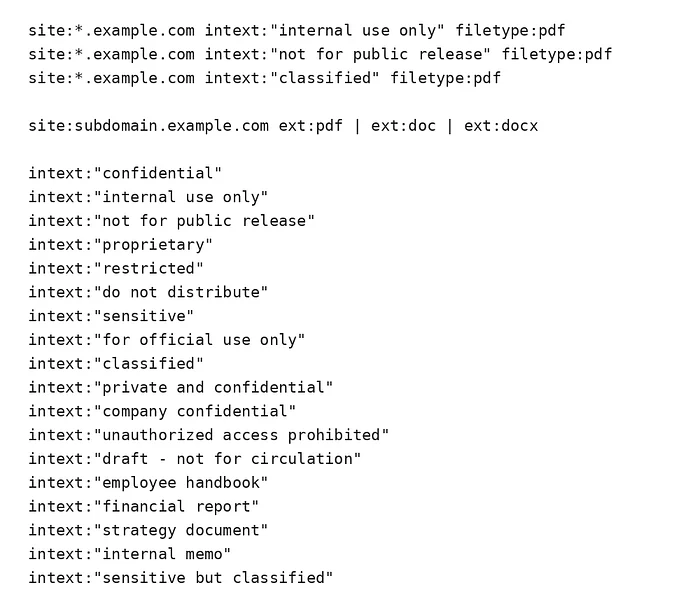
Google dorking was the technique that made the discovery practical during the research period. The dorks used are shown in the article as an image rather than as text:
Exploitation
Step 1: Locate the document through public search
Using Google dorking against NASA's publicly accessible resources, the author identified a document that was reachable without authentication. No request, URL or payload is reproduced in the report, so the exact query and path cannot be given here.
Step 2: Retrieve the document unauthenticated
The document was accessible without authentication, and its contents included project personnel contact information: names, organisational information, email addresses, telephone numbers and other associated details. The exposure is the whole of the technical finding; there was no privilege escalation, no injection and no bypass of an authentication mechanism beyond the fact that none was required.
Step 3: Document and submit
The author documented what was found, created a proof of concept, explained the potential impact, and submitted the report through NASA's Vulnerability Disclosure Program. The report does not reproduce the proof of concept or the impact statement.
Step 4: Triage outcome
The finding was initially classified as P5 / Informational. At that point the author had submitted 7 reports to NASA in total, with these results:
| Outcome | Count |
|---|---|
| Accepted as P5 / Informational | 6 |
| Rejected | 1 |
| Monetary rewards | $0 |
The lesson the author draws from this is that finding something is not enough; the security impact has to be understood and articulated.
Step 5: Disclosure request and verification
After the report had gone through the process, the author requested public disclosure of the report. During that process NASA asked a single question:
"Are you still able to access the information?"
The author went back and checked the original URL. This time the information was no longer accessible, and the URL returned:
404 Not Found
The author verified the change from their side and provided NASA with the requested confirmation. The report was then marked Resolved, meaning the vulnerability had been addressed.
Root cause
The report does not describe the server configuration, access control model or deployment mistake behind the exposure. What can be said from the account is that a document containing personnel contact information was placed on a publicly accessible resource and served without authentication, so anyone who could find it could read it. Why existing controls did not prevent this is not stated.
Impact
The exposed data was project personnel contact information: names, organisational information, email addresses, telephone numbers and other associated details. Anyone who could locate the document could read it without authentication, Anyone who could locate the document could read it without authentication..
Fix
What it records is the observable result: after NASA's question, the original URL returned 404 Not Found, the author confirmed this, and the report was marked Resolved.
Recognition
A few days later, NASA sent an official Letter of Recognition.
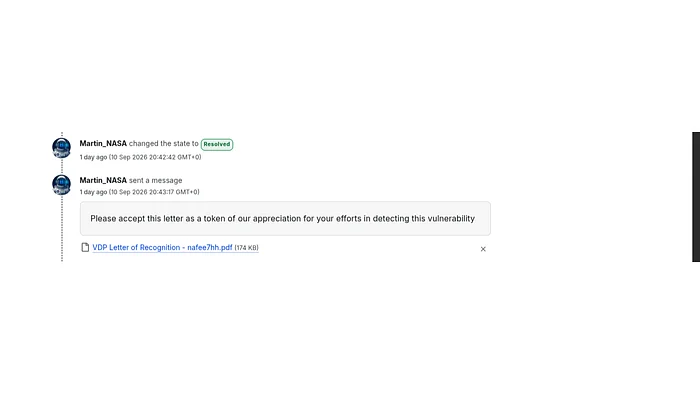
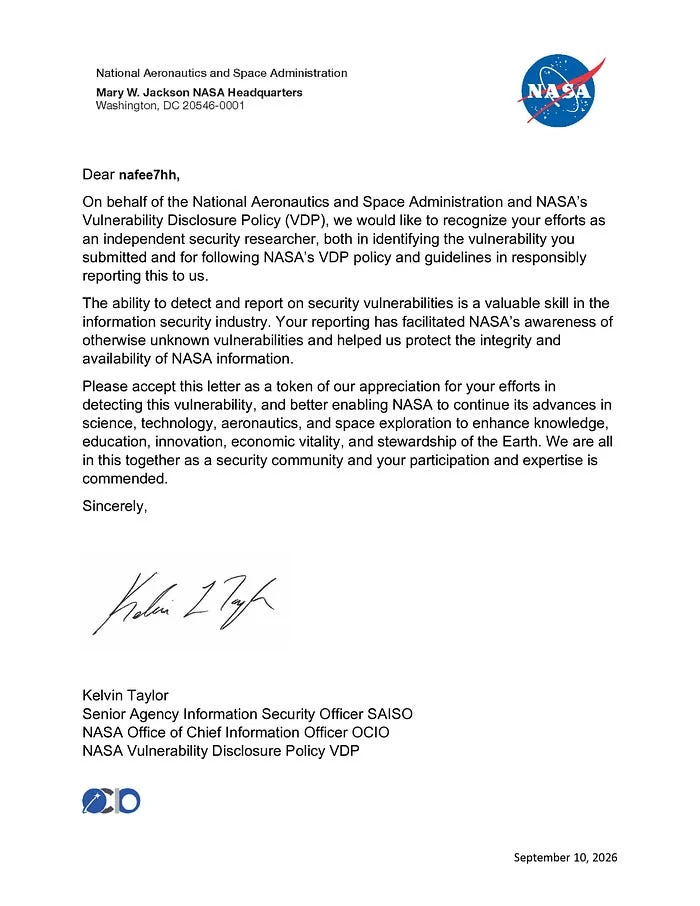
The letter recognised the author's efforts as an independent security researcher, specifically acknowledging that a vulnerability had been identified and responsibly reported while following NASA's Vulnerability Disclosure Policy and guidelines.
The author is careful about the framing: this was not hacking into NASA. It was finding a security exposure in a publicly accessible resource, investigating it, documenting the risk and disclosing it through the VDP. The distinction between the two is the point of the write-up, alongside the argument that consistency, rather than any single technique, produced the result.
Variants to test
- Dork for document types on the same estate. Search for indexed files of common office and PDF formats scoped to the target domain. A positive result is a document that opens without a login prompt and contains staff names, email addresses or phone numbers.
- Dork for directory listings and backup files. Look for open index pages and archive extensions on the same host. A positive result is a listing or archive that exposes files not linked from the site.
- Check whether the document is still cached or mirrored. After a 404, query search engine caches and third-party mirrors for the same filename. A positive result is the same content still retrievable from a cache after the origin has removed it.
- Test adjacent documents in the same path. If one project document was public, request sibling filenames in the same directory. A positive result is another document served with a 200 and no authentication.
- Compare authenticated and unauthenticated responses. Request the same resource with and without a session. A positive result is identical content in both cases, which shows the access control is absent rather than merely weak.
- Re-verify after remediation. When a programme asks whether the issue still reproduces, re-request the original URL and record the status code and body. A positive result for the researcher is a clean 404 or a login redirect, which is what closes the report.
What happened, in plain words
A security researcher who was still learning web penetration testing found a document on NASA's public web resources that anyone could open, with no login required. The document listed contact details for people working on a project: names, organisational information, email addresses, telephone numbers and related details. The researcher reported it through NASA's Vulnerability Disclosure Program, the programme NASA runs for people to report security problems to it. The report was initially classified as P5 / Informational, and no money was paid. Later NASA asked whether the researcher could still reach the information. By then the link returned 404 Not Found, meaning the page was gone. The report was marked Resolved, and a few days later NASA sent an official Letter of Recognition.
This article walks through that story from the beginning, explaining every term as it comes up. You only need a browser and a computer to follow it.
The dream started with someone else's post
When the author was starting out in cybersecurity, they saw a post by another security researcher who had received a NASA Letter of Recognition for responsibly reporting a security vulnerability. A vulnerability, in plain terms, is a weakness in a system that could let someone do something the owners did not intend, such as reading information they meant to keep private. Reporting it responsibly means telling the organisation privately and giving it time to fix the problem, instead of using it or publishing it.
Seeing that post gave the author a goal: to find a vulnerability in NASA one day. At that point it was only a wish. They did not know when or whether it would happen, so they kept learning.
Two months of learning, testing and research
The author spent more time understanding how web applications work, how information gets exposed, how attackers discover publicly available assets, and how vulnerabilities can be identified and responsibly reported.
An asset here simply means something an organisation puts on the internet: a website, a file, a server. Publicly available means anyone on the internet can reach it, with no account and no password.
One technique that became particularly useful was Google dorking. Google dorking means using special search operators in Google to find things that were not meant to be easy to find, such as files of a certain type on a certain website. Think of it as using the library catalogue in a very precise way: instead of asking for "books about space", you ask for "every PDF in this building whose title contains the word contact". The search engine has already indexed those files, so it can point you straight at them.
The dorks used in this journey are shown in the article as an image rather than as text:
Because the dorks appear only in that image, the exact search strings cannot be reproduced here as text.
While researching NASA's publicly accessible resources, the author came across a document that was accessible without authentication. Authentication is the process of proving who you are, usually with a username and password. A page that needs no authentication is open to everyone who knows or guesses its address.
The document contained project personnel contact information: names, organisational information, email addresses, telephone numbers and other associated details.
The author is careful about what the actual problem was. It was not simply that the information existed. Organisations hold contact details all the time, and some of it is published on purpose. The concern was that this information was publicly accessible through a document that could be accessed without authentication. In other words, the issue was exposure: the file sat somewhere anyone could read it, and nothing asked who you were before handing it over.
Documenting and submitting the report
The author documented what they found, created a proof of concept, explained the potential impact, and submitted the report through NASA's Vulnerability Disclosure Program.
A proof of concept, often shortened to PoC, is a small, repeatable demonstration that the problem is real. Potential impact means the harm that could follow if the problem is not fixed, Potential impact means the harm that could follow if the problem is not fixed.. A Vulnerability Disclosure Program, or VDP, is an official channel an organisation runs so that outsiders can report security problems safely. It is not the same as a bug bounty, which pays money for reports; a VDP is about receiving reports and handling them, and payment is not guaranteed.
But it didn't go exactly how I expected
The author is honest that the report did not immediately turn into a reward and recognition.
By this point they had submitted 7 reports to NASA. The results were:
- 6 reports accepted as P5 / Informational
- 1 report rejected
- $0 in monetary rewards
P5 / Informational is a severity rating. Severity describes how serious a finding is. P5 is the lowest level, and Informational means the finding is treated as information rather than as a security problem that needs urgent action. This particular finding was also initially classified as P5 / Informational.
That felt disappointing. When you put hours into learning, researching, testing, documenting and writing reports, seeing a P5 classification again and again can make you question whether you are making progress. But the author did not stop. Instead they kept learning and tried to understand something they were still missing: it is not enough to find something, you need to understand its security impact. Finding a file is only half the job; the other half is explaining clearly why it matters and who could be harmed by it.
I requested disclosure
After the report had gone through the process, the author requested public disclosure of the report. Disclosure means making the report visible to the public, so other people can learn from it. Many programmes allow this once the problem has been fixed, because publishing details before a fix would tell attackers where to look.
During that process, NASA reached out with a simple question:
"Are you still able to access the information?"
So the author went back and checked the original URL. A URL is the address of a page or file on the web, the thing you type into the address bar of a browser. This time, the information was no longer accessible. The URL returned:
404 Not Found
This is an HTTP status code. When your browser asks a web server for a page, the server answers with a number that says what happened. 404 means the server understood the request but has nothing at that address. In everyday terms, it is the web equivalent of knocking on a door and being told there is no such person here. The author verified the change from their side and gave NASA the requested confirmation. Eventually the report was marked Resolved, meaning the vulnerability had been addressed.
Then came the unexpected part
A few days later, something happened that the author honestly did not expect. NASA sent an official Letter of Recognition.
The letter recognised the author's efforts as an independent security researcher, specifically acknowledging that they had identified and responsibly reported a vulnerability while following NASA's Vulnerability Disclosure Policy and guidelines.
Seeing that letter was different. It was not about the money, and it was not about getting a high severity rating. It was about seeing something that the author had once only seen someone else receive. Now it had their name on it.
What this experience taught me
The biggest lesson was not Google dorking, and it was not even vulnerability discovery. It was consistency. The author had reports that were accepted but did not qualify for rewards, a report that was rejected, and findings that did not go the way they expected. But they continued learning, and eventually one of those efforts produced something they had hoped for since first seeing that other researcher's post.
A NASA Letter of Recognition
Today the author can say they are another security researcher who has received official recognition from NASA for responsible vulnerability disclosure. They are proud of the milestone, but careful about the wording: it is not accurate to say "I hacked NASA". They did not break into NASA. They found a security exposure in a publicly accessible resource, investigated it, documented the risk, and responsibly disclosed it through NASA's VDP. That distinction matters.
The journey isn't over
Receiving the letter does not mean the author has become an expert. If anything, it reminds them how much more there is to learn. They are still learning web penetration testing, offensive security, vulnerability research and web application security. There will be more rejected reports, more P5s and probably plenty of failures. But now there is something that reminds them why they started: the dream letter they once saw someone else holding is now in their own hands.
Consistency is what turns "one day" into "today".
Things you can try yourself
These are the kinds of checks the story suggests, written for someone starting out. Only test systems that invite reports, such as a programme with a published VDP, and stay within its rules.
- Search for document types on the same estate. Use a search engine to look for indexed files of common office and PDF formats limited to the target's domain. A positive result is a document that opens without a login prompt and contains staff names, email addresses or phone numbers.
- Search for directory listings and backup files. Look for open index pages and archive file extensions on the same host. A positive result is a listing or archive that exposes files the site does not link to.
- Check whether the document is still cached or mirrored. After a 404, look in search engine caches and third-party mirrors for the same filename. A positive result is the same content still retrievable from a cache after the original site has removed it.
- Test neighbouring documents in the same path. If one project document was public, try sibling filenames in the same directory. A positive result is another document served normally, with no authentication.
- Compare logged-in and logged-out responses. Request the same resource with and without a session. A positive result is identical content in both cases, which shows the access control is absent rather than merely weak.
- Re-check after the fix. When a programme asks whether the issue still reproduces, request the original URL again and record the status code and the page body. A clean 404 or a redirect to a login page is what closes the report.
Glossary
- Asset: something an organisation makes available on the internet, such as a website, server or file.
- Authentication: the process of proving who you are, usually with a username and password.
- Bug bounty: a programme that pays money for security reports, unlike a VDP where payment is not guaranteed.
- Disclosure: making a security report visible to the public, often after the problem has been fixed.
- Google dorking: using special search operators in Google to find files or pages that are not easy to find by normal searching.
- HTTP status code: the number a web server returns to say what happened to a request, such as 404 for not found.
- Impact: the harm that could result from a security problem if it is not fixed.
- Independent security researcher: someone who looks for security problems outside the organisation that owns the system, and reports them.
- Informational: a severity label meaning a finding is treated as information rather than as a serious security problem.
- P5: the lowest severity rating in a scale that runs from P1 (most serious) to P5 (least serious).
- Penetration testing: deliberately testing a system for weaknesses, with permission, to find problems before attackers do.
- Personnel contact information: details about the people working on a project, such as names, email addresses and phone numbers.
- Proof of concept (PoC): a small, repeatable demonstration that a security problem is real.
- Publicly accessible: reachable by anyone on the internet, with no account or password.
- Resolved: the status of a report once the problem has been fixed.
- Responsible disclosure: reporting a problem privately to the organisation and giving it time to fix it before details are shared.
- Severity: how serious a security finding is, usually expressed as a rating such as P5.
- Social engineering: manipulating people into doing something, for example using real contact details to make a fake message look convincing.
- URL: the address of a page or file on the web, typed into a browser's address bar.
- VDP (Vulnerability Disclosure Program): an official channel an organisation runs for outsiders to report security problems safely.
- Vulnerability: a weakness in a system that could let someone do something the owners did not intend.
- Web application: a program you use through a browser, such as a website with forms and pages.
- 404 Not Found: the status code a server returns when there is nothing at the requested address.



