***From React2Shell to the Hall of Fame | How I Exploited a React RCE***
A subdomain running Next.js 15.5.6 was vulnerable to the React2Shell flaw, allowing remote command execution. The researcher confirmed this with an automated tool and then manually via a crafted POST request.

Cybersecurity
The full write-up lives on its author's site
It belongs to its author, so we link to it rather than copy it. The other two tabs are our own rewrites, checked against it.
Context
IONOS is an American company with a public bug bounty programme and a Hall of Fame page for researchers who report valid issues. Ali Ayaz, a security researcher from Pakistan, spent two days testing IONOS assets looking for valid bugs. The application he eventually found was a subdomain running Next.js, the React framework for server-rendered and server-side applications. The bug he exploited is React2Shell, a remote code execution issue affecting server-side use of React.js, tracked as CVE-2025-55182 and described in the linked reference as a 10.0 critical severity vulnerability.
Setup
The work was done from a terminal with Python 3 and from Burp Suite, using Repeater to modify and resend requests. The only tool named in the report is the react2shell-ultimate tool, downloaded from GitHub at https://github.com/hackersatyamrastogi/react2shell-ultimate. No account, role or credential on the target is mentioned; the testing was done against the public-facing subdomain.
Finding it
The first two days of testing produced only a few P5 issues. While testing, the researcher noticed that IONOS was using Next.js. He checked the Next.js versions he could identify and everything seemed to be up to date, so the main application did not look promising.
He then enumerated subdomains. One subdomain was running Next.js 15.5.6. Further research showed that this version was affected by the React2Shell vulnerability, so the next question was whether it could actually be exploited on the target.
Exploitation
Step 1: confirm execution with the automated tool
He downloaded react2shell-ultimate from GitHub and ran the following command in his terminal:
python3 react2shell-ultimate.py - god -u "https://*****.ionos.**/" - cmd "id"
The host is masked in the write-up, and the report does not explain the tool's options. The tool worked, and he was able to execute commands remotely on the target.
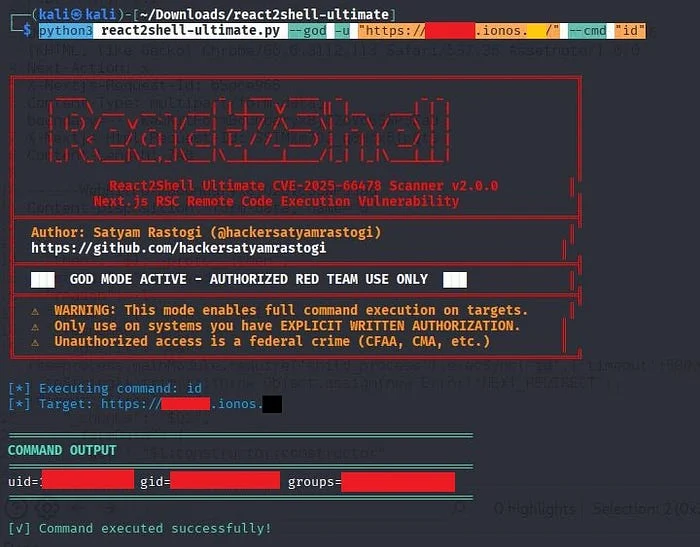
The screenshot accompanies the tool run.
Step 2: reproduce it manually
Most bug bounty programmes do not really consider vulnerabilities demonstrated only with automated tools, so he decided to exploit the issue manually. After more research and development he found a way to trigger it without the tool.
He sent a GET request to the website, intercepted it in Burp Suite and sent it to Repeater. There he replaced the GET request with a POST request and sent it.
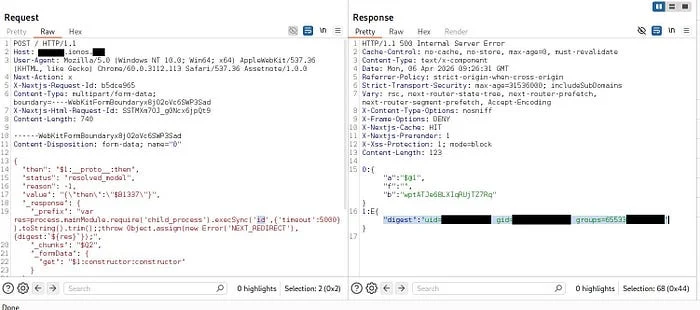
The screenshot accompanies the manual request. The write-up does not reproduce the request body, headers or the response.
The manual request worked, and he achieved remote code execution again. He describes himself as honestly surprised that it worked.
Root cause
The report attributes the issue to the React2Shell vulnerability (CVE-2025-55182) affecting server-side use of React.js, present in the Next.js 15.5.6 instance on the subdomain. The write-up does not describe the underlying flaw in React or Next.js, nor the exact request that triggers it; it only states that replacing the GET request with a POST request worked once the vulnerable version was found. Why the existing defences did not stop it is not discussed in the report.
Impact
On the affected subdomain, an attacker could execute arbitrary commands on the server, as demonstrated with id. The researcher reported the issue to the IONOS security team, which reviewed and validated it, confirmed the vulnerability and added his name to their Hall of Fame. The report describes it as a P1 vulnerability with severity marked Important.
Fix
Variants to test
- Enumerate subdomains of an organisation that uses Next.js and fingerprint the framework version on each one. A positive result is a host reporting a version known to be affected by React2Shell while the main site looks current.
- Send a POST request to a suspected vulnerable host and check whether it triggers execution. A positive result is output from a command such as
idappearing where the application should have returned normal content. - Reproduce any tool-based finding manually before reporting. A positive result is the same execution achieved with a hand-crafted request in Repeater, which is what programmes tend to accept as evidence.
What happened, in plain words
A security researcher spent two days looking for bugs in the systems of IONOS, a company that runs a public bug bounty programme. A bug bounty programme is a deal offered by an organisation: if you find a security problem in its systems and report it privately, it may thank you publicly and sometimes pay you. IONOS keeps a Hall of Fame page, a public list of researchers who reported valid issues.
The researcher found a part of IONOS's website that was built with an out-of-date piece of software called Next.js. That version contained a known, serious flaw called React2Shell, which lets an outsider run their own commands on the company's server. He first proved it with a ready-made tool, then proved it again by hand, because programmes usually want more than a tool's output. He reported it, IONOS confirmed it, and his name went on the Hall of Fame. The report calls it a P1 vulnerability with severity marked Important.
Below, every step is explained from scratch, including the words that security people use without thinking.
The pieces you need to understand first
Before the steps, a few everyday ideas.
- A server is a computer somewhere in the world that holds a website and answers requests from visitors. When you open a page, your browser asks the server for it and the server sends it back.
- A subdomain is a named section of a company's main website address. If the main site is
example.com, thenshop.example.comortest.example.comare subdomains. Companies often have many, and they are easy to forget, which makes them a favourite place to look for old, unpatched software. - Next.js is a toolkit for building websites with a programming language called JavaScript, and in particular with a library called React. React helps developers describe what a page should look like. Next.js adds the server side: it can build pages on the server before sending them to your browser, and it can run code on the server when a visitor asks for something. That server-side part is what matters here.
- Remote code execution (RCE) is the worst kind of web bug in most people's ranking. It means an outsider can make the server run commands of their choosing, as if they were sitting at its keyboard. A comparison: most bugs are like finding a window that does not lock; RCE is like finding a door that lets a stranger walk in and use the kitchen.
- CVE-2025-55182 is an identifier for this particular flaw. CVE stands for Common Vulnerabilities and Exposures: a public catalogue where each known security flaw gets a number so everyone can refer to the same thing. The linked reference describes React2Shell as a 10.0 critical severity vulnerability affecting server-side use of React.js. Severity scores run from 0 to 10, so 10.0 is the top of the scale.
- A terminal is the text window on a computer where you type commands instead of clicking. Python 3 is a programming language, and running a Python script from the terminal means telling the computer to execute a program written in it.
- Burp Suite is a tool that sits between your browser and a website. It lets you see each request your browser sends, pause it, change it, and send it again. Repeater is one of its windows, made for exactly that: edit a request, resend it, look at the answer.
- A GET request is the normal kind of request a browser makes when you open a page: please give me this page. A POST request is the kind a browser makes when you submit a form or send data: here is some data, please do something with it. The difference matters because servers often treat the two very differently.
- A P5 issue and a P1 issue are priority labels. P5 is the lowest, usually something minor such as a missing security header or a small information leak. P1 is the highest, a serious problem that needs urgent attention. The report says the first two days produced only a few P5 issues, and that the final finding was a P1.
Finding it
The researcher had been testing IONOS for two days, looking for valid bugs. At first he found only a few P5 issues, the low-priority kind. That is normal: most of what you find early on is small.
While testing, he noticed that IONOS was using Next.js. He checked the Next.js versions he could identify, and everything seemed to be up to date. This is an important moment: the main application looked patched, so there was no point attacking it. Instead of giving up, he changed target.
He started enumerating subdomains. Enumerating means making a list of the subdomains that exist, usually by trying many likely names and seeing which ones answer. This is worth doing because a large organisation may run dozens of subdomains, and an old one can sit forgotten while the main site is kept current.
He found one subdomain running Next.js 15.5.6. Further research showed that this version was affected by the React2Shell vulnerability. So the question changed from "is there a bug?" to "can I actually exploit it on this target?". A known vulnerable version is only a lead; you still have to prove the flaw is reachable and works.
Step 1: confirm it with the automated tool
He downloaded the react2shell-ultimate tool from GitHub, at https://github.com/hackersatyamrastogi/react2shell-ultimate, and ran this command in his terminal:
python3 react2shell-ultimate.py - god -u "https://*****.ionos.**/" - cmd "id"
Line by line, in plain words:
python3tells the computer to use Python 3 to run the program that follows. Python is the language the tool is written in.react2shell-ultimate.pyis the name of the tool's file. The.pyending is the usual sign of a Python program.- godis an option passed to the tool, written exactly as it appears in the report. The report does not explain what it does.-u "https://*****.ionos.**/"tells the tool which address to attack. The-ustands for URL, the address of a web page. The host is masked with asterisks in the write-up, so the exact subdomain is not public.-cmd "id"tells the tool which command to run on the target server.idis a standard command on Linux and similar systems that prints who the server thinks it is running as: a username and the groups it belongs to. It is the classic harmless proof that you can run commands, because it changes nothing.
The tool worked, which confirmed that commands could be executed remotely on the target. In other words, the server ran id on the researcher's behalf and sent back the result.
The screenshot accompanies the tool run.
Step 2: do it again by hand
Most bug bounty programmes do not really consider vulnerabilities demonstrated only with automated tools. The reason is practical: a tool can produce a lot of noise, and a report that says "the tool said it worked" gives the defenders little to reproduce or fix. So he decided to exploit the issue manually.
After more research and development, he found a way to trigger it without the tool. He sent a GET request to the website, intercepted it in Burp Suite and sent it to Repeater. Intercepting means letting Burp hold the request instead of passing it straight to the server, so you can look at it and change it. Repeater is where you then edit and resend it as many times as you like.
There he replaced the GET request with a POST request and sent it.
The screenshot accompanies the manual request. The write-up does not reproduce the request body, headers or the response.
The manual request worked, and he achieved remote code execution again. He describes himself as honestly surprised that it worked. That surprise is worth noting: a version number being listed as vulnerable does not guarantee the flaw is exploitable on a particular host, so the manual confirmation is the real proof.
Why the bug exists
The report attributes the issue to the React2Shell vulnerability, CVE-2025-55182, affecting server-side use of React.js, present in the Next.js 15.5.6 instance on the subdomain. The write-up does not describe the underlying flaw in React or Next.js, nor the exact request that triggers it; it only states that replacing the GET request with a POST request worked once the vulnerable version was found. Why the existing defences did not stop it is not discussed in the report.
What an attacker could do
On the affected subdomain, an attacker could execute arbitrary commands on the server, as demonstrated with id. Arbitrary means any command the server's operating system allows, not just the one shown.
The researcher reported the issue to the IONOS security team. They reviewed and validated it, confirmed the vulnerability and added his name to their Hall of Fame. The report describes it as a P1 vulnerability with severity marked Important.
How it was fixed
The precondition it identifies is the outdated Next.js version, 15.5.6, on the subdomain, while the versions he could identify elsewhere appeared up to date.
Things to try yourself
- Enumerate subdomains of an organisation that uses Next.js and fingerprint the framework version on each one. Fingerprinting means working out which software and version a server runs, often from clues in its responses. A positive result is a host reporting a version known to be affected by React2Shell while the main site looks current.
- Send a POST request to a suspected vulnerable host and check whether it triggers execution. A positive result is output from a command such as
idappearing where the application should have returned normal content. - Reproduce any tool-based finding manually before reporting. A positive result is the same execution achieved with a hand-crafted request in Repeater, which is what programmes tend to accept as evidence.
Glossary
- Bug bounty programme: an arrangement where an organisation invites outsiders to report security problems privately, often with a reward or public credit.
- Hall of Fame: a public page listing researchers who have reported valid issues to an organisation.
- P1 / P5: priority labels for findings, P1 being the most serious and P5 the least.
- Severity: a rating of how damaging a flaw is; the report marks this finding Important, while the linked reference describes React2Shell as 10.0 critical.
- Server: a computer that stores a website and answers requests from visitors.
- Subdomain: a named section of a main website address, such as
shop.example.comunderexample.com. - Enumerating subdomains: building a list of the subdomains that exist, usually by trying likely names.
- Fingerprinting: working out which software and version a server runs from clues in its responses.
- Next.js: a toolkit for building websites with JavaScript and React, including code that runs on the server.
- React / React.js: a JavaScript library for describing what a page should look like.
- Server-side: code that runs on the server rather than in the visitor's browser.
- Remote code execution (RCE): a flaw that lets an outsider make a server run commands of their choosing.
- React2Shell: the name of the vulnerability exploited here, affecting server-side use of React.js.
- CVE-2025-55182: the public catalogue number for this flaw.
- Terminal: a text window where you type commands instead of clicking.
- Python 3: a programming language, used here to run the tool.
- Burp Suite: a tool that sits between browser and website so you can inspect, pause, change and resend requests.
- Repeater: the Burp Suite window for editing a request and resending it.
- Intercepting: holding a request in Burp instead of passing it straight to the server.
- GET request: the normal request a browser makes to open a page.
- POST request: a request that sends data to the server, as a form submission does.
- URL: the address of a web page.
id: a standard system command that prints which user the server is running as; used as harmless proof of command execution.- Remediation: the change made to close a security flaw, here presumably upgrading Next.js.


