GitLab CVE-2026–110264: Critical Pre-Auth RCE Explained
An integer overflow in Ruby's Onigmo regex engine, reachable through org-ruby's handling of custom TODO keywords in Org-mode files, could cause an out-of-bounds heap write. An unauthenticated attacker could place a crafted .org file in a public project and trigger rendering to crash a worker or, under suitable memory conditions, potentially execute code.

medium.com
Published on medium.com
Cybersecurity
The full write-up lives on its author's site
It belongs to its author, so we link to it rather than copy it. The other two tabs are our own rewrites, checked against it.
Context
GitLab is a DevSecOps platform that combines Git repository hosting, CI/CD pipelines, code reviews, issue tracking and security scanning. Because organisations often keep source code, deployment credentials and automation secrets in GitLab, a server compromise can expose far more than repositories.
On 21 October 2026, GitLab disclosed CVE-2026-110264, a critical remote code execution vulnerability affecting self-managed GitLab Community Edition (CE) and Enterprise Edition (EE). The flaw carried a CVSS score of 10.0 and affected releases dating back to GitLab 7.0, first released in 2014. GitLab.com and GitLab Dedicated had already been patched.
The feature at the centre of the bug is the rich blob viewer: when a visitor opens a file in a project, GitLab renders it according to its type. For Org-mode documents, GitLab uses the org-ruby library to turn the markup into HTML. That rendering path is reachable without authentication on public projects, which is what makes the vulnerability pre-auth.
Setup
The attack requires two things:
- A self-managed GitLab CE or EE instance running an affected release, from 7.0 onwards.
- A public project in which the attacker can place a file. The trigger request itself needs no account, but the crafted file first has to be placed in a public project.
No authentication and no user interaction are needed from the victim. The attacker only needs an unauthenticated visitor to request the file through GitLab's rich blob viewer.
Finding it
The vulnerability originated in Ruby's bundled Onigmo regular expression engine. Onigmo assigns internal identifiers to repeat operations in regular expressions, and a missing range check allowed an identifier to overflow when the pattern contained more than 32,767 repeat quantifiers. The resulting negative identifier could be used as an array index, causing an out-of-bounds heap write.
The path from that engine bug to GitLab runs through org-ruby. The library processed custom TODO keywords supplied through the #+TODO: directive without properly escaping regular expression metacharacters. A crafted .org file could therefore feed attacker-controlled regular expression syntax into Onigmo, and the overflow followed.
Exploitation
The attack involved five stages:
- Place a specially crafted
.orgfile in a public project. - Trigger anonymous rendering of the file.
- Cause org-ruby to compile the crafted regular expression.
- Trigger the integer overflow and corrupt memory.
- Cause a worker crash or, with a suitable memory layout, potentially achieve code execution.
Step 1: Place the crafted file
The attacker commits a .org file to a public project. The file carries a #+TODO: directive with custom keywords that org-ruby fails to escape, and the resulting pattern contains more than 32,767 repeat quantifiers.
Step 2: Trigger anonymous rendering
An unauthenticated visitor requests the file through GitLab's rich blob viewer. No session, token or interaction is required beyond the request itself.
Step 3: Compile the crafted regular expression
The rich viewer hands the document to org-ruby, which builds a regular expression from the custom TODO keywords and compiles it through Onigmo.
Step 4: Overflow and corrupt memory
The repeat identifier overflows, becomes negative, and is used as an array index, producing an out-of-bounds heap write.
Step 5: Crash or code execution
The corruption can bring down the worker. Under suitable memory conditions it could potentially progress from a worker crash to native code execution.
Public proof-of-concept demonstrations confirmed crash-level behaviour. At the time of the original article, a verified public RCE chain for this specific CVE had not been established.
Root cause
Two mistakes combine here.
In Onigmo, the missing range check on repeat-operation identifiers is the direct cause of the memory corruption. A pattern with more than 32,767 repeat quantifiers overflows the signed 16-bit counter, and the negative value is then trusted as an array index.
In org-ruby, the mistake is unsafe input handling: custom TODO keywords from the #+TODO: directive are interpolated into a regular expression without escaping metacharacters. That turns document content into executable pattern syntax, and it is what lets a .org file reach the Onigmo bug at all.
Checking only the displayed Ruby version was not sufficient to confirm remediation in every container image, since the fixes involved bundled components.
Impact
An unauthenticated attacker could potentially execute code on a vulnerable self-managed GitLab server, subject to the memory layout conditions described above. Because GitLab holds source code, deployment credentials and automation secrets, a server compromise can expose much more than repositories.
Crash-level proof-of-concept code became publicly available on 22 October 2026, shortly after disclosure, and additional testing scripts and repositories followed over the next several days. Researchers reported worker crashes, segmentation faults and rendering timeouts during testing. Some public repositories claimed more advanced exploitation, but those claims had not been independently verified at the time of the original article.
As of 28 October 2026, there was no confirmed in-the-wild exploitation and no CISA Known Exploited Vulnerabilities (KEV) listing. Publicly available crash demonstrations did, however, reduce the effort needed to investigate the vulnerability.
Fix
The remediation addressed the problem at two levels.
Ruby's Onigmo engine gained checks to reject invalid repeat identifiers before they could overflow. The org-ruby library also added escaping for custom TODO keywords, preventing user-supplied regular expression syntax from being interpreted as executable patterns.
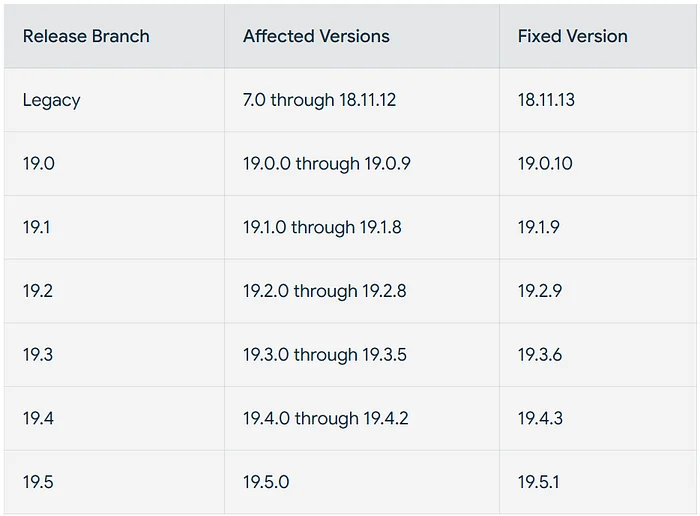
GitLab backported the relevant fixes into its bundled runtime and released patched versions across its supported branches. Self-managed installations should upgrade to the appropriate fixed release:
Servers updated on 12 October for the separate CVE-2026-97229 vulnerability remained vulnerable to CVE-2026-110264. Verify the specific release rather than assuming the earlier patch resolved both issues.
Until patched, no official workaround fully eliminates the vulnerability. Organisations can reduce exposure by restricting public project visibility, limiting public project creation and disabling open self-registration where appropriate. Prioritise internet-facing instances and account for downtime where database migrations are required.
Do not rely exclusively on version strings, particularly in containerised deployments. Verify that the bundled Ruby runtime includes the fix and rejects oversized repeat patterns as expected.
For detection, use GitLab's published Sigma detection rules and review:
- Puma logs for segmentation faults involving org-ruby or headline.rb
exceptions_json.logfor rendering-related timeouts- Web logs for anonymous requests to rich-view
.orgfiles followed by HTTP 502 responses - Public repositories containing unusually long
#+TODO:directives - Unexpected child processes or outbound connections from the GitLab service account
If exploitation is suspected, investigate potential access to repositories and rotate exposed CI/CD variables, runner tokens, deploy keys and access tokens.
Variants to test
- Other markup libraries that build regexes from document content. Look for directives, keywords or configuration lines that are interpolated into patterns. A positive result is a document that changes the compiled pattern, visible as unexpected matching or a crash in the renderer.
- Other bundled regex engines with counter-based identifiers. Feed patterns with very large numbers of repeat quantifiers. A positive result is a crash, a segmentation fault or a timeout in the rendering worker.
- Other rich viewers reachable anonymously. Enumerate file types GitLab renders server-side in public projects and request each without a session. A positive result is a rendering path that processes attacker-controlled syntax before any authorisation check.
- Version-string verification gaps. In containerised deployments, compare the displayed Ruby version with the behaviour of the bundled runtime on oversized repeat patterns. A positive result is a runtime that still accepts the pattern despite a patched-looking version string.
- Post-patch regression checks. Replay the crash-level proof-of-concept against a fixed instance. A positive result is a worker crash where the fix should have rejected the pattern.
What happened, in plain words
GitLab is a website you can install on your own server that helps teams write and store software. Think of it as a shared online filing cabinet for computer code, plus a set of tools that automatically build and test that code. Teams keep their source code in it, but they also keep the passwords and keys their automation uses to deploy software. If someone breaks into the GitLab server, they can reach all of that, not just the code.
On 21 October 2026, GitLab announced a serious security problem, tracked under the name CVE-2026-110264. A CVE is a public catalogue number given to a known security flaw so people can talk about it unambiguously. This one was rated 10.0 on the CVSS scale, which is the highest possible severity score. CVSS is a standard way of scoring how bad a security flaw is. The flaw could potentially let an attacker run their own code on a GitLab server without logging in first. That kind of attack is called remote code execution, or RCE: someone far away, over the network, gets the server to run commands of their choosing. The flaw affected self-managed GitLab Community Edition (CE) and Enterprise Edition (EE), which are the versions organisations install and run themselves, and it went all the way back to GitLab 7.0, first released in 2014. GitLab.com, the hosted service, and GitLab Dedicated had already been fixed.
The feature at the centre of the bug is the rich blob viewer. A blob, in Git terms, is simply a file's contents. When you open a file in a GitLab project, GitLab looks at the file type and shows it nicely: a picture as a picture, a document as formatted text. For Org-mode documents, GitLab uses a library called org-ruby to turn the markup into HTML, the language web pages are written in. Org-mode is a plain-text format for taking notes and organising tasks. That rendering path can be reached without logging in on public projects, which is what makes the vulnerability pre-auth: it works before any authentication, that is, before anyone proves who they are.
Setup
The attack needs two things:
- A self-managed GitLab CE or EE instance running an affected release, from 7.0 onwards.
- A public project in which the attacker can place a file. The trigger request itself needs no account, but the crafted file first has to be placed in a public project.
No authentication and no user interaction are needed from the victim. The attacker only needs an unauthenticated visitor to request the file through GitLab's rich blob viewer. In other words, the attacker plants a booby-trapped file, and anyone (or anything) that opens it sets off the trap.
Finding it
The vulnerability originated in Ruby's bundled Onigmo regular expression engine. Ruby is a programming language, and GitLab is written in it. A regular expression, often shortened to regex, is a pattern used to find or match text, like a very powerful search rule. Onigmo is the part of Ruby that understands those patterns. It assigns internal identifiers to repeat operations in regular expressions, and a missing range check allowed an identifier to overflow when the pattern contained more than 32,767 repeat quantifiers. A repeat quantifier is the part of a pattern that says "match this many times". A range check is a simple test that a number stays within allowed limits. Without it, the number wraps around, like a car odometer rolling past its maximum, and becomes negative. The resulting negative identifier could be used as an array index, causing an out-of-bounds heap write. An array index is a position in a list; a heap write means storing data in memory. Out-of-bounds means writing past the end of the space that was set aside, which corrupts whatever sits next to it.
The path from that engine bug to GitLab runs through org-ruby. The library processed custom TODO keywords supplied through the #+TODO: directive without properly escaping regular expression metacharacters. A TODO keyword is a label like TODO or DONE that Org-mode uses to mark task states. A directive is a special instruction line in the document. Escaping means marking characters so they are treated as plain text rather than as instructions. Metacharacters are characters that have special meaning in a pattern, such as brackets or dots. A crafted .org file could therefore feed attacker-controlled regular expression syntax into Onigmo, and the overflow followed.
Exploitation
The attack involved five stages:
- Place a specially crafted
.orgfile in a public project. - Trigger anonymous rendering of the file.
- Cause org-ruby to compile the crafted regular expression.
- Trigger the integer overflow and corrupt memory.
- Cause a worker crash or, with a suitable memory layout, potentially achieve code execution.
A worker is a background process that does the actual work of rendering pages. Memory layout means how data happens to be arranged in the computer's memory at that moment.
Step 1: Place the crafted file
The attacker commits a .org file to a public project. The file carries a #+TODO: directive with custom keywords that org-ruby fails to escape, and the resulting pattern contains more than 32,767 repeat quantifiers. Committing means saving the file into the project's history, the same way you would save a document.
Step 2: Trigger anonymous rendering
An unauthenticated visitor requests the file through GitLab's rich blob viewer. No session, token or interaction is required beyond the request itself. A session is a short-lived record that a website keeps about a logged-in user; a token is a piece of text that proves identity or grants access. Here neither is needed: just opening the file is enough.
Step 3: Compile the crafted regular expression
The rich viewer hands the document to org-ruby, which builds a regular expression from the custom TODO keywords and compiles it through Onigmo. Compiling means turning the pattern text into a form the engine can run.
Step 4: Overflow and corrupt memory
The repeat identifier overflows, becomes negative, and is used as an array index, producing an out-of-bounds heap write.
Step 5: Crash or code execution
The corruption can bring down the worker. Under suitable memory conditions it could potentially progress from a worker crash to native code execution. Native code execution means the attacker's instructions run directly on the server, as if the server itself had been told to do them.
Public proof-of-concept demonstrations confirmed crash-level behaviour. A proof of concept is a small demonstration that shows a flaw is real without necessarily being a full attack. At the time of the original article, a verified public RCE chain for this specific CVE had not been established. A chain here means the full sequence of steps that turns the flaw into working code execution.
Root cause
Two mistakes combine here.
In Onigmo, the missing range check on repeat-operation identifiers is the direct cause of the memory corruption. A pattern with more than 32,767 repeat quantifiers overflows the signed 16-bit counter, and the negative value is then trusted as an array index. A signed 16-bit counter is a number stored in a fixed amount of space that can hold values from about minus 32,768 to plus 32,767; go past the top and it wraps to the bottom.
In org-ruby, the mistake is unsafe input handling: custom TODO keywords from the #+TODO: directive are interpolated into a regular expression without escaping metacharacters. Interpolated means inserted into the middle of something else. That turns document content into executable pattern syntax, and it is what lets a .org file reach the Onigmo bug at all.
A bundled runtime is a copy of a language engine shipped inside the product. A markup library is code that turns markup text into formatted output. Checking only the displayed Ruby version was not sufficient to confirm remediation in every container image, since the fixes involved bundled components. A container image is a packaged, ready-to-run copy of software.
Impact
An unauthenticated attacker could potentially execute code on a vulnerable self-managed GitLab server, subject to the memory layout conditions described above. Because GitLab holds source code, deployment credentials and automation secrets, a server compromise can expose much more than repositories. Credentials are usernames and passwords or keys; automation secrets are the keys that scripts use to act on a team's behalf.
Crash-level proof-of-concept code became publicly available on 22 October 2026, shortly after disclosure, and additional testing scripts and repositories followed over the next several days. Researchers reported worker crashes, segmentation faults and rendering timeouts during testing. A segmentation fault is the operating system stopping a program because it touched memory it should not have. A timeout is a request that takes so long it is abandoned. Some public repositories claimed more advanced exploitation, but those claims had not been independently verified at the time of the original article.
As of 28 October 2026, there was no confirmed in-the-wild exploitation and no CISA Known Exploited Vulnerabilities (KEV) listing. In the wild means attackers actually using it against real targets. CISA is a US government agency, and its KEV list records flaws known to be exploited for real. Publicly available crash demonstrations did, however, reduce the effort needed to investigate the vulnerability.
Fix
The remediation addressed the problem at two levels.
Ruby's Onigmo engine gained checks to reject invalid repeat identifiers before they could overflow. The org-ruby library also added escaping for custom TODO keywords, preventing user-supplied regular expression syntax from being interpreted as executable patterns.
GitLab backported the relevant fixes into its bundled runtime and released patched versions across its supported branches. Backported means taking a fix written for newer code and applying it to older versions. Self-managed installations should upgrade to the appropriate fixed release:
The image shows the list of affected and fixed GitLab versions that self-managed installations should upgrade to.
Servers updated on 12 October for the separate CVE-2026-97229 vulnerability remained vulnerable to CVE-2026-110264. Verify the specific release rather than assuming the earlier patch resolved both issues.
Until patched, no official workaround fully eliminates the vulnerability. Organisations can reduce exposure by restricting public project visibility, limiting public project creation and disabling open self-registration where appropriate. Prioritise internet-facing instances and account for downtime where database migrations are required. Internet-facing means reachable from the open internet. A database migration is a change to the database structure that can take the service offline while it runs.
Do not rely exclusively on version strings, particularly in containerised deployments. Verify that the bundled Ruby runtime includes the fix and rejects oversized repeat patterns as expected. A version string is the text that reports which version is installed.
For detection, use GitLab's published Sigma detection rules and review:
- Puma logs for segmentation faults involving org-ruby or headline.rb
exceptions_json.logfor rendering-related timeouts- Web logs for anonymous requests to rich-view
.orgfiles followed by HTTP 502 responses - Public repositories containing unusually long
#+TODO:directives - Unexpected child processes or outbound connections from the GitLab service account
Sigma is a shared format for writing detection rules. Puma is the web server component that handles requests. Logs are records of what happened. HTTP 502 is an error code meaning a server behind the front door failed to respond properly. A child process is a program started by another program; an outbound connection is the server reaching out to somewhere else.
If exploitation is suspected, investigate potential access to repositories and rotate exposed CI/CD variables, runner tokens, deploy keys and access tokens. Rotating means replacing a secret with a new one. CI/CD is the automation that builds and ships software; a runner is the machine that executes those jobs; a deploy key is a key that lets automation push code; an access token is a credential for using an API. An API is a way for one program to talk to another over the network.
Variants to test
- Other markup libraries that build regexes from document content. Look for directives, keywords or configuration lines that are interpolated into patterns. A positive result is a document that changes the compiled pattern, visible as unexpected matching or a crash in the renderer.
- Other bundled regex engines with counter-based identifiers. Feed patterns with very large numbers of repeat quantifiers. A positive result is a crash, a segmentation fault or a timeout in the rendering worker.
- Other rich viewers reachable anonymously. Enumerate file types GitLab renders server-side in public projects and request each without a session. A positive result is a rendering path that processes attacker-controlled syntax before any authorisation check.
- Version-string verification gaps. In containerised deployments, compare the displayed Ruby version with the behaviour of the bundled runtime on oversized repeat patterns. A positive result is a runtime that still accepts the pattern despite a patched-looking version string.
- Post-patch regression checks. Replay the crash-level proof-of-concept against a fixed instance. A positive result is a worker crash where the fix should have rejected the pattern. A regression is a bug that comes back after being fixed.
Glossary
- API: a way for one program to talk to another over the network.
- Array index: a position in a list.
- Authentication: proving who you are, usually by logging in.
- Backport: applying a fix written for newer code to an older version.
- Blob: a file's contents in Git.
- Bundled runtime: a copy of a language engine shipped inside a product.
- Child process: a program started by another program.
- CI/CD: automation that builds, tests and ships software.
- Compile (a pattern): turning pattern text into a form the engine can run.
- Container image: a packaged, ready-to-run copy of software.
- Credential: a username and password, key or similar proof of identity.
- CVE: a public catalogue number for a known security flaw.
- CVSS: a standard scale for scoring the severity of a security flaw.
- Deploy key: a key that lets automation push code.
- Directive: a special instruction line in a document.
- Escaping: marking characters so they are treated as plain text, not instructions.
- Heap: the area of memory a program uses for data it creates while running.
- HTML: the language web pages are written in.
- HTTP 502: an error code meaning a server behind the front door failed to respond properly.
- In the wild: attackers actually using a flaw against real targets.
- Integer overflow: a number growing past its maximum and wrapping around.
- Internet-facing: reachable from the open internet.
- Interpolate: insert into the middle of something else.
- KEV: CISA's list of flaws known to be exploited for real.
- Library: reusable code that a program calls on to do a job.
- Log: a record of what happened.
- Markup library: code that turns markup text into formatted output.
- Memory layout: how data happens to be arranged in memory at a given moment.
- Metacharacter: a character with special meaning in a pattern.
- Native code execution: running instructions directly on the server.
- Org-mode: a plain-text format for notes and tasks.
- Out-of-bounds write: storing data past the end of the space set aside for it.
- Pre-auth: reachable before anyone proves who they are.
- Proof of concept: a small demonstration that a flaw is real.
- Puma: the web server component that handles requests.
- RCE (remote code execution): getting a remote server to run commands of your choosing.
- Regression: a bug that comes back after being fixed.
- Regular expression (regex): a pattern used to find or match text.
- Repeat quantifier: the part of a pattern that says how many times to match.
- Rotate: replace a secret with a new one.
- Runner: the machine that executes CI/CD jobs.
- Segmentation fault: the operating system stopping a program because it touched memory it should not have.
- Session: a short-lived record a website keeps about a logged-in user.
- Sigma: a shared format for writing detection rules.
- Signed 16-bit counter: a fixed-size number that can hold about minus 32,768 to plus 32,767.
- Timeout: a request that takes so long it is abandoned.
- Token: a piece of text that proves identity or grants access.
- Worker: a background process that does the actual work.


