How an old bug in Lighttpd gained new life in AMI BMC, including Lenovo and Intel products
A heap out-of-bounds read in the lighttpd web server, caused by folded HTTP headers, was left unpatched in AMI MegaRAC BMC firmware used by Intel and Lenovo. An attacker could potentially exfiltrate sensitive memory data, such as process memory addresses, to bypass ASLR.

binarly.io
Published on binarly.io
01.Here's what happened
The full write-up lives on its author's site
It belongs to its author, so we link to it rather than copy it. The other two tabs are our own rewrites, checked against it.
Context
AMI MegaRAC is a baseboard management controller (BMC) firmware platform used by many device vendors, including Intel and Lenovo. The BMC is the small always-on computer inside a server that exposes management interfaces, and in these products one of the components used to build the firmware image is the lighttpd web server. The issue described here is a heap out-of-bounds read (CWE-125) in the lighttpd module as shipped in that firmware. The vulnerable code path is the handling of folded HTTP request header values, which is a normal part of HTTP/1.1 header parsing: a header value can be continued on the next line when that line starts with whitespace.
The Binarly REsearch team found the issue while continuing its work on BMC security and improving the Binarly Transparency Platform. The affected Intel product is an Intel Server System device, and the affected Lenovo products are the HX3710, HX3710-F and HX2710-E servers. Three Binarly identifiers were assigned: BRLY-2024-002 for the Intel BMC firmware, BRLY-2024-003 for the Lenovo BMC firmware, and BRLY-2024-004 for vulnerable lighttpd builds in general.
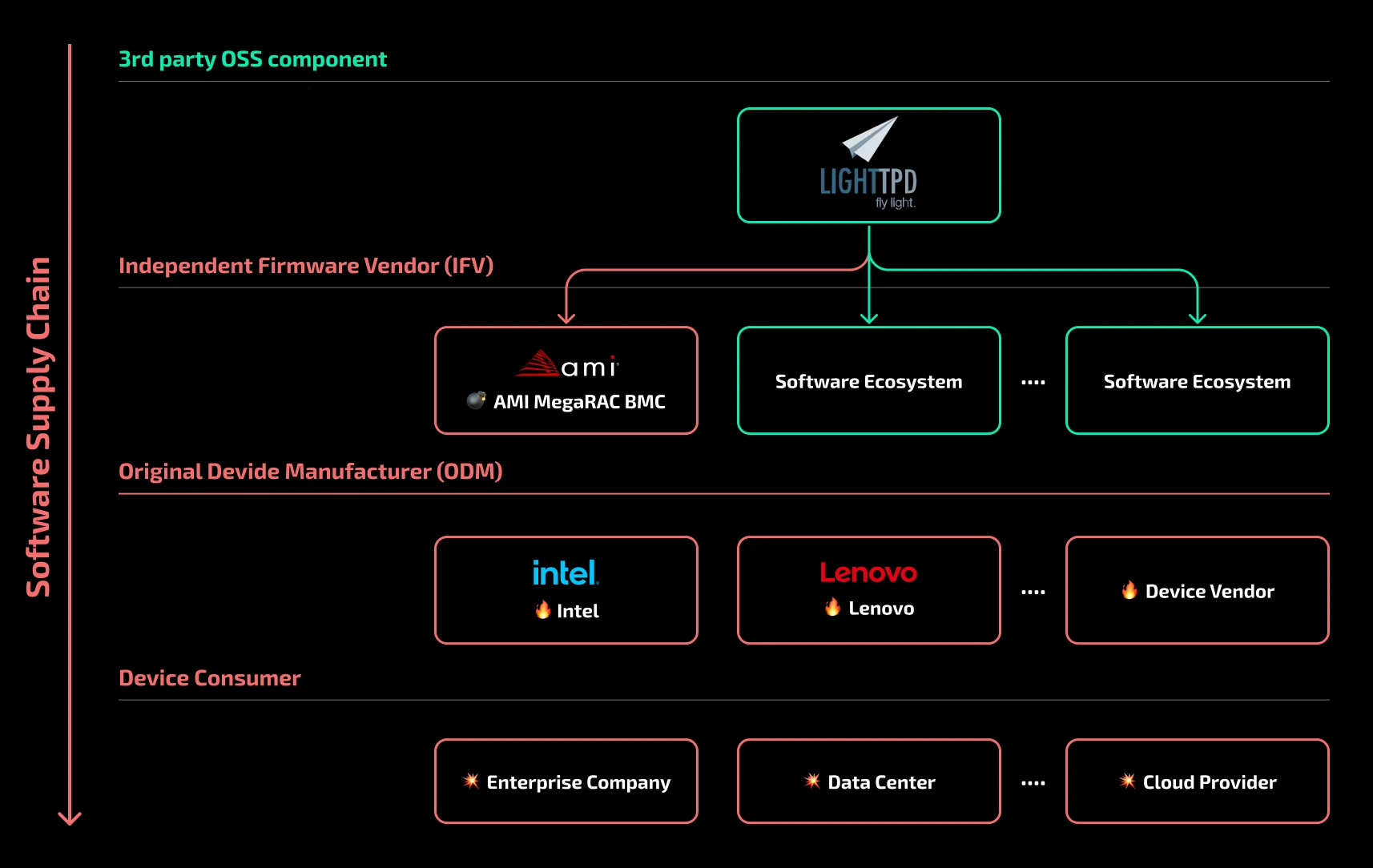
The upstream fix in lighttpd was pushed as a commit without details in an advisory and without a CVE identifier, which the report highlights as a problem for defenders doing patch management:
https://github.com/lighttpd/lighttpd1.4/commit/[redacted]
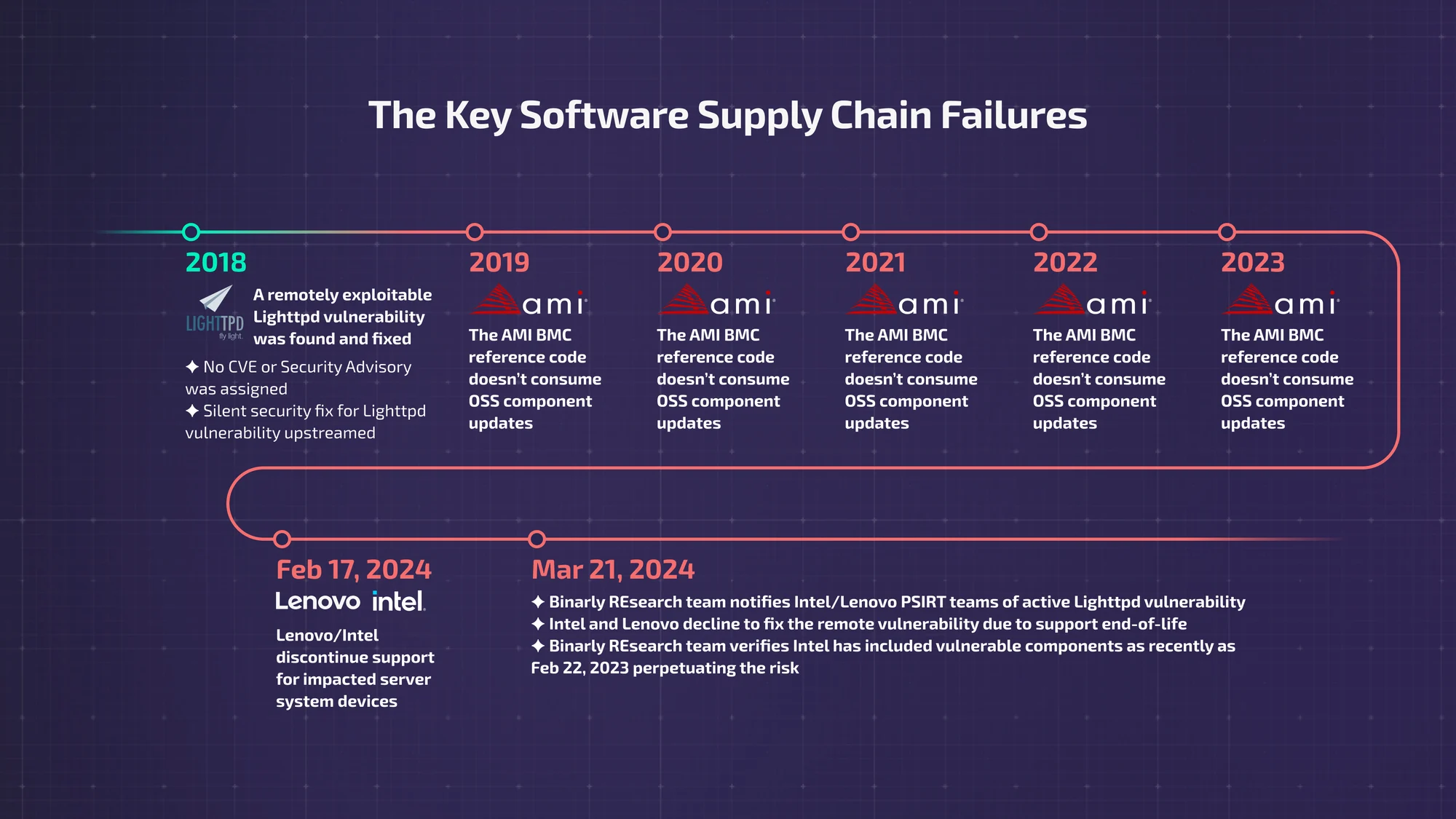
Setup
No accounts, roles or special tooling are needed to reach the vulnerable code: it is in the HTTP request parsing of the lighttpd web server that the BMC firmware exposes. The precondition is simply the ability to send HTTP requests to that server. The report does not describe authentication requirements for the affected endpoint, so the parsing path should be treated as reachable by whoever can talk to the web server.
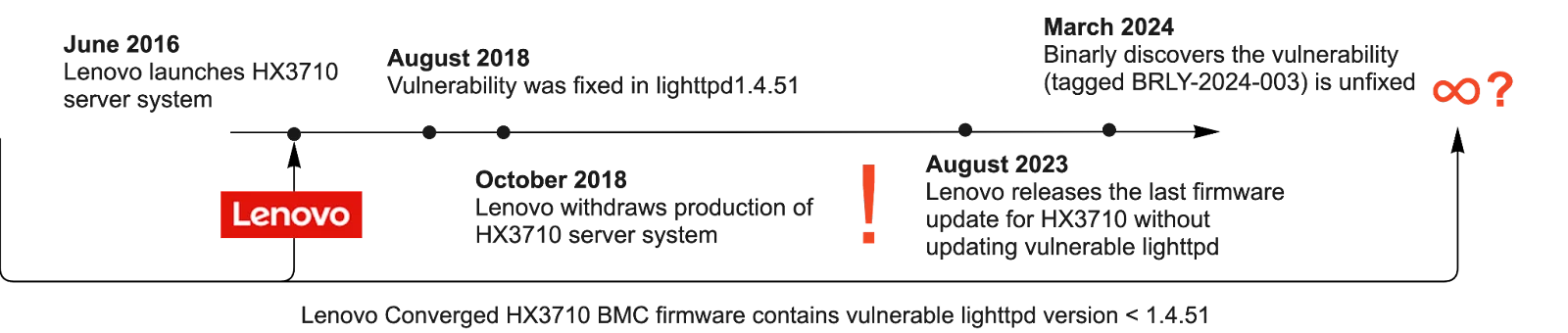
The report's firmware screenshots label the affected Intel and Lenovo BMC firmware as containing a vulnerable lighttpd version below 1.4.51. The report's screenshots label the Intel M70KLP and Lenovo Converged HX3710 BMC firmware as containing a vulnerable lighttpd version below 1.4.51.
Finding it
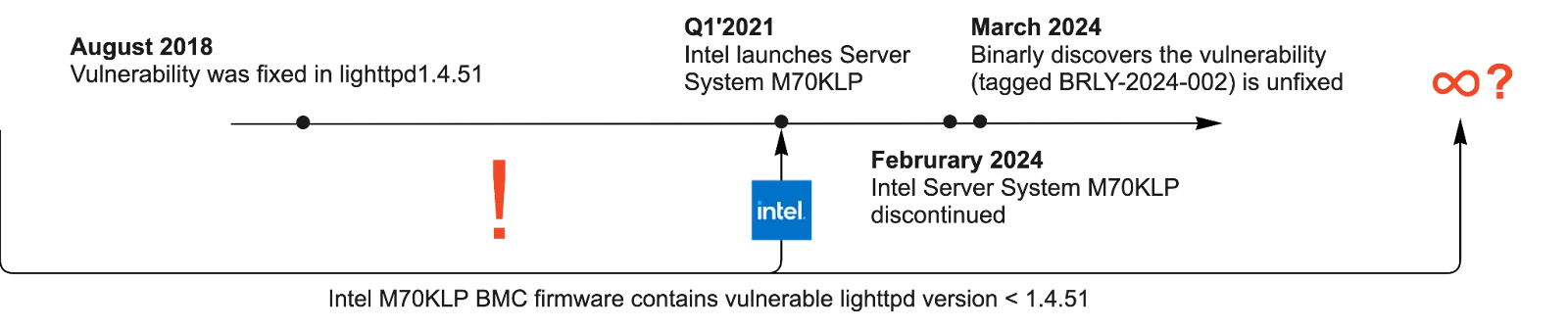
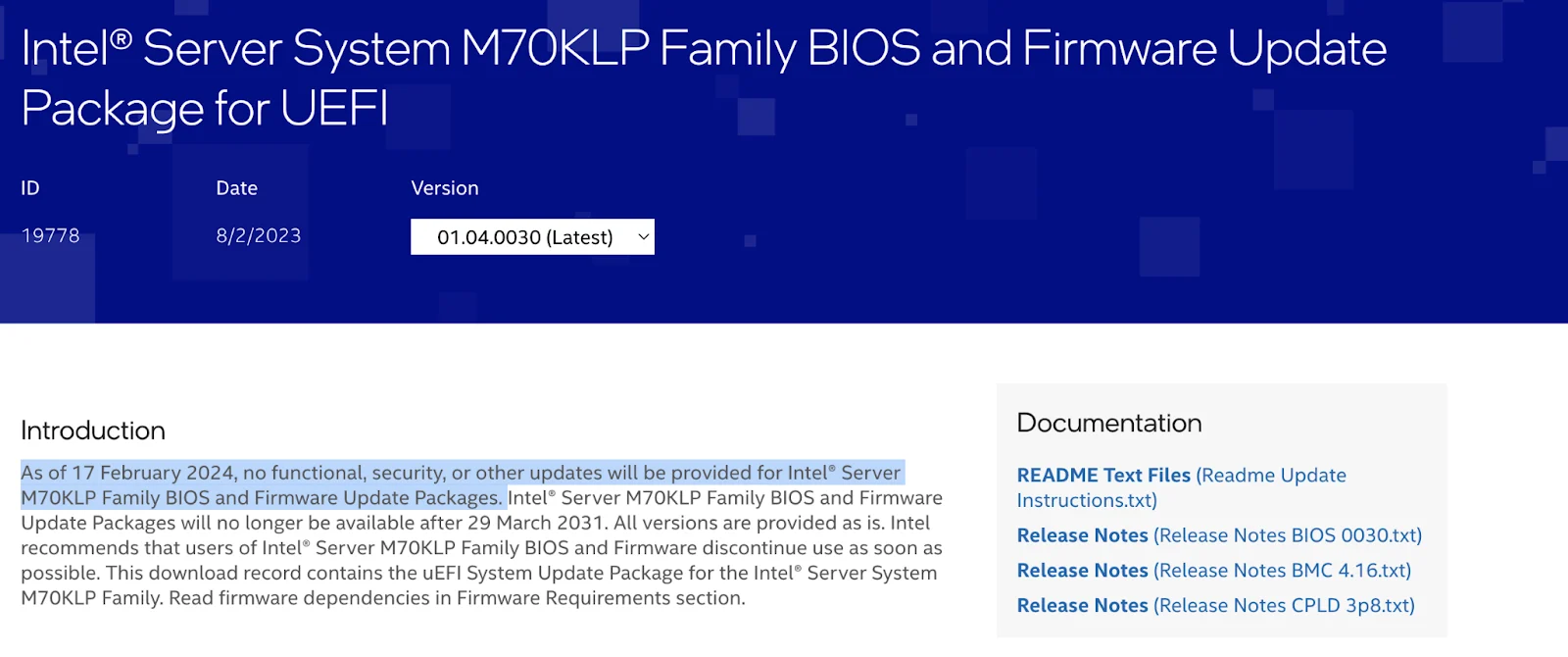
The team found the issue in the lighttpd module used in one of the Intel Server System devices and notified Intel's PSIRT of an unfixed issue. Intel's response was that the affected device is currently end-of-life and will no longer receive firmware updates or security patches.
The report stresses the age of the problem: it is almost six years old, and it was present and fixed a few years before this Server System was launched. The outdated third-party component is still present in the latest firmware version, which is what made the finding worth documenting as a supply chain failure.
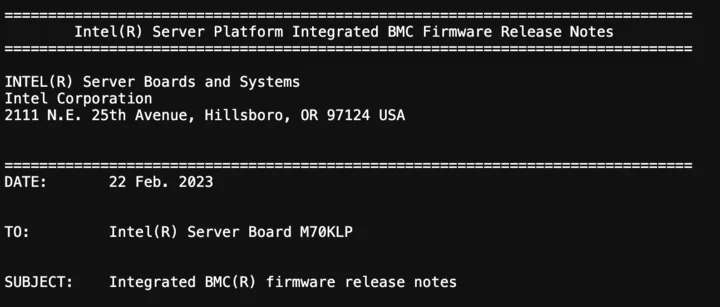
The research team later confirmed that the Lenovo BMC firmware for the HX3710, HX3710-F and HX2710-E servers is vulnerable to the very same security issue. Lenovo's PSIRT was notified, and like Intel, Lenovo responded that these servers were also end-of-life and would no longer be supported with security patches.
Exploitation
Step 1: send a folded header value
lighttpd processes folded HTTP request header values, meaning a value can be provided in the following form:
GET / HTTP/1.1\r\n
Host: test\r\n
If-Modified-Since: PartOne\r\n\
\tPartTwo\r\n
\r\n
Here PartTwo is the continuation of the If-Modified-Since header, and the server appends it to the buffer that already holds PartOne.
Step 2: the append path
When a folded value is seen, the code looks up the existing header entry and appends the continuation to its value with buffer_append_string:
if (in_folding) {
	buffer *key_b;
	…
	key_b = buffer_init();
	buffer_copy_string_len(key_b, key, key_len);

	if (NULL != (ds = (data_string *)array_get_element(con->request.headers, key_b->ptr))) {
		buffer_append_string(ds->value, value);
	}
PartTwo (stored in the variable value) is appended to the buffer that contains PartOne (ds->value).
Step 3: the buffer is reallocated
buffer_append_string_len calls buffer_string_prepare_append with the same buffer (ds->value) and the length of the string to append:
void buffer_append_string_len(buffer *b, const char *s, size_t s_len) {
	char *target_buf;

	force_assert(NULL != b);
	force_assert(NULL != s || s_len == 0);

	target_buf = buffer_string_prepare_append(b, s_len);

	if (0 == s_len) return;

	memcpy(target_buf, s, s_len);

	buffer_commit(b, s_len);
}
buffer_string_prepare_append and the buffer_realloc it calls are responsible for checking that the buffer is large enough. If it is not, a new memory region of the required size is requested with realloc, and the address of that region is assigned to the buffer:
char* buffer_string_prepare_append(buffer *b, size_t size) {
	force_assert(NULL !=  b);

	if (buffer_string_is_empty(b)) {
		return buffer_string_prepare_copy(b, size);
	} else {
		size_t req_size = b->used + size;

		force_assert(req_size >= b->used);

		force_assert(req_size >= b->used);

		buffer_realloc(b, req_size);

		return b->ptr + b->used - 1;
	}
}
static void buffer_realloc(buffer *b, size_t size) {
	force_assert(NULL != b);
	if (0 == size) size = 1;

	if (size <= b->size) return;

	b->size = buffer_align_size(size);
	b->ptr = realloc(b->ptr, b->size);

	force_assert(NULL != b->ptr);
}
When the buffer grows, b->ptr is reassigned to the new region returned by realloc.
Step 4: a second If-Modified-Since header compares against freed memory
If the request contains multiple If-Modified-Since headers, the server checks whether their values are equal with strcasecmp. con->request.http_if_modified_since holds the value of the previously provided header, and ds->value->ptr holds the current one:
} else if (cmp > 0 && 0 == (cmp = buffer_caseless_compare(CONST_BUF_LEN(ds->key), CONST_STR_LEN("If-Modified-Since")))) {

	if (!con->request.http_if_modified_since) {
		con->request.http_if_modified_since = ds->value->ptr;
	} else if (0 == strcasecmp(con->request.http_if_modified_since,
				ds->value->ptr)) {

		ds->free((data_unset *)ds);
		ds = NULL;
	} else {
		con->http_status = 400;
		con->keep_alive = 0;
The critical case is when folding was used for the previously provided header and the buffer pointer was reassigned by the realloc call. The memory region that con->request.http_if_modified_since points to is not updated before the strcasecmp call, so the current header value is compared with freed memory. If the contents of the two memory regions are not equal, the web server returns a 400 error code. That difference in response status lets an attacker start guessing the content of the target memory region.
Step 5: use the oracle
By observing whether the server returns 400 or not, the attacker learns whether the guessed bytes match the freed memory region. The report states that using this OOB read it is potentially possible to exfiltrate sensitive data such as process memory addresses, which can then be used to bypass security mechanisms such as ASLR.
Root cause
The bug is a stale pointer combined with a reallocation. When a folded header value is appended, buffer_realloc may move the buffer to a new address and free the old one. The pointer saved in con->request.http_if_modified_since still refers to the old, freed region, and the later strcasecmp reads from it. The comparison result is exposed through the 400 status code, letting an attacker start guessing the content of the target memory region.
The report also points to a process failure rather than only a code failure: the upstream fix was a silent commit with no advisory and no CVE, so the fix did not propagate down the firmware and software supply chains, and the vulnerable component stayed in firmware images for years, including the latest firmware version. The report does not describe any additional defence in the firmware that would have caught the stale pointer.
Impact
The direct impact is a heap out-of-bounds read in the lighttpd web server used by the affected BMC firmware. The report says it is potentially possible to exfiltrate sensitive data such as process memory addresses, which can then be used to bypass ASLR. The affected products named are the Intel Server System device (BRLY-2024-002) and the Lenovo HX3710, HX3710-F and HX2710-E servers (BRLY-2024-003), with BRLY-2024-004 covering vulnerable lighttpd builds in general. Both vendors declined to fix the issue because the products are end-of-life, so the vulnerability will remain unfixed forever in those products. The report notes that the Binarly research team is tracking a large number of vulnerable and publicly available BMC devices that are out of support and will remain vulnerable to this issue forever. For Intel devices it links a Shodan search; at the time of writing, no publicly available affected Lenovo devices had been identified using Shodan.
Fix
Upstream, the issue was fixed in lighttpd by the commit referenced above, pushed without an advisory or CVE. The fix was not accompanied by an advisory or a CVE identifier. For the affected Intel and Lenovo products there is no fix: both vendors stated the devices are end-of-life and will not receive security patches. The report's broader recommendation is to use BMC firmware scanning tools, as described in the CISA BMC hardening guidance, and it presents the Binarly Transparency Platform as capable of detecting this and other known and unknown BMC issues. It also notes that simple firmware integrity checks will not help in all cases.
Variants to test
- Other folded-header consumers. Send a folded value for a header that the server stores a pointer to and later compares or reuses, then send a second copy of the same header. A positive result is a status code that changes depending on the guessed bytes, indicating a read of freed memory.
- Other reallocating append paths. Look for code that saves a pointer into a buffer and later appends to that same buffer before using the saved pointer. A positive result is a comparison or copy that behaves differently after the buffer has grown past its allocation.
- Other firmware images built on the same BMC platform. Check the lighttpd version in firmware from other vendors that use AMI MegaRAC. A positive result is a version below 1.4.51 in the latest available firmware.
- Version fingerprinting of exposed BMCs. Use the Shodan query linked in the report to enumerate Intel devices and check the lighttpd version they expose. A positive result is a device running a vulnerable build that is still reachable.
- Silent upstream fixes in other components. For each third-party component in a firmware image, compare the bundled version against upstream commits rather than against advisories or CVE lists. A positive result is a security-relevant commit that never produced an advisory and never reached the firmware.
What happened, in plain words
Every server, the big computer in a data centre that runs websites and services, has a small helper computer inside it that stays on even when the main machine is off. That helper is called a BMC, short for Baseboard Management Controller. Its job is to let an administrator check the health of the server, switch it on or off remotely, and reach a management web page through a browser. Because it is always on and reachable over the network, the software running on it matters a great deal for security.
Many hardware vendors do not write that management software themselves. They buy a ready-made platform called AMI MegaRAC and build it into their own products. Intel and Lenovo are two of those vendors. Inside the MegaRAC firmware image, one of the pieces is a small web server called lighttpd, which is the program that answers the browser requests for the management page.
This article is about a bug in lighttpd that was fixed quietly years ago, but that never made it into the firmware of some Intel and Lenovo servers. The bug is a heap out-of-bounds read that, according to the report, could potentially let someone who can send web requests to that web server exfiltrate sensitive data. The Binarly REsearch team found it in real products, reported it to both vendors, and both replied that the affected machines are end-of-life, meaning they are no longer sold or supported and will not receive security patches. So the bug stays there forever in those devices.
Three identifiers were assigned to track the findings: BRLY-2024-002 for the Intel firmware, BRLY-2024-003 for the Lenovo firmware, and BRLY-2024-004 for vulnerable lighttpd builds in general. An identifier like this is simply a label that lets everyone refer to the same issue unambiguously.
The supply chain problem in one picture
A supply chain, in software, is the chain of suppliers whose work ends up inside a finished product. A car maker buys brakes from one company, electronics from another, and the finished car contains all of it. Firmware is built the same way: a vendor takes an operating system, a web server, libraries and tools from many different projects, and assembles them into one image that ships on a device.
When one supplier fixes a problem in their part, every assembler downstream has to notice the fix and rebuild their product with the new version. If they do not notice, the old, broken part stays inside the finished product, sometimes for years. That is exactly what happened here.
The report calls these forever bugs: flaws that will never be patched in some products because the product itself is no longer supported, yet the devices are still plugged in and reachable somewhere.
Finding it
The Binarly team was researching BMC security and improving their own scanning product, the Binarly Transparency Platform, when they came across the issue. They found it in the lighttpd module used in one of Intel's Server System devices. They gave it the identifier BRLY-2024-002 and told Intel's PSIRT. PSIRT stands for Product Security Incident Response Team: the group inside a vendor that receives reports of security problems from outside researchers and coordinates the response.
Intel's answer was that the affected device is currently end-of-life, so it will no longer receive firmware updates or security patches. Firmware is the software permanently stored on the device's own memory chip; a firmware update is how a vendor repairs such a device remotely.
The report points out how old the problem is: almost six years. The bug was present and already fixed upstream a few years before this Server System was launched. The outdated third-party component is still present in the latest firmware version, which is what makes this a supply chain failure rather than a one-off coding mistake.
Later the team confirmed that Lenovo's BMC firmware for the HX3710, HX3710-F and HX2710-E servers has the very same problem. They assigned BRLY-2024-003 and notified Lenovo's PSIRT. Lenovo's response matched Intel's: those servers are also end-of-life and will not be supported with security patches.
How the vulnerability works
The background you need first
To follow the rest, you need three ideas.
- HTTP request. When your browser loads a page, it sends a short text message to the server. The first line says what it wants, for example
GET / HTTP/1.1, which means give me the page at the root path using version 1.1 of the protocol. The lines after that are called headers: little labelled facts such asHost: test, which tells the server which site name the browser is asking for. - Header folding. The HTTP standard allows a long header value to be split across several lines. The continuation lines start with a space or a tab, and the server is supposed to glue them back together into one value. This is called folding. It is a normal, legal part of the protocol, not an attack by itself.
- Memory and buffers. A running program keeps its data in memory, a big shared space divided into regions. A buffer is a reserved chunk of memory that holds a piece of text or data. When more data needs to fit than the chunk can hold, the program asks the operating system for a bigger chunk, copies the old contents over, and frees the old chunk. In the C programming language this is done with a function called
realloc, short for reallocate. After that, the old address is invalid: the memory there may be reused for something else at any moment.
A pointer is simply a memory address, the number that says where a piece of data lives. If a program keeps a pointer to the old chunk after the move, that pointer is called stale, and reading through it is called a use-after-free or, in this case, an out-of-bounds read: the program reads memory it no longer owns.
Step 1: send a folded header value
lighttpd processes folded HTTP request header values, which means a value can be provided in the following form:
GET / HTTP/1.1\r\n
Host: test\r\n
If-Modified-Since: PartOne\r\n\
	PartTwo\r\n
\r\n
Line by line:
GET / HTTP/1.1\r\nasks the server for the page at/using HTTP version 1.1. The\r\nis the invisible carriage-return plus line-feed pair that marks the end of a line in HTTP.Host: test\r\nis the header that names the site being requested. Here it is just the wordtest.If-Modified-Since: PartOne\r\n\starts a header calledIf-Modified-Sincewith the valuePartOne. The trailing backslash is a line continuation in this written form, showing that the value carries on.\tPartTwo\r\nis the continuation line. It begins with a tab character, written\t, which is what tells the server this line belongs to the header above. So the full value isPartOnefollowed byPartTwo.- The final empty line,
\r\n, marks the end of the request.
If-Modified-Since is a real HTTP header that browsers send to ask whether a page has changed since a given date, so that the server can answer with a short "not modified" reply instead of sending the whole page again. Here the values are just the words PartOne and PartTwo, but the server treats them as ordinary text.
Why send this? Because the folding path is the code that appends the second part to the first, and that append is where the memory gets moved.
Step 2: the append path
When a folded value is seen, the code looks up the existing header entry and appends the continuation to its value with buffer_append_string:
if (in_folding) {
	buffer *key_b;
	…
	key_b = buffer_init();
	buffer_copy_string_len(key_b, key, key_len);

	if (NULL != (ds = (data_string *)array_get_element(con->request.headers, key_b->ptr))) {
		buffer_append_string(ds->value, value);
	}
Line by line:
if (in_folding) {runs this block only when the server has decided the current line is a continuation of the previous header.buffer *key_b;declares a variable that will hold a buffer for the header's name.key_b = buffer_init();creates that buffer.buffer_copy_string_len(key_b, key, key_len);copies the header name into it, so the code can look the header up.if (NULL != (ds = (data_string *)array_get_element(con->request.headers, key_b->ptr))) {searches the table of headers already received for one with this name. If it finds one,dspoints at its stored entry.buffer_append_string(ds->value, value);glues the continuation text, held invalue, onto the end of the stored value, held inds->value.
So PartTwo (stored in the variable value) is appended to the buffer that contains PartOne (ds->value). This is the moment where the buffer may need to grow.
Step 3: the buffer is reallocated
buffer_append_string_len calls buffer_string_prepare_append with the same buffer (ds->value) and the length of the string to append:
void buffer_append_string_len(buffer *b, const char *s, size_t s_len) {
	char *target_buf;

	force_assert(NULL != b);
	force_assert(NULL != s || s_len == 0);

	target_buf = buffer_string_prepare_append(b, s_len);

	if (0 == s_len) return;

	memcpy(target_buf, s, s_len);

	buffer_commit(b, s_len);
}
Line by line:
void buffer_append_string_len(buffer *b, const char *s, size_t s_len) {defines a function that takes a bufferb, a piece of texts, and its lengths_len.char *target_buf;declares a pointer that will say where to write the new text.force_assert(NULL != b);andforce_assert(NULL != s || s_len == 0);are safety checks: the buffer must exist, and the text must exist unless its length is zero.target_buf = buffer_string_prepare_append(b, s_len);asks the buffer to make room fors_lenmore bytes and returns the address where they should go.if (0 == s_len) return;does nothing more if there is nothing to append.memcpy(target_buf, s, s_len);copies the bytes into the buffer.buffer_commit(b, s_len);records that the buffer now holds that many more bytes.
buffer_string_prepare_append and the buffer_realloc it calls are responsible for checking that the buffer is large enough. If it is not, a new memory region of the required size is requested with realloc, and the address of that region is assigned to the buffer:
char* buffer_string_prepare_append(buffer *b, size_t size) {
	force_assert(NULL !=  b);

	if (buffer_string_is_empty(b)) {
		return buffer_string_prepare_copy(b, size);
	} else {
		size_t req_size = b->used + size;

		force_assert(req_size >= b->used);

		force_assert(req_size >= b->used);

		buffer_realloc(b, req_size);

		return b->ptr + b->used - 1;
	}
}
Line by line:
char* buffer_string_prepare_append(buffer *b, size_t size) {defines a function that makes room in bufferbforsizemore bytes and returns where to write them.force_assert(NULL != b);checks the buffer exists.if (buffer_string_is_empty(b)) {handles the case where the buffer holds nothing yet.return buffer_string_prepare_copy(b, size);in that case simply prepares a fresh copy of the right size.size_t req_size = b->used + size;calculates the total size needed: what is already used plus what is being added.force_assert(req_size >= b->used);guards against an arithmetic overflow, where the sum would wrap around to a small number.buffer_realloc(b, req_size);asks for the buffer to be resized to that total.return b->ptr + b->used - 1;returns the address just after the current contents, which is where the new bytes will be written.
static void buffer_realloc(buffer *b, size_t size) {
	force_assert(NULL != b);
	if (0 == size) size = 1;

	if (size <= b->size) return;

	b->size = buffer_align_size(size);
	b->ptr = realloc(b->ptr, b->size);

	force_assert(NULL != b->ptr);
}
Line by line:
static void buffer_realloc(buffer *b, size_t size) {defines the function that actually resizes the memory.if (0 == size) size = 1;avoids asking for zero bytes.if (size <= b->size) return;does nothing if the current allocation is already big enough.b->size = buffer_align_size(size);rounds the requested size up to a tidy boundary and records it.b->ptr = realloc(b->ptr, b->size);asks the operating system for a region of that size, copies the old contents in, frees the old region, and stores the new address inb->ptr.force_assert(NULL != b->ptr);checks the allocation succeeded.
When the buffer grows, b->ptr is reassigned to the new region returned by realloc, and the old region is freed. From that moment, any other pointer that still holds the old address is stale.
Step 4: a second If-Modified-Since header compares against freed memory
If the request contains multiple If-Modified-Since headers, the server checks whether their values are equal with strcasecmp. con->request.http_if_modified_since holds the value of the previously provided header, and ds->value->ptr holds the current one:
} else if (cmp > 0 && 0 == (cmp = buffer_caseless_compare(CONST_BUF_LEN(ds->key), CONST_STR_LEN("If-Modified-Since")))) {

	if (!con->request.http_if_modified_since) {
		con->request.http_if_modified_since = ds->value->ptr;
	} else if (0 == strcasecmp(con->request.http_if_modified_since,
				ds->value->ptr)) {

		ds->free((data_unset *)ds);
		ds = NULL;
	} else {
		con->http_status = 400;
		con->keep_alive = 0;
Line by line:
} else if (cmp > 0 && 0 == (cmp = buffer_caseless_compare(CONST_BUF_LEN(ds->key), CONST_STR_LEN("If-Modified-Since")))) {checks whether the header being processed is namedIf-Modified-Since, ignoring upper and lower case.strcasecmpandbuffer_caseless_compareare comparison functions that ignore case.if (!con->request.http_if_modified_since) {asks whether this is the firstIf-Modified-Sinceheader seen in this request.con->request.http_if_modified_since = ds->value->ptr;if it is the first, the server saves a pointer to its value for later comparison.} else if (0 == strcasecmp(con->request.http_if_modified_since, ds->value->ptr)) {if it is not the first, compare the saved value with the current one.ds->free((data_unset *)ds); ds = NULL;if they are equal, discard the duplicate header.} else { con->http_status = 400; con->keep_alive = 0;if they differ, answer with HTTP status 400, which means bad request, and close the connection.
The critical case is when folding was used for the previously provided header and the buffer pointer was reassigned by the realloc call. The memory region that con->request.http_if_modified_since points to is not updated before the strcasecmp call, so the current header value is compared with freed memory. If the contents of the two memory regions are not equal, the web server returns a 400 error code. That difference in response status lets an attacker start guessing the content of the target memory region.
An everyday comparison: imagine a note pinned to a board, and someone moves the board to a new room but leaves the old pin behind. If you read the old pin, you are reading whatever now happens to sit in the old room. Here the old room is freed memory, and the server tells you, through its 400 answer, whether what you guessed matches what is lying there.
Step 5: use the oracle
An oracle, in security, is any behaviour that answers a yes or no question about something you cannot see directly. Here the oracle is the status code: 400 means your guess did not match the freed memory, and no 400 means it did.
By observing whether the server returns 400 or not, the attacker learns whether the guessed bytes match the freed memory region. The report says an attacker can start guessing the content of the target memory region this way. The report states that using this OOB read it is potentially possible to exfiltrate sensitive data such as process memory addresses, which can then be used to bypass security mechanisms such as ASLR.
ASLR stands for Address Space Layout Randomisation. It is a defence where the operating system loads programs and their data at unpredictable addresses each time they start, so that an attacker who can only read memory cannot easily know where things are. If the attacker learns real addresses from leaked memory, that defence is weakened.
Why it happens: the root cause
The bug is a stale pointer combined with a reallocation. When a folded header value is appended, buffer_realloc may move the buffer to a new address and free the old one. The pointer saved in con->request.http_if_modified_since still refers to the old, freed region, and the later strcasecmp reads from it. The comparison result is exposed through the 400 status code, letting an attacker start guessing the content of the target memory region.
The report also points to a process failure rather than only a code failure: the upstream fix was a silent commit with no advisory and no CVE, so the fix did not propagate down the firmware and software supply chains, and the vulnerable component stayed in firmware images for years, including the latest firmware version.
A commit is a saved change in a source code repository, the shared online place where a project keeps its code and its history. A CVE is a public catalogue number for a known security flaw, used by defenders to track what needs patching. An advisory is a short public notice explaining a flaw and its fix. When a fix lands as a commit with none of that, nobody downstream is told to look, and the fix quietly fails to travel.
The report does not describe any additional defence in the firmware that would have caught the stale pointer.
What the impact is
The direct impact is a heap out-of-bounds read in the lighttpd web server used by the affected BMC firmware. The heap is the area of memory a program uses for data it creates while running, as opposed to the stack, which holds short-lived local variables. An out-of-bounds read means reading past the edge of a region the program was given.
The report says it is potentially possible to exfiltrate sensitive data such as process memory addresses, which can then be used to bypass ASLR. The affected products named are the Intel Server System device (BRLY-2024-002) and the Lenovo HX3710, HX3710-F and HX2710-E servers (BRLY-2024-003), with BRLY-2024-004 covering vulnerable lighttpd builds in general.
Both vendors declined to fix the issue because the products are end-of-life, so the vulnerability will remain unfixed forever in those products. The report notes that the Binarly research team is tracking a large number of vulnerable and publicly available BMC devices that are out of support and will remain vulnerable to this issue forever. For Intel devices it links a Shodan search; at the time of writing, no publicly available affected Lenovo devices had been identified using Shodan.
Shodan is a search engine for internet-connected devices rather than web pages. It lets you find machines by what they answer, which is how researchers count how many exposed devices exist.
The fix, and why it did not reach everyone
Upstream, the issue was fixed in lighttpd by this commit:
https://github.com/lighttpd/lighttpd1.4/commit/[redacted]
That address points at one specific saved change in the lighttpd project's repository. The report's screenshots label the affected firmware as containing a vulnerable lighttpd version below 1.4.51. The fix was not accompanied by an advisory or a CVE identifier.
For the affected Intel and Lenovo products there is no fix: both vendors stated the devices are end-of-life and will not receive security patches.
The report's broader recommendation is to use BMC firmware scanning tools, as described in the CISA BMC hardening guidance. CISA is the United States Cybersecurity and Infrastructure Security Agency, which publishes public guidance on securing systems. Hardening means deliberately reducing the ways a system can be attacked. The report presents the Binarly Transparency Platform as capable of detecting this and other known and unknown BMC issues, and notes that simple firmware integrity checks will not help in all cases. An integrity check only confirms that the firmware has not changed since it was installed; it cannot tell you that the unchanged firmware contains a known bug.
Other places to look for the same pattern
These are variants worth testing for the same pattern, each with the reasoning behind it.
- Other folded-header consumers. Send a folded value for a header that the server stores a pointer to and later compares or reuses, then send a second copy of the same header. A positive result is a status code that changes depending on the guessed bytes, indicating a read of freed memory. The reasoning: the flaw is not really about
If-Modified-Sincespecifically, it is about any code that keeps a pointer across a resize. - Other reallocating append paths. Look for code that saves a pointer into a buffer and later appends to that same buffer before using the saved pointer. A positive result is a comparison or copy that behaves differently after the buffer has grown past its allocation. The reasoning: the same stale-pointer mistake can appear anywhere a buffer grows.
- Other firmware images built on the same BMC platform. Check the lighttpd version in firmware from other vendors that use AMI MegaRAC. A positive result is a version below 1.4.51 in the latest available firmware. The reasoning: if one vendor shipped the old copy, others building on the same platform may have too.
- Version fingerprinting of exposed BMCs. Use the Shodan query linked in the report to enumerate Intel devices and check the lighttpd version they expose. A positive result is a device running a vulnerable build that is still reachable. Fingerprinting means identifying what software and version a machine is running from the outside.
- Silent upstream fixes in other components. For each third-party component in a firmware image, compare the bundled version against upstream commits rather than against advisories or CVE lists. A positive result is a security-relevant commit that never produced an advisory and never reached the firmware. The reasoning: this whole story happened because the fix was silent, so watching commits catches what watching advisories misses.
Glossary
- Advisory: a public notice from a vendor or project describing a security flaw and its fix.
- ASLR (Address Space Layout Randomisation): an operating system defence that loads programs and data at unpredictable memory addresses to make attacks harder.
- BMC (Baseboard Management Controller): the small always-on computer inside a server that provides remote management, including a web interface.
- Buffer: a reserved chunk of memory holding a piece of data, such as text.
- CISA: the United States Cybersecurity and Infrastructure Security Agency, which publishes security guidance.
- Commit: a saved change in a source code repository, with its history.
- CVE: a public catalogue number assigned to a known security vulnerability so defenders can track it.
- CWE-125: the catalogue entry for an out-of-bounds read, reading memory outside the region a program was given.
- End-of-life: a product the vendor no longer sells or supports, so it receives no further updates or security patches.
- Exfiltrate: to extract data from a system without authorisation.
- Firmware: software stored permanently on a device's own memory chip, updated only through a firmware update.
- Folding (HTTP header folding): the HTTP feature that lets a header value continue on the next line when that line starts with a space or tab.
- Freed memory: a memory region the program has handed back to the operating system, which may be reused at any time.
- Hardening: deliberately reducing the ways a system can be attacked.
- Header: a labelled line in an HTTP request or response carrying extra information, such as the site name or a date.
- Heap: the area of memory a program uses for data it creates while running.
- HTTP: the protocol browsers and servers use to exchange web requests and responses.
- Integrity check: a check that confirms a file or firmware has not changed, without judging whether its contents are safe.
- Lighttpd: a small, widely used open-source web server program.
- MegaRAC: AMI's baseboard management controller firmware platform, used by many hardware vendors.
- Oracle (in security): any observable behaviour that answers a yes or no question about data the attacker cannot see directly.
- Out-of-bounds read: reading memory outside the region a program was allocated, which can expose unrelated data.
- Pointer: a memory address that says where a piece of data lives.
- PSIRT: a vendor's Product Security Incident Response Team, which receives and handles security reports.
- Realloc: the C function that resizes a memory allocation, possibly moving it and freeing the old region.
- Shodan: a search engine for internet-connected devices, which finds machines by what they answer.
- Stale pointer: a pointer that still holds the address of memory that has since been freed or moved.
- Supply chain (software): the chain of suppliers whose components are assembled into a finished product.
- Use-after-free: using memory after it has been freed, which can expose or corrupt data.
- Vulnerability: a weakness in software that an attacker can use to make it behave in ways its author did not intend.




