How I Forged My Way Into a Real Service Account Token: An OIDC Trust Chain Attack
The platform's OIDC provider registration accepted an arbitrary provider URL and fetched its discovery document and JWKS server-side without validation. An attacker could register a malicious provider with their own signing keys and empty claim restrictions, then submit a self-signed JWT to the token exchange endpoint and receive a real service account token.
 Published on medium.com
Bug Bounty
The full write-up lives on its author's site
It belongs to its author, so we link to it rather than copy it. The other two tabs are our own rewrites, checked against it.

OIDC is everywhere in modern SaaS. It powers the "sign in with GitHub" buttons, the CI/CD token exchanges and the service account authentication flows that production pipelines depend on. Most hunters treat it as a black box, and that is partly why the class of bug below is underexplored in bug bounty. When OIDC is implemented incorrectly, the consequences go well beyond a typical SSRF or misconfiguration: you are not just reaching an internal endpoint, you are substituting yourself into the trust chain the entire authentication model is built on.
This is the story of finding that class of vulnerability on a package registry platform, confirming it end to end, and getting a real service account token issued using a JWT signed with a key generated on a laptop.
Context
The target was a package registry platform that had built a CI/CD identity system of the kind now common across SaaS. An organisation admin could configure a trusted OIDC provider, for example the GitHub Actions token endpoint, and map it to a service account. When a CI job wanted to authenticate, it called the platform's token exchange endpoint with its OIDC token. The platform then fetched the provider's published keys, verified the token's signature, checked that the claims matched the configured requirements, and, if everything lined up, issued a short-lived service account token in return.
Modern CI/CD platforms such as GitHub Actions, GitLab CI and CircleCI generate short-lived identity tokens for running jobs. Those tokens carry claims about the pipeline: which repository triggered it, which branch, which environment. The point is to avoid storing long-lived API keys as secrets: the CI job proves who it is by presenting one of these tokens to a service that trusts the issuing provider.
The security of the whole flow rests on one assumption: that the configured provider URL actually points to a legitimate, trustworthy OIDC provider. That assumption is where things broke down.
Setup
All testing was conducted against researcher-owned trial accounts. No production data was accessed.
The relevant surface was the platform's OIDC configuration feature, specifically the API endpoint that lets organisation admins register a new provider. The request body takes a provider_url field, which is supposed to be the base URL of a trusted OIDC provider such as:
https://token.actions.githubusercontent.com
On the attacker side the researcher used an interactsh listener to observe server-side fetches, and a publicly accessible host under their control to serve the malicious provider. The RSA key pair used for signing was generated with standard tooling, so the private key stayed with the researcher while the public key was advertised by the malicious server.
Finding it
The first question was what the platform does with provider_url immediately after the config is submitted. OIDC clients typically bootstrap the relationship by fetching a standardised discovery document at {provider_url}/.well-known/openid-configuration, which tells the client where the JWKS endpoint is, which algorithms are supported, and so on.
The researcher pointed provider_url at an interactsh listener and created the provider config. Within seconds an incoming request arrived: the platform's backend had fetched the discovery document automatically, with a user agent identifying it as the platform's own OIDC client.
That established two things. First, the URL was being fetched server-side without any validation that it pointed to a legitimate or even publicly routable host. Second, the researcher had full control over what the discovery document said, including where the platform should go to fetch signing keys.
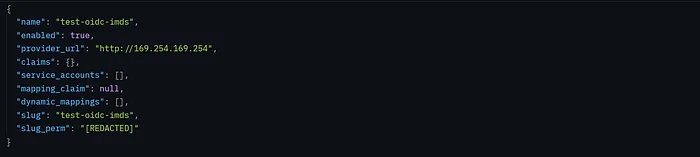
The screenshot shows the 201 Created response, captioned as the IMDS address being accepted with no validation error.
At that point there was an SSRF primitive. The more interesting question was the second-order consequence. If you control the discovery document, you control the JWKS URI. If you control the JWKS URI, you control the signing keys the platform will use to verify tokens. And if you control the signing keys, you can sign your own tokens and the platform will accept them as valid.
Exploitation
Step 1: stand up the malicious provider
A simple server was set up on a publicly accessible host under the researcher's control, serving two endpoints:
/.well-known/openid-configuration, returning a discovery document that pointed back to the same server for the JWKS URI./.well-known/jwks.json, returning a JWKS containing the researcher's own RSA public key.
The key pair was generated with standard tooling. The private key stays with the researcher; the server advertises the public key. Any token signed with the private key therefore verifies successfully against the keys the platform fetches from that server.
Step 2: register the provider and map it to a service account
The malicious provider was registered with the platform, pointing at the researcher's server, and mapped to a service account. The claims configuration was left empty. That detail matters and is covered below.
Step 3: forge the JWT
With the provider registered and the platform having already fetched the discovery document and JWKS, a JWT was generated. The payload contained the standard claims: iss pointing to the researcher's server, aud set to match what the platform expects, a valid exp, and a sub. It was signed with the private RSA key, using the same kid published in the JWKS.
The token has no relationship to any legitimate OIDC provider. It was never issued by GitHub or GitLab or anyone else; it is entirely self-signed. The only reason it would be accepted is that the platform trusts the researcher's signing keys, which it does, because it was told to.
Step 4: exchange the forged JWT
The platform's token exchange endpoint was called with the forged JWT, specifying the target service account. The response came back with a real service account token: two hour validity, scoped to the service account, issued by the platform.
The token was destroyed immediately after confirming it was real. It was not used for anything beyond a single failed test call to verify that the token was genuine and not a dummy response.
Why the empty claims configuration matters
Configuring the provider with empty claims is what made this work cleanly. The platform's own documentation warned that doing so means any token from that provider can authenticate, with no claim restrictions enforced.
In the legitimate use case you would configure claims to restrict authentication to specific repositories, branches or environments, for example accepting only tokens from the main branch of a specific repository. Without those restrictions, any token that passes signature verification is accepted.
Since the researcher controlled the signing keys, the claims inside the token were also under control, so even if claims had been required, whatever values were needed could have been included. The empty configuration simply made it trivially straightforward: as long as iss, aud and exp were correct, the platform issued a token.
The documentation warning existed. The platform did not enforce it programmatically. That gap is what turns a theoretical risk into a confirmed finding.
Out-of-band confirmation
Throughout the process out-of-band evidence was collected. The platform's backend made real HTTP requests to the researcher's server, identifiable by the user agent, and every interaction was logged with timestamps. When the token exchange triggered the JWKS fetch, that showed up in the logs too.
The sequence of server-side requests followed by the issued token in the API response gave a complete evidence chain:
- Discovery document fetched by the platform.
- JWKS fetched by the platform.
- Forged JWT submitted.
- Real token returned.
Root cause
Two weaknesses combine here.
The first is that the provider_url field accepts any URL and the platform fetches it server-side without validating that it is a publicly routable, non-attacker-controlled host. The discovery fetch happens automatically on config creation, so the attacker gets a server-side request and, more importantly, gets to define the JWKS URI that the platform will trust.
The second is that empty claims configurations are permitted at all. The platform documented that an empty claims configuration means any token from that provider can authenticate, but did not enforce the restriction programmatically. A UI warning is not enough.
A third improvement, which the report proposes rather than describes as an existing defence, would be to verify the iss field in the fetched discovery document against the configured provider_url exactly, before accepting it. That prevents a scenario where an attacker supplies a URL that redirects or serves a document claiming a different issuer.
Impact
The token received in testing was scoped to a service account with a Member role, which the researcher had configured. In a real attack the approach would be slightly different: the attacker would either map the malicious OIDC provider to a pre-existing high-privilege service account within their organisation, or create a new service account with elevated permissions before registering the provider.
With a write-capable service account token on a package registry, the realistic impact is supply chain interference. Private packages can be read. Malicious packages can be pushed to repositories that downstream build systems trust. Entitlement tokens can be created and revoked. And because the attacker can generate a fresh forged JWT at any time, token renewal is unlimited as long as the malicious provider config remains in place.
Fix
The report does not describe a fix applied by the platform; it sets out what should be done.
- Validate
provider_urlbefore fetching it. Reject private ranges and link-local addresses, and apply some form of provider verification before the config is treated as trusted. - Treat the empty-claims warning as a hard enforcement. If a provider has no claim restrictions, it should not be activatable.
- Verify the
issfield in the fetched discovery document against the configuredprovider_urlexactly, before accepting it.
Variants to test
- Discovery fetch on config creation. Register a provider pointing at a listener you control and watch for an immediate server-side request to
/.well-known/openid-configuration. A positive result is an inbound request carrying the platform's own OIDC client user agent, which confirms server-side fetching and gives you control of the document. - JWKS URI redirection. Serve a discovery document whose JWKS URI points somewhere you control and see whether the platform fetches keys from there during token exchange. A positive result is a JWKS request in your logs followed by acceptance of a token signed with your key.
- Empty or absent claim restrictions. Register a provider with no claim requirements and submit a self-signed token with only
iss,audandexpset correctly. A positive result is a real service account token in the response. - Issuer mismatch. Serve a discovery document whose
issdiffers from the configuredprovider_urland check whether the platform accepts it. A positive result shows the issuer is not pinned to the configured URL. - Internal address acceptance. Submit an internal or link-local address as
provider_urland observe whether the config is created without a validation error. A positive result is acceptance plus a server-side fetch attempt.
What I took from this
Finding this required thinking about the protocol rather than just the inputs. A lot of hunters look at a URL field and think SSRF. That is correct, but stopping there leaves the deeper impact unexamined. The more interesting question is what the application does with what it fetches, and how that interacts with the authentication flow it is part of.
OIDC is a trust delegation mechanism. Its security depends entirely on the integrity of the chain from provider registration to key publication to token verification. If you can insert yourself into any link in that chain, you can potentially forge your way into the next one. Here, controlling the provider URL gave the discovery document, which gave the JWKS URI, which gave key material control, which gave token signing authority, which gave a real credential. Each step followed logically from the one before it.
What happened, in plain words
A security researcher found a way to make a package registry platform hand out a real, working login credential for one of its own service accounts, without ever having been given permission to have one. A package registry is a website where software packages are stored and downloaded, a bit like an app store for code libraries that other programs install automatically. A service account is a login that belongs to a program rather than a person: no human types its password, machines use it to talk to each other.
The trick relied on a feature that lets an organisation connect the platform to an outside identity provider, so that automated build jobs can log in without storing long-lived passwords. The researcher pointed that feature at a server they controlled, told the platform to trust keys that they had made themselves, and then signed their own login token. The platform checked the token against the keys it had been told to trust, the keys matched because they were the researcher's own, and it issued a real credential in return.
Nothing was broken into on someone else's account: all testing happened on trial accounts the researcher owned, and the credential was destroyed straight after it was confirmed to be real. But the flaw was genuine, and the write-up explains both how it worked and how it should be fixed.
First, the ideas you need
Before the story makes sense, a handful of everyday concepts need to be on the table. None of them require any security background.
A server and a client. A client is the program asking for something, usually your browser. A server is the computer that answers. When you load a web page, your browser (client) asks a web server for it, and the server sends it back.
An API. An API is a way for one program to talk to another over the internet, without a human clicking anything. Think of a restaurant: the menu and the waiter form the API between you and the kitchen. You do not walk into the kitchen yourself; you ask through a fixed set of requests, and food comes back. A web API works the same way: a program sends a request to a specific address (an endpoint) with some data, and gets a structured answer back, usually in a format called JSON, which is just text arranged as labelled fields.
An endpoint. A specific address on a server that accepts one kind of request. If a website is a building, endpoints are the individual service windows in it.
A token. A token is a short piece of text that acts like a temporary pass. Instead of sending your username and password with every single request, you send the token, and the server recognises it. Think of a hotel key card: it opens your room for the length of your stay, and it can be cancelled at the front desk. A service account token is exactly that, but for a program instead of a person.
A JWT. JWT stands for JSON Web Token. It is a token with a very specific structure: three chunks of text joined by dots. The middle chunk contains claims, which are labelled facts such as who issued the token, who it is for, and when it expires. The third chunk is a signature, a mathematical stamp that lets the receiver check the token was really created by whoever claims to have created it, and was not altered on the way.
Signing keys, public and private. A signature is made with a private key, which must be kept secret, and checked with a matching public key, which can be shared with anyone. It is like a wax seal: only you own the stamp (private key), but anyone who has a copy of the expected seal pattern (public key) can confirm a letter really came from you. The pair is called a key pair, and the common algorithm for this is RSA.
OIDC. OpenID Connect, OIDC for short, is a standard way for one service to trust another service's proof of identity. It is what powers the "sign in with GitHub" buttons you have seen on many websites. You do not give the website your GitHub password; GitHub vouches for you instead. The website trusts GitHub, so it trusts the proof GitHub hands over.
CI/CD. Continuous Integration and Continuous Delivery: the automated systems that build and ship software every time a developer saves a change. A CI job is one automated run of that machinery, for example "build the app and run its tests".
SSRF. Server-Side Request Forgery. This is when an attacker can make a server fetch an address of the attacker's choosing. The server is the one making the request, so it can reach places your browser cannot, such as internal machines. The everyday comparison: you cannot get into the staff-only back corridor, but you can ask a member of staff to go and fetch something from it for you, and they will, because they work there.
Out-of-band (OOB) confirmation. Evidence collected through a different channel than the main one. If you want to prove a server really contacted you, you watch your own server's logs rather than trusting the response the application shows you. It is like confirming a letter was posted by seeing it arrive in your own letterbox.
interactsh. A free service that gives you a throwaway address and records every request that arrives at it, so you can see when a target server reaches out to you.
IMDS. Instance Metadata Service: an internal address that cloud servers use to fetch information about themselves. It is a classic SSRF target because it is only reachable from inside the network.
JWKS. JSON Web Key Set: a small file, published at a known address, that lists the public keys a provider uses to sign tokens. Anyone verifying a token downloads this file to know which key to check against.
Discovery document. A standard file that an OIDC provider publishes at a fixed address, /.well-known/openid-configuration, telling clients where to find its keys and what it supports. It is the provider's business card.
Claims. The labelled facts inside a JWT: iss (who issued it), aud (who it is meant for), exp (when it expires), sub (who it is about).
kid. Key ID: a short label inside a token saying which of the published keys was used to sign it, so the verifier knows which one to check.
How OIDC is supposed to work in CI/CD
Modern build platforms such as GitHub Actions, GitLab CI and CircleCI create a short-lived identity token for every job that runs. That token carries claims about the pipeline: which repository triggered it, which branch, which environment. The point is to stop teams storing long-lived API keys as secrets, because long-lived keys leak and live forever. Instead, the job proves who it is by presenting a token that a trusted provider issued, and the token expires quickly.
The platform in this story had built exactly that system. An organisation admin could register a trusted OIDC provider, for example the GitHub Actions token endpoint, and map it to a service account. When a CI job wanted to log in, it called the platform's token exchange endpoint with its OIDC token. The platform then:
- fetched the provider's published keys,
- checked the token's signature against them,
- checked that the claims matched the configured requirements,
- and, if everything lined up, issued a short-lived service account token in return.
The whole flow rests on one assumption: that the configured provider URL really points at a legitimate, trustworthy OIDC provider. That assumption is where things broke down.
Finding the surface
The researcher looked at the platform's OIDC configuration feature, specifically the API endpoint that lets organisation admins register a new provider. The request body takes a provider_url field, which is supposed to be the base address of a trusted OIDC provider, such as:
https://token.actions.githubusercontent.com
That single line is the address of GitHub's token service. It is the kind of value the field is meant to hold: a well-known, public, trustworthy provider. The question the researcher wanted answered was what the platform does with that address the moment the form is submitted.
OIDC clients normally start by fetching {provider_url}/.well-known/openid-configuration, the discovery document described above, which tells the client where the keys live and which algorithms are supported.
So the researcher pointed provider_url at an interactsh listener they controlled and created the provider config. Within seconds a request arrived. The platform's backend had fetched the discovery document automatically, and the request carried a user agent identifying it as the platform's own OIDC client. A user agent is the little name tag a program sends with every request saying who it is; browsers send one too.
That told the researcher two things:
- The address was being fetched by the server, with no check that it pointed at a legitimate or even publicly reachable host.
- The researcher now controlled what the discovery document said, including where the platform should go to fetch signing keys.
The screenshot shows the 201 Created response, captioned as an IMDS address being accepted with no validation error. A 201 Created is the standard HTTP answer meaning "I made the thing you asked for".
At this point there was an SSRF primitive: the ability to make the platform's server fetch an address of the researcher's choosing. Interesting, but the real thought was about the second-order consequence. If you control the discovery document, you control the JWKS address. If you control the JWKS address, you control the signing keys the platform will use to check tokens. And if you control the signing keys, you can sign your own tokens and the platform will accept them as valid. Each link in that chain follows from the one before it.
Building the attack chain
The attack has a few moving parts, so here is each one in turn.
Step 1: stand up the malicious provider
The researcher set up a simple server on a publicly reachable host they controlled, serving two endpoints:
/.well-known/openid-configuration, returning a discovery document that pointed back to the same server for the JWKS address./.well-known/jwks.json, returning a JWKS containing the researcher's own RSA public key.
The key pair was generated with standard tooling. The private key stayed with the researcher; the server advertised the public key. That means any token signed with the private key will verify successfully against the keys the platform fetches from that server. The platform is checking the seal against a pattern the researcher supplied, so of course it matches.
Step 2: register the provider and map it to a service account
The malicious provider was registered with the platform, pointing at the researcher's server, and mapped to a service account. The claims configuration was left empty. That detail matters and is covered below.
Step 3: forge the JWT
With the provider registered and the platform having already fetched the discovery document and JWKS, the researcher generated a JWT. The payload contained the standard claims: iss pointing to the researcher's server, aud set to match what the platform expects, a valid exp, and a sub. It was signed with the private RSA key, using the same kid published in the JWKS.
In plain words: the token says "my server issued me, I am meant for this platform, I am still valid, and here is who I am", and it carries a signature made with the researcher's own private key. The token has no relationship to any legitimate OIDC provider. It was never issued by GitHub or GitLab or anyone else; it is entirely self-signed. The only reason it would be accepted is that the platform trusts the researcher's signing keys, which it does, because it was told to.
Step 4: exchange the forged JWT
The platform's token exchange endpoint was called with the forged JWT, specifying the target service account. The response came back with a real service account token: two hour validity, scoped to the service account, issued by the platform.
The token was destroyed immediately after confirming it was real. It was not used for anything beyond a single failed test call to verify that the token was genuine and not a dummy response. That last point matters: a fake success message would prove nothing, so the researcher tried the credential once and then threw it away.
Why the empty claims configuration matters
Configuring the provider with empty claims is what made this work cleanly. The platform's own documentation warned that doing so means any token from that provider can authenticate, with no claim restrictions enforced.
In the legitimate use case you would configure claims to restrict authentication to specific repositories, branches or environments, for example accepting only tokens from the main branch of a specific repository. Without those restrictions, any token that passes signature verification is accepted.
Since the researcher controlled the signing keys, the claims inside the token were also under control, so even if claims had been required, whatever values were needed could have been included. The empty configuration simply made it trivially straightforward: as long as iss, aud and exp were correct, the platform issued a token.
The documentation warning existed. The platform did not enforce it programmatically. That gap is what turns a theoretical risk into a confirmed finding. A warning in a manual is like a sign saying "do not lean on the glass": it only helps if someone is watching.
Out-of-band confirmation
Throughout the process the researcher collected out-of-band evidence. The platform's backend made real HTTP requests to the researcher's server, identifiable by the user agent, and every interaction was logged with timestamps. When the token exchange triggered the JWKS fetch, that showed up in the logs too.
The sequence of server-side requests followed by the issued token in the API response gave a complete evidence chain:
- Discovery document fetched by the platform.
- JWKS fetched by the platform.
- Forged JWT submitted.
- Real token returned.
That chain is what makes the finding convincing rather than speculative: each step is visible in the researcher's own records, not just in what the platform chose to display.
What an attacker could actually do with this
The token received in testing was scoped to a service account with a Member role, which the researcher had configured. In a real attack the approach would be slightly different: the attacker would either map the malicious OIDC provider to a pre-existing high-privilege service account within their organisation, or create a new service account with elevated permissions before registering the provider.
With a write-capable service account token on a package registry, the realistic impact is supply chain interference. Private packages can be read. Malicious packages can be pushed to repositories that downstream build systems trust. Entitlement tokens can be created and revoked. And because the attacker can generate a fresh forged JWT at any time, token renewal is unlimited as long as the malicious provider config remains in place.
Supply chain interference is worth spelling out: if you can publish a package that other teams' automated builds will download and run, you are not attacking one machine, you are attacking everyone who installs your package. It is the difference between tampering with one person's lunch and tampering with the delivery van that serves a whole office.
Root cause and how to fix it
Two weaknesses combine here.
The first is that the provider_url field accepts any address and the platform fetches it server-side without validating that it is a publicly routable, non-attacker-controlled host. The discovery fetch happens automatically when the config is created, so the attacker gets a server-side request and, more importantly, gets to define the JWKS address that the platform will trust. The fix is straightforward: validate the address before fetching it, reject private ranges and link-local addresses, and apply some form of provider verification before the config is treated as trusted.
The second is that empty claims configurations are permitted at all. The platform documented that an empty claims configuration means any token from that provider can authenticate, but did not enforce the restriction programmatically. A UI warning is not enough. If a provider has no claim restrictions, it should not be activatable.
A third improvement, which the report proposes rather than describes as an existing defence, would be to verify the iss field in the fetched discovery document against the configured provider_url exactly, before accepting it. That prevents a scenario where an attacker supplies an address that redirects or serves a document claiming a different issuer.
Variants to test
If you want to look for the same class of bug elsewhere, these are the checks the report sets out, each with what a positive result looks like.
- Discovery fetch on config creation. Register a provider pointing at a listener you control and watch for an immediate server-side request to
/.well-known/openid-configuration. A positive result is an inbound request carrying the platform's own OIDC client user agent, which confirms server-side fetching and gives you control of the document. - JWKS address redirection. Serve a discovery document whose JWKS address points somewhere you control and see whether the platform fetches keys from there during token exchange. A positive result is a JWKS request in your logs followed by acceptance of a token signed with your key.
- Empty or absent claim restrictions. Register a provider with no claim requirements and submit a self-signed token with only
iss,audandexpset correctly. A positive result is a real service account token in the response. - Issuer mismatch. Serve a discovery document whose
issdiffers from the configuredprovider_urland check whether the platform accepts it. A positive result shows the issuer is not pinned to the configured address. - Internal address acceptance. Submit an internal or link-local address as
provider_urland observe whether the config is created without a validation error. A positive result is acceptance plus a server-side fetch attempt.
What I took from this
Finding this required thinking about the protocol rather than just the inputs. A lot of hunters look at a URL field and think SSRF. That is correct, but stopping there leaves the deeper impact unexamined. The more interesting question is what the application does with what it fetches, and how that interacts with the authentication flow it is part of.
OIDC is a trust delegation mechanism. Its security depends entirely on the integrity of the chain from provider registration to key publication to token verification. If you can insert yourself into any link in that chain, you can potentially forge your way into the next one. Here, controlling the provider address gave the discovery document, which gave the JWKS address, which gave key material control, which gave token signing authority, which gave a real credential. Each step followed logically from the one before it.
All testing was conducted against researcher-owned trial accounts. No production data was accessed. The issued token was destroyed immediately after confirming issuance and was not used for any further operations. Responsible disclosure was followed throughout.
Glossary
- API: a fixed way for one program to send requests to another and get structured answers back, without a human clicking anything.
- API endpoint: a specific address on a server that accepts one kind of request.
- aud (audience): the claim in a token saying who the token is meant for.
- CI/CD: the automated systems that build, test and ship software whenever a developer makes a change.
- CI job: one automated run of that machinery, such as building an app and running its tests.
- Claim: a labelled fact inside a token, such as who issued it or when it expires.
- Client: the program asking for something, usually your browser.
- Discovery document: a standard file an OIDC provider publishes at
/.well-known/openid-configuration, saying where its keys are and what it supports. - Endpoint: see API endpoint.
- exp (expiry): the claim in a token saying when it stops being valid.
- HTTP: the language browsers and servers use to exchange requests and responses.
- IMDS: Instance Metadata Service, an internal cloud address that servers use to fetch information about themselves; a common SSRF target.
- interactsh: a free service that gives you a throwaway address and records every request that arrives at it.
- iss (issuer): the claim in a token saying who created it.
- JSON: a text format for structured data, made of labelled fields and values.
- JWKS: JSON Web Key Set, a published file listing the public keys a provider uses to sign tokens.
- JWT: JSON Web Token, a token made of three dot-separated parts: a header, a set of claims, and a signature.
- kid: key ID, a short label in a token saying which published key signed it.
- Key pair: a private key kept secret and a matching public key that can be shared; one signs, the other verifies.
- Link-local address: an address that only works on the local network segment, not across the public internet.
- OIDC: OpenID Connect, a standard way for one service to trust another service's proof of identity, as used by "sign in with GitHub" buttons.
- Out-of-band (OOB) confirmation: evidence gathered through a separate channel, such as your own server logs, rather than the application's own response.
- Package registry: a service that stores and distributes software packages for other programs to download.
- Private key: the secret half of a key pair, used to create signatures.
- Public key: the shareable half of a key pair, used to check signatures.
- RSA: a common algorithm for creating key pairs and signatures.
- Server: the computer that answers requests from clients.
- Server-side fetch: a request made by the server itself, rather than by your browser.
- Service account: a login that belongs to a program rather than a person.
- SSRF: Server-Side Request Forgery, a flaw that lets an attacker make a server fetch an address of the attacker's choosing.
- sub (subject): the claim in a token saying who or what the token is about.
- Supply chain interference: attacking the packages or build steps that other teams trust and install, so the harm spreads to them.
- Token: a short piece of text acting as a temporary pass, so credentials do not have to be sent with every request.
- Token exchange endpoint: the API endpoint a CI job calls with its OIDC token to receive a service account token in return.
- User agent: the name tag a program sends with each request saying who it is.
- 201 Created: the standard HTTP response meaning the server successfully created the thing that was requested.

