**How I Got Unlimited Office 365 Premium Memberships & Unlimited LinkedIn Premium Vouchers For Free**
The Microsoft 365 Education signup flow treated email addresses with plus tags as distinct identities, allowing repeated free trial activations from a single inbox. An attacker could obtain unlimited Office 365 and LinkedIn Premium subscriptions by adding different plus tags to the same email address.
 Published on medium.com
Bug Bounty Writeup
The full write-up lives on its author's site
It belongs to its author, so we link to it rather than copy it. The other two tabs are our own rewrites, checked against it.
Context
The target was the Microsoft 365 Education signup flow, the page where an eligible user with a .edu address can claim a free 12-month subscription. Normally the flow is meant to enforce one trial per identity: you enter an email, receive a verification message at that address, click the link, set up a payment method (no charge for the trial), and the subscription is provisioned.
The researcher, Sai Krishna Sobila (iamsecure1920), found that the Microsoft Account identity system did not canonicalise email addresses before enforcing account creation rate limits. Because most mail systems support sub-addressing, a +tag suffix creates aliases that all deliver to the same inbox, so the same person could be treated as many different people. Each new alias produced another trial, and each bypassed account also triggered cross-product entitlements, including a 12-month LinkedIn Premium Career subscription delivered through Microsoft Store infrastructure.
The report states the issue has been fixed, and the author waited about five months after the fix before writing it up.
Setup
The only precondition described is a valid .edu email address whose provider supports sub-addressing. In the write-up the main address is [redacted]. No special tools, roles or versions are mentioned; the work was done through the ordinary signup flow, and Step 2 suggests signing out or opening an incognito window to repeat it.
Finding it
The researcher first completed the flow normally, entering [redacted], verifying it, and watching a 12-month free subscription light up. That behaved as expected.
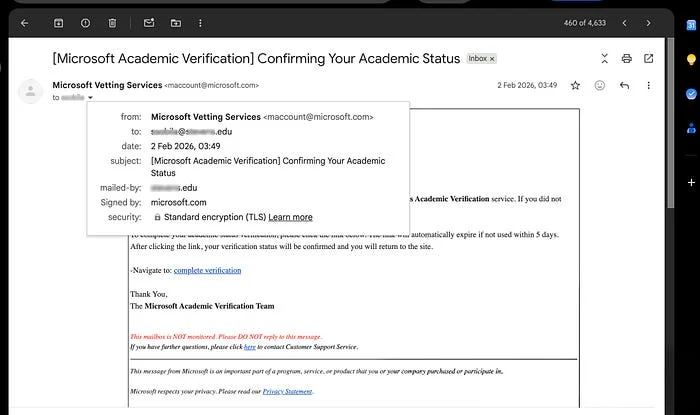
The question that followed was what happens if a plus tag is added. Sub-addressing, described in RFC 5322 and RFC 5233, lets the local part of an address carry a +tag that many providers ignore on delivery:
This is a deliberate feature, useful for filtering newsletters and receipts. It becomes a problem when an identity system does not canonicalise addresses before enforcing rate limits. The researcher tried [redacted], the verification email arrived at [redacted], and another trial activated. Then [redacted] produced the same result: same inbox, another trial.
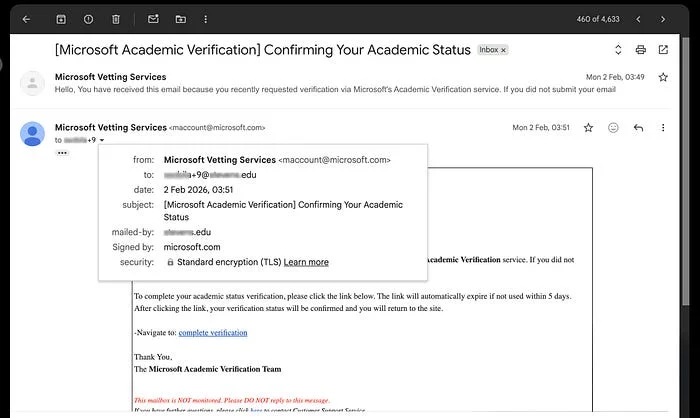
The signup flow was treating [redacted] and [redacted] as two different people while the inbox knew they were one. The system was checking the string, not the identity.
Exploitation
Step 1: The first crack
- Go to the Microsoft 365 Education offer page.
- Sign in with an existing Microsoft account or create a new one.
- On the payment setup page, enter
[redacted]. - Complete the payment method setup. No charge is required for the trial.
- Check the inbox at
[redacted]for the verification email. - Click the verification link.
- Return to the payment page and click Continue.
Result: a 12-month free subscription is activated for [redacted].
Step 2: The repeatable bypass
- Sign out or open an incognito window.
- Repeat Step 1 using
[redacted]. - The verification email arrives in the same inbox,
[redacted]. - Verify and complete signup.
Result: a second 12-month free subscription is activated on the same email infrastructure. The report says to repeat with +3, +4, +5 and so on; in the researcher's words, the well never runs dry.
Root cause
The Microsoft Account identity system did not canonicalise email addresses according to RFC 5322/5233 sub-addressing conventions before enforcing account creation rate limits. In other words, it did not strip the +tag before asking whether it had seen this identity before.
The intended control was one account per unique identity (email address). The bypass was that sub-addressing aliases were treated as distinct identities, giving a rate-limiting bypass that enabled unlimited automated account provisioning. The report characterises this as string matching masquerading as identity verification: the system saw test+1 and test+2 as strangers, while the inbox saw the same person wearing different hats.
Impact
The report frames the impact as broader than a few extra months of Microsoft 365, with two scenarios.
Service abuse. Automated account creation can abuse OneDrive storage, Teams resources or API quotas. The resource exhaustion is spread across multiple "identities" that resolve to a single actor, which makes detection difficult and mitigation a game of whack-a-mole.
Cross-product entitlements. Each bypassed account did not just unlock Microsoft 365; it triggered a cascade of cross-product entitlement provisioning, including a 12-month LinkedIn Premium Career subscription delivered through Microsoft Store infrastructure.
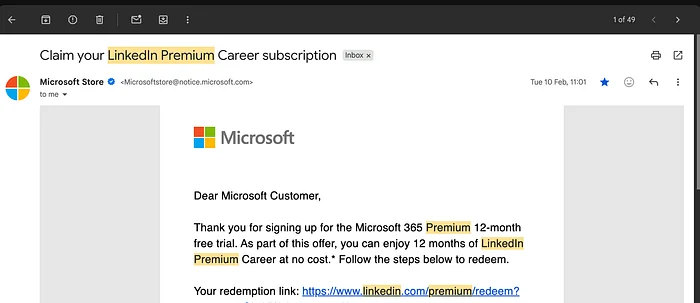
One plus sign pulled in Office apps and LinkedIn Premium, expanding the resource impact across multiple Microsoft services tied to a single inbox. The attacker could manage everything from one place: centralised coordination, distributed abuse, a single point of control for a sprawling network of entitlements.
The report says this violates the CIA triad in two directions. On availability, there is resource exhaustion across shared services. On integrity, business rule enforcement is undermined, and the "one account per identity" control becomes a polite suggestion.
Fix
Microsoft addressed the issue after the report. According to the write-up, the signup flow now properly canonicalises email addresses before enforcing rate limits and account creation controls, so sub-addressed aliases are recognised as belonging to the same underlying identity.
The timeline given is:
| Date | Event |
|---|---|
| Feb 7, 2026 | Vulnerability reported to Microsoft |
| Mar 16, 2026 | Microsoft released a fix |
| September 2026 | Public disclosure via Medium |
The researcher waited about five months after the fix before writing, as coordinated vulnerability disclosure.
As the researcher puts it: when you write a rate limiter, ask whether you are checking the string or the identity.
What happened, in plain words
A security researcher found that the signup page for a free Microsoft 365 Education subscription could be used over and over by the same person, simply by adding a small tag to their email address. Most email systems let you write [redacted] and still deliver the message to [redacted]. The signup system looked at the full text of the address, decided each tagged version was a brand new person, and handed out another 12-month free subscription each time. Each bypassed account also triggered cross-product entitlements, including a 12-month LinkedIn Premium Career subscription delivered through Microsoft Store infrastructure. The researcher reported it to Microsoft, Microsoft fixed it, and the author waited about five months after the fix before writing it up.
Before going further, a few words you will meet constantly in security writing:
- An email address has two halves split by the
@sign. The part before it is the local part (here,test), and the part after it is the domain (here,redacted.edu). - A signup flow is the sequence of pages a website shows you to create an account: enter details, prove you own an email address, maybe add payment information, then confirm.
- Provisioning means the system actually creating the thing you asked for, in this case switching on a subscription.
- An entitlement is a permission or benefit attached to an account, such as access to a paid product.
- A rate limit is a cap on how often something can happen, for example "one free trial per person". It exists to stop one person, or one automated script, from taking a shared resource many times.
The setup
The only thing the researcher needed was a valid .edu email address whose mail provider supports sub-addressing. In the write-up the main address is [redacted]. No special tools, accounts or software versions are mentioned. Everything was done through the ordinary signup pages, and Step 2 suggests signing out or opening an incognito window to repeat the process.
An incognito window (private browsing) is a browser window that does not keep your normal cookies and login state. A cookie is a small piece of data a website stores in your browser so it can remember who you are between page loads. Opening an incognito window is a simple way to start again as if you were a fresh visitor, which is why it appears in the repeat step later.
Finding it
The researcher first did the normal thing: entered [redacted], received the verification email, clicked the link, and saw a 12-month free subscription light up. That is exactly how the flow is supposed to behave.
A verification email is a message the site sends to prove you really control the address you typed. It contains a link with a unique code. Clicking it tells the site "yes, this person can read mail at this address".
The next question was what happens if a plus tag is added. Sub-addressing, described in the email standards RFC 5322 and RFC 5233, lets the local part of an address carry a +tag that many mail providers ignore when delivering. The write-up lays it out like this:
Line by line: the first line is the plain address and its inbox. The second line says that adding +1 before the @ still delivers to that same inbox. The third says +2 does the same. The fourth says any tag at all does the same. In everyday terms, it is like a building with one letterbox but many possible names on the envelope: the postman still puts everything through the same slot.
This is a deliberate feature, not a mistake. People use it to sort newsletters and receipts into folders without creating new accounts. It becomes a problem when a website's identity system does not canonicalise addresses before enforcing rate limits. To canonicalise means to reduce different spellings of the same thing to one standard form, the way you might write all versions of a name as just the surname before comparing them.
The researcher tried [redacted]. The verification email arrived at [redacted], and another trial activated. Then [redacted] produced the same result: same inbox, another trial.
The signup flow was treating [redacted] and [redacted] as two different people, while the inbox knew they were one. The system was checking the text of the string, not the identity behind it.
Exploitation
Step 1: The first crack
- Go to the Microsoft 365 Education offer page.
- Sign in with an existing Microsoft account or create a new one.
- On the payment setup page, enter
[redacted]. - Complete the payment method setup. No charge is required for the trial.
- Check the inbox at
[redacted]for the verification email. - Click the verification link.
- Return to the payment page and click Continue.
Result: a 12-month free subscription is activated for [redacted].
Why each step: step 1 opens the offer you are claiming. Step 2 gives you a logged-in session, because the site needs to attach the subscription to some account. Step 3 is the actual test: a tagged address that the site has not seen before. Step 4 satisfies the flow's requirement for a payment method, which is normal even when nothing is charged. Step 5 checks that the verification message really does land in the original inbox, which is the proof that the two addresses are one mailbox. Step 6 proves ownership to the site. Step 7 finishes the signup so the subscription is provisioned.
Step 2: The repeatable bypass
- Sign out or open an incognito window.
- Repeat Step 1 using
[redacted]. - The verification email arrives in the same inbox,
[redacted]. - Verify and complete signup.
Result: a second 12-month free subscription is activated on the same email infrastructure. The report says to repeat with +3, +4, +5 and so on; in the researcher's words, the well never runs dry.
Why each step: signing out or using incognito clears the site's memory of your previous visit, so the flow starts clean. Changing only the tag tests whether the site's "have I seen this person before?" check looks at the whole address or at the real mailbox. The verification email arriving in the same inbox is the evidence that nothing about the person changed. Completing signup shows the site happily provisions again.
Root cause
The Microsoft Account identity system did not canonicalise email addresses according to RFC 5322/5233 sub-addressing conventions before enforcing account creation rate limits. In other words, it did not strip the +tag before asking whether it had seen this identity before.
The intended control was one account per unique identity (email address). The bypass was that sub-addressing aliases were treated as distinct identities, giving a rate-limiting bypass that enabled unlimited automated account provisioning. The report calls this string matching masquerading as identity verification: the system saw test+1 and test+2 as strangers, while the inbox saw the same person wearing different hats.
A useful comparison: a bouncer checking names against a guest list by reading the exact spelling on each ID, without noticing that "Sam", "Sammy" and "S. Smith" are the same guest. The list is only as good as the matching rule behind it.
Impact
The report frames the impact as broader than a few extra months of Microsoft 365, with two scenarios.
Service abuse. Automated account creation can abuse OneDrive storage, Teams resources or API quotas. An API (application programming interface) is the set of rules one piece of software uses to talk to another; an API quota is a cap on how many requests you may make. The resource exhaustion is spread across multiple "identities" that resolve to a single actor, which makes detection difficult and mitigation a game of whack-a-mole.
Cross-product entitlements. Each bypassed account did not just unlock Microsoft 365; it triggered a cascade of cross-product entitlement provisioning, including a 12-month LinkedIn Premium Career subscription delivered through Microsoft Store infrastructure.
One plus sign pulled in Office apps and LinkedIn Premium, expanding the resource impact across multiple Microsoft services tied to a single inbox. The attacker could manage everything from one place: centralised coordination, distributed abuse, a single point of control for a sprawling network of entitlements.
The report says this violates the CIA triad in two directions. The CIA triad is a common way of describing what security protects: confidentiality (only the right people can see data), integrity (data and rules stay correct and are not tampered with), and availability (systems keep working for everyone who needs them). On availability, there is resource exhaustion across shared services. On integrity, business rule enforcement is undermined, and the "one account per identity" control becomes a polite suggestion.
Fix
Microsoft addressed the issue after the report. According to the write-up, the signup flow now properly canonicalises email addresses before enforcing rate limits and account creation controls, so sub-addressed aliases are recognised as belonging to the same underlying identity.
The timeline given is:
| Date | Event |
|---|---|
| Feb 7, 2026 | Vulnerability reported to Microsoft |
| Mar 16, 2026 | Microsoft released a fix |
| September 2026 | Public disclosure via Medium |
The researcher waited about five months after the fix before writing, as coordinated vulnerability disclosure. That term means telling the vendor privately, giving them time to fix the problem, and only then telling the public, so that people cannot use the details against systems that are still unpatched.
As the researcher puts it: when you write a rate limiter, ask whether you are checking the string or the identity.
Glossary
- API: the set of rules one piece of software uses to talk to another.
- API quota: a cap on how many requests a client may make to an API.
- Availability: the part of the CIA triad about systems staying usable for everyone who needs them.
- Canonicalise: reduce different spellings of the same thing to one standard form before comparing or storing it.
- CIA triad: a way of describing security as protecting confidentiality, integrity and availability.
- Confidentiality: the part of the CIA triad about only the right people being able to see data.
- Cookie: a small piece of data a website stores in your browser so it can remember who you are between page loads.
- Coordinated vulnerability disclosure: reporting a flaw privately to the vendor, waiting for a fix, then publishing the details.
- Cross-product entitlement: a benefit in one product that is switched on as a side effect of an account in another.
- Domain: the part of an email address after the
@sign. - Entitlement: a permission or benefit attached to an account, such as access to a paid product.
- Incognito window: a private browsing window that does not keep your normal cookies and login state.
- Integrity: the part of the CIA triad about data and rules staying correct and untampered with.
- Local part: the part of an email address before the
@sign. - Provisioning: the system actually creating or switching on the thing you asked for.
- Rate limit: a cap on how often something can happen, such as one free trial per person.
- RFC: a published document that defines how internet standards work.
- Signup flow: the sequence of pages a website shows you to create an account.
- Sub-addressing: the email feature where a
+tagadded to the local part is ignored on delivery, so all tagged versions reach the same inbox. - Verification email: a message sent to an address to prove you control it, usually containing a link with a unique code.




