How One Free Trial Became Unlimited Number Of Licenses | $$$$ Bounty
The application enforced a one-free-trial-per-company limit when generating a trial license but did not enforce it when registering a license. An attacker could register multiple trial licenses under a single company, bypassing the restriction.
 Published on medium.com
Bug Bounty
The full write-up lives on its author's site
It belongs to its author, so we link to it rather than copy it. The other two tabs are our own rewrites, checked against it.
Context
This write-up covers a business logic vulnerability found in a private bug bounty program. The target's identity and sensitive information are redacted throughout. The application offered a free 30-day trial with a stated restriction: one trial licence per company.
What drew the researcher's attention was that obtaining a licence and registering it were two separate operations. The initial operation checked whether a company had already used its trial. The open question was whether that same rule was enforced when a licence was actually registered, that is, whether the restriction covered the entire licence lifecycle or only the first operation.
The report was accepted, rewarded and marked as resolved. The finding was classified as Low severity, and the bounty amount is undisclosed.
Setup
The testing used separate controlled company accounts. One was a test company that had already received its free trial; others were additional controlled companies used to examine how the application handled licence registration.
The researcher's focus was the server-side relationship between a licence, its issuing company, and the company registering it. The registration request used multipart form data, carried the authenticated session and form-verification data, and contained two licence-related fields identifying the licence being registered.
No specific tooling is named for the manual phase. For the automated phase the researcher wrote a Python script, which was later shared with the security team as part of the report.
Finding it
Step 1 was to check the trial restriction itself. Starting with a test company that had already received its free trial, the normal trial-generation workflow enforced the restriction as expected. Nothing was unusual there.
The interesting question was whether that restriction applied to the entire licence lifecycle or only to the first operation. So the researcher examined how the application handled licence registration using the separate controlled company accounts.
The result exposed a mismatch. The registration workflow accepted an additional trial for a company that had already used its entitlement. It also allowed a trial issued under a different controlled company to be associated with the receiving company.
Exploitation
Step 1: Confirm the trial-generation check
Using a test company that had already received its free trial, the researcher confirmed that the normal trial-generation workflow enforced the one-trial-per-company restriction. This established that the check existed and worked at the point where a trial is issued.
Step 2: Register a licence through the registration endpoint
The registration request was submitted as multipart form data. The two licence-related fields identify the licence being registered; the request also carries the authenticated session and form-verification data. The version published in the report is redacted:
The important parts are the two licence fields, which tell the server which licence is being registered, and the session and verification data that make the request an authenticated, legitimate-looking submission. The path, host, cookie and field names are all withheld in the published version.
What mattered was not a redirect or a successful HTTP status on its own, but the server-side change that followed: an additional licence appeared in the receiving company's records. A successful response alone was not enough for the researcher; the question was whether the licence had actually been associated with the receiving company.
Step 3: Verify the impact in the licence list
The company's licence list was checked to confirm whether the additional trial licenses had been successfully registered. The results confirmed the findings: 11 trial licenses were registered under a single company account, despite the application's stated limit of one free trial per company.
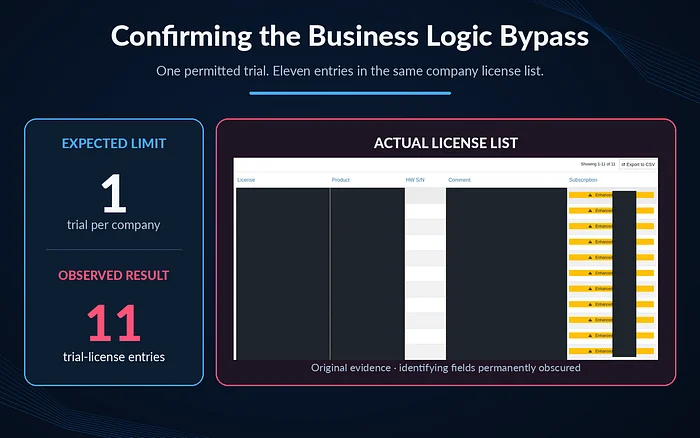
This demonstrated that the restriction was not consistently enforced throughout the licensing process.
Step 4: Automate the proof of concept
After reproducing the vulnerability manually, the researcher wanted to determine whether the behaviour was repeatable, and developed a Python script to automate the testing workflow and verify the resulting licence state.
Rather than relying solely on HTTP response codes, the script checked whether the additional licenses actually appeared in the company's licence list.
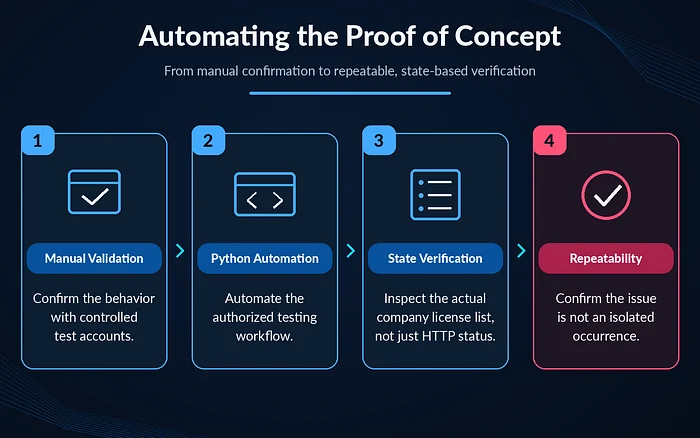
The results confirmed that the issue was not an isolated occurrence: the one-trial-per-company restriction was not consistently enforced throughout the licensing workflow.
The complete automation script was provided to the security team as part of the original report to assist with reproduction and validation. The report links to it as the automated PoC.
Root cause
The issue was a business logic flaw in the way the application enforced its commercial policy. The initial trial workflow checked eligibility, but the final registration operation did not consistently enforce that same restriction, nor the expected relationship between the licence and the company.
In other words, the eligibility check was enforced when a trial is generated, but not consistently at the point where a licence is bound to a company. The registration step accepted a trial for a company that had already used its entitlement, and accepted a trial issued under a different company. The check in the trial-generation workflow did not consistently carry over to the later operation, so it did not protect the overall business rule.
Impact
The demonstrated impact was the registration of an unlimited number of licenses under a single controlled company. Potential consequences included abuse of the trial model and lost sales opportunities.
The researcher is explicit about the limits of what was established: actual revenue loss, unlimited active usage, and the ability to predict valid licence identifiers were not demonstrated. The finding was classified as Low severity.
Fix
The appropriate fix, as stated in the report, is to verify ownership and trial eligibility on the server at the final registration step, and to enforce the rule consistently throughout the licence lifecycle. The report does not describe a specific code change made by the vendor; it records that the report was marked as resolved after the team reproduced the issue.
Variants to test
- Split workflows with a check only at the first step. Look for features where an entitlement is granted in one request and consumed or bound in another, such as trial generation followed by licence registration, invite creation followed by acceptance, or coupon issuance followed by redemption. A positive result is that the second request succeeds for an account that has already used its entitlement, and the resulting state is visible in the account's records.
- Cross-account association. Take an object issued under one controlled account and register or attach it to a second controlled account. A positive result is that the object appears in the receiving account's list even though it was issued elsewhere.
- Trusting the response code. Repeat the registration and compare the HTTP status with the server-side state. A positive result is a request that looks unremarkable at the HTTP level but changes the account's licence or entitlement list.
- Repeat the registration at volume. Automate the registration and count the resulting entries in the account's list rather than counting successful responses. A positive result is a growing list of entitlements under one account, which shows the rule is not enforced at the state-changing step.
- Check the UI against the backend. Where the interface hides or disables an action after the first use, send the underlying request directly. A positive result is that the backend accepts what the interface would have prevented.
What happened, in plain words
A security researcher was testing a private bug bounty program. In a bug bounty program, a company invites independent researchers to try to break its software and pays them for reporting real problems. The company behind this particular program asked to stay anonymous, so the researcher hid its name, its web addresses and other identifying details in the write-up.
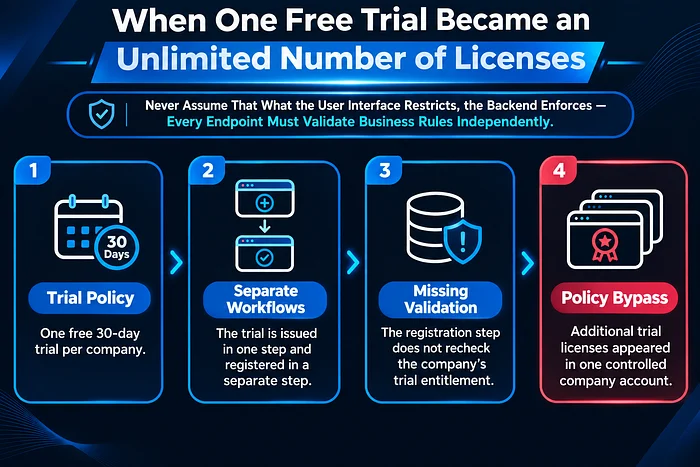
The product offered a free 30-day trial. The rule was simple and clearly stated: one trial licence per company. A licence, in this context, is the digital permission slip that lets a company use the product. The trial was meant to be a one-off taste of the product, so that a company would then buy a paid licence.
The researcher noticed something interesting about how the product worked. Getting a licence and registering it were two separate operations. Think of it like a cinema: one desk hands out a voucher for a free ticket, and a different desk turns that voucher into an actual seat reservation. The first desk checked whether you had already had your free ticket. The question the researcher wanted answered was whether the second desk checked the same thing.
It did not. The researcher was able to register 11 trial licenses under a single company account, even though the company had already used its one free trial. The report was accepted, a bounty was paid (the amount is not disclosed), and the issue was marked as resolved. It was classified as Low severity.
This is a business logic vulnerability. That term means the software does exactly what it was programmed to do, with no crashes and no strange errors, but it does not enforce a rule that the business depends on. It is like a shop assistant who correctly scans every item but forgets to check whether the customer is old enough to buy the age-restricted product. Nothing is technically broken; a rule is simply missing.
Understanding the application
The application offered a free 30-day trial with a clear restriction: one trial licence per company.
What caught the researcher's attention was that getting a licence and registering it were two separate operations. The initial operation checked whether a company had already used its trial. The researcher wanted to know whether the same rule was enforced when a licence was actually registered.
To follow the rest of this article, a few basic ideas help:
- A web application is a program you use through your browser. The pages you see are only the front part. Behind them sits a server, a computer owned by the company that does the real work and stores the real data.
- The frontend is everything that runs in your browser: the buttons, the forms, the messages. The backend is everything that runs on the server. A useful comparison is a restaurant: the menu and the waiter are the frontend, the kitchen is the backend. A rule printed on the menu means nothing if the kitchen does not follow it.
- An API (Application Programming Interface) is the set of doors on the backend that the frontend knocks on to ask for things. When you click a button, your browser sends a request to one of those doors, and the server sends back an answer. Each door has an address, called an endpoint.
- A request is the message your browser sends to the server. It has a method (such as
GETto read something orPOSTto send something), a path (which door), headers (extra information about the message) and often a body (the data being sent). - A cookie is a small piece of text that the server gives your browser and your browser sends back on every later request. It is how the server recognises you between page loads. A session cookie is the one that proves you are logged in, a bit like the wristband you get at an event: show it at the door and you are let in without showing your ticket again.
- A licence lifecycle is the whole journey of a licence, from being created, through being registered to a company, to being used and eventually expiring. The researcher's question was whether the one-trial rule was checked at every stage of that journey or only at the first one.
Step 1: Checking the trial restriction
The researcher started with a test company that had already received its free trial. The normal trial-generation workflow enforced the restriction, as expected.
At this point, there was nothing unusual. The interesting question was whether that restriction applied to the entire licence lifecycle or only to the first operation.
Why start here? Because before claiming that a rule is broken, you have to show that the rule exists and works somewhere. If the trial-generation step had let the company take a second trial, the finding would have been a much simpler and different bug. By confirming that the first step behaved correctly, the researcher narrowed the question to the second step.
Step 2: Investigating licence registration
The researcher examined how the application handled licence registration using separate controlled company accounts. These are accounts the researcher controlled, so that testing did not touch real customers. The focus was on the server-side relationship between a licence, its issuing company (the company the licence was created for) and the company registering it.
The result exposed a mismatch: the registration workflow accepted an additional trial for a company that had already used its entitlement. It also allowed a trial issued under a different controlled company to be associated with the receiving company.
In plain terms, the second desk did not check the voucher properly. It accepted a voucher from a company that had already had its free trial, and it even accepted a voucher that had been issued to a different company.
The HTTP request
The registration request used multipart form data. This is the same format a browser uses when you upload a file through a form: the data is split into several labelled parts, each with a name, separated by a boundary line. The two licence-related fields identified the licence being registered; the request also contained the authenticated session and form-verification data.
Below is the redacted version of the request submitted with the report.
Line by line, in plain words:
POST /[REDACTED-REGISTRATION-PATH] HTTP/2is the first line of the request.POSTis the method used when you are sending data to the server to create or change something. The path after it is the address of the endpoint, the specific door being knocked on; it is hidden here.HTTP/2is the version of the language the browser and server use to talk.Host: [REDACTED]names the website the request is going to. Hidden.Cookie: [REDACTED]carries the session cookie, the wristband that proves the researcher was logged in to the controlled company account. Hidden, because a live session cookie would let anyone act as that account.User-Agent: [REDACTED]normally says which browser and operating system sent the request. Hidden.Referer: [REDACTED]normally says which page the request came from. Hidden.Origin: [REDACTED]normally says which site the request was sent from. Hidden.Content-Type: multipart/form-data; boundary=REDACTED_BOUNDARYtells the server that the body is split into parts, and gives the boundary string that separates one part from the next. Think of the boundary as the perforation between pages of a form.--REDACTED_BOUNDARYfollowed byContent-Disposition: form-data; name="[LICENSE_NUMBER_FIELD]"starts the first part of the form. The name is the label of the field, the same way an online form has a box labelled "first name". The field name is hidden.[REDACTED]on the next line is the value the researcher put in that field: the licence number. Hidden.- The next
--REDACTED_BOUNDARYstarts the second part,Content-Disposition: form-data; name="[LICENSE_IDENTIFIER_FIELD]", with its own hidden value. Together, these two fields tell the server which licence is being registered. [Remaining form fields and verification tokens redacted]stands for the other fields the form normally contains, including the tokens the site uses to confirm the form really came from its own pages. These are hidden too.- The final
--REDACTED_BOUNDARY--closes the body. The double dash at the end means there are no more parts.
What mattered was not a redirect or a successful HTTP status on its own, but the server-side change that followed: an additional licence appeared in the receiving company's records.
A successful response alone was not enough for the researcher. A server can answer "OK" and still do nothing useful, or answer with an error page while quietly saving the data. The only trustworthy evidence is the state of the account afterwards, so the researcher went to look at the company's licence list.
Step 3: Confirming the impact
The researcher checked the company's licence list to verify whether the additional trial licenses had been successfully registered.
The results confirmed the findings. The researcher was able to register 11 trial licenses under a single company account, despite the application's stated limit of one free trial per company.
This demonstrated that the restriction was not consistently enforced throughout the licensing process.
Eleven under one account, all visible in the account's own records, shows a repeatable gap in the rule.
Automating the PoC
After reproducing the vulnerability manually, the researcher wanted to determine whether the behaviour was repeatable. Doing something once by hand can be an accident; doing it many times automatically shows it is a property of the system.
The researcher developed a Python script to automate the testing workflow and verify the resulting licence state. Python is a programming language often used for small testing scripts because it is readable and has good tools for sending web requests.
Rather than relying solely on HTTP response codes, the script checked whether the additional licenses actually appeared in the company's licence list.
The results confirmed that the issue was not an isolated occurrence.
The one-trial-per-company restriction was not consistently enforced throughout the licensing workflow.
The complete automation script was provided to the security team as part of the original report to assist with reproduction and validation. The report links to it as the automated PoC. A PoC, or proof of concept, is a small, focused demonstration that a problem is real, rather than a full attack tool.
Root cause and impact
The issue was a business logic flaw in the way the application enforced its commercial policy. The initial trial workflow checked eligibility, but the final registration operation did not consistently enforce that same restriction or the expected relationship between the licence and company.
The demonstrated impact was the registration of an unlimited number of licenses under a single controlled company. Potential consequences included abuse of the trial model and lost sales opportunities.
The researcher was careful about what had actually been proven. Actual revenue loss, unlimited active usage, and the ability to predict valid licence identifiers were not established. In other words, the researcher showed that many licenses could be registered, not that the company had lost a measurable amount of money, not that every licence would keep working indefinitely, and not that anyone could guess a valid licence number out of thin air.
The appropriate fix is to verify ownership and trial eligibility on the server at the final registration step, and enforce the rule consistently throughout the licence lifecycle. The report does not describe a specific code change made by the vendor; it records that the report was marked as resolved after the team reproduced the issue.
Bounty and disclosure
The security team initially requested additional reproduction details. After the researcher supplied further evidence, the team reproduced the issue, accepted the report, awarded a bounty, and marked it as resolved.
Bounty: $$$$ (amount undisclosed)
The finding was classified as Low severity. The exact program details, report identifiers and sensitive request data are intentionally withheld.
Final thoughts
The initial trial limit worked. That was what made this case interesting: a valid check in one part of an application can still fail to protect the overall business rule.
A business rule should be enforced where the final state changes, not only where the workflow begins.
Variants to test
If you want to look for similar problems in software you are allowed to test, these are the patterns to try. Only test systems you have permission to test.
- Split workflows with a check only at the first step. Look for features where a benefit is granted in one request and used or bound in another, such as trial generation followed by licence registration, invite creation followed by acceptance, or coupon issuance followed by redemption. A positive result is that the second request succeeds for an account that has already used its benefit, and the resulting state is visible in the account's records.
- Cross-account association. Take an object issued under one controlled account and register or attach it to a second controlled account. A positive result is that the object appears in the receiving account's list even though it was issued elsewhere.
- Trusting the response code. Repeat the registration and compare the HTTP status with the server-side state. A positive result is a request that looks unremarkable at the HTTP level but changes the account's licence or entitlement list.
- Repeat the registration at volume. Automate the registration and count the resulting entries in the account's list rather than counting successful responses. A positive result is a growing list of entitlements under one account, which shows the rule is not enforced at the state-changing step.
- Check the UI against the backend. Where the interface hides or disables an action after the first use, send the underlying request directly. A positive result is that the backend accepts what the interface would have prevented.
Glossary
- API: the set of endpoints a backend exposes so that a frontend, or another program, can ask it to do things.
- Backend: the part of an application that runs on the server and holds the real data and rules.
- Boundary (multipart): the separator string that marks where one part of a multipart form body ends and the next begins.
- Bounty: a payment made by a company to a researcher who reports a valid security problem.
- Bug bounty program: a scheme where a company invites researchers to test its systems and rewards valid reports.
- Business logic vulnerability: a flaw where the software works as programmed but fails to enforce a rule the business depends on.
- Content-Type: a request header that says what format the body is in, such as multipart form data.
- Cookie: a small piece of text a server gives the browser, which the browser sends back on later requests so the server can recognise the user.
- Endpoint: a specific address on a server that accepts requests, like one door of a building.
- Entitlement: the right an account has earned, such as one free trial.
- Frontend: the part of an application that runs in the browser, including pages, forms and buttons.
- GET: an HTTP method used to read something from a server.
- Header: extra information attached to a request or response, such as the host, cookie or content type.
- Host: the header naming the website a request is sent to.
- HTTP: the language browsers and servers use to exchange requests and responses.
- HTTP/2: a version of HTTP.
- HTTP status: the three-digit code a server returns, such as 200 for success or 404 for not found.
- Licence: the digital permission that lets a company use a product.
- Licence lifecycle: the whole journey of a licence, from creation through registration and use to expiry.
- Multipart form data: a request body format that splits data into labelled parts separated by a boundary, commonly used for forms and file uploads.
- Origin: a header saying which site a request was sent from.
- Path: the part of a URL that identifies which endpoint is being called.
- PoC (proof of concept): a small demonstration that a security problem is real.
- POST: an HTTP method used to send data to a server to create or change something.
- Python: a programming language often used for small testing and automation scripts.
- Referer: a header saying which page a request came from.
- Request: the message a browser or script sends to a server.
- Response: the message a server sends back.
- Server: the computer that runs the backend and stores the data.
- Session cookie: the cookie that proves a user is logged in.
- Severity: a rating of how serious a security issue is, such as Low, Medium or High.
- Token: a value used to prove something, such as that a form came from the site's own pages.
- User-Agent: a header describing the browser and operating system that sent a request.
- Verification token: a value in a form that the server checks to confirm the form was genuinely issued by the site.




