I Asked How Guests Get Their Identity — and Found a Meeting Logic Flaw
A meeting application trusted a client-supplied cookie to identify guest participants, accepting arbitrary values instead of generating its own identifier. An attacker could create lobby entries the host could not remove, and by reusing another participant's identifier could cause that participant to be removed or replaced.
 Published on medium.com
Bug Bounty
The full write-up lives on its author's site
It belongs to its author, so we link to it rather than copy it. The other two tabs are our own rewrites, checked against it.
Context
The target was a web application for online meetings, similar to Google Meet. Its access model was simple: authenticated users could create meetings, while unauthenticated guests could only join existing ones. A host therefore had to be able to see who was waiting in the lobby, admit them, or reject them, and the application needed some way to tell guest participants apart without an account behind them.
That question, how guests get an identity, is where this investigation started. The author's interest was in business logic rather than injection: how components depend on each other, and what happens when one component makes an assumption that another component does not enforce.
Setup
No specific tooling, versions or account details are given beyond the following:
- A guest session, which is unauthenticated and can only join an existing meeting.
- A separate browser used as the meeting host, to exercise the moderation controls.
- Two guest sessions in the same meeting for the second test.
- An intercepting proxy, implied by the instruction to intercept the request sent when requesting entry to the meeting.
The precondition for everything below is simply the ability to join a meeting as a guest and to modify the cookies sent with the join request.
Finding it
The first step was comparing the cookies used by authenticated users and guests. Authenticated users had a session identifier, while guests had a separate cookie named lobbyParticipantId.
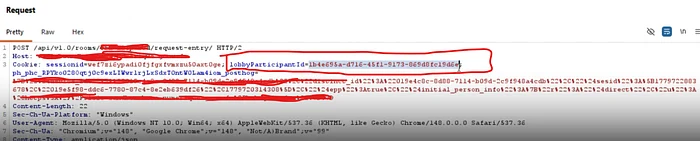
That difference suggested a separate mechanism for identifying unauthenticated participants. The open question was whether that identifier was generated and enforced by the server, or whether the client could influence it.
To answer it, the author began modifying the lobbyParticipantId cookie and watching the server's response. The server accepted the modified value and returned it as the participant's ID. The supplied value was not ignored in favour of an independently generated identifier.
Injection-style ideas were tried first, including CRLF injection and XSS, but none produced a working vulnerability. The focus then moved to the role the identifier played in the application's business logic, with the question: what happens if I supply an identifier the application was never designed to accept?
The application appeared to expect a UUID-like identifier. The cookie value was therefore replaced with an arbitrary string:
Cookie: sessionid=xxxxx; lobbyParticipantId=https://evil.com
The string was only a test value; there was no need to contact the external domain. The server accepted it and returned a response similar to:
{ "status": "waiting", "username": "medooooo", "id": "https://evil.com"}
This was the turning point: a value outside the expected identifier format had been accepted and used as the participant's ID.
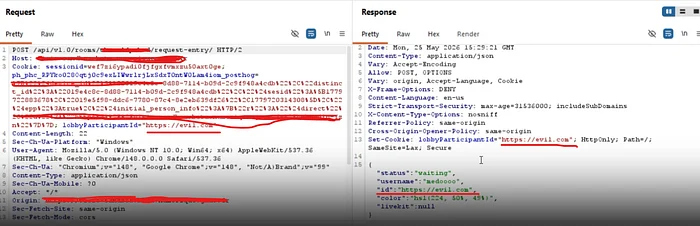
At that stage the full impact was not yet established. The next step was to follow the identifier into the parts of the application that relied on it.
Exploitation
Step 1: A participant the host cannot remove
The identifier was followed into the meeting's moderation workflow. Normally the host can remove or reject guests waiting in the lobby. Using a separate browser as the meeting host, the author tried to remove the guest whose lobbyParticipantId contained the arbitrary string.
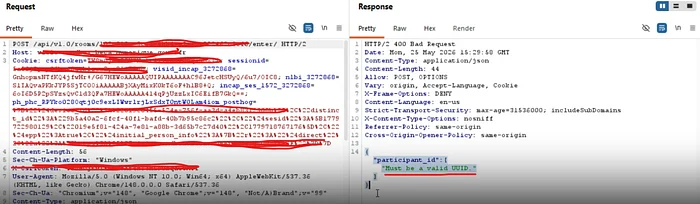
The removal did not work as expected. The participant could not be properly removed through the host's normal moderation controls, because the identifier did not match the format that functionality expected. The joining workflow accepted a value that the moderation workflow could not correctly handle, and the moderation side reported that it must be a valid UUID.
Steps to reproduce the malformed participant identity:
- Open a meeting as a guest user.
- Intercept the request sent when requesting entry to the meeting.
- Modify the cookie named
lobbyParticipantIdtolobbyParticipantId=https://evil.com. - Send the request. Example:
Cookie: sessionid=xxxxx; lobbyParticipantId=https://evil.com
- Observe that the server accepts the attacker-controlled value and uses it as the participant identifier. Server response:
{ "status":"waiting", "username":"medo2", "id":"https://evil.com" }
- The meeting host or admin can no longer properly remove the malicious participant from the lobby.
- Repeat the process with different arbitrary values to verify that the behaviour is reproducible.
Step 2: Reusing another participant's identifier
The malformed-value test showed a moderation bypass, but the underlying issue was broader: the server accepted an identifier supplied through a client-controlled cookie. That raised a second question: what happens if the value is a valid identifier belonging to an existing participant rather than an arbitrary string?
Using two guest sessions in a meeting, the author identified the lobbyParticipantId associated with one participant and replaced the other session's cookie value with that identifier, then submitted the join request with the modified cookie.
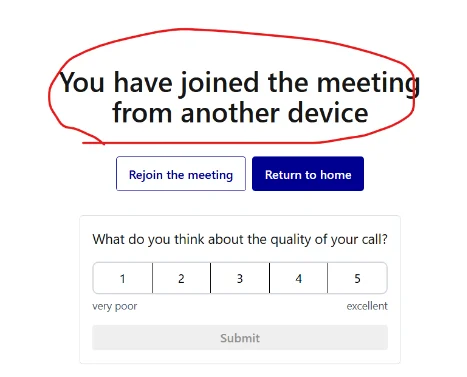
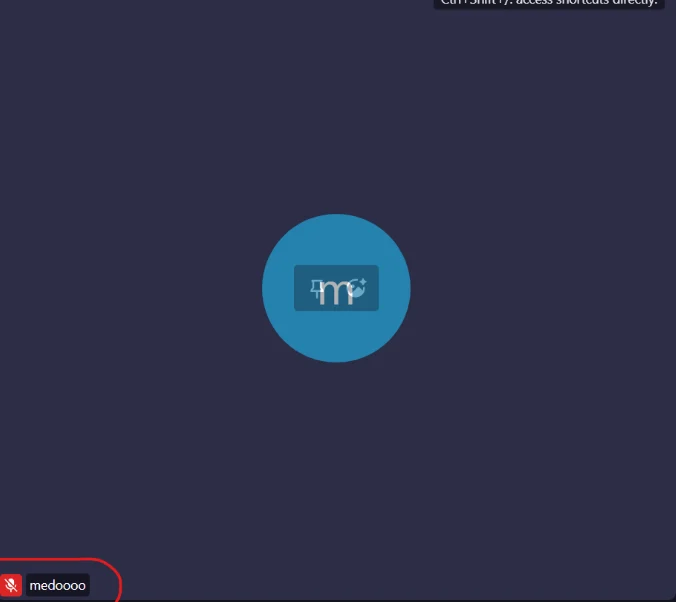
The result was more serious. The original participant was removed or replaced, while the second guest joined using the original participant's identity reference. The application did not adequately protect the relationship between a participant identifier and the session it belonged to.
Steps to reproduce the identifier reuse:
- Join a meeting as a guest user.
- Obtain a valid
lobbyParticipantIdbelonging to another participant. - Intercept the request sent while requesting entry to the meeting.
- Replace your own
lobbyParticipantIdcookie value with the victim's identifier. - Send the modified request.
- Observe that the victim participant gets removed or disconnected.
- The attacker joins instead, using the victim's identifier.
Root cause
The application trusted a client-supplied cookie to establish who a guest participant was. The join workflow accepted whatever value arrived in lobbyParticipantId, including values outside the expected UUID-like format, and used it as the participant's ID. Other components, such as lobby moderation, assumed the identifier would always be a valid UUID, so a value that the join path accepted could not be handled by the moderation path.
For the second test, the identifier was not bound to the session that created it. Any session presenting another participant's identifier was treated as that participant, so the original entry was removed or replaced. The report does not describe the server-side code.
Impact
The two tests exposed different consequences of the same weakness.
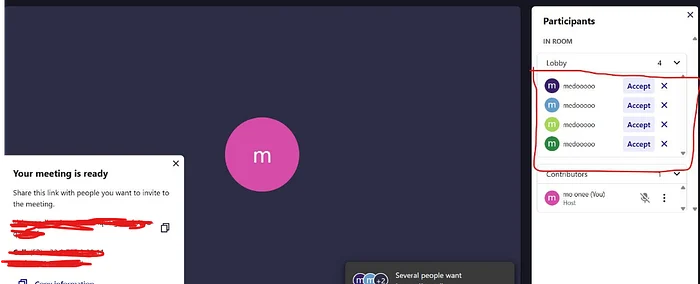
- Lobby moderation bypass. By supplying an identifier outside the expected format, a guest can create a lobby entry that the host cannot properly remove through the normal moderation controls. This undermines the host's ability to control who is waiting to join.
- Repeated lobby disruption. The guest can repeat the process with different arbitrary identifiers to create multiple distinct lobby entries from the same session, forcing the host to deal with repeated entries and disrupting the admission process. The demonstrated impact is repeated lobby disruption; a broader denial-of-service claim would require evidence of a larger availability impact.
- Participant replacement. By reusing a valid participant identifier, a guest can cause the original participant to be removed or replaced and take their place in the participant state. This affects the victim's availability and the integrity of the meeting's participant list.
All of these require only guest access to a meeting and the ability to modify the cookie on the join request.
Fix
The report does not state what was changed. Based on the behaviour described, the server should generate the participant identifier itself and ignore any client-supplied value, or at minimum reject values that are not valid UUIDs on the join path and verify that an identifier belongs to the session presenting it before acting on it. Moderation and join should share the same validation so that a value one accepts cannot be one the other cannot handle.
Variants to test
- Other identity cookies. Look for cookies that carry a participant, guest or visitor identifier and try replacing them with arbitrary strings. A positive result is a response that echoes your value back as the identifier.
- Format mismatch between components. Send a value that one endpoint accepts and another rejects, as with the UUID expectation here. A positive result is an object you created that the administrative or moderation interface cannot act on.
- Identifier reuse across sessions. Take a valid identifier from one session and present it from another. A positive result is the original session being disconnected or replaced while the second session takes over its state.
- Repetition from one session. Submit several join requests with different arbitrary identifiers from the same session. A positive result is multiple distinct lobby entries attributable to one client.
Evaluation
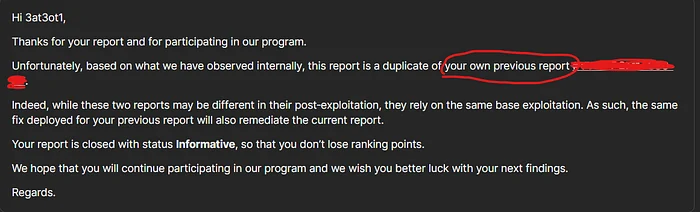
A second report was closed as a duplicate of the first.

Final takeaway
This started with a simple question: how does the application identify guests who do not have accounts? Comparing cookies led to lobbyParticipantId, testing showed the server accepted arbitrary values, and following the identifier through the application showed it could break lobby moderation and let one participant replace another.
The lesson is not to stop when you find something you can manipulate, but to understand how the application uses it and what happens when other features depend on it. A cookie may look like an ordinary piece of data, but if the application trusts it to decide who someone is, changing it can have consequences far beyond that single value. Instead of asking only whether you can modify a value, ask what you can do if the application trusts a value it should not.
What happened, in plain words
A researcher was looking at a website for online meetings, the kind of site where you click a link and join a video call in your browser, similar to Google Meet. On this site, people with accounts could create meetings, and people without accounts (guests) could only join meetings that already existed.
The researcher asked a simple question: if a guest has no account, how does the site know which guest is which? The host of a meeting needs to see a list of people waiting to be let in, and needs to be able to admit or reject each one. So the site must give every guest some kind of label.
The researcher found that label in a cookie, a small piece of data the site stores in your browser. The cookie was called lobbyParticipantId. The researcher then changed the value of that cookie to something the site would never produce itself, and the site accepted it. That meant the server accepted a value the guest supplied as their identity label.
From there, two problems appeared. First, a guest could pick a label in a strange format that the host's "remove this person" button could not handle, so the host could not get rid of them. Second, a guest could copy another guest's label, and the site would treat the copier as that other person, kicking the original out.
This is a business logic flaw. That term means the site's rules about how things should work (who can join, who can remove whom, who is who) can be bent, even though no technical protection like a password check was broken. It is like a club where the bouncer checks your name on the list, but the list is written in pencil and you are allowed to hold the pencil.
1. The starting question: how are guests identified?
The researcher was specifically interested in business logic problems rather than the more common kind of attack where you send malicious code and hope the site runs it. Business logic problems need you to understand how the different parts of a site depend on each other, and what happens when one part makes an assumption that another part does not enforce.
A quick word on the pieces involved:
- Web application: a program that runs on a server and that you use through your browser. When you click a button, your browser sends a request to the server, and the server sends back a response.
- Request and response: a request is your browser asking the server to do something ("let me join this meeting"). A response is the server's answer ("you are now waiting in the lobby").
- Authenticated user: someone who has logged in, so the site knows their account.
- Unauthenticated guest: someone who has not logged in. They have no account, so the site has no built-in way to know who they are.
- Lobby: the waiting area of a meeting. Guests sit in the lobby until the host lets them in.
- Host: the person who created the meeting and controls who gets in.
The site's access model was clear: logged-in users could create meetings, guests could only join existing ones. That raised the question the whole investigation is built on: how does the site tell one guest apart from another when neither has an account?
The host needs to know who is waiting, who was admitted and who was rejected. Without accounts, the site must use some other mechanism to track guest identities.
2. Comparing cookies
The researcher started by comparing the cookies used by logged-in users and by guests.
A cookie is a small piece of text that a website asks your browser to store and to send back with every request to that site. Think of it like a wristband you get at an event: the organisers give it to you, and later they look at it to decide whether to let you into a room. Cookies are how most sites remember who you are between page loads, because the web itself does not remember anything.
The difference was interesting: logged-in users had a session identifier, while guests had a separate cookie named lobbyParticipantId.
A session identifier (often called a session ID or session token) is a cookie that stands in for your login. After you log in, the server gives your browser a long random value, and on every later request your browser sends it back so the server knows it is still you. It is like a cloakroom ticket: the ticket itself means nothing, but it matches the coat the staff are holding for you.
So guests did not have a session identifier, but they did have lobbyParticipantId. The name suggests it is the ID of the participant in the lobby. That suggested the site used a different mechanism to identify guests. The open question was whether that identifier was generated and enforced by the server, or whether the browser (and therefore the user) could influence it.
3. Testing who controls the identifier
The researcher began modifying the lobbyParticipantId cookie and watching how the server responded.
To do this you need an intercepting proxy. That is a tool that sits between your browser and the website and lets you pause a request, look at it, change it, and then send it on. Think of it as a postal worker who lets you open an envelope, swap the letter inside, and seal it again before delivery. The report does not name a specific tool.
The server accepted the modified value and returned it as the participant's ID. That was the first important clue: the value supplied by the client was not simply ignored in favour of an identifier the server generated itself.
Before going further, the researcher tried some common attack ideas, including CRLF injection and XSS. Neither produced a working vulnerability.
- CRLF injection: CRLF stands for carriage return and line feed, the two invisible characters that mark the end of a line in many network protocols. If a site puts user input into a place where line breaks matter, an attacker might sneak in extra line breaks and add their own instructions. It is like writing an extra line at the bottom of a form and hoping the clerk reads it as an official instruction.
- XSS (cross-site scripting): a class of attack where an attacker gets their own JavaScript code to run in another user's browser through a vulnerable site. JavaScript is the programming language that runs inside web pages and makes them interactive.
Neither worked here, so the researcher shifted attention from injecting code to the role the identifier played in the site's business logic. The question became: what happens if I supply an identifier the site was never designed to accept?
The site appeared to expect a UUID-like identifier. A UUID (universally unique identifier) is a long string in a fixed pattern, something like 123e4567-e89b-12d3-a456-426614174000. It is designed to be unique. Think of it as a serial number printed by the factory: long, random-looking, and always in the same shape.
The researcher therefore replaced the cookie value with an arbitrary string:
Cookie: sessionid=xxxxx; lobbyParticipantId=https://evil.com
Line by line:
Cookie:is the name of the HTTP header that carries cookies. An HTTP header is a labelled line of extra information that travels with a request or response, separate from the main content. Think of it as the writing on the outside of an envelope.sessionid=xxxxxis the session identifier cookie.xxxxxis a placeholder; the real value is not shown.lobbyParticipantId=https://evil.comis the cookie under test, now set to a web address instead of a UUID.https://evil.comis just a test string here; the researcher did not need to contact that domain.
The string was only a test value. The server accepted it and returned a response similar to:
{ "status": "waiting", "username": "medooooo", "id": "https://evil.com"}
Line by line:
- The response is in JSON, a text format for structured data. It uses curly braces for an object, and each entry is a name in quotes, a colon, and a value. It is like a labelled form the server fills in and sends back.
"status": "waiting"says the participant is in the lobby, waiting to be admitted."username": "medooooo"is the display name of the participant."id": "https://evil.com"is the important part: the server has taken the value from the cookie and is now using it as the participant's ID.
This was the turning point. The site had accepted a value outside its expected identifier format and used it as the participant's ID.
At this stage the full impact was not yet established. The next step was to follow the identifier into the other parts of the site that relied on it.
4. First impact: a participant the host cannot remove
The next step was to follow the identifier into the meeting's moderation workflow. Moderation here means the host's controls: the buttons that let the host admit or reject people waiting in the lobby.
The host could normally remove or reject guests waiting in the lobby. The researcher wanted to see whether the site would still handle the participant correctly after the identifier was changed.
Using a separate browser as the meeting host, the researcher tried to remove the guest whose lobbyParticipantId contained the arbitrary string.
The removal did not work as expected. The participant could not be properly removed through the host's normal moderation controls, because the identifier did not match the format that functionality expected. The joining workflow accepted a value that the moderation workflow could not correctly handle, and the moderation side reported that it must be a valid UUID.
This is the core of the first problem: two parts of the same site disagreed about what a valid identifier looks like. The part that lets you in accepted anything. The part that removes people insisted on a UUID. A value that one part accepts can therefore be a value the other part cannot handle.
Steps to reproduce: malformed participant identity
- Open a meeting as a guest user.
- Intercept the request sent when requesting entry to the meeting.
- Modify the cookie named
lobbyParticipantIdtolobbyParticipantId=https://evil.com. - Send the request. Example:
Cookie: sessionid=xxxxx; lobbyParticipantId=https://evil.com
This is the same header as before: the session cookie plus the lobbyParticipantId cookie, now holding a web address instead of a UUID.
- Observe that the server accepts the attacker-controlled value and uses it as the participant identifier. Server response:
{ "status":"waiting", "username":"medo2", "id":"https://evil.com" }
Again, the response is JSON. status is waiting, meaning the guest is in the lobby. username is the display name. id is the value taken straight from the cookie, which confirms the server is using the client's value as the identity.
- The meeting host or admin can no longer properly remove the malicious participant from the lobby.
- Repeat the process with different arbitrary values to verify that the behaviour is reproducible.
Step 7 matters because a single odd result could be a glitch. Repeating it with different values shows the behaviour is consistent, which is what makes it a finding rather than an accident.
5. Going deeper: what if the identifier belongs to someone else?
After the moderation bypass, the researcher wanted to know whether the problem was limited to malformed values. The server had accepted an identifier supplied through a client-controlled cookie. That raised a second question: what happens if the value is a valid identifier belonging to an existing participant, rather than an arbitrary string?
This was a different test of the same underlying trust assumption. The site trusted the cookie to say who you are. The first test asked what happens if the cookie says something strange. The second asks what happens if the cookie says you are someone else.
Using two guest sessions in a meeting, the researcher identified the lobbyParticipantId associated with one participant and replaced the other session's cookie value with that identifier. Then the join request was submitted with the modified cookie.
The result was more serious. The original participant was removed or replaced, while the second guest joined using the original participant's identity reference. The site did not adequately protect the relationship between a participant identifier and the session it belonged to.
In plain terms: the site treated the cookie as proof of identity, but the cookie was not tied to the browser session that first received it. Anyone holding the value could present it and be treated as that person. It is like a cinema where the ticket has a seat number but no name, so whoever holds the ticket takes the seat and the original holder loses it.
Steps to reproduce: reusing another participant's identifier
- Join a meeting as a guest user.
- Obtain a valid
lobbyParticipantIdbelonging to another participant. - Intercept the request sent while requesting entry to the meeting.
- Replace your own
lobbyParticipantIdcookie value with the victim's identifier. - Send the modified request.
- Observe that the victim participant gets removed or disconnected.
- The attacker joins instead, using the victim's identifier.
6. Understanding the full security impact
The two tests exposed different consequences of the same underlying weakness.
A. Lobby moderation bypass
By supplying an identifier outside the expected format, a guest can create a lobby entry that the host cannot properly remove through the normal moderation controls. This undermines the host's ability to control who is waiting to join the meeting.
B. Repeated lobby disruption
The guest can repeat the process using different arbitrary identifiers to create multiple distinct lobby entries from the same session. This forces the host to deal with repeated entries and can disrupt the meeting's admission process. The demonstrated impact is repeated lobby disruption; a broader denial-of-service claim would require evidence of a larger availability impact.
A denial-of-service attack is one aimed at making a service unusable for others. The researcher is careful here: the evidence shows repeated lobby entries, not a full outage, so the claim is kept to what was actually shown.
C. Participant replacement
By reusing a valid participant identifier, a guest can cause the original participant to be removed or replaced and take their place in the participant state. This affects the victim's availability and the integrity of the meeting's participant list.
Integrity, in security, means data being correct and not tampered with. Here the participant list no longer reflects who is actually in the meeting.
7. Evaluation
A second report was closed as a duplicate of the first.
A duplicate means the platform decided the second report described the same issue as the first, so it was closed against the earlier one rather than treated as a new finding.
8. Final takeaway
This finding started with a simple question: how does the application identify guests who do not have accounts?
Comparing cookies led to lobbyParticipantId, testing showed the server accepted arbitrary values, and following the identifier through the application showed it could break lobby moderation and let one participant replace another.
The main lesson is not to stop when you find something you can manipulate. You should understand how the application uses it and what happens when other features depend on it.
A cookie might look like an ordinary piece of data, but if the application trusts it to decide who someone is, changing it can have consequences far beyond that single value. Instead of asking only whether you can modify a value, ask what you can do if the application trusts a value it should not.
Glossary
- API: a defined way for one piece of software to talk to another, usually by sending requests and receiving structured responses.
- Authenticated user: someone who has logged in, so the site knows which account they belong to.
- Business logic flaw: a weakness in the rules a site follows (who can do what, in what order), rather than in its technical protections.
- Cookie: a small piece of text a website asks your browser to store and send back with later requests, used to remember things about you.
- CRLF injection: an attack that inserts carriage return and line feed characters into input so that extra lines or instructions are added to a protocol message.
- Denial-of-service: an attack aimed at making a service unavailable or unusable for others.
- Duplicate: a report that a platform decides describes the same issue as an earlier report, and closes against it.
- Guest: a visitor who has not logged in and has no account.
- Host: the person who created a meeting and controls who is admitted.
- HTTP header: a labelled line of extra information sent with a request or response, separate from the main content.
- Integrity: the property of data being correct and not tampered with.
- Intercepting proxy: a tool placed between your browser and a website that lets you pause, inspect and modify requests before they are sent.
- JavaScript: the programming language that runs inside web pages and makes them interactive.
- JSON: a text format for structured data, using curly braces for objects and quoted names and values.
- Lobby: the waiting area of a meeting, where guests wait until the host admits them.
- Moderation: the host's controls for admitting, rejecting or removing participants.
- Request and response: a request is your browser asking the server to do something; a response is the server's answer.
- Session identifier: a cookie value that stands in for your login, sent with each request so the server recognises you.
- Unauthenticated: not logged in, with no account behind the visitor.
- UUID: a long identifier in a fixed, random-looking pattern, designed to be effectively impossible to guess.
- Web application: a program running on a server that you use through your browser.
- XSS (cross-site scripting): an attack that gets an attacker's JavaScript to run in another user's browser through a vulnerable site.




