I Found a DoS Vulnerability by Asking “What About the Next Function?” | MRUBY/C | CVE-2026-85647
The op_enter() handler in mrubyc's bytecode VM read the current call frame pointer without checking it for NULL, so a crafted .mrb file with an OP_ENTER instruction at the top level caused a NULL pointer dereference. An attacker who can get such a file loaded could crash the interpreter process, affecting availability only.
 Published on medium.com
Cybersecurity
The full write-up lives on its author's site
It belongs to its author, so we link to it rather than copy it. The other two tabs are our own rewrites, checked against it.
Context
mrubyc is a lightweight implementation of Ruby built for embedded devices: IoT hardware, microcontrollers and robots with too little memory for a full runtime. It executes .mrb files, compiled Ruby programs in a binary bytecode format, in the same way a JVM executes .class files.
The component that runs bytecode is the VM, and its code lives in a single file, src/vm.c. That file contains one handler function per instruction type. When the VM reads an instruction from a .mrb file it dispatches to the matching handler: OP_SUPER goes to op_super(), OP_ENTER goes to op_enter().
OP_ENTER is the instruction that sets up method arguments. When Ruby compiles a method with optional arguments, default values, splat parameters or keyword arguments, the compiler emits an OP_ENTER at the start of the method body. The handler works out which arguments were passed and places them in the right registers, and to do that it reads the current call frame through vm->callinfo_tail.
Setup
The vulnerable code path shown is in mrubyc at tag release4.0.0. The vulnerable code is in src/vm.c, around line 1537. The researcher built a standalone C harness that reproduces the memory access pattern of the real handler, and ran it both with and without AddressSanitizer.
The precondition for the bug is a .mrb file that contains an OP_ENTER instruction at the top level, outside any method definition, which an attacker can produce by crafting the binary by hand.
Finding it
The starting point was someone else's bug. CVE-2026-38976, filed as a GitHub issue, was a NULL pointer dereference in op_super(), the handler for Ruby's super keyword. Inside a class method, super calls the parent class's version of the same method, which is ordinary Ruby. The problem was what happens at the top level.
When mrubyc starts a program, mrbc_vm_begin() sets up the initial VM state and explicitly sets vm->callinfo_tail to NULL. That field points at the current call stack frame. At the top of a program, before any method has been called, there is no frame, so NULL is correct by design.
op_super() assumed it would never run outside a method, and dereferenced callinfo_tail without checking it. A crafted .mrb with OP_SUPER at the top level therefore crashed the interpreter. The fix added a runtime guard that checks for NULL and raises a proper Ruby exception instead of crashing.
That raised the question behind this write-up: if op_super() was missing the guard, was op_enter() missing it too? OP_ENTER only makes sense inside a method, and it reads vm->callinfo_tail in the same way.
Exploitation
Step 1: read the vulnerable handler
The code path in src/vm.c at release4.0.0 looks like this:
static inline void op_enter(mrbc_vm *vm, mrbc_value *regs EXT){ FETCH_W(); mrbc_callinfo *callinfo = vm->callinfo_tail; int reg_offset = callinfo->reg_offset; ...}
vm->callinfo_tail is NULL at the top level, and the handler reads callinfo->reg_offset from it without a check. On x86-64 the offset of reg_offset within mrbc_callinfo is 0x14, so the read targets address 0x000000000014, a NULL pointer dereference. The answer to the question was no: op_enter() had no guard.
Step 2: reproduce the access in a harness
The researcher built a standalone C harness that mirrors the exact access pattern of op_enter(), using the same struct layout mrubyc uses for mrbc_callinfo and mrbc_vm. callinfo_tail is set to NULL, as mrbc_vm_begin() does, and the code then reads callinfo->reg_offset without a NULL check, as the vulnerable handler does.
Run without AddressSanitizer:
[VULNERABLE PATH] op_enter without NULL guard vm->callinfo_tail = NULL (top-level frame) About to dereference NULL...Segmentation fault (exit 139)
The program crashes as soon as it touches the NULL pointer.
Step 3: confirm the faulting address with AddressSanitizer
Run with AddressSanitizer:
[VULNERABLE PATH] op_enter without NULL guard vm->callinfo_tail = NULL (top-level frame) About to dereference NULL...AddressSanitizer:DEADLYSIGNAL===================================================================2047==ERROR: AddressSanitizer: SEGV on unknown address 0x000000000014==2047==The signal is caused by a READ memory access.==2047==Hint: address points to the zero page. #0 op_enter_vulnerable /tmp/op_enter_repro.c:30 #1 main /tmp/op_enter_repro.c:69
SUMMARY: AddressSanitizer: SEGV op_enter_vulnerable
The address 0x000000000014 is 0x0 + 20, exactly offsetof(mrbc_callinfo, reg_offset) in the struct layout. ASan points at the precise field being read from a NULL base pointer, which confirms the bug in terms of real memory addresses.
Step 4: verify the fix
With the NULL guard added:
[FIXED PATH] op_enter with NULL guard [GUARD] top-level OP_ENTER — rejected safely [control, valid frame] reg_offset = 5Fixed path: no crash.
The guard fires and rejects the top-level instruction safely, and a control test with a real frame still reads reg_offset correctly. All three behaviours are confirmed.
Step 5: how it would be triggered in a real .mrb file
The .mrb format is binary bytecode and nothing prevents crafting one by hand. A valid .mrb file containing an OP_ENTER at the top level, outside any method definition, reaches op_enter() with callinfo_tail == NULL and crashes the interpreter. Any application that loads and runs .mrb files from an untrusted source is exposed: a device that executes user-uploaded scripts, a system that loads configuration logic at runtime, a robotics platform that accepts new behaviour files over the network. If the attacker can get their file to run, a single instruction at the top level kills the process.
Root cause
op_enter() assumes it is always executing inside a method, so it dereferences vm->callinfo_tail without checking for NULL. That assumption holds for compiler-generated bytecode but not for a hand-crafted .mrb, where OP_ENTER can appear at the top level while mrbc_vm_begin() has left callinfo_tail as NULL. The same missing guard had already been fixed in op_super() for CVE-2026-38976, and op_enter() read the same field without a check.
Impact
VulnCheck published the issue as Medium severity, CVSS 6.9, CWE-476 (NULL Pointer Dereference). The vector is local, because triggering it requires getting the mrubyc process to load the crafted bytecode file, and user interaction is required in the sense that someone or something has to feed the file to the interpreter. The impact is availability only: the process dies cleanly, without writing anything or leaking data, so this is not code execution.
On an embedded device running unattended, a repeatable crash is still a real problem. A process that dies when handed a malformed file, restarts, and dies again on the same file is worth fixing even without a path to code execution.
Fix
The harness shows a NULL guard in op_enter(): check whether callinfo_tail is NULL and, if so, reject the instruction safely rather than dereferencing it. The post-fix code is referenced at commit [redacted] in src/vm.c. The report links a post-fix commit reference for src/vm.c at [redacted]. The harness output above shows the guarded path rejecting a top-level OP_ENTER while a valid frame still works.
Variants to test
A positive result is a handler that dereferences the field with no check, reachable from a crafted instruction at the top level.
2. Look for other fields initialised to NULL or zero by mrbc_vm_begin() and dereferenced by handlers that assume a method context. A positive result is a crash in a harness that mirrors the access with the field left at its initial value.
3. Craft .mrb files that place method-only instructions (OP_ENTER, OP_SUPER and similar) at the top level and run them through the real VM.
4. When a fix lands for one handler, diff the neighbouring handlers written under the same assumptions. A positive result is a sibling function with the same missing check.
5. Run the harness under AddressSanitizer and compare the reported faulting address with offsetof of the field in the struct. A match confirms which field was read from the NULL base.
What happened, in plain words
A security researcher found a way to make a small piece of software crash on purpose. The software is called mrubyc, and it is a tiny version of the Ruby programming language made for small computers, the kind built into gadgets, sensors and robots. The crash happens when mrubyc is given a specially made file. The file is not a virus and does not steal anything. It simply makes the program stop working, every time it is opened. That kind of bug is called a denial of service, or DoS: the software is not broken into, it is just knocked over.
The interesting part is how the researcher found it. He did not start from mrubyc. He started from a bug that someone else had already reported in the same software, read it carefully, and asked a simple question: if this one function forgot an important safety check, did the function next to it forget the same check? The answer was yes. That question is the whole story.
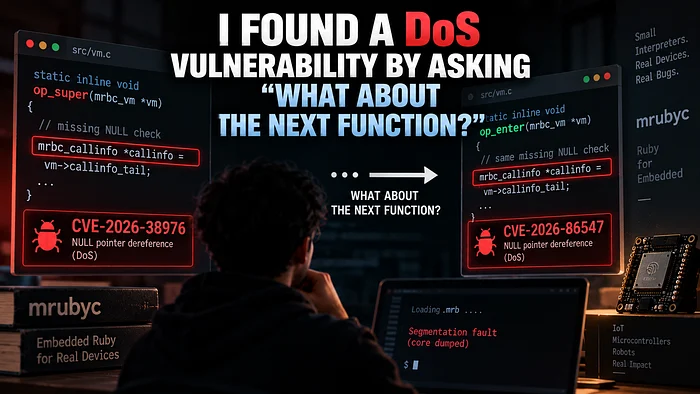
The image at the top of the post carries the caption 'CVE-2026-85674'. A CVE is a public catalogue number given to a known security flaw, so that everyone can refer to the same issue by the same name.
The software: what mrubyc is
Ruby is a programming language. Normally you run Ruby on a server or a laptop, where there is plenty of memory and a full operating system to help. mrubyc is a cut-down version of Ruby built for embedded devices: small computers inside everyday objects, such as internet-connected sensors (the Internet of Things, or IoT), microcontrollers (a computer on a single chip) and robots. These devices often have very little memory, so they cannot run the full Ruby interpreter.
mrubyc does not read Ruby source code directly. It reads .mrb files. An .mrb file is a compiled Ruby program: the source code has already been translated into a compact binary format, a long sequence of numbers and instructions rather than readable text. The comparison the researcher uses is a JVM running .class files: Java programs are compiled to .class files, and the Java Virtual Machine executes them. mrubyc does the same job for Ruby on small hardware. You give mrubyc a .mrb file and it runs it on the device.
The part of mrubyc that actually executes the instructions is called the VM, short for virtual machine. Think of it as a very literal-minded worker: it reads one instruction at a time from the file and does exactly what the instruction says, with no judgement about whether the instruction makes sense in that place. All of the VM code lives in one file, src/vm.c. That file has one handler function for each type of instruction the bytecode can contain. When the VM reads an instruction, it hands it to the matching handler. The handler for the instruction called OP_SUPER is a function named op_super(). The handler for the instruction called OP_ENTER is a function named op_enter().
The bug that made him look
Before this story, another researcher found a bug and filed it as a GitHub issue. GitHub is a website where programmers keep and share code, and an issue is a public note on a project describing a problem. That bug was given the identifier CVE-2026-38976. It lived in op_super(), the handler for Ruby's super keyword.
To understand it, you need two ideas. First, super: inside a class method, super calls the parent class's version of the same method. Classes in Ruby can inherit from other classes, and super is the ordinary way to say "now run the version of this method that my parent defines". It is a very normal thing to do. Second, the call stack: when a program calls a method, and that method calls another method, the computer keeps a stack of frames, one per active call, so it knows where to return when each one finishes. In mrubyc, the field vm->callinfo_tail is a pointer to the current frame, meaning "where we are in the call hierarchy right now".
When mrubyc starts running a program, it sets up the VM in an initial state. Part of that setup happens in a function called mrbc_vm_begin(), and one thing it does explicitly is set vm->callinfo_tail to NULL. NULL is the programming way of saying "points at nothing". At the very top of a program, before any method has been called, there is no call frame, so NULL is correct by design.
op_super() assumed you would never call super without being inside a method first. In well-behaved code that assumption is true. But a .mrb file is just a binary file, and an attacker can craft one by hand that contains OP_SUPER at the top level. The handler did not check whether callinfo_tail was NULL before using it. Using a pointer that points at nothing is like following a sign that says "see the office" when there is no office: the program tries to read from a place that does not exist, and it crashes. The fix added a runtime guard: check whether callinfo_tail is NULL, and if so, raise a proper Ruby exception (a controlled error message) instead of crashing.
That fix made the researcher ask one question. If op_super() had this missing guard, did op_enter() have the same guard?
What OP_ENTER does
OP_ENTER is the instruction that handles method argument setup. When you call a method, you pass it values, called arguments. Some methods accept optional arguments, default values, splat parameters (a way of accepting any number of arguments) or keyword arguments (arguments named by label). When Ruby compiles a method like that, the compiler puts an OP_ENTER instruction at the start of the method body. It is the instruction that says "figure out which arguments we got and put them in the right registers". Registers here are small storage slots inside the VM, like labelled pigeonholes where the method's values are placed.
Like op_super(), OP_ENTER only really makes sense when you are inside a method, and like op_super(), it accesses vm->callinfo_tail to read information about the current call frame. So the question was natural: same assumption, same field, same missing check?
Step 1: read the vulnerable handler
Here is what the vulnerable code path looks like in src/vm.c at release4.0.0, around line 1537:
static inline void op_enter(mrbc_vm *vm, mrbc_value *regs EXT){ FETCH_W(); mrbc_callinfo *callinfo = vm->callinfo_tail; int reg_offset = callinfo->reg_offset; ...}
Line by line, in plain words:
static inline void op_enter(mrbc_vm *vm, mrbc_value *regs EXT)declares the handler function. It receives the VM (vm) and the registers (regs).EXTis a macro in the function signature.FETCH_W();fetches the next word from the bytecode stream.mrbc_callinfo *callinfo = vm->callinfo_tail;copies the current call frame pointer into a local variable calledcallinfo. At the top level of a program, this value isNULL.int reg_offset = callinfo->reg_offset;reads thereg_offsetfield from the structure thatcallinfopoints at. IfcallinfoisNULL, this is a read from an address near zero, which is not valid memory....stands for the rest of the handler, which is not relevant to the bug.
On x86-64, the common 64-bit processor architecture used in ordinary PCs and servers, the reg_offset field sits 0x14 bytes into the mrbc_callinfo structure. 0x14 is hexadecimal for 20. So the read targets address 0x000000000014, which is NULL plus 20. That is a NULL pointer dereference: the program follows a pointer that points at nothing and tries to read data there. The answer to the researcher's question was no. op_enter() did not have the guard.
Step 2: reproduce the access in a harness
The researcher did not need to run the real mrubyc binary. He built a standalone harness in C: a small test program, separate from mrubyc, that copies the exact memory access pattern from op_enter(). A harness is like a crash-test dummy: it is not the real car, but it is built to the same shape so you can study what happens on impact without wrecking the real thing. The harness uses the same struct layout mrubyc uses for mrbc_callinfo and mrbc_vm. A struct is a way of grouping several pieces of data together in C, with each piece at a fixed position inside the group.
The key details: callinfo_tail is set to NULL, exactly as mrbc_vm_begin() does at startup, and then the code reads callinfo->reg_offset without a NULL check, exactly as the vulnerable handler does. Running it without AddressSanitizer gives:
[VULNERABLE PATH] op_enter without NULL guard vm->callinfo_tail = NULL (top-level frame) About to dereference NULL...Segmentation fault (exit 139)
What this output says, piece by piece:
[VULNERABLE PATH] op_enter without NULL guardis a label the harness prints to say which version of the code it is testing: the one without the safety check.vm->callinfo_tail = NULL (top-level frame)confirms the setup: the call frame pointer is deliberately set to nothing, as it would be at the top of a program.About to dereference NULL...is a message printed just before the dangerous read, so you can see the crash happens at that exact moment.Segmentation fault (exit 139)is the operating system's way of saying the program tried to touch memory it is not allowed to touch. The program is killed immediately. The number 139 is what the shell reports when a process is killed by signal 11, the segmentation fault signal.
Plain segfault. The program crashes the moment it touches the NULL pointer. This matters because it shows the crash is not a quirk of mrubyc's build or of some other library: the access pattern alone is enough.
Step 3: confirm the faulting address with AddressSanitizer
AddressSanitizer, often shortened to ASan, is a memory-error detector that works with compilers such as GCC and Clang. When you compile a program with it, the program carries extra checks that watch every memory access and report precisely what went wrong and where. It is like putting a smoke detector in every room instead of waiting to see flames. Running the same harness with AddressSanitizer gives:
[VULNERABLE PATH] op_enter without NULL guard vm->callinfo_tail = NULL (top-level frame) About to dereference NULL...AddressSanitizer:DEADLYSIGNAL===================================================================2047==ERROR: AddressSanitizer: SEGV on unknown address 0x000000000014==2047==The signal is caused by a READ memory access.==2047==Hint: address points to the zero page. #0 op_enter_vulnerable /tmp/op_enter_repro.c:30 #1 main /tmp/op_enter_repro.c:69
SUMMARY: AddressSanitizer: SEGV op_enter_vulnerable
Reading the report:
AddressSanitizer:DEADLYSIGNALmeans the program received a fatal signal, the operating system's way of stopping a process that has done something illegal.ERROR: AddressSanitizer: SEGV on unknown address 0x000000000014is the core finding: a segmentation violation (SEGV) happened while accessing address0x000000000014.The signal is caused by a READ memory access.tells us the program was trying to read, not write. It wanted to fetch a value from that address.Hint: address points to the zero page.explains that the address is in the very first page of memory, the region around zero, which operating systems deliberately leave unmapped so that NULL pointer bugs are caught instead of silently reading garbage.#0 op_enter_vulnerable /tmp/op_enter_repro.c:30is the top of the call stack: the crash happened inside the harness function namedop_enter_vulnerable, at line 30 of the file/tmp/op_enter_repro.c.#1 main /tmp/op_enter_repro.c:69is the caller: the program'smainfunction, at line 69, called that function.SUMMARY: AddressSanitizer: SEGV op_enter_vulnerablerepeats the conclusion in one line: a segmentation violation inop_enter_vulnerable.
The address 0x000000000014 is 0x0 + 20, which is exactly the position of reg_offset inside the mrbc_callinfo structure. ASan is pointing at the exact field being read from a NULL base pointer. That is the bug, confirmed in terms of real memory addresses rather than assumptions.
Step 4: verify the fix
With the NULL guard added, the harness prints:
[FIXED PATH] op_enter with NULL guard [GUARD] top-level OP_ENTER — rejected safely [control, valid frame] reg_offset = 5Fixed path: no crash.
What each part means:
[FIXED PATH] op_enter with NULL guardsays this run uses the corrected version, the one that checks for NULL first.[GUARD] top-level OP_ENTER — rejected safelyshows the check doing its job: when the instruction appears at the top level with no call frame, the handler refuses it in a controlled way instead of crashing.[control, valid frame] reg_offset = 5is a control test. The harness also runs the same code with a real, valid call frame, and the field is read correctly as 5. This proves the guard does not break normal operation; it only blocks the bad case.Fixed path: no crash.is the overall result.
Guard fires, safe rejection, control test with a real frame works correctly. Three behaviours, all three confirmed. The control test is important: a fix that simply refused everything would also stop the crash, but it would break the software. Showing that a valid frame still works proves the fix is narrow.
Step 5: reach it through a real .mrb file
mrubyc runs .mrb files. The .mrb format is a binary bytecode format, and there is nothing stopping you from crafting one by hand. A valid .mrb file that contains an OP_ENTER instruction at the top level, outside any method definition, reaches op_enter() with callinfo_tail == NULL and crashes the interpreter. The harness proved the memory access; this step explains how an attacker would reach it in the real product.
Any application that loads and runs .mrb files from an untrusted source is vulnerable. That is the typical embedded use case: a device that executes user-uploaded scripts, a system that loads configuration logic at runtime, a robotics platform that accepts new behaviour files over the network. If the attacker can get their .mrb file to run, one instruction at the top level crashes the whole process.
Root cause
op_enter() assumes it is always executing inside a method, so it uses vm->callinfo_tail without checking for NULL. That assumption holds for bytecode produced by the normal Ruby compiler, because the compiler only puts OP_ENTER at the start of a method body. It does not hold for a hand-crafted .mrb, where OP_ENTER can appear at the top level while mrbc_vm_begin() has left callinfo_tail as NULL. The same missing guard had already been fixed in op_super() for CVE-2026-38976, and op_enter() read the same field without a check. The mistake did not stop at one place.
Impact
VulnCheck, a company that publishes vulnerability advisories, published this as Medium severity, CVSS 6.9, CWE-476, NULL Pointer Dereference. Some of those terms need unpacking:
- CVSS is the Common Vulnerability Scoring System, a standard 0 to 10 scale for how serious a flaw is. 6.9 is in the Medium band.
- CWE-476 is a catalogue entry for a class of weakness: NULL Pointer Dereference. CWE is the Common Weakness Enumeration, a list of bug types.
- The vector is local, because actually triggering it requires getting the mrubyc process to load your crafted bytecode file. It is not something an attacker can do over the internet to a random device; they need a way to deliver the file.
- User interaction is required in the sense that someone or something has to feed the file to the interpreter.
- The impact is availability only. In security, the three classic goals are confidentiality (keeping data secret), integrity (keeping data correct) and availability (keeping the service running). This bug only affects availability: the process dies cleanly, without writing anything or leaking data. It is not code execution, meaning the attacker cannot make the device run their own commands.
That is an honest read of what the evidence shows. The researcher is explicit that he will not call this a more dangerous bug than it is. But on an embedded device running unattended, a repeatable crash is a real problem. A process that dies because someone handed it a malformed file, comes back, and dies again the next time it encounters the same file, does not need to be a code execution bug to be worth fixing. Imagine a doorbell camera or a factory sensor whose program dies every time a particular file arrives: nothing is stolen, but the device stops working.
The pattern, one more time
CVE-2026-38976 was not the researcher's bug. Someone else found that op_super() was missing a NULL check on callinfo_tail. He read the report, understood what assumption the code was making, and asked whether the same assumption was sitting in op_enter().
It was. That is really all this was: reading one report carefully enough to notice what it implied, and checking whether the implication was sitting somewhere nearby. He keeps writing about this because it keeps working. Not every time, and not with every bug report, but often enough to be worth keeping as a habit: when you understand why a bug exists, look at the code written by the same hand, under the same assumptions, at roughly the same time. The mistake does not always stop at one place.
Variants to test
A positive result is a handler that uses the field with no check, reachable from a crafted instruction at the top level.
2. Look for other fields initialised to NULL or zero by mrbc_vm_begin() and used by handlers that assume a method context. A positive result is a crash in a harness that mirrors the access with the field left at its initial value.
3. Craft .mrb files that place method-only instructions (OP_ENTER, OP_SUPER and similar) at the top level and run them through the real VM. A positive result is a segfault or an ASan report pointing at a low address such as 0x14.
4. When a fix lands for one handler, compare the neighbouring handlers written under the same assumptions. A positive result is a sibling function with the same missing check.
5. Run the harness under AddressSanitizer and compare the reported faulting address with the position of the field in the struct. A match confirms which field was read from the NULL base.
Glossary
- AddressSanitizer (ASan): a compiler tool that watches every memory access in a program and reports exactly where and how a bad access happened.
- Argument: a value passed to a method when it is called.
- Availability: the security goal of keeping a service running and reachable; a DoS attack targets it.
- Bytecode: a compact binary form of a program, halfway between source code and machine code, that a virtual machine executes.
- Call frame: the record of one active method call, including where to return when it finishes.
- Call stack: the stack of call frames for the methods currently running.
callinfo_tail: the mrubyc field that points at the current call frame;NULLat the top level of a program.- Code execution: a bug class where an attacker can make the target run their own commands; this bug is not one.
- Control test: a test run with valid input, used to prove a fix does not break normal operation.
- CVE: a public catalogue number for a known security vulnerability.
- CVSS: the Common Vulnerability Scoring System, a 0 to 10 scale for vulnerability severity.
- CWE: the Common Weakness Enumeration, a catalogue of bug types; CWE-476 is NULL Pointer Dereference.
- Denial of service (DoS): making a service stop working, without necessarily breaking into it.
- Dereference: following a pointer to read or write the data it points at.
- Embedded device: a small computer built into another object, such as a sensor, appliance or robot.
- Exception: a controlled error raised by a program, as opposed to an uncontrolled crash.
- Exit code: the number a process returns when it ends; 139 indicates it was killed by a segmentation fault.
- Handler: the function in the VM that carries out one type of instruction.
- Harness: a small standalone test program built to reproduce a specific behaviour safely.
- Hexadecimal: base-16 number notation;
0x14equals 20 in decimal. - Instruction: one step in a bytecode program, such as
OP_ENTER. - IoT (Internet of Things): everyday devices with small computers and network connections.
- Issue: a public note on a code hosting site describing a problem or task.
- JVM: the Java Virtual Machine, which executes compiled Java
.classfiles. .mrbfile: a compiled Ruby program in mrubyc's binary bytecode format.- Microcontroller: a computer on a single chip, used in embedded devices.
- mrubyc: a lightweight Ruby implementation for embedded devices.
mrbc_vm_begin(): the mrubyc function that sets up the VM's initial state at program start.mrbc_callinfo: the C struct that holds one call frame's data, includingreg_offset.mrbc_vm: the C struct that holds the VM's state, includingcallinfo_tail.- NULL: a pointer value meaning "points at nothing".
- NULL pointer dereference: reading or writing through a NULL pointer, which crashes the program.
OP_ENTER: the bytecode instruction that sets up a method's arguments.OP_SUPER: the bytecode instruction for Ruby'ssuperkeyword.op_enter()/op_super(): the mrubyc handler functions for those two instructions.- Pointer: a value that holds the memory address of some data.
- Register: a small storage slot inside the VM where a method's values are placed.
- Root cause: the underlying reason a bug exists, as opposed to its symptoms.
- Segmentation fault (segfault): the operating system killing a program that touched memory it is not allowed to touch.
- Splat parameter: a Ruby parameter that accepts any number of arguments.
- Struct: a C construct that groups several named pieces of data at fixed positions.
super: a Ruby keyword that calls the parent class's version of the current method.- Top level: code that runs directly in a program, outside any method definition.
- User interaction: a precondition where a person or another system must perform an action, such as supplying a file.
- Vector: in CVSS, the description of how a vulnerability is reached (local, network, and so on).
- Virtual machine (VM): software that executes bytecode instructions one at a time.
- VulnCheck: the organisation that published the advisory for this issue.
- x86-64: the common 64-bit processor architecture used in most PCs and servers.


