I Took Over a Media Giant’s Subdomain with a Free Netlify Account and a Ten-Minute Attention Span
 Published on khanmoeez.medium.com
Bug Bounty
The full write-up lives on its author's site
It belongs to its author, so we link to it rather than copy it. The other two tabs are our own rewrites, checked against it.
Context
The target was a subdomain of a large, publicly traded European media and technology company that operates dozens of well-known news and consumer brands. The company authorised this write-up but asked not to be named and asked that the exact hostname not be published, so both are redacted throughout. The technique, the requests and the timeline are otherwise unmodified.
The feature at the centre of it is Netlify's custom domain support. Netlify is a platform-as-a-service provider: you create a site, deploy content to it, and can then attach your own hostname to that site as a custom domain. The company had at some point pointed a subdomain of its real domain at Netlify's shared hosting infrastructure via CNAME, so that the site could be served under a branded hostname rather than a *.netlify.app address. The Netlify site behind that CNAME was later deleted, but the DNS record was not.
That leaves a dangling DNS record: a hostname that is still part of the company's domain, still fronted by the company's Cloudflare proxy and still covered by a valid TLS certificate, but resolving to infrastructure the company no longer controls. If the platform on the other end lets a stranger claim that hostname, the stranger takes over the subdomain.
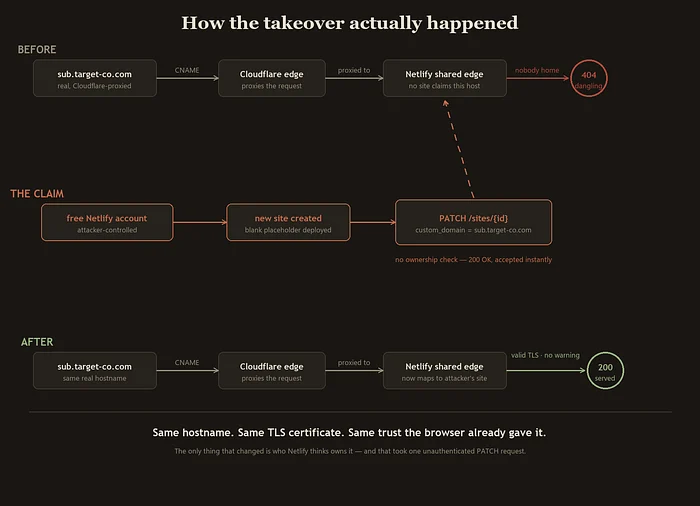
The full chain, before and after: the same trusted hostname, pointed at two very different places.
Setup
The researcher's tooling was minimal. Discovery was passive reconnaissance against certificate transparency logs, using a CT log query against the company's root domain. The report later suggests crt.sh for the query and subfinder -d target.com for an automated, deduplicated list. Resolution was done with dig. Claiming the hostname required only a free Netlify account, a throwaway site and a placeholder deployment. No authentication bypass, no fuzzing infrastructure and no lab environment were involved.
The precondition on the target side is the dangling CNAME: a DNS record pointing at a PaaS provider whose far end no longer has a site claiming that hostname. The precondition on the attacker side is simply an account on that provider.
Finding it
The researcher did not start from the company's main application. The starting point was certificate transparency. Every time a certificate authority issues a TLS certificate, including the automatic ones behind Cloudflare or Let's Encrypt, the certificate is logged publicly and permanently in CT logs. Every subdomain a company has ever requested a certificate for is therefore discoverable, whether or not it is still in active use.

That single query against the company's domain returned several hundred distinct hostnames: the accumulated DNS debris of over a decade of marketing campaigns, preview environments and internal tools. Most resolved to exactly what you would expect. A handful did not resolve at all. A small number resolved to something, but that something looked wrong.
One hostname stood out because of its own name: it described its own infrastructure. The labels cloudflare, netlify and publicsite all appeared in the subdomain label itself, like a debugging label left in from a previous life. Resolving it gave:
$ dig +short [REDACTED-SUBDOMAIN].[REDACTED-COMPANY].com[REDACTED-SUBDOMAIN].[REDACTED-COMPANY].com.cdn.cloudflare.net.
The hostname was Cloudflare-proxied and CNAME'd through to what its own name was already saying: Netlify's shared edge.
A CNAME pointing at a PaaS provider is not automatically a vulnerability. Plenty of companies run perfectly legitimate, actively maintained sites this way. The question is whether anything on the other end still claims the hostname. Netlify answers that question directly. Its edge returns a specific response when traffic reaches it but no site on the platform has the domain configured: the x-nf-request-id header combined with a body reading Not Found — Request ID: …. That is not a generic 404 from some application; it is Netlify itself reporting that nothing is there.
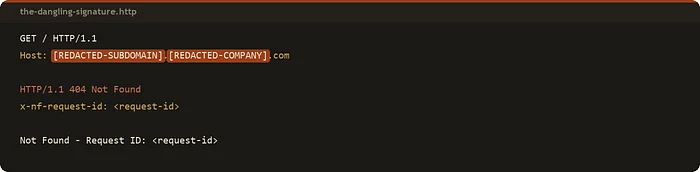
That signature is the thing to look for. Seeing it on a corporate subdomain means the hostname is claimable by anyone with a Netlify account, because nobody currently claims it.
Exploitation
There is no clever bypass here: no fuzzing, no race condition, no obscure API quirk. It is the documented, intended behaviour of Netlify's custom domain feature, and it takes four requests.
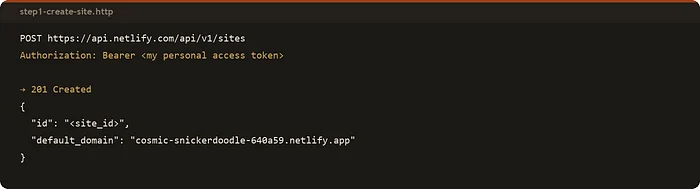
Step one: spin up a throwaway site
Step two: deploy anything to it

Step three: claim the target hostname as the new site's custom domain
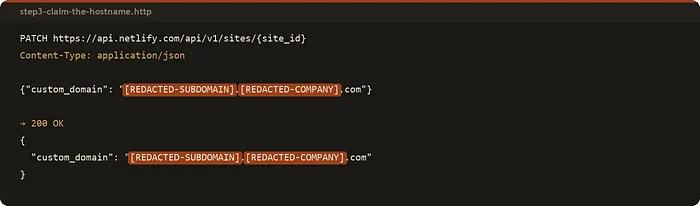
This is the actual vulnerability. The claim went through with no DNS TXT challenge, no email saying the domain was not in the account and asking for verification, and no check for whether the hostname was already configured elsewhere. From Netlify's point of view it was not configured elsewhere, because nothing on their platform had claimed it. The API accepted the claim on the strength of "nobody else on Netlify has this", full stop.
Step four: the hostname becomes the attacker's
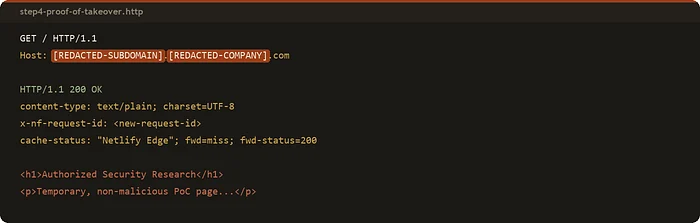
From the moment the PATCH request returned 200 OK, anyone visiting the subdomain was served the researcher's content instead of nothing at all. The TLS certificate was completely valid, the hostname was still fronted by the same Cloudflare proxy the company had set up, and there was no browser warning of any kind. No login, no interstitial, no indication that this was not part of the company's real infrastructure.
The researcher let it sit just long enough to capture headers, then reverted immediately: cleared the custom_domain field, deleted the site, and confirmed the hostname dropped back to the generic Netlify 404. The total window in which the hostname served attacker-controlled content was under two minutes, and the only content it ever served was a static, clearly labelled disclosure notice with no tracking, no forms and no scripts.
Root cause
The primary cause is the orphaned DNS record: a CNAME left standing after the thing behind it was decommissioned. The report is explicit that this is the root cause every time, and that weak platform verification is true but secondary.
The secondary cause is the claiming model. Netlify, like most PaaS providers offering bring-your-own-domain, lets any account claim any hostname as a custom domain with no ownership verification of any kind. The API accepted the claim because no other Netlify site had the hostname configured, which is a check for internal conflicts, not for ownership. Platforms keep the claiming step trivial because friction is bad for onboarding: nobody wants a "prove you own this domain before you can even try to configure it" step in their signup flow, so most do not have one, or the verification is soft enough that a dangling reference sails through.
The record was still valid, the Cloudflare proxy still fronted it, and the certificate was still valid. The only party that could have refused the claim was the platform, and it did not ask for proof.
Impact
A subdomain of a company users already trust is not just a URL. The report lists what it gives an attacker:
- A same-origin-adjacent trust anchor. Depending on how cookies are scoped on the parent domain, a malicious subdomain can sometimes read or influence cookies set with
Domain=.company.com. The researcher did not have real user cookies to test this against here and does not claim that impact specifically happened, but it is the kind of escalation this bug class regularly enables elsewhere. - A phishing platform with a built-in trust seal. A valid TLS certificate and a legitimate-looking hostname under a real, recognisable company is most of what makes a phishing page convincing. The bug hands you both for free, with no compromise of the target company required at all.
- An SEO and brand-integrity liability. Fake press releases or manipulated articles served under a real news brand's subdomain do not just fool casual visitors; they can get indexed, shared and cited before anyone notices they are not real.
- Permanent, public discoverability. Certificate transparency logs are public, permanent and trivially queryable. The risk window is not "until someone finds it" but "until someone finds it and decides to be nice about it".
In this case the researcher served only a static disclosure notice for under two minutes. The report notes that had someone less well-intentioned found it first, the same hostname could have served phishing, malware staging or fake press releases, inheriting the company's trust and TLS certificate with no security warning.
The company rated the issue High severity and paid a bounty, the amount of which is redacted.
Fix
The report gives four recommendations. It does not say which of them the company implemented; it says only that the company confirmed remediation, and later that the CNAME was finally gone for good.
- Delete the DNS record the moment the thing behind it is decommissioned. This is the actual root cause, every time.
- Treat CNAMEs to third-party PaaS platforms as a tracked inventory item, not a fire-and-forget config change. If a CNAME points anywhere a stranger could plausibly claim the far end, someone should own the lifecycle of that record the same way they would own an IAM credential.
- Automate the check.
dnsx,subjack,nuclei's takeover templates, or a five-line script hitting your own CT log history against your current DNS zone will catch this class of bug in CI, continuously, for free. - If you are the platform: a lightweight DNS TXT ownership challenge before a custom domain claim goes live is not a huge UX cost, and it closes this entire bug class at the source, for every one of your customers, permanently.
Variants to test
The report describes the general method for hunting this class on other targets. Each step has a clear positive result:
- Query CT logs for the target's root domain. Use
crt.sh, orsubfinder -d target.comfor an automated, deduplicated list. A positive result is a set of hostnames, often several hundred, including ones whose labels describe infrastructure (cloudflare,netlify,publicsiteand similar). - Resolve every result and flag the ones that CNAME to a known PaaS provider. Netlify, Heroku, Vercel, GitHub Pages, Fastly and S3 buckets are all named in the report as platforms this pattern applies to. A positive result is a hostname that resolves through to a provider's shared infrastructure.
- Check each flagged hostname for that provider's specific "nothing's here" signature. Every major platform has one. For Netlify it is the
x-nf-request-idheader combined with a body readingNot Found — Request ID: …. A positive result is that signature on a corporate subdomain. - Confirm claimability through the platform's own signup flow, with the minimum footprint necessary to prove it, and revert immediately. A positive result is the provider accepting the hostname as a custom domain and serving your content under a valid certificate.
The report's closing point is that the skill is not the PATCH request. It is having the patience to resolve four hundred boring hostnames to find the one that is not boring.
What happened, in plain words
A very large European company, one that owns dozens of well-known news and consumer brands, once put a small piece of its website on a hosting service called Netlify. To make that piece of the site appear under its own web address rather than a Netlify address, the company added a forwarding entry in the internet's address book, the DNS. Later, someone deleted the Netlify site. Nobody deleted the forwarding entry.
That leftover entry is the whole story. It still says "this address belongs to Netlify", but on Netlify's side nothing is there any more. Netlify, like many hosting platforms, lets any customer claim any web address as their own, without asking them to prove they own it. So the researcher created a free account, put a placeholder page on it, told Netlify the company's address was his, and Netlify agreed. Thirty seconds after the claim, the company's own subdomain was serving his page, with a valid padlock in the browser and no warning at all.
It cost nothing and took about ten minutes. The company rated it High severity and paid a bounty, the amount of which is redacted. The researcher kept the page up for under two minutes, showing only a static notice saying what he had found, then put everything back. The company allowed this write-up but asked not to be named and asked that the exact address stay private, so both are hidden here too. Everything else, the technique, the requests and the timeline, is as it happened.
The full chain, before and after: the same trusted hostname, pointed at two very different places.
The setup: why "dangling DNS" is an old problem that keeps coming back
Before the details, a few ideas from zero.
DNS is the internet's address book. Humans type names like example.com; computers need numbers. DNS translates one into the other. One kind of DNS entry is a CNAME, short for canonical name. A CNAME is a forwarding note: "for this name, go and look at that other name instead". Companies use CNAMEs to point a nice branded address such as promo.bigcompany.com at some outside service, so visitors see the company's name in the address bar rather than the service's.
PaaS stands for platform as a service. It is a company that runs servers and websites for you so you do not have to. You upload your files, the platform serves them to the world. Netlify, Heroku, Vercel, GitHub Pages, Fastly and Amazon's S3 storage are all named in the report as examples. A useful comparison: a PaaS is like a serviced office building. You rent a desk, the building handles the electricity and the front door, and you can put your own nameplate on the door.
A subdomain is a name that sits under a company's main name. If the company is bigcompany.com, then promo.bigcompany.com is a subdomain. It belongs to the same family, and visitors treat it as part of the same company.
TLS is the technology behind the padlock in your browser. A TLS certificate is a digital document, issued by a certificate authority (a trusted body whose job is to vouch for who owns what), that proves a web address really is operated by whoever holds the certificate. When the padlock shows, your browser is saying: the certificate is valid and matches this address.
Cloudflare is a company that sits in front of websites as a protective middle layer, a proxy. Traffic goes to Cloudflare first, and Cloudflare passes it on. One effect is that the site keeps working and keeps its padlock even when the thing behind it changes.
Now the mechanism. It is almost insultingly simple, and the report lays it out in four stages:
- A company builds something on a third-party platform: a landing page, a preview environment, an A/B test.
- It points a subdomain of its real domain at that platform with a CNAME, so the address looks branded.
- Eventually someone tears down the thing behind the CNAME. The site is deleted, the account closed, the project moved.
- Nobody removes the CNAME itself. DNS records are the security equivalent of things you leave in a junk drawer: they do not break anything by existing, they just sit there.
What is left is a hostname that is still technically part of the company's domain, still with its padlock if it sits behind something like Cloudflare, but which resolves to infrastructure the company no longer controls. If the platform on the other end will let a stranger claim that hostname, the stranger has taken over the subdomain. That is what subdomain takeover means: someone else ends up in control of a name that looks like yours.
The report calls this class of bug underrated, and points at why it keeps happening. Platforms make the claiming step trivial because friction is bad for business. Nobody wants a "prove you own this domain before you can even try to configure it" step in their signup flow, so most platforms do not have one, or the check is soft enough that a leftover record sails straight through.
Finding it: a recon problem, not an exploit problem
The researcher did not find this by poking at the company's main website. He found it the boring way: passive reconnaissance against certificate transparency logs. Reconnaissance just means looking around and gathering information before doing anything. Passive means doing it without touching the target's own systems.
Here is the idea behind certificate transparency. Every time a certificate authority issues a TLS certificate, including the automatic ones behind Cloudflare or Let's Encrypt, the certificate is written into a public log, permanently. Anyone can read those logs. So every subdomain a company has ever asked for a certificate for can be discovered, whether or not it is still in use. The report calls it one of the best-kept-in-plain-sight recon sources in the industry, and it costs nothing to query.
That single query against the company's domain returned several hundred distinct hostnames: the accumulated DNS debris of over a decade of marketing campaigns, preview environments and internal tools. Most resolved to exactly what you would expect. A handful did not resolve at all. A small number resolved to something, but that something looked wrong.
One hostname stood out because of its own name. It described its own infrastructure: the labels cloudflare, netlify and publicsite all appeared in the subdomain label itself, like a debugging label someone left in from a previous life. Curiosity got the better of him and he resolved it.
$ dig +short [REDACTED-SUBDOMAIN].[REDACTED-COMPANY].com[REDACTED-SUBDOMAIN].[REDACTED-COMPANY].com.cdn.cloudflare.net.
Line by line:
$is the prompt, the symbol a command line shows to say it is waiting for you to type. Everything after it is the command.digis a small program that asks DNS a question and prints the answer. It is the standard tool for looking up what a name points to.+shorttellsdigto print only the answer, not the long technical report it normally produces.[REDACTED-SUBDOMAIN].[REDACTED-COMPANY].comis the name being looked up. Both parts are hidden because the company asked for that.- The second part,
[REDACTED-SUBDOMAIN].[REDACTED-COMPANY].com.cdn.cloudflare.net., is the answer: the name that the first one forwards to. The trailing dot is how DNS writes a complete name.
The result: the hostname was Cloudflare-proxied and CNAME'd through to what its own name was already saying, Netlify's shared edge. "Shared edge" means the platform's front door, the machines that receive visitors' requests before passing them to whichever customer's site is meant to answer.
Confirming it is actually dangling
A CNAME pointing at a PaaS provider is not automatically a vulnerability. Plenty of companies run perfectly legitimate, actively maintained sites this way. The question is whether anything on the other end still claims the hostname. Netlify answers that question directly. Its edge returns a specific response when traffic reaches it but no site on the platform has the domain configured: the x-nf-request-id header combined with a body reading Not Found — Request ID: ….
Two terms there. A header is a small piece of information a web server sends alongside a page, like the label on a parcel. x-nf-request-id is a header Netlify adds, carrying an identifier for that particular request. A 404 is the standard web code for "not found". The report is careful to say this is not a generic 404 from some application; it is Netlify itself reporting that nothing is there.
That signature is the thing to look for. Seeing it on a corporate subdomain means the hostname is claimable by anyone with a Netlify account, because nobody currently claims it.
Taking it over
This is the part the report says should bother people more than it seems to. There is no clever bypass here: no fuzzing (throwing huge numbers of guesses at a system), no race condition (a timing trick where two actions collide), no obscure API quirk. It is the documented, intended behaviour of Netlify's custom domain feature, and it takes four requests.
An API is the way one piece of software asks another to do something, without a human clicking buttons. Think of a restaurant: the menu and the waiter are the API. You do not walk into the kitchen; you ask through the agreed channel, and the kitchen acts. Netlify's API is how its website and its command-line tools tell its servers what to do.
Step one: spin up a throwaway site
This creates an empty site on the account. It is throwaway because it will be deleted at the end; its only purpose is to be the thing the stolen hostname gets attached to.
Step two: deploy anything to it
Deploying means uploading content so the platform has something to serve. Anything works. The point is that when a visitor arrives, there is a page waiting for them rather than an error.
Step three: claim the target hostname as the new site's custom domain
This is the actual vulnerability. The claim went through with no DNS TXT challenge, no email saying the domain was not in the account and asking for verification, and no check for whether the hostname was already configured elsewhere. From Netlify's point of view it was not configured elsewhere, because nothing on their platform had claimed it. The API accepted the claim on the strength of "nobody else on Netlify has this", full stop.
A DNS TXT challenge is the usual proof-of-ownership trick: the platform asks you to add a special text record to the domain's DNS, something only the real owner could do, and checks for it. No such check happened here. The check Netlify did perform was for internal conflicts, whether another Netlify site already had the name, which is not the same thing as asking who owns it.
Step four: the hostname becomes the attacker's
From the moment the PATCH request returned 200 OK, anyone visiting the subdomain was served the researcher's content instead of nothing at all. The TLS certificate was completely valid, the hostname was still fronted by the same Cloudflare proxy the company had set up, and there was no browser warning of any kind. No login, no interstitial, no indication that this was not part of the company's real infrastructure.
A PATCH request is one of the standard verbs of the web. A browser fetching a page uses GET; a PATCH asks a server to modify an existing thing. 200 OK is the standard code for "done, it worked".
The researcher let it sit just long enough to capture headers, then reverted immediately: cleared the custom_domain field, deleted the site, and confirmed the hostname dropped back to the generic Netlify 404. The total window in which the hostname served attacker-controlled content was under two minutes, and the only content it ever served was a static, clearly labelled disclosure notice with no tracking, no forms and no scripts.
Why this is worse than it looks on paper
It is tempting to read "subdomain takeover" and file it mentally next to things like clickjacking or missing security headers: technically real, rarely consequential. The report pushes back, because of what a subdomain actually is from a trust perspective. A subdomain of a company you already trust is not just a URL. It is four things at once.
- A same-origin-adjacent trust anchor. A cookie is a small piece of data a website stores in your browser so it can recognise you on the next page, which is how you stay logged in. Cookies can be scoped to a whole domain, written as
Domain=.company.com, meaning every subdomain under it can see them. Depending on how cookies are scoped on the parent domain, a malicious subdomain can sometimes read or influence those cookies. The researcher did not have real user cookies to test this against here and does not claim that impact specifically happened, but it is the kind of escalation this bug class regularly enables elsewhere. - A phishing platform with a built-in trust seal. Phishing is a fake page that pretends to be a real one to steal something from you. A valid TLS certificate and a legitimate-looking hostname under a real, recognisable company is most of what makes a phishing page convincing. This bug hands you both for free, with no compromise of the target company required at all.
- An SEO and brand-integrity liability. SEO is search engine optimisation, how visible a page is in search results. Fake press releases or manipulated articles served under a real news brand's subdomain do not just fool casual visitors; they can get indexed, shared and cited before anyone notices they are not real.
- Permanent, public discoverability. Certificate transparency logs are public, permanent and trivially queryable. The risk window is not "until someone finds it" but "until someone finds it and decides to be nice about it".
In this case the researcher served only a static disclosure notice for under two minutes. Had someone less well-intentioned found it first, the same hostname could have served phishing, malware staging or fake press releases, inheriting the company's trust and TLS certificate with no security warning.
The disclosure timeline
The report includes the back-and-forth because it is more instructive than a clean "found it, reported it, got paid" summary would be.
- Mid-August: reported through the company's public bug bounty program, with full proof-of-concept evidence: before and after headers, Netlify API responses, and a timestamped record of the claim-and-revert cycle. A bug bounty program is a scheme where a company invites outsiders to report security problems and pays for good ones.
- About a week later: triaged and validated, rated High severity. Triaged means someone looked at it and sorted it into the queue.
- A few days after that: the company confirmed remediation and paid a bounty of €[redacted].
- Two days later: the researcher re-checked independently, from two different resolvers, specifically to rule out any DNS caching artifact on his end, and the CNAME was still dangling. He flagged it rather than assuming the fix had failed to propagate. A resolver is the part of the internet that answers DNS questions for you; caching means keeping a copy of an answer for a while, so an old copy can make a fixed problem look unfixed.
- A few days later still: the company re-opened the report, thanked him for catching it, and re-verified. The report notes that "resolved" status on a bug bounty platform is a claim, not a guarantee, and it costs nothing to double-check.
- About a month later: he independently confirmed the CNAME was finally gone for good, asked for the report to be formally closed, and requested authorisation to write about it publicly. The company said yes, with one condition: no names, no hostnames.
What actually fixes this
The report gives four recommendations. It does not say which of them the company implemented; it says only that the company confirmed remediation, and later that the CNAME was finally gone for good.
- Delete the DNS record the moment the thing behind it is decommissioned. This is the actual root cause, every time. Not "Netlify's verification is weak", which is true but secondary. The primary cause is always an orphaned pointer that should never have been left standing.
- Treat CNAMEs to third-party PaaS platforms as a tracked inventory item, not a fire-and-forget config change. If a CNAME points anywhere a stranger could plausibly claim the far end, someone should own the lifecycle of that record the same way they would own an IAM credential. An IAM credential is a login or key that grants access to a company's cloud systems; it is the kind of thing companies track carefully, because losing it is dangerous.
- Automate the check.
dnsx,subjack,nuclei's takeover templates, or a five-line script hitting your own CT log history against your current DNS zone will catch this class of bug in CI, continuously, for free. CI means continuous integration, the automated pipeline that runs checks every time a company changes something. - If you are the platform: a lightweight DNS TXT ownership challenge before a custom domain claim goes live is not a huge UX cost, and it closes this entire bug class at the source, for every one of your customers, permanently. UX means user experience, how pleasant or annoying a product is to use.
What this means if you are hunting, not defending
If you are newer to this and looking for a place to start that has a genuinely good effort-to-reward ratio, the report says this bug class is still it, even in 2026. It requires no authentication bypass, no fuzzing infrastructure, no lab. It requires four things:
- Query CT logs for the target's root domain. Use
crt.sh, orsubfinder -d target.comfor an automated, deduplicated list. A positive result is a set of hostnames, often several hundred, including ones whose labels describe infrastructure (cloudflare,netlify,publicsiteand similar). - Resolve every result and flag the ones that CNAME to a known PaaS provider. Netlify, Heroku, Vercel, GitHub Pages, Fastly and S3 buckets are all named in the report as platforms this pattern applies to. A positive result is a hostname that resolves through to a provider's shared infrastructure.
- Check each flagged hostname for that provider's specific "nothing's here" signature. Every major platform has one. For Netlify it is the
x-nf-request-idheader combined with a body readingNot Found — Request ID: …. A positive result is that signature on a corporate subdomain. - Confirm claimability through the platform's own signup flow, with the minimum footprint necessary to prove it, and revert immediately. A positive result is the provider accepting the hostname as a custom domain and serving your content under a valid certificate.
The report's closing point is that the skill is not the PATCH request. It is having the patience to resolve four hundred boring hostnames to find the one that is not boring.
Glossary
- API: the agreed channel through which one piece of software asks another to do something, like a waiter taking your order to the kitchen.
- Bug bounty program: a scheme where a company invites outsiders to report security problems and pays for good ones.
- Caching: keeping a copy of an answer for a while, so an old copy can make a fixed problem look unfixed.
- Certificate authority: a trusted body whose job is to vouch for who owns a web address, by issuing TLS certificates.
- CI (continuous integration): the automated pipeline that runs checks every time a company changes something.
- CNAME: a DNS forwarding note saying "for this name, go and look at that other name instead".
- Cookie: a small piece of data a website stores in your browser so it can recognise you on the next page, which is how you stay logged in.
- Cloudflare: a company that sits in front of websites as a protective middle layer, passing traffic on to whatever is behind it.
- CT logs (certificate transparency logs): public, permanent records of every TLS certificate ever issued, readable by anyone.
- Deploy: to upload content to a hosting platform so it has something to serve.
- dig: a small program that asks DNS a question and prints the answer.
- DNS: the internet's address book, translating human names into the numbers computers use.
- DNS TXT challenge: a proof-of-ownership trick where a platform asks you to add a special text record to a domain's DNS, something only the real owner could do.
- Fuzzing: throwing huge numbers of guesses at a system to see what breaks.
- Header: a small piece of information a web server sends alongside a page, like the label on a parcel.
- IAM credential: a login or key that grants access to a company's cloud systems.
- PaaS (platform as a service): a company that runs servers and websites for you so you do not have to, like a serviced office building.
- PATCH request: a standard web verb asking a server to modify an existing thing.
- Phishing: a fake page that pretends to be a real one in order to steal something from you.
- Proxy: a middle layer that receives traffic first and passes it on.
- Race condition: a timing trick where two actions collide in a way the system did not expect.
- Reconnaissance: looking around and gathering information before doing anything.
- Resolver: the part of the internet that answers DNS questions for you.
- SEO (search engine optimisation): how visible a page is in search results.
- Subdomain: a name that sits under a company's main name, such as
promo.bigcompany.comunderbigcompany.com. - Subdomain takeover: someone else ending up in control of a name that looks like yours.
- TLS / TLS certificate: the technology behind the browser padlock, and the digital document proving a web address really is operated by whoever holds it.
- Triaged: looked at and sorted into a queue by the receiving team.
- UX (user experience): how pleasant or annoying a product is to use.
- 200 OK: the standard web code for "done, it worked".
- 404: the standard web code for "not found".




