Intel Inside: How a Cracked JWT Key led to Full Account Takeover on Intel and CBSE’s AI Platform
The platform used a weak, guessable HS256 JWT signing key and leaked account existence through timing and response differences. An attacker could enumerate valid emails, forge tokens for any user, and brute-force sequential user IDs to take over accounts without a password.
 Published on infosecwriteups.com
While taking part in Tinkerpreneur 2026, I spent some time on the AI Student Community (aistudent.community), an AI learning platform built through an initiative by Intel and CBSE for students. Out of curiosity, I decided to test the login endpoint just to see how the authentication flow behaved.
The full write-up lives on its author's site
It belongs to its author, so we link to it rather than copy it. The other two tabs are our own rewrites, checked against it.
Context
During Tinkerpreneur 2026 I spent some time on the AI Student Community (aistudent.community), an AI learning platform built through an initiative by Intel and CBSE for students. The feature I looked at was the login endpoint: the ordinary email and password authentication flow that issues a session token once credentials are accepted. The platform also had a forgot-password endpoint, and it issued JWTs signed with HS256 as session tokens.
What follows is the chain I found: two account enumeration bugs and a weak JWT signing key, which together allowed a full account takeover. All of the issues were reported and have since been patched.
Setup
The testing was done against the live platform, using Burp Intruder for the timing measurements and a Python script with the rockyou.txt wordlist for the offline key cracking.
Finding it
Testing the login endpoint, two things stood out immediately: there was no rate limiting, and the server took noticeably longer to respond to some emails than others. The platform also had a history of critical vulnerabilities, which suggested there was more to find beneath the surface.
Exploitation
Step 1: Login timing discrepancy (Bug 1)
Running the login endpoint through Burp Intruder showed a consistent timing gap between valid and invalid emails:
- Unregistered email:
30–50 msresponse time - Registered email:
120–140 msresponse time
Every failed login returned the exact same response body, so the difference was only visible in timing. The roughly 100 ms gap pointed to the backend checking whether the user existed before doing the heavier password-verification work. With no rate limiting in place, separating real emails from fake ones was straightforward.

Step 2: Password reset response difference (Bug 2)
The forgot-password endpoint made timing checks unnecessary. Sending a request for an existing email versus a non-existing one returned different responses directly from the server, giving a clean way to confirm valid accounts.
Step 3: Cracking the HS256 JWT secret
With a way to find real emails in hand, I looked at how session tokens were handled. The platform used JWTs signed with HS256, where a single shared secret signs and verifies tokens. Because HS256 verification happens locally against a signature, anyone holding a token can run offline guesses without hitting rate limits or generating server traffic.
Using a Python script and rockyou.txt, I cracked the signing key:
- Secret:
intel - Base64:
aW50ZWw=
Seeing intel as the actual signing key on an Intel-backed platform was ironic. It meant I could modify and re-sign arbitrary JWT payloads locally.
Step 4: Chaining into account takeover
Inspecting the decoded JWT payload showed that it only contained email, role, iat, and exp, so the user's numeric ID was not inside the token. Instead, the numeric ID was passed in the URL path (/dashboard/{ID}) to load the account page.
Because IDs were sequential and there was no rate limiting, the full exploit chain came down to three steps:
- Enumerate a target email using the password reset response difference or the login timing delay.
- Forge a JWT for that email and sign it with the cracked
intelkey. - Brute-force sequential User IDs with the forged token until it matches the forged email.
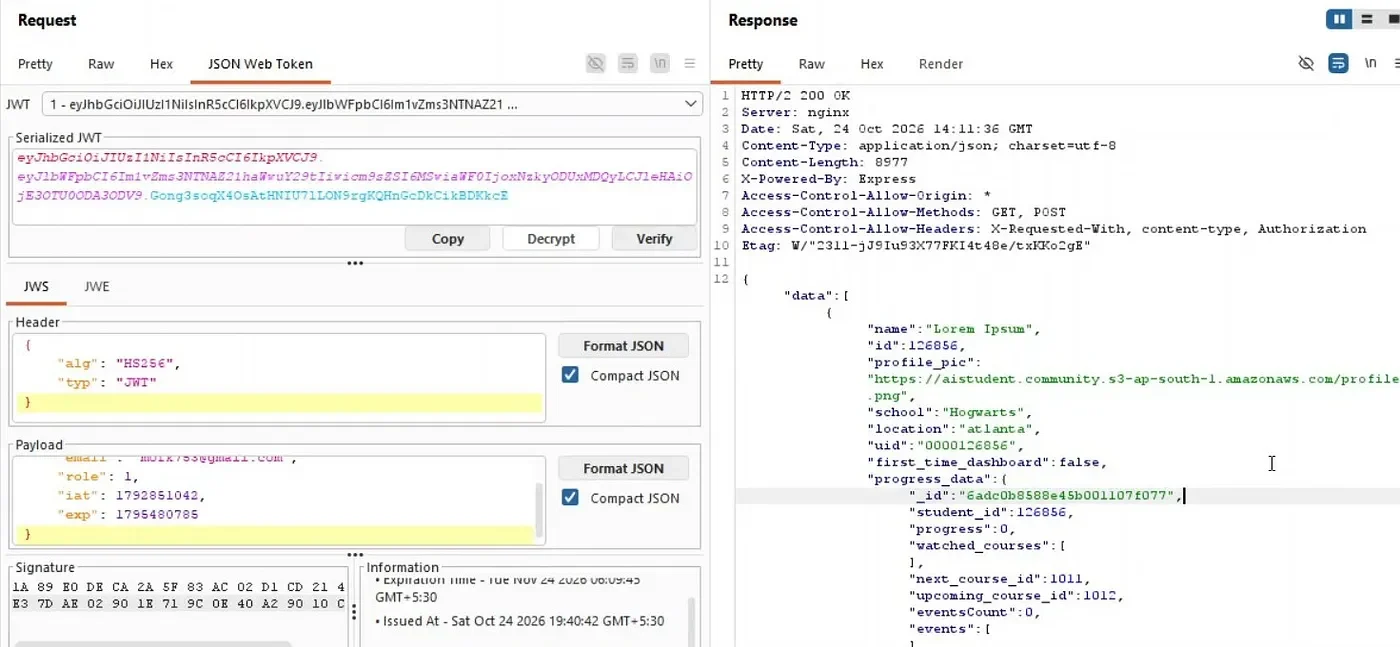
That was enough to access a complete account without ever knowing the user's password.
Root cause
Three design mistakes combined:
- User existence leaked through side channels. The login handler returned identical bodies for every failure but did different amounts of work depending on whether the account existed, and the forgot-password handler returned visibly different responses for existing and non-existing emails. Neither endpoint was rate limited, so both signals could be sampled freely.
- A guessable JWT signing secret.
HS256uses one shared secret for signing and verification, so a token holder can test candidate secrets offline. The secret was the dictionary wordintel, which therockyou.txtwordlist produced. - Authorisation keyed on a client-supplied identifier. The token carried only
email,role,iatandexp; the account's numeric ID came from the URL path (/dashboard/{ID}). With sequential IDs and no rate limiting, a forged token for one email could be paired with guessed IDs until the two matched.
Existing defences did not stop any of this: there was no rate limiting on login, the login and reset flows leaked account existence, and nothing tied the ID in the path to the identity in the token.
Impact
An attacker could take over any account on the platform without knowing the password, provided they could first identify a valid email (via either enumeration bug) and then match it to a sequential user ID. The report does not describe what data or actions were available inside a taken-over account. The AISC team reviewed their access logs for signs of unauthorised activity and found no evidence that any user data had been accessed or taken through the flaw prior to the patch.
Fix
According to AISC's response, confirmed during re-testing, four core fixes were rolled out:
- Rotated signing credentials and invalidated sessions: strengthened token signing and validation, rotated the signing key to a high-entropy secret, and invalidated all active sessions so old tokens could no longer be accepted.
- Eliminated timing leaks and added rate limiting: hardened the login process so response times can no longer be used to infer whether an account exists, alongside applying rate limiting.
- Reinforced authorisation checks: enforced authorisation so each account can only access its own data.
- Input validation and hardening: added further input validation and related security hardening across the platform.
Disclosure timeline
- October 24, 2026: Reported the vulnerability chain to both CERT-In and the AI Student Community (AISC) team.
- October 25, 2026: Submitted proof-of-concept videos after CERT-In requested PoC verification (CERT-In did not send any acknowledgement after receiving them).
- October 27, 2026: The AISC team replied directly, confirming they had reproduced the issue, audited their logs, and deployed fixes to production.
Variants to test
- Login timing on other platforms. Send the same login request with a known-valid and a known-invalid email many times and compare response times. A positive result is a stable gap (here roughly 100 ms) with identical response bodies.
- Forgot-password response comparison. Submit an existing and a non-existing email and diff the responses. A positive result is any difference in body, status or headers that correlates with account existence.
- Offline JWT secret guessing. Capture any
HS256token and run a wordlist such asrockyou.txtagainst the signature locally. A positive result is a candidate secret that reproduces the token's signature. - Payload inspection. Decode the token and check which claims identify the user. If the token carries only
emailandrolewhile the account is loaded from a path or query parameter, test whether that parameter is checked against the token's identity. - Sequential ID enumeration. With a valid token, request
/dashboard/{ID}across a range of IDs. A positive result is access to another account's page, especially when the ID does not match the token's email.
What happened, in plain words
A security researcher was taking part in Tinkerpreneur 2026 and spent some time on the AI Student Community (aistudent.community), an AI learning platform built through an initiative by Intel and CBSE for students. Out of curiosity, they tested the login endpoint, the part of the website that checks your email and password when you sign in. Two things stood out straight away: there was no rate limiting (nothing stopped someone from trying again and again very quickly), and the server took noticeably longer to answer for some email addresses than for others. The platform also had a history of critical vulnerabilities, which suggested there was more to find beneath the surface.
Pulling on that thread uncovered three flaws: two account enumeration bugs (ways to work out which email addresses have accounts) and a session signing key that lived up to the "Intel Inside" slogan a little too literally. Chained together, they allowed a full account takeover: getting into someone else's account without ever knowing their password. All of the issues were reported and have since been patched.
This article walks through the whole chain from zero. You only need to be comfortable using a browser and a computer.
Some background ideas first
Before the steps make sense, a few everyday comparisons help.
What is an API? Think of a restaurant. The dining room is the website you see in your browser; the kitchen is the server where the real data lives. The API is the waiter: you tell it what you want in a structured way, it goes to the kitchen, and it brings back an answer. Websites and apps talk to their servers through APIs all the time, and so do attackers, because the waiter will answer anyone who asks in the right format.
What is an endpoint? An endpoint is one specific counter at that restaurant: one address on the server that does one job. The login endpoint handles sign-ins. The forgot-password endpoint handles password resets. Each has its own address and its own behaviour.
What is a token (or cookie)? When you log in successfully, the server needs a way to remember you on your next request, because the web is forgetful: every request arrives as if for the first time. So the server hands you a small piece of text, a token, and your browser sends it back with every request. It is like a wristband at a festival: you show your ticket once at the gate, get the wristband, and after that the staff just glance at your wrist. A cookie is simply one common way of storing that wristband in the browser.
What is a JWT? A JSON Web Token is a particular format for such a token. It is a string made of three parts separated by dots. The first part says which signing method was used, the second part carries information about you (called claims), and the third part is a signature. The signature is produced with a secret key, so the server can later check that nobody tampered with the token. If you change even one character of the middle part, the signature no longer matches and the server rejects it.
What is HS256? It is one specific signing method for JWTs. Its defining feature is that one single shared secret is used both to create the signature and to check it. That is convenient, but it has a consequence: anyone who holds a token can sit at home and try candidate secrets against it, offline, as fast as their computer allows, without the server ever knowing.
What is account enumeration? It means finding out which accounts exist. On its own it sounds harmless, but it is the first half of many attacks: you cannot break into an account if you do not know it is there.
What is a side channel? A side channel is information that leaks not through the official answer but through something around it: how long the answer took, how big it was, whether it came with different headers. Like a shop assistant who says "we don't have that item" the same way for every product, but pauses a second longer when the item exists in the back. The words are identical; the pause gives it away.
What is rate limiting? A cap on how many requests you may make in a given time. Without it, an attacker can ask the same question thousands of times per minute, which is exactly what you need to measure tiny timing differences or to guess numbers one by one.
What is brute-forcing? Trying every possibility in order until one works, like spinning a combination lock through all combinations. Computers make this fast when the space of possibilities is small.
What is Burp Suite and Burp Intruder? Burp Suite is a tool that sits between your browser and a website, letting you see and edit every request before it is sent. Intruder is its component for sending the same request many times with one part changed each time, which is how you measure timings across many email addresses.
What is rockyou.txt? A famous list of millions of real passwords that leaked from a breach years ago. Security testers use it as a dictionary of guesses, because people and systems keep choosing words that appear in it.
Setup
The testing was done against the live platform, using Burp Intruder for the timing measurements and a Python script with the rockyou.txt wordlist for the offline key cracking.
Finding it
Testing the login endpoint, two things stood out immediately: there was no rate limiting, and the server took noticeably longer to respond to some emails than others.
Exploitation
Step 1: Login timing discrepancy (Bug 1)
To get into an account without a password, you first need a reliable way to tell whether a target email address actually exists on the platform. That is why this step comes first: everything later depends on knowing a real email.
Running the login endpoint through Burp Intruder showed a consistent timing gap between valid and invalid emails:
- Unregistered email:
30–50 msresponse time - Registered email:
120–140 msresponse time
Every failed login returned the exact same response body, so the difference was only visible in timing. The roughly 100 ms gap pointed to the backend checking whether the user existed before doing the heavier password-verification work. With no rate limiting in place, separating real emails from fake ones was straightforward.
In plain words: the server's answer looked identical in both cases, so nobody reading the response would notice anything. But the server did more work when the account existed, and that extra work took about a tenth of a second. Because nothing limited how often the researcher could ask, they could send the same login attempt for many email addresses and simply compare stopwatch readings. A consistent gap of around 100 ms is a side channel: the pause, not the words, tells you whether the account is real.
Step 2: Password reset response difference (Bug 2)
The forgot-password endpoint made timing checks unnecessary. Sending a request for an existing email versus a non-existing one returned different responses directly from the server, giving a clean way to confirm valid accounts.
In plain words: this is the same goal as Bug 1, finding out which emails have accounts, but achieved more simply. Instead of measuring how long the server takes, you look at what it actually says. If the reply for one email differs from the reply for another in any visible way, that difference itself reveals which one exists. Two independent ways to enumerate accounts also means the attack is more robust: if one signal is noisy, the other still works.
Step 3: Cracking the HS256 JWT secret
With a way to find real emails in hand, the researcher looked at how session tokens were handled. The platform used JWTs signed with HS256, where a single shared secret signs and verifies tokens. Because HS256 verification happens locally against a signature, anyone holding a token can run offline guesses without hitting rate limits or generating server traffic.
Using a Python script and rockyou.txt, the cracked signing key was:
- Secret:
intel - Base64:
aW50ZWw=
Seeing intel as the actual signing key on an Intel-backed platform was ironic. It meant the researcher could modify and re-sign arbitrary JWT payloads locally.
In plain words: the wristband from the festival analogy is checked by a signature, and the signature is made with a secret. If the secret is a common word, you can guess it. The researcher took one token they had been given, and tried every word in the rockyou.txt list as the secret, offline, on their own machine. When the word intel produced a signature matching the token's, the secret was found. From that moment on, the researcher could write any wristband they liked, for any email address, and sign it correctly, because they held the same secret the server uses. The base64 line is just the same word intel written in a text encoding that is common in web traffic; it is not a different secret.
Step 4: Chaining into account takeover
Inspecting the decoded JWT payload showed that it only contained email, role, iat, and exp, so the user's numeric ID was not inside the token. Instead, the numeric ID was passed in the URL path (/dashboard/{ID}) to load the account page.
In plain words: the token says who you claim to be by email, what role you have, when it was issued (iat, issued at) and when it expires (exp). It does not contain the account's number. The account number is instead put in the web address itself, in the place of {ID} in /dashboard/{ID}, when the page loads. That is like a hotel where your key card says your name, but the room number is written on the door you walk up to: nothing checks that the name on the card matches the room you are opening.
Because IDs were sequential and there was no rate limiting, the full exploit chain came down to three steps:
- Enumerate a target email using the password reset response difference or the login timing delay.
- Forge a JWT for that email and sign it with the cracked
intelkey. - Brute-force sequential User IDs with the forged token until it matches the forged email.
In plain words, step by step:
- Use Bug 1 or Bug 2 to learn a real email address. You now know a target exists.
- Build a token that claims that email, and sign it with the secret
intel. The server will accept it as genuine because the signature checks out. - Account numbers are sequential, meaning they run 1, 2, 3 and so on. With no rate limiting, you can simply try
/dashboard/1,/dashboard/2,/dashboard/3and so on, sending your forged token each time, until the page you land on belongs to the email you forged. That is the brute-force part: trying numbers in order until one matches.
That was enough to access a complete account without ever knowing the user's password.
Root cause
Three design mistakes combined:
- User existence leaked through side channels. The login handler returned identical bodies for every failure but did different amounts of work depending on whether the account existed, and the forgot-password handler returned visibly different responses for existing and non-existing emails. Neither endpoint was rate limited, so both signals could be sampled freely.
- A guessable JWT signing secret.
HS256uses one shared secret for signing and verification, so a token holder can test candidate secrets offline. The secret was the dictionary wordintel, which therockyou.txtwordlist produced. - Authorisation keyed on a client-supplied identifier. The token carried only
email,role,iatandexp; the account's numeric ID came from the URL path (/dashboard/{ID}). With sequential IDs and no rate limiting, a forged token for one email could be paired with guessed IDs until the two matched.
Existing defences did not stop any of this: there was no rate limiting on login, the login and reset flows leaked account existence, and nothing tied the ID in the path to the identity in the token.
In plain words: each of the three mistakes is small on its own. A timing difference is a nuisance. A weak secret is bad practice. Trusting a number in the address bar is careless. But together they form a complete path: find a real email, forge a token for it, then walk through account numbers until you find the one that belongs to that email. None of the usual safety nets (rate limits, uniform responses, checking that the number in the address belongs to the person in the token) was in place to break the chain.
Impact
An attacker could take over any account on the platform without knowing the password, provided they could first identify a valid email (via either enumeration bug) and then match it to a sequential user ID. The report does not describe what data or actions were available inside a taken-over account. The AISC team reviewed their access logs for signs of unauthorised activity and found no evidence that any user data had been accessed or taken through the flaw prior to the patch.
In plain words: the practical consequence is that a stranger could end up inside someone else's account. The report does not say what they could then see or do there. The platform team checked their records of who accessed what and found no sign that anyone had actually done this before the fix went in.
Fix
According to AISC's response, confirmed during re-testing, four core fixes were rolled out:
- Rotated signing credentials and invalidated sessions: strengthened token signing and validation, rotated the signing key to a high-entropy secret, and invalidated all active sessions so old tokens could no longer be accepted.
- Eliminated timing leaks and added rate limiting: hardened the login process so response times can no longer be used to infer whether an account exists, alongside applying rate limiting.
- Reinforced authorisation checks: enforced authorisation so each account can only access its own data.
- Input validation and hardening: added further input validation and related security hardening across the platform.
In plain words: the first fix replaces the guessable secret with a long random one and throws away every existing wristband, so any forged token stops working immediately. The second fix makes the login answer take the same time whether or not the account exists, and caps how often anyone can ask, so the stopwatch trick no longer works. The third fix checks that the number in the address bar belongs to the person named in the token, so guessing numbers gets you nowhere. The fourth fix is general tidying: checking incoming data more carefully and tightening things across the platform.
Disclosure timeline
- October 24, 2026: Reported the vulnerability chain to both CERT-In and the AI Student Community (AISC) team.
- October 25, 2026: Submitted proof-of-concept videos after CERT-In requested PoC verification (CERT-In did not send any acknowledgement after receiving them).
- October 27, 2026: The AISC team replied directly, confirming they had reproduced the issue, audited their logs, and deployed fixes to production.
In plain words: CERT-In is India's national computer emergency response team, the body you notify about serious security problems. A proof of concept is a demonstration that the problem is real, usually a video or a script showing it happening. The platform team confirmed they could reproduce the issue, checked their logs, and deployed the fixes to production.
Variants to test
If you want to look for similar problems on other sites, these are the same checks in a general form. Each one describes what to send and what a positive result looks like.
- Login timing on other platforms. Send the same login request with a known-valid and a known-invalid email many times and compare response times. A positive result is a stable gap (here roughly 100 ms) with identical response bodies.
- Forgot-password response comparison. Submit an existing and a non-existing email and diff the responses. A positive result is any difference in body, status or headers that correlates with account existence.
- Offline JWT secret guessing. Capture any
HS256token and run a wordlist such asrockyou.txtagainst the signature locally. A positive result is a candidate secret that reproduces the token's signature. - Payload inspection. Decode the token and check which claims identify the user. If the token carries only
emailandrolewhile the account is loaded from a path or query parameter, test whether that parameter is checked against the token's identity. - Sequential ID enumeration. With a valid token, request
/dashboard/{ID}across a range of IDs. A positive result is access to another account's page, especially when the ID does not match the token's email.
In plain words: these are recipes for checking whether a site has the same three weaknesses. Number one is the stopwatch test. Number two is the compare-the-replies test. Number three is the guess-the-secret test, done on your own machine. Number four is reading the token to see what it actually says about you. Number five is walking through account numbers to see whether the site stops you.
Glossary
- Account enumeration: finding out which accounts exist on a platform, usually by observing small differences in how the server responds.
- Account takeover: gaining access to someone else's account, here without knowing their password.
- API: the structured interface a website or app uses to talk to its server, like a waiter carrying requests to the kitchen and answers back.
- Authentication: proving who you are, typically with an email and password.
- Authorisation: deciding what a proven identity is allowed to see or do.
- Base64: a text encoding that represents data using letters, digits and a few symbols;
aW50ZWw=is the base64 form ofintel. - Brute-forcing: trying possibilities one after another until one works, such as walking through account numbers in order.
- Burp Intruder: the part of Burp Suite that sends the same request many times with one part changed each time.
- Burp Suite: a tool that sits between your browser and a website so you can inspect and edit every request.
- CERT-In: India's national computer emergency response team, the body you notify about serious security problems.
- Claims: the pieces of information inside a token, such as an email address or a role.
- Constant-time handling: making a process take the same amount of time regardless of the outcome, so timing cannot reveal anything.
- Cookie: a small piece of data a browser stores and sends back to a site, often used to hold a session token.
- Endpoint: one specific address on a server that performs one job, such as login or forgot-password.
exp: the claim in a JWT saying when the token expires.- Forged token: a token created by an attacker rather than issued by the server, made to look genuine by signing it with the real secret.
- High-entropy secret: a secret with lots of randomness, making it impractical to guess.
HS256: a JWT signing method that uses one shared secret both to create and to check the signature.iat: the claim in a JWT saying when the token was issued.- JWT (JSON Web Token): a token format made of three dot-separated parts: a header, a payload of claims, and a signature.
- Offline guessing: trying candidate secrets on your own machine against a captured token, without sending requests to the server.
- Proof of concept (PoC): a demonstration that a problem is real, often a video or a script showing it happening.
- Rate limiting: a cap on how many requests can be made in a given time.
rockyou.txt: a large list of leaked real-world passwords used as a dictionary of guesses.- Role: a claim describing what kind of user an account is, such as student or administrator.
- Rotating a key: replacing a secret with a new one so that anything signed with the old one stops being accepted.
- Sequential IDs: account numbers that run in order, 1, 2, 3 and so on, making them easy to guess.
- Session: the period during which a server remembers you as logged in, usually via a token.
- Side channel: information that leaks through something other than the official answer, such as how long a response took.
- Signature: the part of a token produced with a secret key, used to prove the token was not tampered with.
- Tinkerpreneur 2026: the event during which the researcher was spending time on the platform.
- Token: a piece of text issued after login that the browser sends back with each request so the server can recognise you.
- Wordlist: a file of candidate words or passwords tried one by one, such as
rockyou.txt.



